Palacio Arzobispal: Archiepiscopal Palace and Seat of Quito’s Church
Site at a Glance
- Rating
- 4.7
- Popularity
- Low
- Country
- Ecuador
- Primary era
- Early Modern
- External website
- Open
- Eras represented
- Early Modern
- Civilizations
- Spanish
- Site type
- Religious
- Remains
- Palace
On this page11 sections
History
Palacio Arzobispal is a palatial building in Quito, Ecuador, at the eastern corner of Chile and Venezuela streets in the city’s Historic Centre. It houses the Metropolitan Archdiocese of Quito and serves as the official residence of the archbishop of Quito, who has held the title Primate of Ecuador since 1995.
Foundation of Quito’s ecclesiastical institutions
Quito’s ecclesiastical parish was established on 20 December 1534 by the city’s founder. Juan de Rodríguez, its first parish priest, received a lot, while land on the south side of the main square was assigned for the parish church, now the Metropolitan Cathedral. For several years, parish priests lived in houses around the cathedral.
The parish first belonged to the Diocese of Panama. It was transferred to the Diocese of Cusco on 5 September 1536 and then to the Diocese of Lima on 14 May 1541. Pope Paul III ordered the creation of the Diocese of San Francisco de Quito on 8 January 1545. The new diocese was implemented on 13 April 1546, when Garcí Díaz Arias arrived from Lima as its first bishop.
After the diocese was established, it received authorization to purchase the lot assigned to the conquistador Núñez de Bonilla and his heirs on the northeastern side of the main square. The Bishop’s Palace was established on the corner where Palacio Arzobispal stands. Until 1789, the Diocese of Quito covered the territory of the Royal Audiencia of Quito, a Spanish colonial jurisdiction and high court whose territory was administered from Quito and extended from Pasto in the north to Piura in the south.
From diocese to metropolitan archdiocese
On 13 January 1848, Pope Pius IX elevated Quito from a diocese to a metropolitan archdiocese. This ended its suffragan dependence on Lima, while Cuenca and Guayaquil became its suffragan dioceses. A metropolitan archdiocese traditionally holds authority over associated dioceses.
Guayaquil, Cuenca, and Portoviejo were later also elevated to metropolitan status. In response, a decree of 11 November 1995 granted both Quito Cathedral and the archbishop of Quito the status of Primate of Ecuador. A primate holds a senior ecclesiastical rank within a country.
Palace alterations and conservation
The original palace was modified in 1775 after the arrival of the Spanish architect Antonio García, who also worked on Carondelet Palace, the seat of Ecuador’s national government in Quito. García introduced European neoclassical features, a style based on the forms and vocabulary of ancient Greek and Roman architecture.
Some of García’s original elements were altered during a twentieth-century restoration, particularly inside the palace. A further intervention took place in 1978 because the archbishop considered the building dangerous owing to the age of its construction materials. The work provided structural reinforcement and improved the electrical and sanitary systems.
Palacio Arzobispal forms part of Quito’s UNESCO World Heritage property, inscribed in 1978 under criteria ii and iv. Its continuing ecclesiastical use and its place beside the cathedral reflect the institutional development of Quito’s Catholic administration from the sixteenth century onward.
Remains
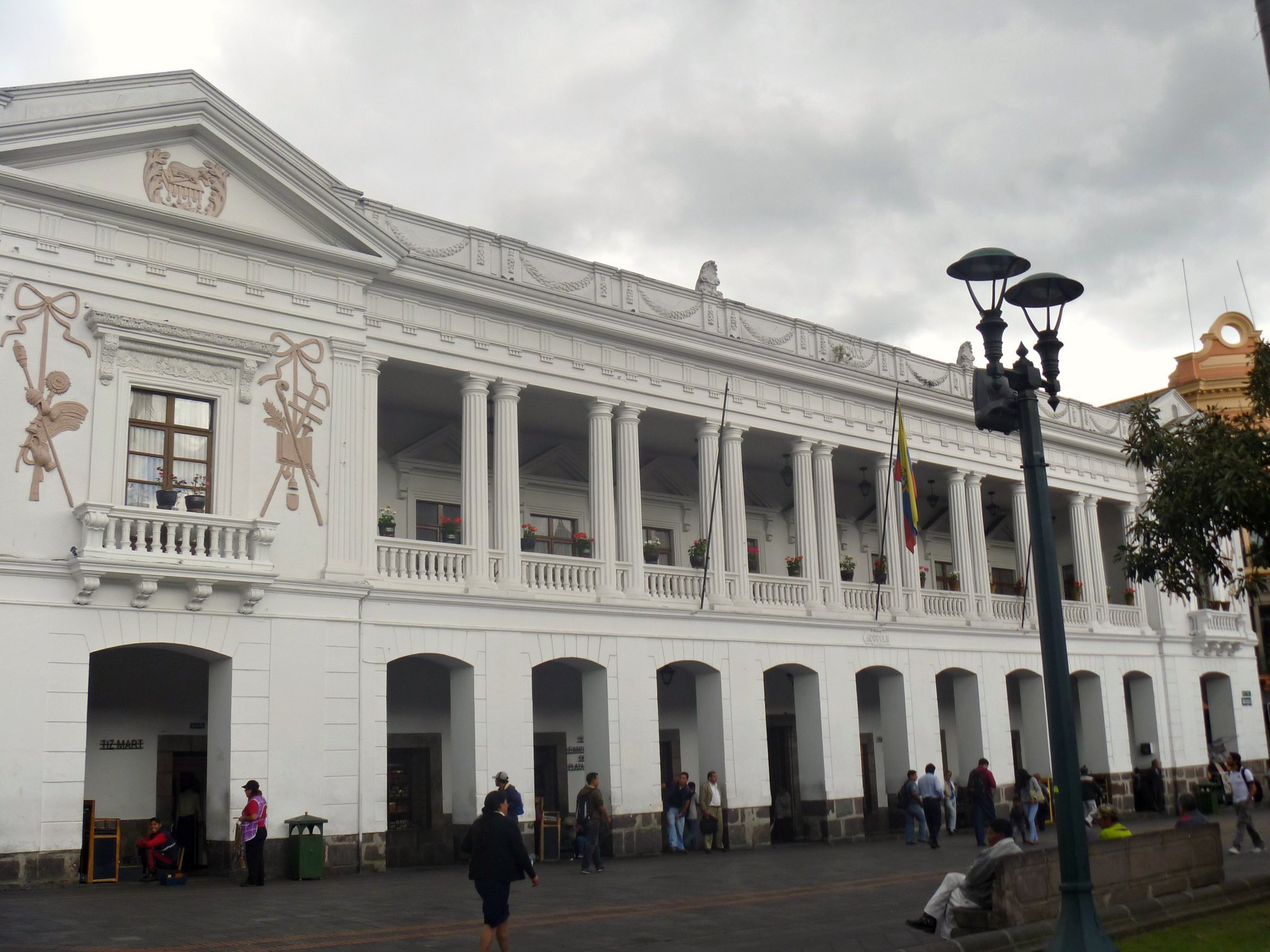
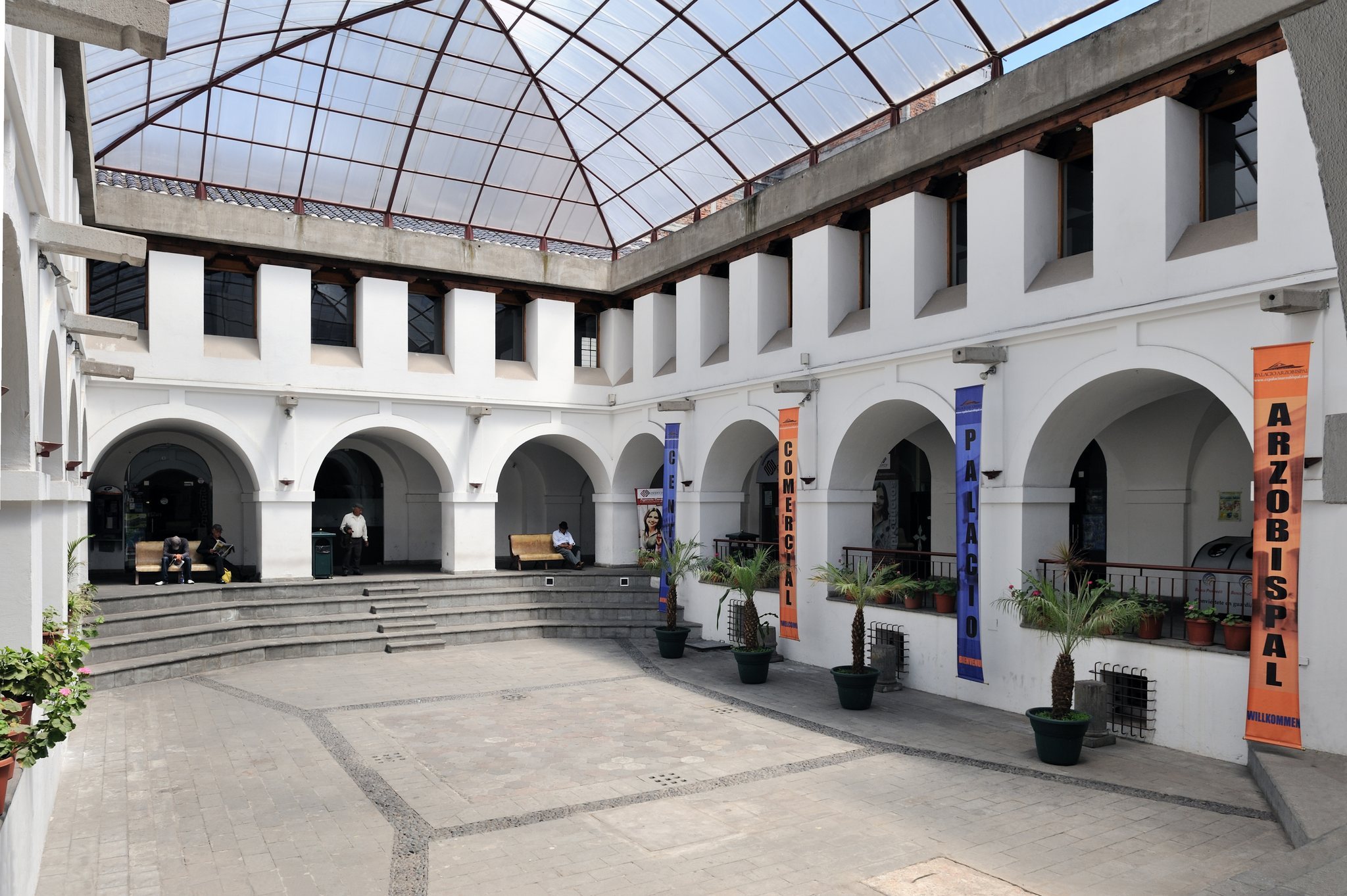
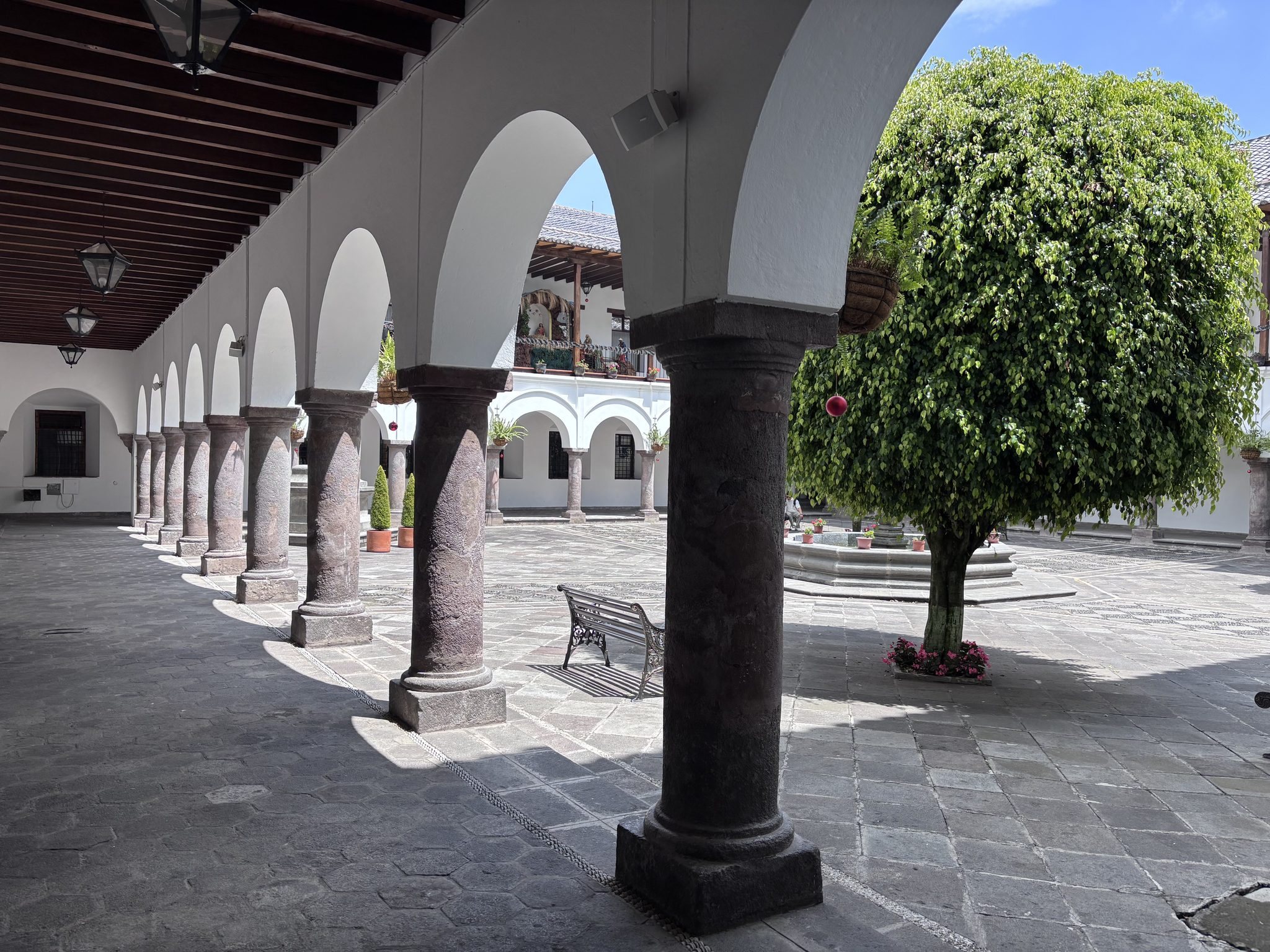
The palace is one of the four buildings along the north side of Plaza de la Independencia. Its lower level forms a covered arcaded portal that connects the building with the square and continues as an exterior covered corridor toward the neighboring buildings on the west. A vestibule leads into a large stone-paved courtyard, where a carved-stone fountain stands at the centre. Four two-storey wings surround this courtyard.
Facade and entrance spaces
Arcaded portal and balcony
The portal is topped by an entablature, the horizontal architectural band above a colonnade. Above it, a large upper-floor balcony has a double colonnade of cylindrical shafts with Ionic capitals, whose spiral volutes identify the classical order. Together, the covered passage and balcony form the principal public-facing architectural elements of the palace.
Projecting facade sections
At either end of the facade, a massive projecting section contains rectangular windows on the upper floor and an arched opening at ground level toward the portal. Each section is crowned by a triangular element. The right-hand feature carries carved representations of the arms of the Vatican, while the left-hand feature bears those of the Archdiocese of Quito.
Courtyard wings and ecclesiastical interiors
Western wing and Archbishop’s Chapel
The western wing contains the principal staircase and the Archbishop’s Chapel. The archbishop’s office occupies the centre of this wing on the second floor and is reached by the main staircase. The chapel contains treasures of the Quito School, the artistic tradition associated with colonial Quito, dating from the sixteenth through the nineteenth centuries. It also serves as the administrative seat of the secular clergy, meaning diocesan priests who serve under a bishop rather than belonging to a monastic order.
Archbishop’s Library of Quito
The Archbishop’s Library of Quito is an archival complex dating from the establishment of the Diocese of Quito in 1545. Its historical material is arranged in fifteen sections covering ecclesiastical government, Holy Orders, the minor and major seminary colleges, competitions for benefices, religious doctrinal personnel, confraternities, matrimonial records, pious works, chaplaincies, civil trials, parishes, parish inventories, miscellaneous material, the González Suárez Collection, and periodical publications such as newspapers, journals, bulletins, and pamphlets.
The archive has no separate section devoted specifically to Indigenous peoples, but Indigenous subjects occur throughout its holdings. Six of its catalogued sections contain especially precise ethnographic information about them. The archbishop’s offices and adjoining diocesan offices form part of the continuing institutional use of the palace.