St Mary’s Church, Nottingham: Nottingham’s Civic and Historic Parish Church
Site at a Glance
- Rating
- 4.7
- Popularity
- Low
- Country
- United Kingdom
- Primary era
- Medieval
- External website
- Open
- Eras represented
- Medieval, Modern
- Civilizations
- British, English
- Site type
- Religious
- Remains
- Church
On this page18 sections
History
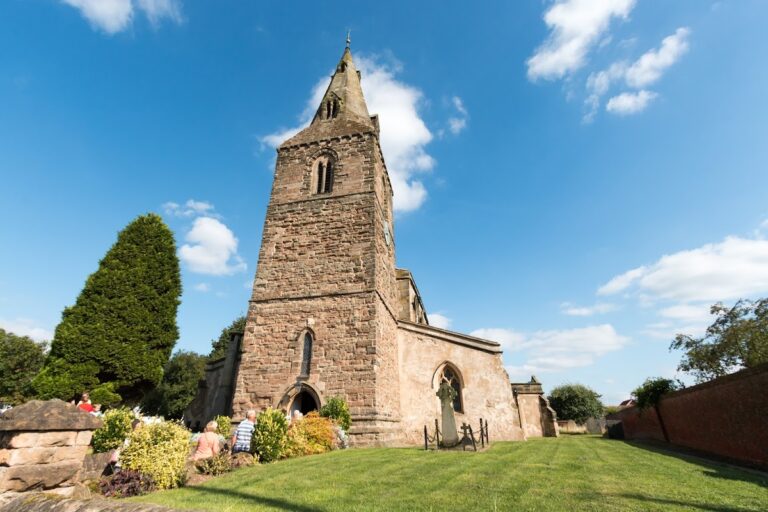
St Mary’s Church, Nottingham, in the United Kingdom, is the city’s oldest parish church, a Perpendicular Gothic building whose principal medieval fabric was constructed from the late fourteenth to the early sixteenth century. Dedicated to St Mary the Virgin, it belongs to the Church of England and remains Nottingham’s Civic Church and University Church.
Medieval foundations and construction
A church on the site appears in the Domesday Book of 1086, the great survey of landholding and resources commissioned by William the Conqueror. The site is believed to have Saxon origins, and the present building is at least the third church established there. Its south aisle wall probably dates from the early 1380s, while the nave and transepts were mainly built in the early fifteenth century. The nave was complete before 1475, and the crossing tower was finished during the reign of Henry VIII.
The church was owned by Lenton Priory from 1108 until 1538. The priory’s monks held the rectory and appointed a vicar to conduct the daily offices. The priory was later demolished during the dissolution of the English monasteries, the process by which religious houses were closed and their property transferred during the sixteenth century.
Civic, educational, and community roles
In 1513, Dame Agnes Mellers founded the Free School of the Town of Nottingham at St Mary’s. Its foundation deed required an annual commemoration service on the Feast of the Translation of St Richard of Chichester. This ceremony remains one of Nottingham’s oldest continuing civic observances, apart from the Goose Fair. The school is now Nottingham High School.
St Mary’s also became involved in the religious and civic disputes of the seventeenth century. George Fox, founder of the Religious Society of Friends, commonly known as the Quakers, was imprisoned in Nottingham in 1649 after interrupting the preacher at the church. Nottingham Bluecoat School was founded in 1706, and its first lessons took place in the church porch.
The church housed Nottingham’s town fire engine from about 1716 until at least 1770. It opened and operated a workhouse from 1726 until 1834, when responsibility for workhouses passed from parishes to secular Boards of Guardians. The workhouse was demolished in 1895, partly to make way for Nottingham Victoria railway station. In 1751, St Mary’s opened the first Sunday School for children unable to attend a day school, teaching reading, writing, arithmetic, and religious knowledge.
The parish was gradually divided as new parishes and chapels of ease were created between 1822 and 1903. These included St Paul’s, Holy Trinity, St John the Baptist, St Mark’s, St Matthew’s, St Ann’s, St Luke’s, St Saviour’s, All Saints’, Emmanuel, St Catharine’s, and St Bartholomew’s.
Alteration and restoration
The west front was rebuilt in the Classical style by William Hiorne of Warwick in 1762. William Stretton restored the south aisle and replaced the crossing vault around 1818 to 1820. The church then closed for five years from 1843 during a major restoration. Lewis Nockalls Cottingham saved the tower from collapse in 1843, while George Gilbert Scott returned the west front to a Gothic appearance and restored the roofs. Scott and William Bonython Moffatt continued the interior restoration during the 1840s and 1850s, and Scott reroofed the chancel in 1872.
Further additions followed. George Frederick Bodley built the Chapter House in 1890, Temple Lushington Moore added the Lady Chapel in 1912, and a choir vestry commemorating the Simpson family was added in 1940. In 1935, the tower ringing-room floor was concreted and a new bell frame was installed. The external fabric was restored and cleaned in 1992 and 1993. Later work included new kitchens and toilets in 2008, the removal of wooden flooring platforms and installation of underfloor heating and a new stone floor in 2013, and repairs to the south transept, a new servery, and a new west porch in 2024.
St Mary’s was designated a Grade I listed building on 11 August 1952 because of its outstanding architectural and historic interest. It is one of five Grade I listed buildings in Nottingham and belongs to the Major Churches Network. The church continues to host worship, civic and university services, concerts, and public performances. It uses both the Book of Common Prayer, the historic Anglican service book first authorised in the sixteenth century, and Common Worship. Its assistant curate historically held the title of Lecturer, an office that fell out of use in the seventeenth century and was revived for Reverend John Pennington in 1975. The post is currently vacant.
The church sometimes celebrates the Eucharist at the High Altar ad orientem, with priest and congregation facing eastward towards the altar. The laying on of hands by the bishop during confirmation was first observed at St Mary’s around 1760. Thomas Newton, Bishop of Bristol, described the practice, which was performed by John Gilbert, Archbishop of York.
Burials and continuing commemorations
People buried at St Mary’s include the Nottingham mayors John Samon and Thomas Thurland; John Holles, 1st Earl of Clare, and John Holles, 2nd Earl of Clare; Eleanor Fitzwilliam, Countess of Tyrconnell; Lady Jane, Dowager Countess of Valentia; Chambre Brabazon, 5th Earl of Meath, and his daughter Lady Mary Brabazon; Thomas Berdmore, dentist to George III; George Africanus; and Robert Aldridge, vicar of St Mary’s from 1598 to 1616.
In 2022, structural repairs were identified as necessary in the bell tower because the swinging bells placed loads on the supporting timbers. Regular bellringing was suspended while repairs were pending, and by April 2023 the estimated cost had risen to at least £185,000, with completion expected to take 20 weeks.
Remains
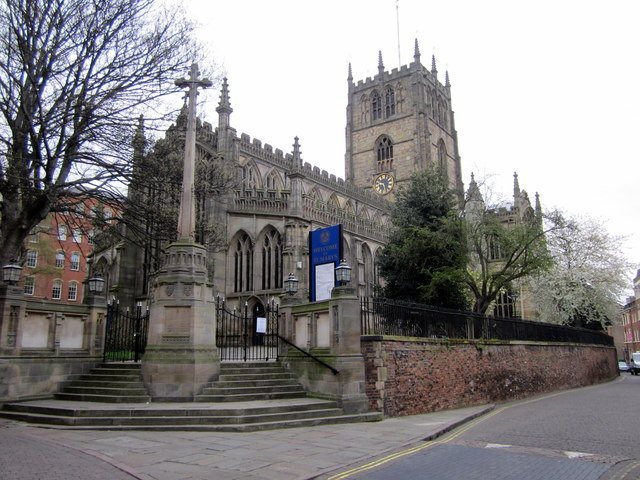
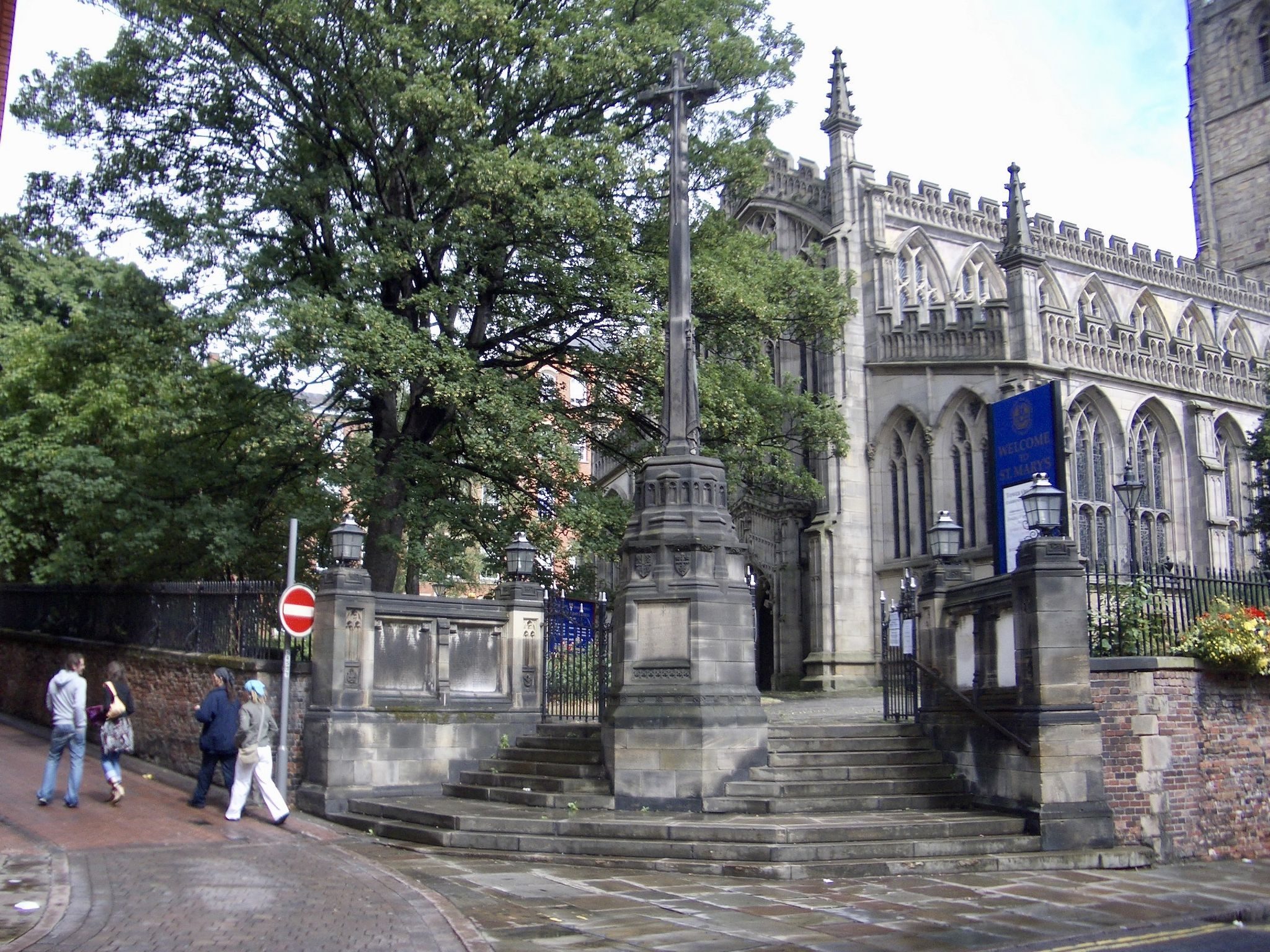
St Mary’s stands on High Pavement in Nottingham’s historic Lace Market district. It is a three-aisled Perpendicular Gothic church, a late medieval English Gothic style marked by strong vertical lines, large windows, and regular divisions. The nave ends at the transepts, while the single-aisled chancel has side chapels and wooden ceilings. The building measures approximately 215 feet (66 metres) from west to east and 100 feet (30 metres) across the transepts. The nave is about 19 metres high internally, and the crossing tower rises 126 feet (38 metres) above the ground.
Exterior and medieval fabric
Nave, transepts, and crossing tower
The nave is notable for the consistency of its Perpendicular Gothic design. The tower dominates the exterior and forms the crossing between the nave, transepts, and chancel. Its completion during the reign of Henry VIII followed the earlier construction of the south aisle, nave, and transepts. The restored roofs and crossing vault belong to the building’s later history of repair and alteration.
Chantry door and room
The chantry door, dating from the 1370s or 1380s, is regarded as Nottingham’s oldest surviving door and one of England’s oldest surviving wooden doors. Its medieval locking mechanism retains ironwork. The adjoining chantry room, originally associated with prayers or masses for the dead, was later used successively as a bonehouse, coal store, and chair store. It now contains a wheelchair-accessible toilet.
West entrance
The bronze doors at the west entrance were designed by Henry Wilson in 1904 in memory of his father-in-law, Reverend Francis Morse. Their imagery connects the life of Christ with the Virgin Mary, the church’s dedication. The tympanum shows the Virgin supporting Christ, while the spandrels represent the gates of Death and Life, with a dove symbolising the spirit. The inscription reads, “In loving memory of Francis Morse, 1818–1886, Father, Pastor, Friend.”
Each door leaf contains five relief panels. The left leaf depicts the Annunciation, Visitation, Nativity, Epiphany, and Salvator Mundi on the Cross. The right leaf shows the Flight into Egypt, Baptism in the Jordan, Entry into Jerusalem, the Three Maries at the Sepulchre, and the Resurrection.
Interior furnishings and artistic features
Windows and altar furnishings
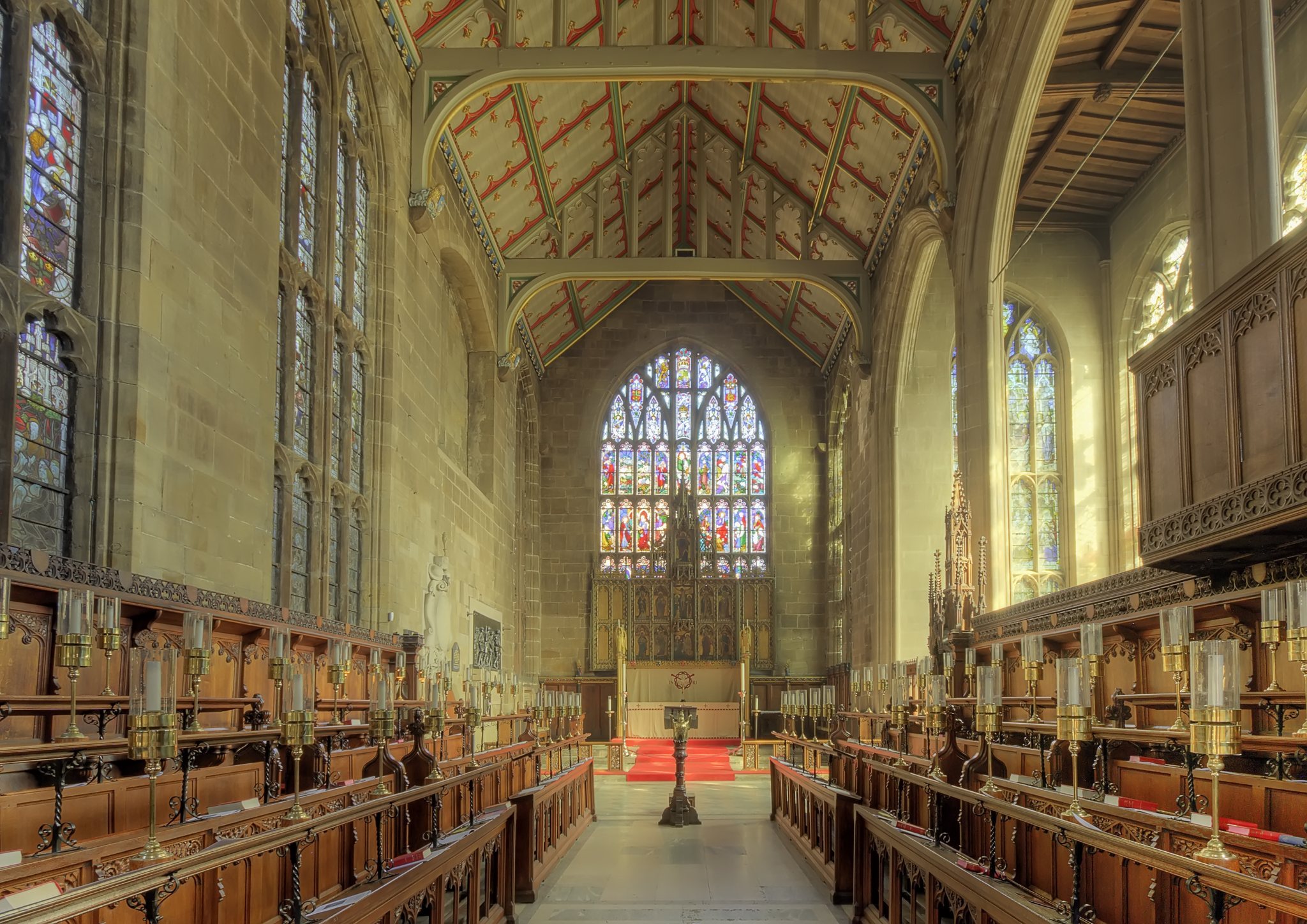
The church contains a substantial collection of late Victorian stained-glass windows by makers including Kempe, Burlison and Grylls, and Hardman & Co. The reredos, an ornamental screen or panel behind an altar, was made by Charles Edgar Buckeridge in 1885 and stands above the altar.
Font and medieval fragments
The medieval octagonal font bears a palindromic Greek inscription meaning, “Wash my transgressions, not only my face.” The church also contains a battered alabaster tomb fragment showing a lily crucifix and a Nottingham alabaster panel depicting Archbishop Thomas Becket.
Chapter House, Lady Chapel, and choir vestry
The Chapter House, built by George Frederick Bodley in 1890, the Lady Chapel added by Temple Lushington Moore in 1912, and the choir vestry added in 1940 form part of the later architectural development of the church. The vestry commemorates the Simpson family.
Tower and musical equipment
Bells and ringing room
The tower contains twelve bells. Two were made by Eijsbouts in 1980, while several earlier bells were recast by Gillett & Johnston in 1935. Other bells preserve dates or histories from 1595, 1605, 1613, 1690, 1699, 1761, 1765, 1856, and 1935. Their inscriptions include religious texts, dedications, the names of vicars and churchwardens, civic subscribers, and references to restoration or recasting. The bell dated 1595 bears four impressions of Elizabeth I’s arms alternating with four signs of the Henry Oldfield foundry.
Clock
A tower clock made by Richard Roe of Epperstone was installed in 1707. Thomas Hardy of Nottingham made its replacement in 1807, and the earlier clock was moved to Staunton church. The present clock was installed by George & Francis Cope in 1936. It was the firm’s first electric auto-wind clock and has a 150-pound pendulum weight.
Organ
The Marcussen & Søn organ was installed in 1973 by the organist David Butterworth. It is a neo-Classical instrument with 25 speaking stops. Records of earlier organs at St Mary’s date from the late sixteenth and early seventeenth centuries.