Sanctuary of the Miracle: A Marian Pilgrimage Center in Spain
Site at a Glance
- Rating
- 4.5
- Popularity
- Low
- Country
- Spain
- Primary era
- Early Modern
- External website
- Open
- Eras represented
- Early Modern, Modern
- Civilizations
- Crown of Aragon, Spanish
- Site type
- Religious
- Remains
- Sanctuary
On this page17 sections
History
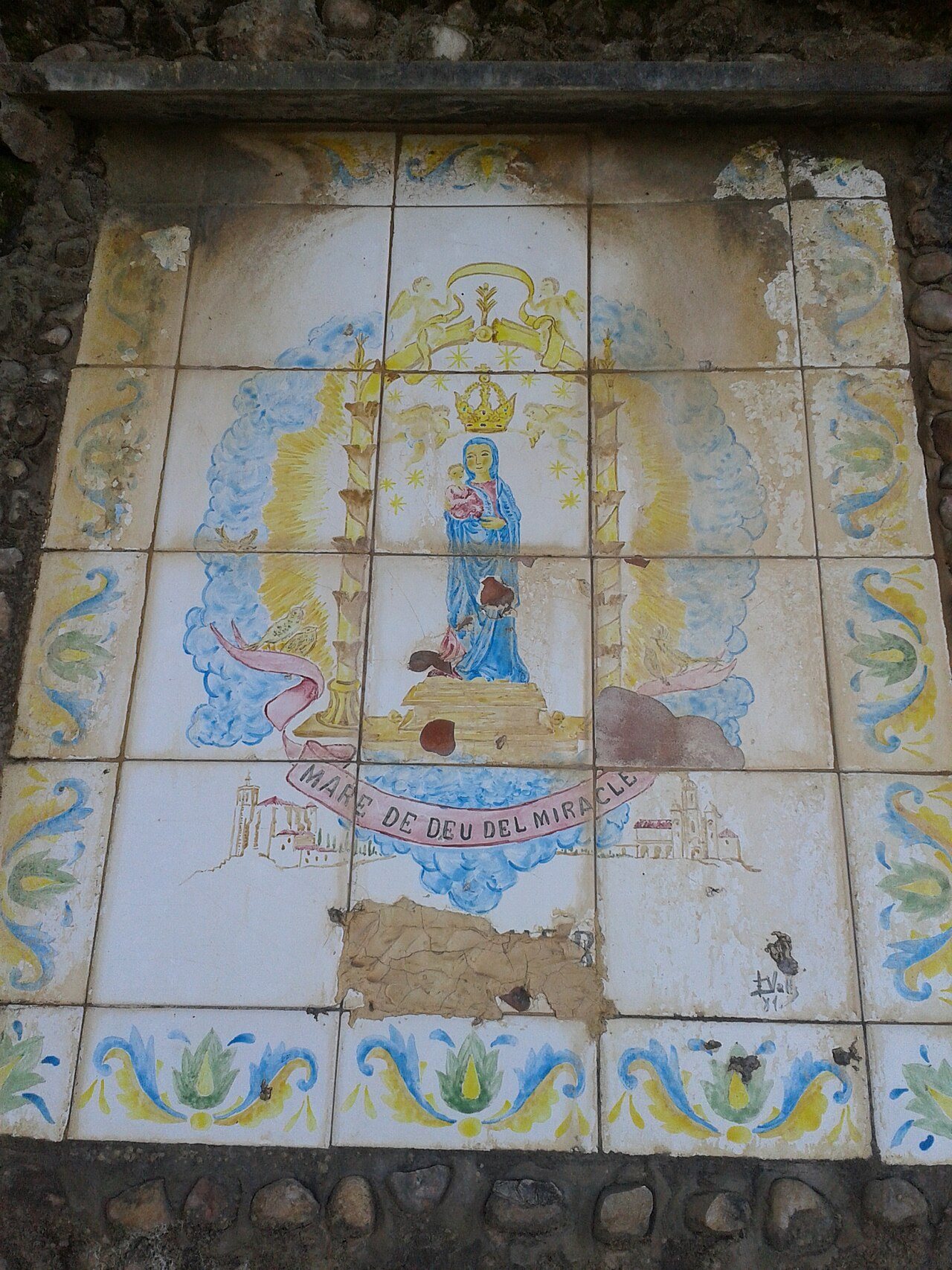
The Sanctuary of the Miracle is a Marian religious center in Riner, Spain, dedicated to the Virgin of the Miracle. Its origins are traditionally linked to an apparition on 3 August 1458, and it has remained a place of Marian pilgrimage and devotion through successive churches, monastic foundations, periods of abandonment, and modern restoration.
The apparition tradition
The traditional account places the apparition during an outbreak of bubonic plague in Catalonia. Near the Cirosa farmstead, about 500 meters north of the church, the shepherd boy Celdoni reportedly saw a kneeling childlike figure holding a cross with the crucified Christ. His companion Jaumet later saw a small girl with long blond hair kneeling beside a juniper. She urged the people to hold devout processions, confess, convert, and return to God.
Four days later, Jaumet became ill with plague. He died at the age of ten after recounting the apparition to the physician Pere Ots. A formal ecclesiastical investigation, known as a canonical process, began shortly afterward. This apparition tradition became the official and most widely circulated explanation for the sanctuary’s foundation. A less familiar version, published by the folklorist Joan Amades, tells instead of the Virgin supporting a loosened rock at the entrance to a shelter until a sleeping shepherd awoke.
In 1459, construction of a chapel dedicated to Our Lady of the Miracle was authorized. It survived until the end of the sixteenth century. The sanctuary continued to attract devotion, and the Virgin became an object of prayers and songs asking for water and protection of crops.
Churches and early construction
The second church began construction in 1546 and was consecrated in 1590. It was later demolished at the end of the eighteenth century. In 1553, work also began on a Gothic-Renaissance altarpiece and on the first pilgrim hostel, which later developed into the Casa Gran.
The present church, the sanctuary’s third, was commissioned from the architect Josep Morató in 1652. It remained unfinished and incorporated surviving elements of the second Gothic church. Its Baroque high altarpiece was begun by the sculptor Carles Morató in 1747 and completed as a sculptural work in 1758. Antoni Bordons gilded and painted it between 1760 and 1774, and the sacred image was installed in the altarpiece in 1774.
War, confiscation, and revival
French troops reached the sanctuary in 1810 during the Napoleonic Wars, the conflicts in which France fought several European coalitions, and plundered the complex. The church remained unfinished, and the organ lost its pipes. A state process of confiscating and selling church property, known as desamortization, took place between 1841 and 1872. The sanctuary’s possessions were sold, and the complex was subsequently abandoned.
In 1886, Antoni Freixes of Riner recovered ownership of the property and transferred it to the Diocese of Solsona in exchange for compensation. This allowed the sanctuary to resume its religious function. The foundation stone of a Benedictine monastery was laid in 1889, and monks from Montserrat settled there on 1 September 1901. Benedictines belong to the Order of Saint Benedict, a monastic tradition centered on communal prayer and work; the community at the sanctuary remains dependent on Montserrat.
Antoni Oliva i Pera restored the Gothic-Renaissance altarpiece in 1906 and moved it to the Chapel of the Blessed Sacrament, where it remains. During the Spanish Civil War of 1936 to 1939, the monastic community dispersed. The sacred image was taken first to Solsona and then to Barcelona, returning to the sanctuary in 1940.
Modern religious and historic life
In 1976, the priest Jon Etxabe Garitazelaia was transferred from the concordat prison of Zamora to the monastery. He remained detained there until receiving amnesty on 7 April 1977.
The organ was restored by Gerhard Grenzing between 1992 and 2004, including the reinstatement of its pipes. New bells were blessed in 2003, the church was restored in 2009, and further restoration took place in 2015 and 2016. The Baroque altarpiece received curative repair and general cleaning in 2020. On 22 April 2008, the sanctuary complex was declared a Cultural Asset of National Interest and a historic monument. The Diocese of Solsona oversees the complex, while its Benedictine community cares for the sanctuary, its liturgy, and the pastoral work of the House of Spirituality.
Remains
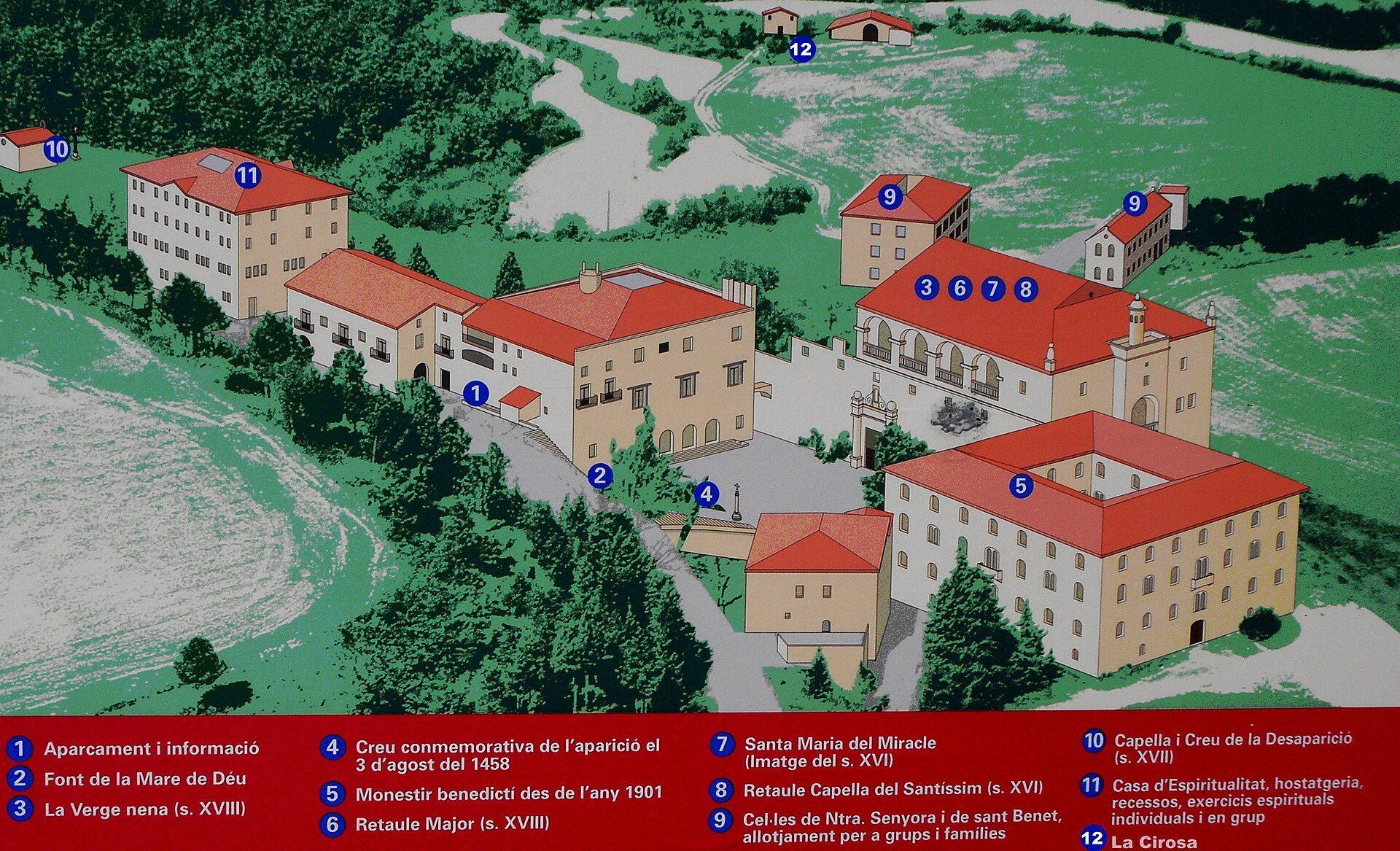
The sanctuary complex brings together the church, the Chapel of the Disappearance, the Benedictine monastery, the Casa Gran, the House of Spirituality, several former and current monastic cells, Sanctuary Square, fountains, a commemorative cross, a basin, and the Rock of the Virgin. Its surviving buildings and features represent successive phases from the fifteenth century to the modern period.
The church and sacred furnishings
The unfinished church
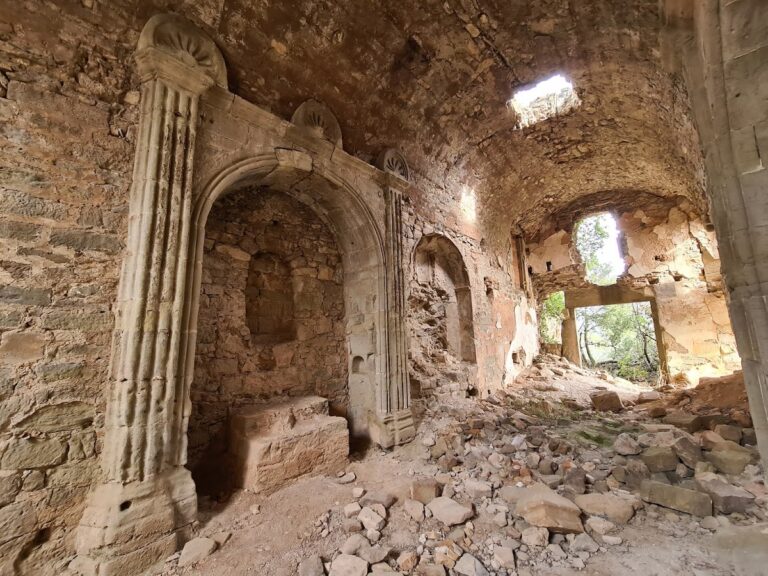
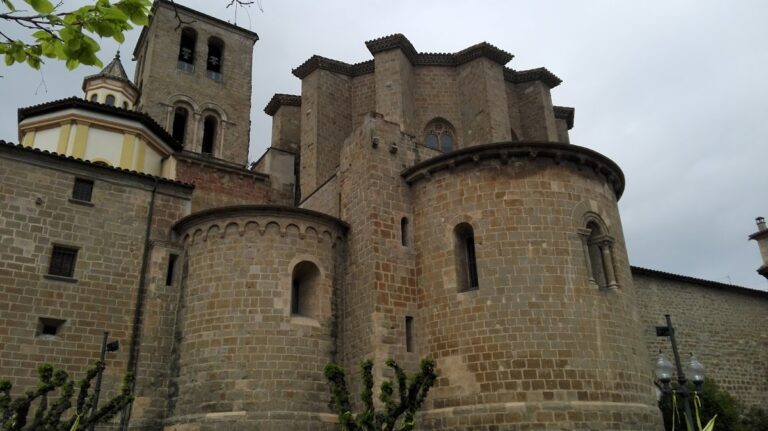
The church is an unfinished seventeenth-century building that incorporates vestiges of the second Gothic church. It contains the fifteenth-century Gothic image of the Virgin of the Miracle, the Gothic-Renaissance altarpiece in the Chapel of the Blessed Sacrament, an eighteenth-century Baroque high altarpiece, an eighteenth-century stone altar, and an organ dating from the late sixteenth or early seventeenth century.
The Gothic-Renaissance altarpiece
The Gothic-Renaissance altarpiece is attributed to Pere Nunyes, a Portuguese painter active in Catalonia. It dates to the sixteenth century, with one description assigning it specifically to 1530. Its 18 painted panels depict scenes from the Mysteries of the Rosary. The upper central painting shows the Coronation of the Virgin by the Trinity and is a copy of Diego Velázquez’s Coronation of Mary in Heaven; the subject of the original panel is unknown.
The Baroque high altarpiece
The Baroque high altarpiece stands in the central apse, the curved or polygonal end of the church where the principal altar is commonly placed. It measures approximately 23 meters high and 12 meters wide and has three superimposed sections. Its central image represents the apparition: the Virgin holds a cross and addresses the two shepherds, one kneeling and the other fleeing in fear. Carles Morató produced the sculpture, while Antoni Bordons carried out the gilding and painting.
The organ and bells
The organ was commissioned in 1593 from the Solsona organ builder Antoni Bordons. French troops removed its pipes during the 1810 plunder, leaving its mechanism. The Manresa organist Pau Obradors repaired it in 1821, and Gerhard Grenzing later reconstructed and restored it between 1992 and 2004.
The church has no tower. Four bells stand on a terrace above the apse. Made in 2003 by the German bell founder Albert Bachert, they are dedicated to the Marian invocations Miracle, Claustre, Patrocini, and Pinós, all associated with the Solsonès region.
Monastery and associated buildings
Benedictine monastery and Casa Gran
The Benedictine monastery dates from 1899 and houses the community dependent on Montserrat. The Casa Gran is an uncommon late Gothic civic building dated to 1532. It was first built as a pilgrims’ hostel and later altered through successive reforms.
Chapel and accommodation buildings
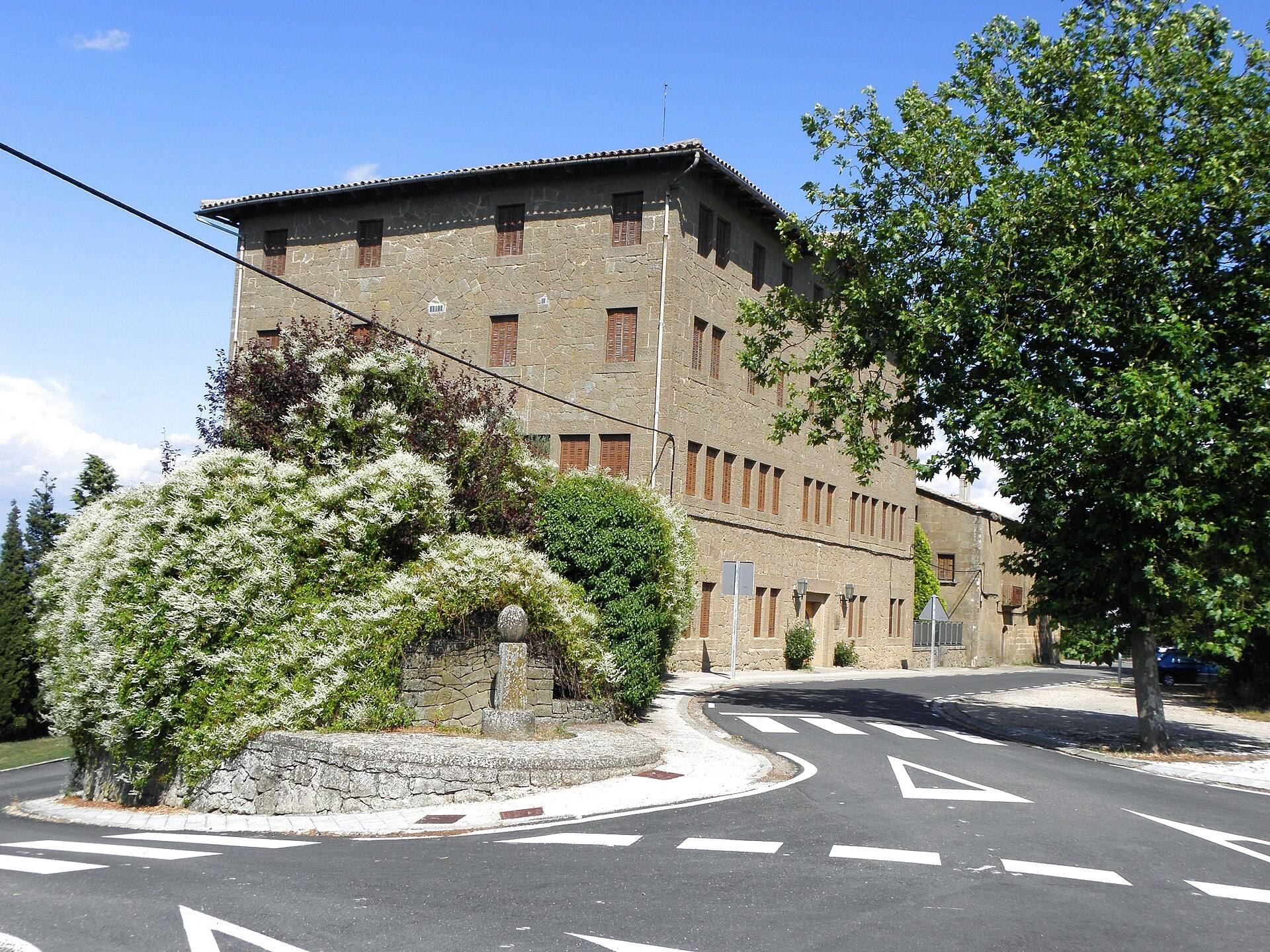
The Chapel of the Disappearance stands at the traditionally identified place where Jaumet of the Cirosa saw the Virgin as a child disappear. The House of Spirituality opened in 1981 in the former Sanctuary Hotel. It contains 40 rooms, four conference rooms, and a chapel.
The cells of Saint Benedict and Our Lady occupy two apartment buildings. Each apartment has three double bedrooms, a bathroom, and a kitchen-dining room. The former cells of Saint Anthony stand at the eastern edge of the enclosure beside the monastery and are now used occasionally and in summer.
Sanctuary Square and commemorative features
Square, cross, and basin
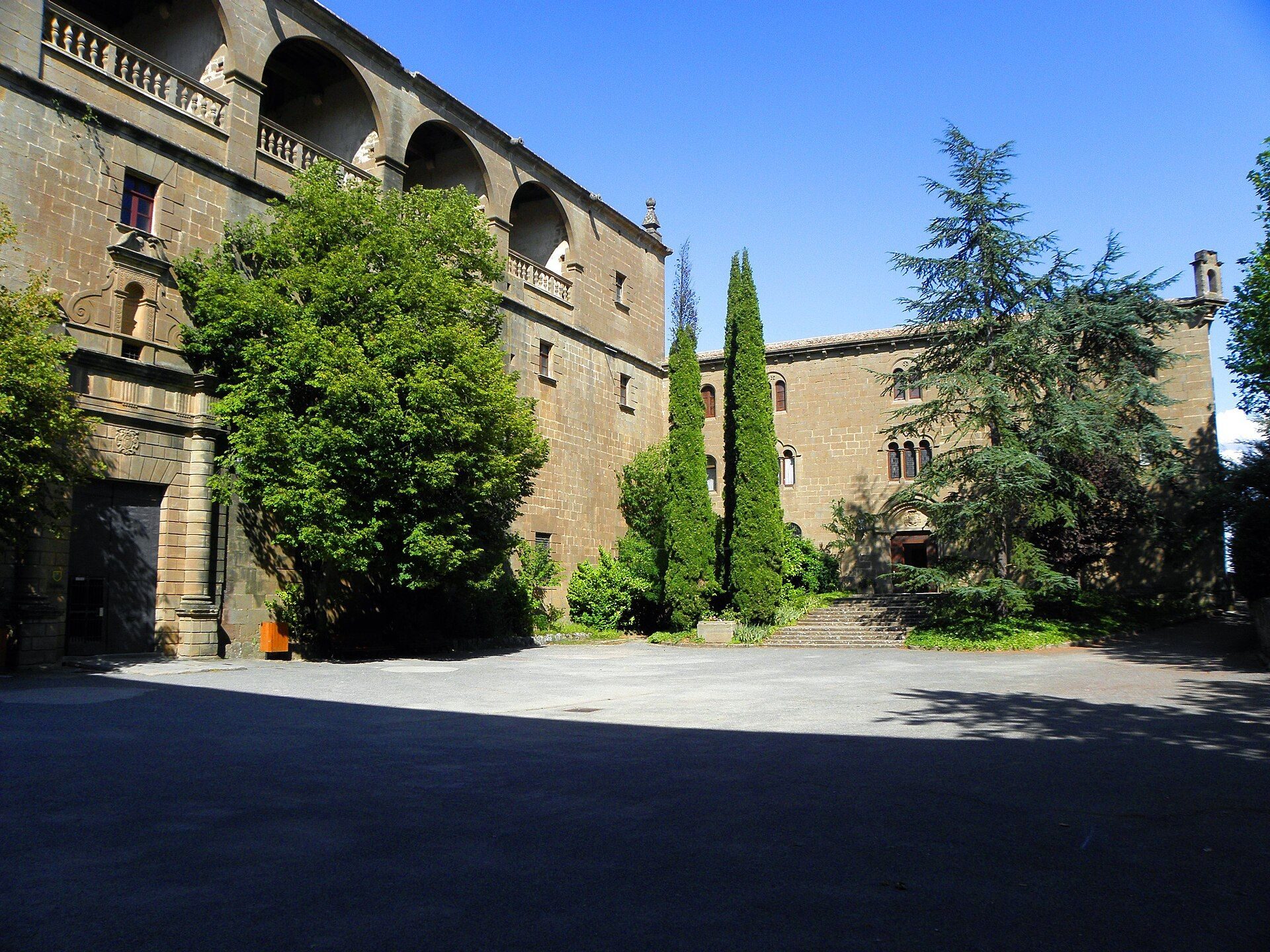
Sanctuary Square measures approximately 45 by 25 meters. The church, monastery, and Casa Gran bound it on the north, east, and west. A descending retaining wall beside the southern road closes the square on the south and contains the commemorative cross of the apparition, the Fountain of the Virgin, and a stone basin.
The original commemorative cross stood about 30 meters from the church in the former Bassedòria meadow, at the place associated with the two junipers where Celdoni saw the apparition. The junipers disappeared after pilgrims began visiting the site, and a Gothic-style stone cross replaced them. Its carved capital is now in the Solsona Diocesan Museum and bears eight statuettes representing Saint Martin, Saint Helena, Saint Paul, an angel, Saint Lawrence, Saint Engràcia, Saint Peter, and another angel.
The original cross was demolished during the Spanish Civil War and replaced by the present cross, which stands on the octagonal base of its predecessor. The base bears the inscription “RESTORED IN 1898” on the side facing the church and inscriptions referring to the shepherds of the Cirosa and 3 August 1458 on the sides facing the Casa Gran. A marble plaque beneath the cross contains the first part of the Virgin’s words to Jaumet as a child.
The stone basin behind the commemorative cross, between the cross and the road, has an elliptical form. At the western end of the square, the Fountain of the Virgin stands opposite the southeastern corner of the Casa Gran. Manel Anglarill built it in 1719 as a metal push-button tap set in a dressed-stone wall beneath a blind semicircular arch. An L-shaped stone bench and a stone table stand beside it.
The Rock of the Virgin
The Rock of the Virgin is an oval stone slab approximately 3.40 meters long, 1.56 meters wide, and 0.34 meters thick. It lies at the southern end of Saint Gabriel Hill, less than 100 meters east of the Chapel of Saint Gabriel and less than 40 meters southeast of the hill’s geodetic summit. In 1784, it was separated from its associated burial structure and placed horizontally on two pillars, giving it the appearance of a dolmen, a megalithic burial monument made from large stones.
The slab’s upper surface is polished and covered with lichens. Its sides and underside carry heavily worn incised designs formed by chevron or zigzag bands. Joan Serra i Vilaró interpreted it as the worked cover of a megalithic burial structure, possibly a half-dolmen, while M. Cura proposed that it was a displaced and decorated menhir-stela, an upright symbolic stone combining the forms of a standing stone and a stela.
The rock formerly served as a station for blessing the surrounding territory and as a stopping place during sanctuary processions. A tabernacle containing the sacred image was placed on it while three Salve prayers were sung to Our Lady of Montserrat, Our Lady of Lord, and Our Lady of Pinós. A concavity in the center of the underside has inspired local legends, including the belief that the Virgin used the stone as a sunshade while spinning and that anyone who could lift it with the head placed in the cavity would never suffer headaches.