St Catherine’s Church: A Gothic Parish Church in Gdańsk
Site at a Glance
- Rating
- 4.6
- Popularity
- Medium
- Country
- Poland
- Primary era
- Medieval
- External website
- Open
- Eras represented
- Medieval, Early Modern
- Civilizations
- Unclassified
- Site type
- Religious
- Remains
- Church
On this page14 sections
History
St Catherine’s Church is a medieval brick Gothic church in Gdańsk, Poland, and the oldest parish church in the city’s Old Town. A traditional account places a wooden predecessor here in 1185, during the rule of Prince Sobiesław I. The stone church was built between 1227 and 1239, while its main nave is dated more specifically to approximately 1230–1240. This early phase developed under the Pomeranian princes and the rule of Świętopełk II, the thirteenth-century ruler of Pomerelia, the historical region around Gdańsk.
Medieval foundation and expansion
The church appears in surviving written records from 1263 and 1268, which name a priest called Luder. A record from 1271 refers to the church’s patronal institution. In 1298, Władysław Łokietek, a medieval Polish ruler, held judicial proceedings in the church. These references place St Catherine’s within the civic and religious life of medieval Gdańsk.
After 1379, the earlier building was replaced or transformed into a larger Gothic church. A low tower was added around 1380, then raised between 1484 and 1486. Further enlargement during the fourteenth and fifteenth centuries created the broader medieval complex. The church was dedicated to Saint Catherine of Alexandria, a Christian martyr traditionally associated with Alexandria in Egypt and commemorated on 25 November.
Reformation and early modern history
The congregation joined the Reformation in 1525. The Reformation was the sixteenth-century religious movement that led many western Christian congregations to adopt Protestant forms of worship and church organization. St Catherine’s remained Protestant from 1555 until 1945. After the Second World War, responsibility passed to the Roman Catholic Church.
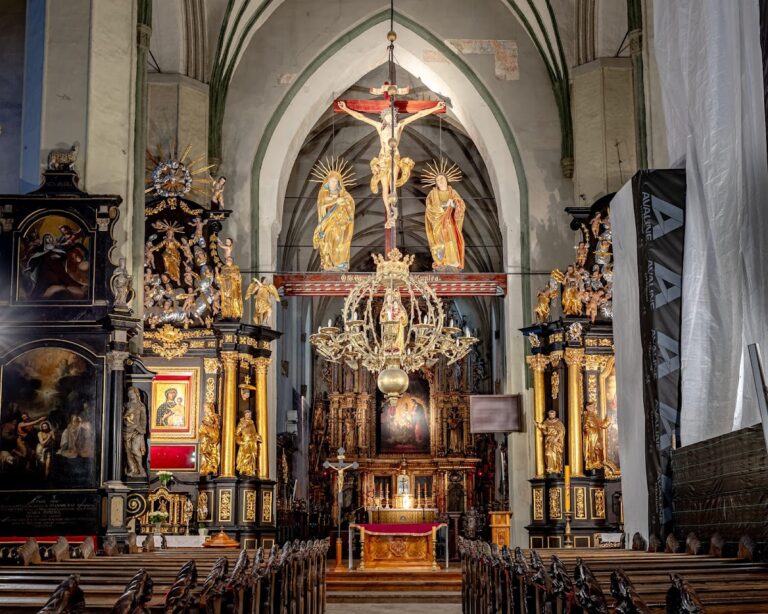
The church received important furnishings during the early modern period. Anton Möller created a triptych for the high altar around 1601, showing the Crucifixion, the Last Supper, and the Last Judgment. His pupil Izaak van den Blocke completed the Crucifixion after Möller’s death. A large organ was built by Johann Hellwig between 1603 and 1607, and a smaller instrument followed in 1609. Major renovations took place around 1675 and 1715.
Johannes Hevelius, the seventeenth-century astronomer based in Gdańsk, was buried in the church in 1687. A tombstone dated 1659 commemorates him. During the Napoleonic occupation of Gdańsk from 1807 to 1813, the building was temporarily used to house large numbers of horses. It subsequently required renovation.
Fire, war, and reconstruction
Lightning struck the tower on 3 July 1905 and started a fire. The spire collapsed, the carillon was destroyed, and burning fragments partly set the church roof alight. The tower was restored, and its spire was reconstructed by 1910. The large organ was also rebuilt that year by Eduard Wittek, with three manuals and 50 stops fitted into the older case.
Fighting in Gdańsk in 1945 destroyed the church’s roofs and tower spire and damaged parts of the vaults. The 1613 high altar by Simon Herle was also lost. Many members of the Protestant congregation fled or were expelled, and the congregation was subsequently dissolved. The church’s postwar reconstruction began soon afterwards. By 1958, part of the main structure, the gables above the presbytery, and the gables of the southern chapels had been restored. The nave was completed in 1967, the roof was finished in 1966–1967, the side-aisle vaults were reconstructed in 1971–1973, the tower spire in 1974–1979, and the remaining vaults in 1980–1982.
Another major fire occurred on 22 May 2006, when the roof collapsed onto the church’s intermediate ceiling. This helped protect the interior and most historic objects from the flames. The tower was stabilized, and historic objects were moved to Gdańsk City Hall and the National Museum. The carillon survived, although it was damaged. The roof was rebuilt, damaged timber in the spire was replaced, and the ten-year reconstruction was completed in 2016.
St Catherine’s is now a Roman Catholic rectoral church, meaning that it is administered directly by a rector rather than operating as an ordinary parish church. It is administered within the Roman Catholic Archdiocese of Gdańsk and associated with the parish of Saint Bridget in Gdańsk. The church is protected as a Polish cultural-heritage monument, forms part of Gdańsk’s protected historic area within the seventeenth-century fortifications, and was designated a Historic Monument of Poland in 1994.
Remains
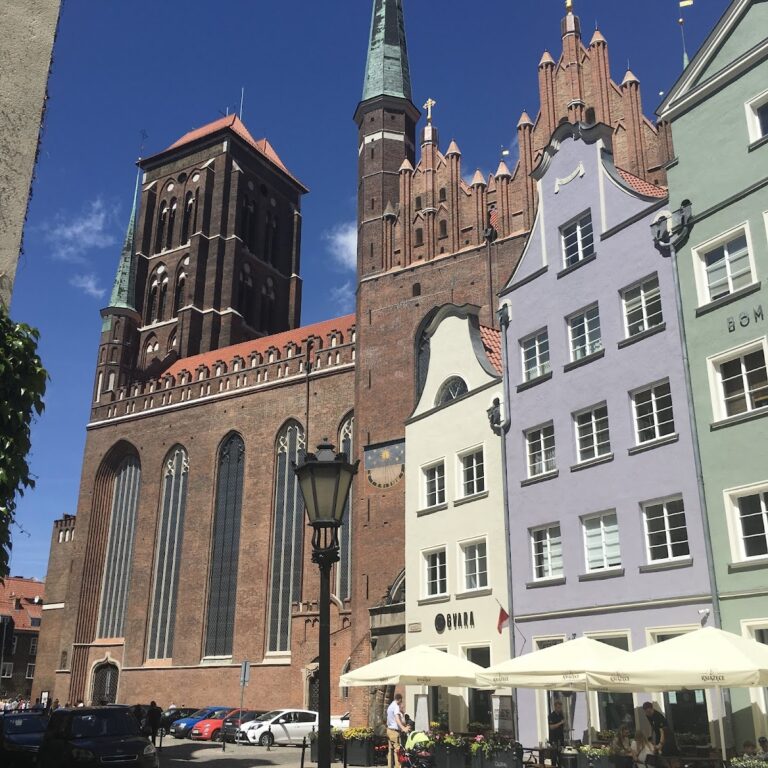
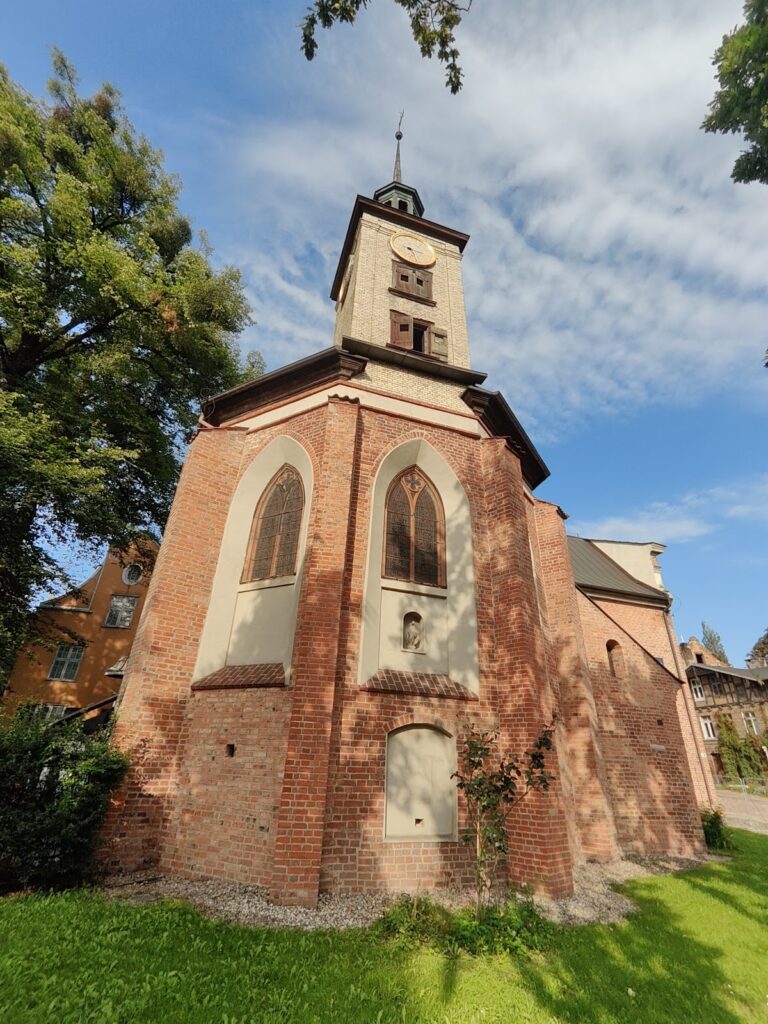
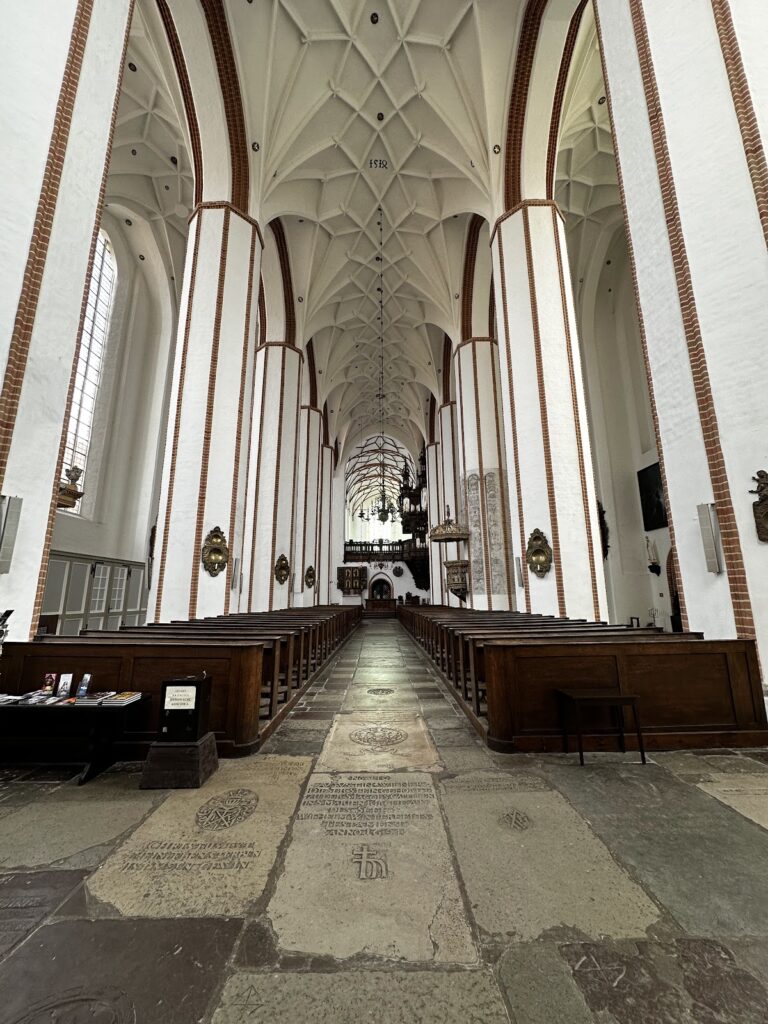
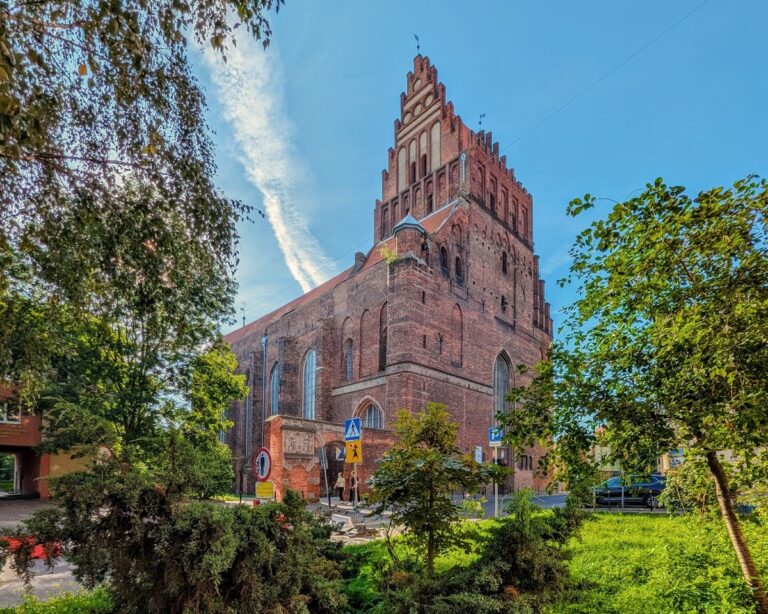
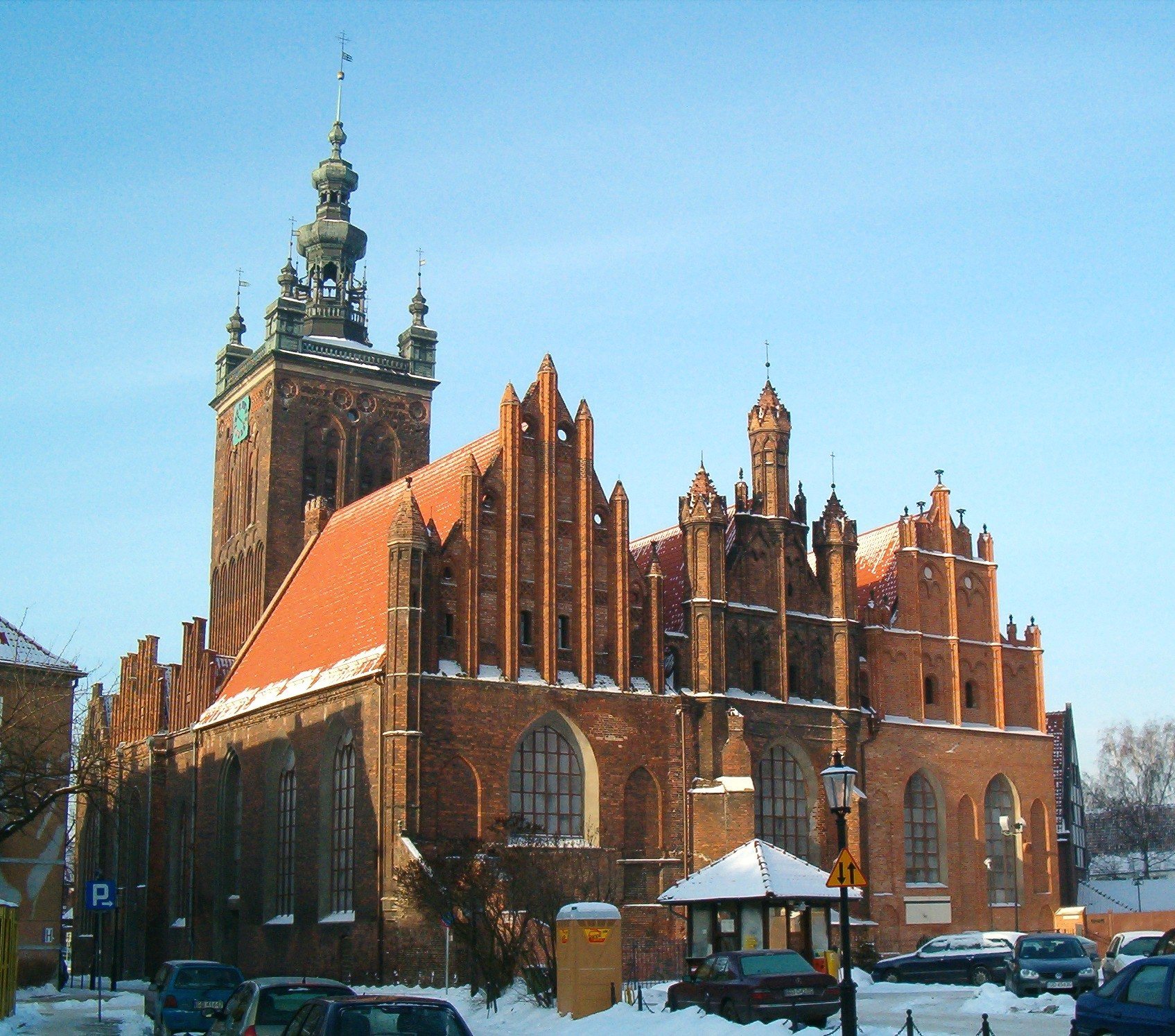
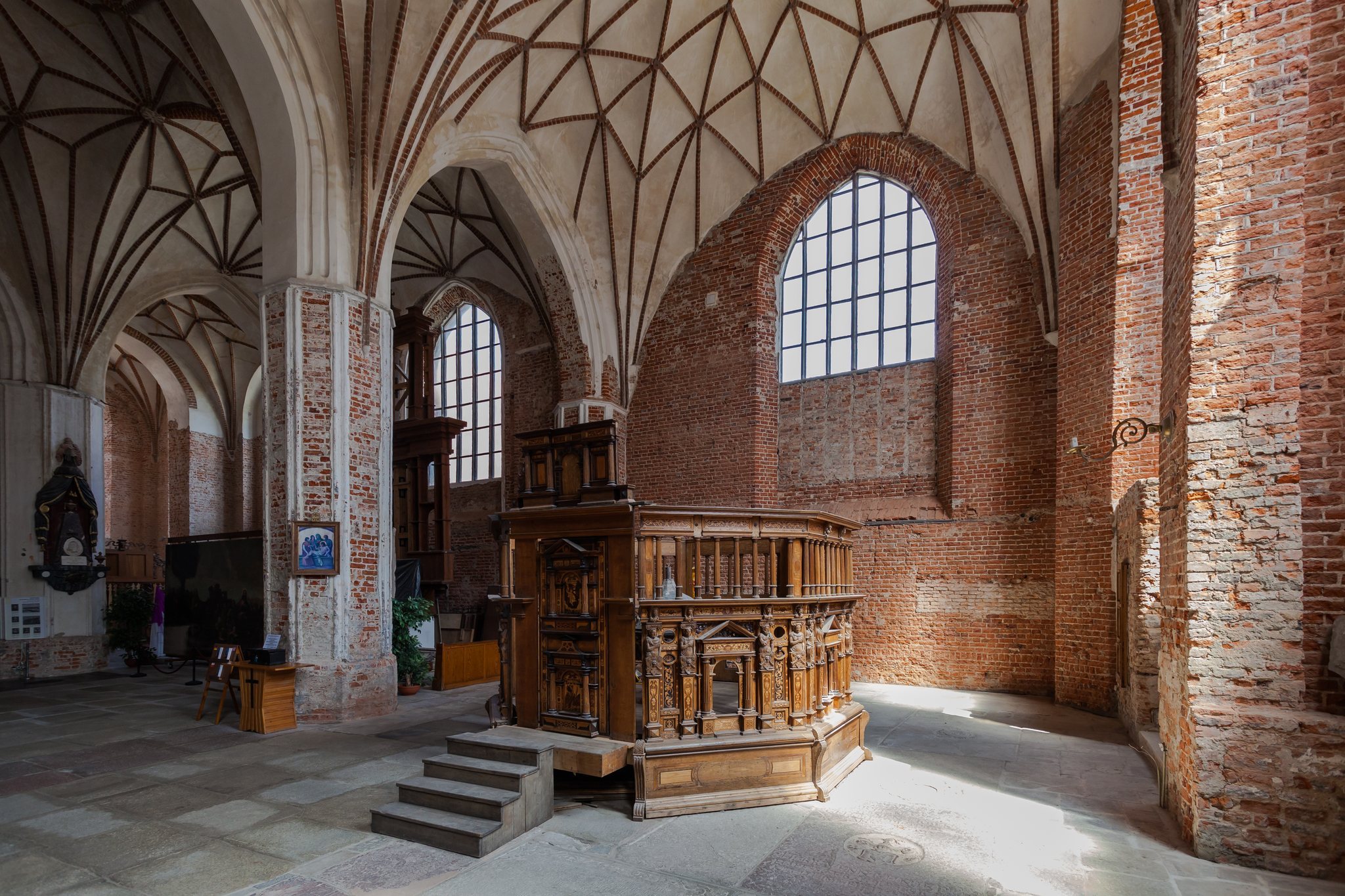
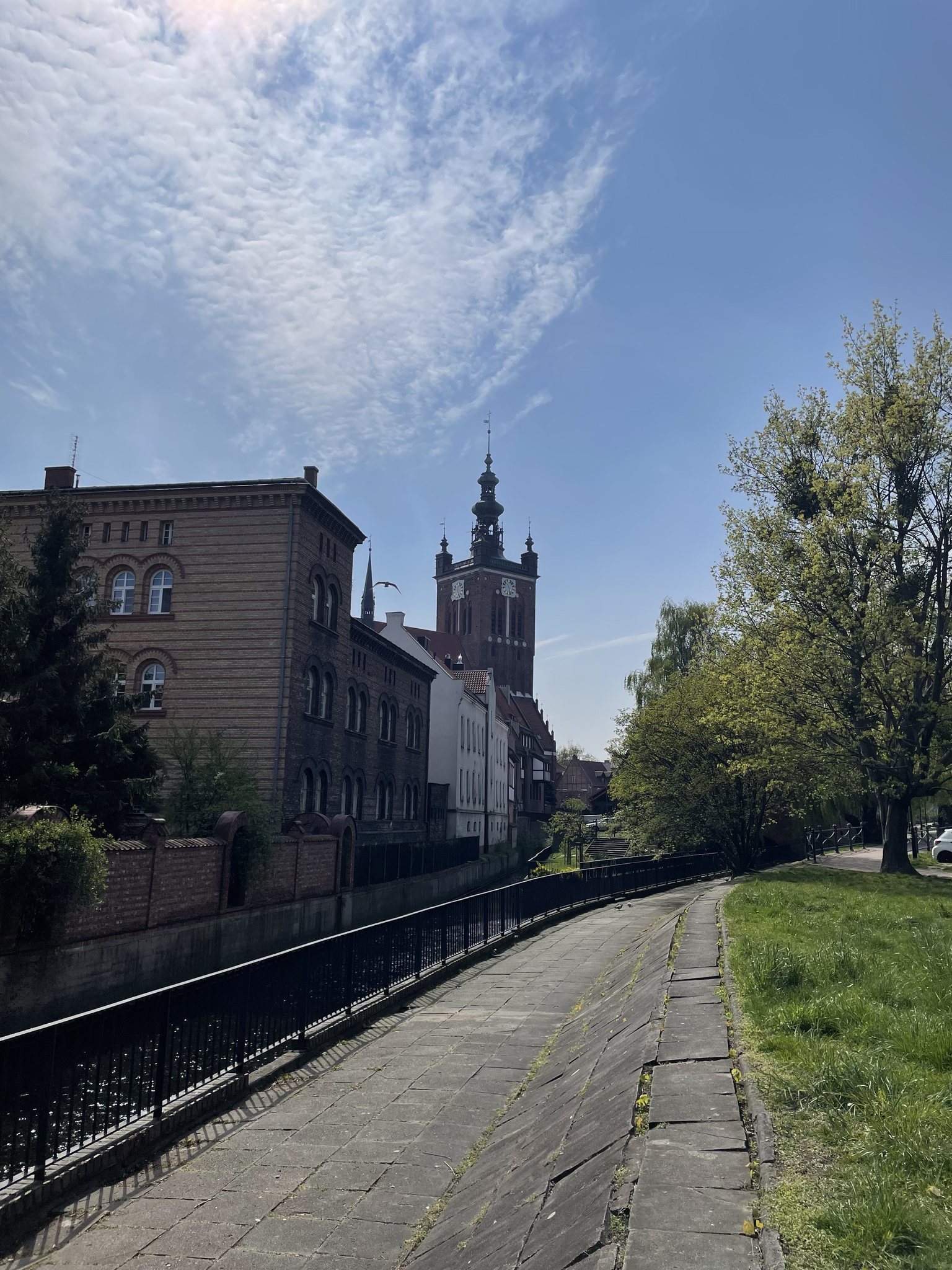
St Catherine’s is chiefly a brick Gothic structure with a basilical plan, meaning that a taller central nave is flanked by lower side aisles. The building includes three naves, a single-nave presbytery surrounding the high altar, a sacristy for vestments and liturgical objects, a vestibule, southern chapels, and other Gothic ancillary spaces. It measures approximately 61.5 metres in length and between 25 and 40 metres in width. Its square-plan tower rises 44 metres to the base of the spire and approximately 76 metres to its summit.
Church structure and furnishings
Gothic body and tower
The church has high gabled roofs and vaulted interiors, with the chapels and supporting spaces extending the Gothic plan. The tower began as a low structure around 1380, was raised in 1484–1486, and was later given a gabled roof. Its present Baroque spire was designed in 1634 by Jacob van den Blocke, the Gdańsk city carpenter. The roofs, spire, and parts of the vaulting were reconstructed after the destruction of 1945. A storm caused the eastern gable of the southern aisle beside the presbytery to collapse in 1953, and the damaged gable and related parts were rebuilt.
Memorials and sacred images
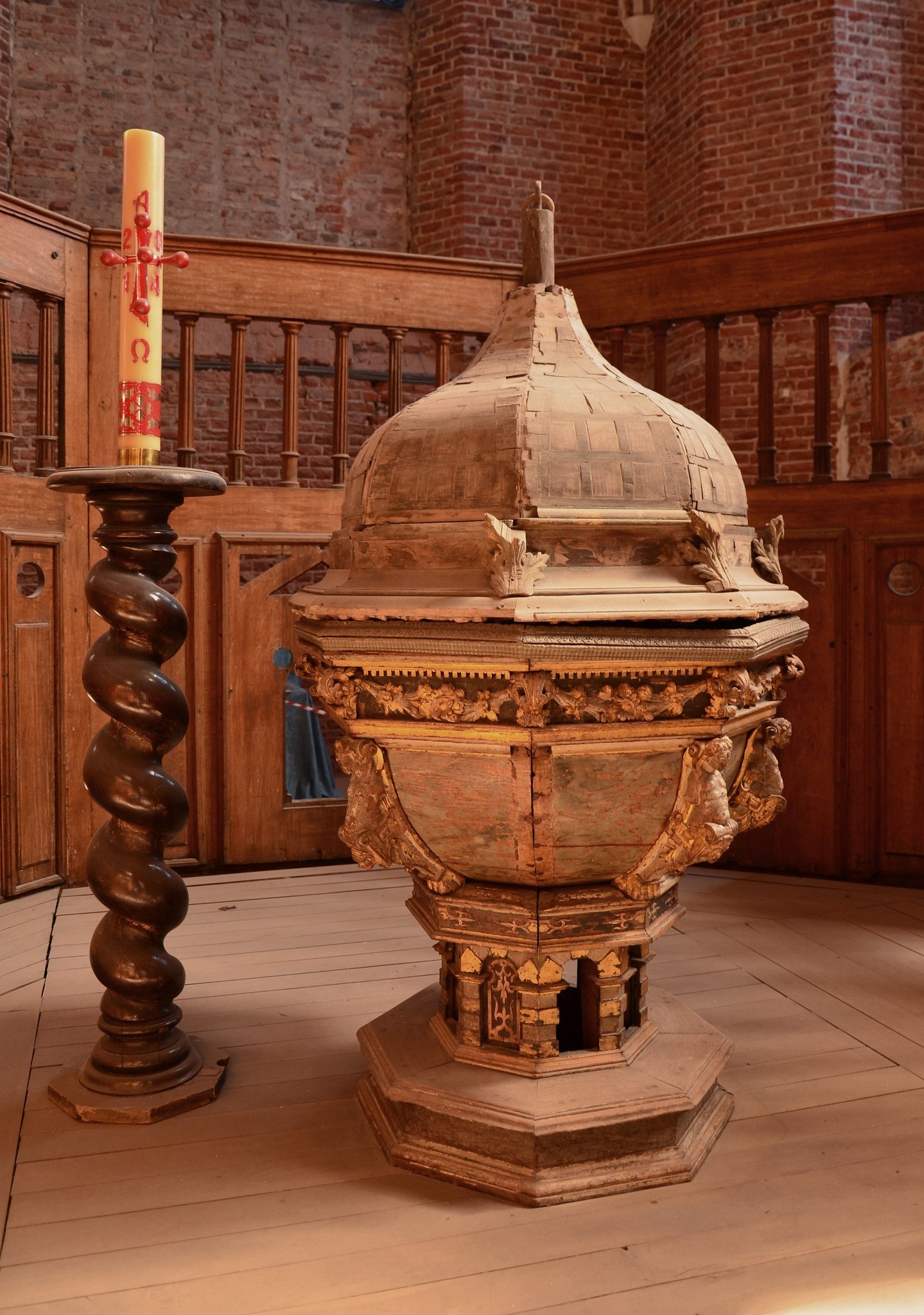
Baroque epitaphs remain among the church’s interior memorials, together with the 1659 tombstone commemorating Johannes Hevelius. The church also contains the Bolszowiec Mother of God image, transferred after the Second World War from the sanctuary at Bolszowiec and crowned with papal crowns. The Trembowla Mother of God image, regarded as miraculous and artistically dated to the late sixteenth or early seventeenth century, is also preserved here, as is a miraculous image of Saint Jude Thaddeus brought from Lviv. The triptych made by Anton Möller and completed by Izaak van den Blocke has been held by the National Museum in Gdańsk since 2016.
Tower, clocks, and bells
Carillon
The tower houses the church’s carillon, a musical instrument made from tuned bells arranged for manual and often automatic performance. The first carillon was installed in 1575 and removed in 1634 during work on the tower clock and roof. A second instrument, made from 35 Dutch bells, was installed in 1738. Its keyboard was made by Andreas Hildebrandt, while the automatic mechanism was installed in 1741 by the Gdańsk clockmaker Daniel Böttcher.
The 1738 carillon was damaged in the 1905 tower fire and replaced in 1910 by a 37-bell instrument cast by the Schilling foundry in Thuringia. In 1942, the bells were removed for wartime metal collection. Twenty-eight survived melting and were installed in the carillon of St Mary’s Church in Lübeck. The present carillon was made by Royal Eijsbouts of Asten and installed in 1989 with 37 bells. Twelve more were added in 1998, and the fiftieth bell, named Catherine, was installed in 2013. The instrument now weighs approximately 17 tonnes and has manual and automatic mechanisms. Its automatic mechanism plays at every full hour, while the fiftieth bell weighs approximately 2.8 tonnes.
Tower Clock Museum and pulsar clock
Part of the tower is occupied by the Tower Clock Museum, a branch of the Museum of Gdańsk, and the tower provides access to the carillon. Since 2011 it has also housed the world’s first pulsar clock. A pulsar clock uses the highly regular signals of pulsars as a time reference, linking the historic tower with a modern form of astronomical timekeeping.
Organs
Large organ
The large organ was built by Johann Hellwig between 1603 and 1607. Georg Nitrowski enlarged it in 1650 by adding two pedal towers. Eduard Wittek rebuilt the instrument in 1910, giving it three manuals and 50 stops within the older case. Its facade was removed for safekeeping in 1943, and fragments were preserved by Polish monument conservators.
Smaller organ
Johann Hellwig built the smaller organ in 1609, using parts from an instrument made by Hans Hauck in 1516. It originally had nine stops on one manual and no pedal; Eduard Wittek added a pedal around 1910. The instrument was removed for safekeeping in 1943, and its subsequent history remains connected with the wartime dispersal of the church’s historic furnishings.