Church of St Mary Magdalene and Chapel of Nuestra Señora de Montserrat: A Dominican Baroque Church in Seville
Site at a Glance
- Rating
- 4.7
- Popularity
- Medium
- Country
- Spain
- Primary era
- Early Modern
- External website
- Open
- Eras represented
- Medieval, Early Modern
- Civilizations
- Crown of Castile, Spanish
- Site type
- Religious
- Remains
- Church
On this page29 sections
History
The Church of St Mary Magdalene and chapel of Nuestra Señora de Montserrat is a Catholic royal parish in Seville, Spain, built by the Dominicans in the Baroque period between 1694 and 1709 to designs by Leonardo de Figueroa. It preserves the church of the former Convent of San Pablo, which became the principal Dominican convent in Andalusia and a centre of study, preaching, and missionary activity.
Foundation of the Dominican convent
After Ferdinand III conquered Seville in 1248, he granted houses in the city to the Dominicans, a Catholic religious order founded in the early thirteenth century and known for preaching, theological study, and missionary work. The friars founded the Convent of San Pablo on the site. Alfonso X confirmed the donation in 1255, and Dominican friars were assigned to the convent at a provincial chapter held in Toledo around 1250.
San Pablo developed into the leading Dominican convent in Andalusia. Its community numbered about 200 friars in the early seventeenth century. The plague of 1649 killed 85 of them, while 190 friars were recorded at the convent in 1757. The institution also supported Dominican education and missions. An Estudio General, a higher centre of study, was established there in 1504 and received university status through a bull issued by Pope Julius III in 1552.
The convent was linked to Dominican activity overseas. Friars who later evangelized in America and the Philippines stayed at San Pablo, and Bartolomé de las Casas organized some missions to the Indies there. He was appointed bishop of Chiapas at the convent in 1544.
Damage, rebuilding, and the Baroque church
The medieval convent experienced several damaging events before the present church was built. An earlier fire around 1353 led to repairs supported by King Pedro I in 1361. In 1504, the Catholic Monarchs and local families helped repair the church roof after a severe storm. Some of those families subsequently received burial in the church.
Floods of the Guadalquivir caused collapses in the medieval convent complex between 1691 and 1692. The damaged buildings were demolished for rebuilding, and the present church was erected between 1694 and 1709 under Leonardo de Figueroa. The church was consecrated in 1724. Its monumental high altarpiece was made during the period between the completion of the building and its consecration.
During the French invasion of Seville, troops looted the convent and occupied it as a barracks. The convent church later became the Church of Santa María Magdalena after the former parish church of that dedication was demolished in 1811 under the demolition plan of Mayer, the contractor.
From convent to parish church
The Dominicans returned later and repaired the complex, but the confiscation of ecclesiastical property in 1835 converted the convent to civil offices. Reconstruction of the former parish church was abandoned in 1842, leaving the former convent church as the permanent parish church of Santa María Magdalena.
The former convent was remodelled for civil use. Its enclosure and entrance portal were demolished in 1889, and the former convent, then occupied by civil government offices, was destroyed by fire in July 1906. Twentieth-century urban projects removed its two cloisters and other dependencies. The church, sacristy, and Chapel of Nuestra Señora de Montserrat are the surviving elements of the former Dominican complex.
The building was declared a Spanish monument of cultural interest in 1970, recognizing the surviving church and its historical and artistic importance. It remains a parish of the Archdiocese of Seville and the canonical seat of several Catholic brotherhoods, including the Sacramental Brotherhood of La Magdalena, the Brotherhood of Our Lady of Amparo, the Brotherhood of the Fifth Anguish, the Brotherhood of Montserrat, and the Brotherhood of Calvary.
Brotherhoods and continuing devotional use
The Sacramental Brotherhood of La Magdalena was founded in 1575 and continues an annual Eucharistic procession on the feast of Corpus Christi. The Brotherhood of Our Lady of Amparo developed from a sixteenth-century charitable brotherhood established to receive abandoned children. It was re-established under the same dedication in the early eighteenth century.
The Brotherhood of the Fifth Anguish began in 1575 as the Brotherhood of the Holy Name of Jesus. It moved to San Pablo in 1587 and remained affiliated with the Dominicans until 1764. In 1851 it united with the Brotherhood of the Descent of Christ and the Fifth Anguish of Mary, which had been founded in 1540.
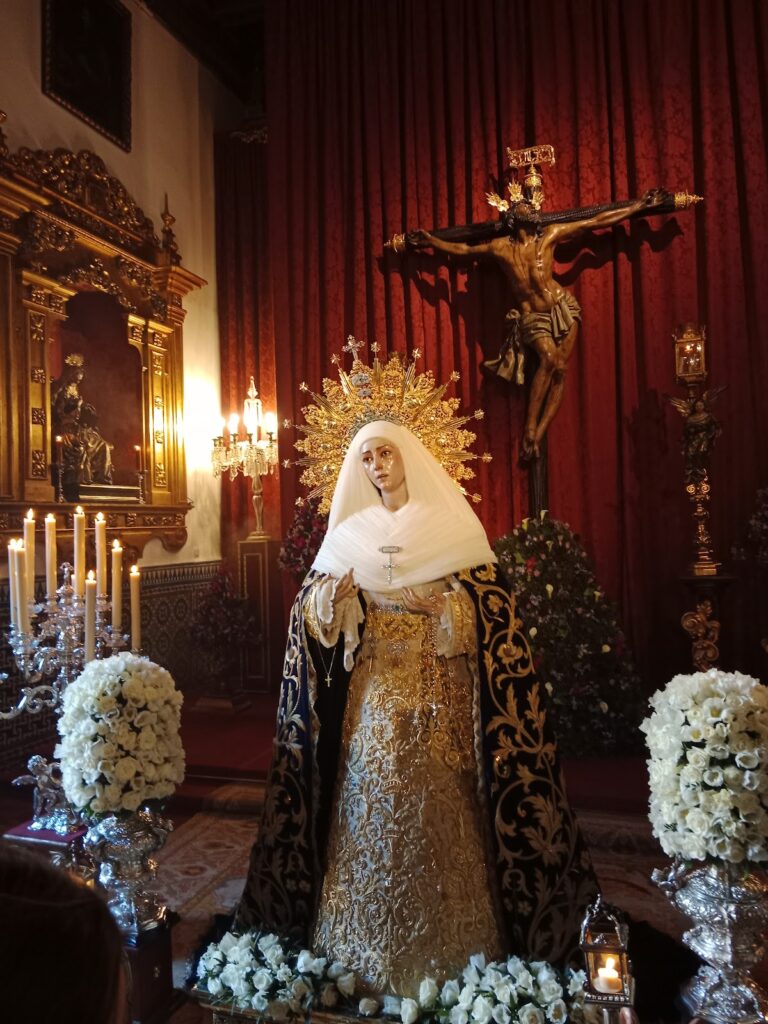
The present Brotherhood of Calvary was refounded in 1886 and moved to the church in 1916. It holds its penitential procession during the early hours of Good Friday. The Brotherhood of Montserrat occupies a chapel formerly belonging to the convent enclosure. A brotherhood dedicated to Christ of the Conversion of the Good Thief and Our Lady of Montserrat was founded in the late sixteenth century and moved to San Pablo in the mid-seventeenth century. After declining and selling its furnishings in the early nineteenth century, it was refounded in 1849 and returned to the chapel in 1938.
The chapel had housed the Brotherhood of Our Lady of Antigua from 1546. That brotherhood merged with the Brotherhood of the Seven Sorrows in 1596, and the united brotherhood disappeared in the early nineteenth century. The Brotherhood of Montserrat later occupied the chapel and continues its penitential procession on Good Friday.
Remains
The surviving church is a Baroque building with three longitudinal naves, a transept, and a presbytery. The central nave rises higher and is wider than the side naves, and it is divided into five bays. The former convent enclosure survives in part through the Chapel of Nuestra Señora de Montserrat, while the church and sacristy form the principal remaining elements of the Dominican complex.
Exterior and structural form
Principal façade and entrance
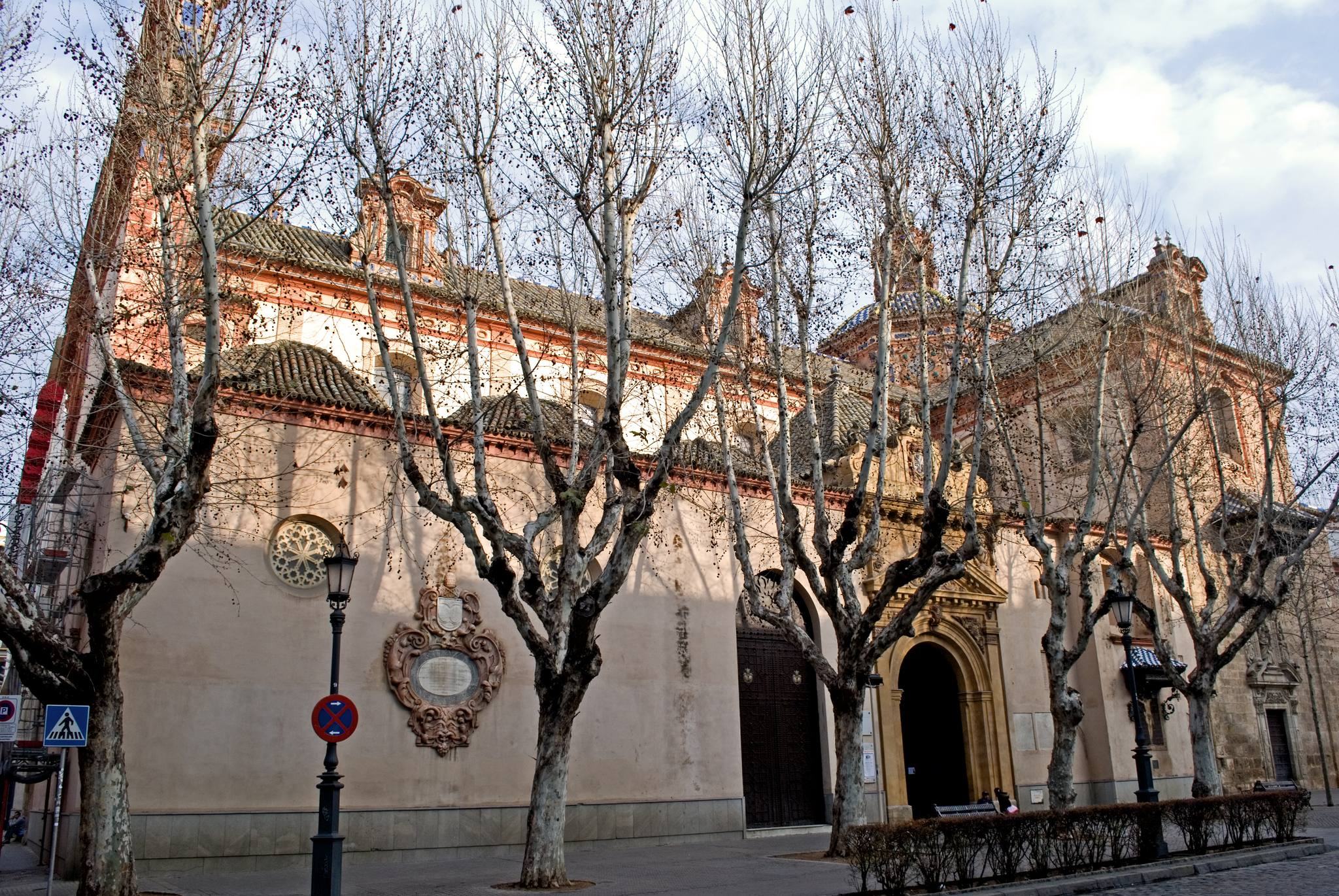
The main stone portal stands at the foot of the central nave. It originally opened onto the convent enclosure and now faces Cristo del Calvario Street. Its frontispiece includes two vases, the Dominican coat of arms, and a bust of Saint Thomas Aquinas attributed to Pedro Roldán.
Above the entrance is a large rose window surrounded by blue ceramic rosary beads and a floral crown. Higher on the façade is a balcony arrangement with two belfries at the sides and a central section containing the balcony entrance. The bell gable bears the date 1697.
Side entrances and dome
The Epistle side has three entrances. One is a simple doorway to the Chapel of the Brotherhood of the Fifth Anguish. Another, used regularly, carries the Dominican arms and sculptures of Saint Ferdinand flanked by Saint Isidore and Saint Leander. The transept portal is crowned by a statue of Saint Dominic attributed to Pedro Roldán and has an ironwork canopy supported by three brackets.
The crossing dome was the first in Seville built over an octagonal drum, the vertical base supporting a dome. It has a lantern and an ironwork crown, while its exterior is decorated with figures resembling Inca Indians.
Dome, vaults, and painted decoration
Crossing dome
The interior of the dome is painted with the Glory of the Virgin. Medallions in its eight segments spell “Ave Maria,” and angels hold symbols of the Marian litanies. The arches show the Catholic Church, Providence, Mercy, Wisdom, and Divine Justice. The four supporting piers contain paintings of sixteen Dominican saints and blessed figures by Lucas Valdés.
Presbytery vault
The vault over the high altar depicts the Triumph of Faith. Saint Dominic and Saint Thomas Aquinas appear among angels, while four pendentive medallions represent the continents and the evangelization of the world. Lucas Valdés painted this ensemble between 1710 and 1715.
Many of the church’s frescoes by Lucas Valdés are dedicated to Dominican themes, the mysteries of the Rosary, and the apostles, and many are badly deteriorated. Other important works include the Entry of Saint Ferdinand into Seville on the right side of the transept, the Auto-da-fé in the Time of Saint Ferdinand on the left side, and the Virgin of the Rosary Protecting the Spanish Ships at the Battle of Lepanto. An auto-da-fé was a public ceremony associated with the Spanish Inquisition, during which judgments against people accused of religious offenses were pronounced.
The Lepanto fresco represents the battle of 7 October 1571 beneath the Virgin of the Rosary and is framed by gilded plasterwork. Another work by Lucas Valdés shows Solomon Making an Offering in the Temple.
High altar and principal artworks
High altarpiece
The monumental high altarpiece was made between the completion of the church in 1709 and its consecration in 1724. A retable is a large architectural altarpiece placed behind an altar. This one is attributed to Leonardo de Figueroa and Pedro Duque Cornejo and measures about 160 square metres and 18 metres in height. It has a banco, or lower base, and two main levels arranged in three vertical streets separated by Solomonic columns, whose shafts spiral upward. The altarpiece was restored in 2012.
The retable is dedicated to Saint Paul, patron of the former convent. Its sculptures include Saint Paul, Saint Pius V, Saint Benedict XI, Saint Francis, Saint Dominic, Saint Catherine of Siena, and Saint Rose of Lima. A relief of the Conversion of Saint Paul occupies the upper central section, and most of the remaining sculptures are attributed to Pedro Duque Cornejo and date from 1709 to 1724.
Lower central section
The central niche of the lower level contains a sculpture of Mary Magdalene made by Felipe Malo de Molina in 1704. It was transferred from the former parish church in the mid-nineteenth century. The predella, the decorated area below the main level, contains an Immaculate Conception. Two adjoining portals have marble columns and allegorical sculptures of Hope and Charity.
Paintings and sculptures in the nave
The church contains Francisco de Zurbarán’s Healing Miracle of Blessed Reginald of Orleans and Saint Dominic in Soriano, also known as The Miraculous Delivery of the True Portrait of Saint Dominic in Soriano. Painted in 1626, it represents the Dominican tradition in which the Virgin, Mary Magdalene, and Saint Catherine deliver an image of Saint Dominic to a Dominican sacristan.
The nave also contains the altarpiece of the Assumption of the Virgin. Its relief of the Assumption was made by Juan de Mesa in 1619, as was the relief of the Coronation of the Virgin. Other recorded works include a Miraculous Virgin, a seventeenth-century Pietà, a seventeenth-century Virgin of Clemency, and a painting of the Exaltation of the Eucharist attributed to Zurbarán and dated around 1650.
Transept altarpieces and chapels
Gospel-side altarpieces
The Gospel side of the transept contains an eighteenth-century altarpiece with an image of Our Lady of Antigua by Pedro Roldán, made in 1650 to 1651. Another eighteenth-century altarpiece is attributed to Cristóbal de Guadix and contains Our Lady of Amparo by Roque Balduque, made around 1555.
A seventeenth-century altarpiece of Saint Anne and the Virgin contains sculptures by Francisco Ruiz Gijón dating from 1675 to 1678. Another seventeenth-century altarpiece, dedicated to Our Lady of the Fevers, includes an image attributed to Juan Bautista Vázquez the Elder and dated to 1565.
Jesus Carrying the Cross
The Gospel-side transept also contains the altarpiece of Jesus Carrying the Cross. Gaspar del Águila made the sculpture and Antonio de Alfián polychromed it in 1587. The image carries a tortoiseshell cross with a silver frame and came from the former parish church. It was formerly known as Christ Carrying the Cross and Christ of La Magdalena, and later as the Nazarene of the Fatigues.
Chapel of Christ of Calvary
On the Epistle side of the transept is the Chapel of Christ of Calvary, with an early eighteenth-century altarpiece of Solomonic columns and a contemporary grille. Its central group consists of Christ of Calvary by Francisco de Ocampo, dated 1612, the Virgin of the Presentation by Juan de Astorga, made around 1839, and Saint John the Evangelist by Astorga, also made around 1839.
Other Epistle-side furnishings
Other furnishings on the Epistle side include an eighteenth-century sculpture of Saint Catherine of Siena, an early eighteenth-century altarpiece of Saint Anthony of Padua with a seventeenth-century Ecce Homo, and eighteenth-century altarpieces and sculptures of Our Lady of Mount Carmel and Saint Joseph with the Child.
Side chapels
Chapel of the Fifth Anguish
The Chapel of the Fifth Anguish is attached to the Gospel nave and dates from the late fourteenth or early fifteenth century. It was remodelled in the early eighteenth century and regained its earlier form during a restoration in 1917. It may originally have consisted of three independent chapels, each with its own dome. Its decoration includes mural paintings of nature, three heraldic shields belonging to the Ayala and Medina families, and tiles from Cartuja installed in 1896.
The chapel houses the titular images of the Brotherhood of the Fifth Anguish. Christ of the Descent is attributed to Pedro Roldán and dated 1659, while the Virgin of the Fifth Anguish was made by Vicente Rodríguez-Caso in 1932.
Sacramental Chapel
The Sacramental Chapel extends from the transept to the lateral entrance. It was originally dedicated to Our Lady of the Rosary and became the Sacramental Chapel after the parish moved into the former convent church. Its altarpiece was made by Miguel Albín in 1817.
The altarpiece has a banco, a main body, and an attic. Its silver tabernacle dates from the late eighteenth century and was retouched by Fernando Marmolejo in 1954. Four fluted Corinthian columns frame the main body, which has a central niche with an interior baldachin, or canopy, and side niches containing an eighteenth-century Immaculate Conception and two late seventeenth-century archangels by Juan Bautista Patroni. The attic contains a relief of the Holy Trinity by Manuel María Fernández. The altarpiece is painted to imitate marble with gilded profiles.
Baptismal Chapel
The Baptismal Chapel stands at the foot of the church on the Epistle side. Its font came from the former parish church of Santa María Magdalena, where the painter Bartolomé Esteban Murillo was baptized on 1 January 1618. The chapel also contains the Christ of the Gonfalon, a sculpture attributed to Nicolás de León and dated 1536, accompanied by the Virgin Mary and Saint John in a Calvary group.
Chapel of Our Lady of the Rosary
The Chapel of Our Lady of the Rosary stands at the foot of the church on the Gospel side. It has an eighteenth-century altarpiece and a statue of Our Lady of the Rosary by Cristóbal Ramos, made around 1787.
Processional object and surviving convent chapel
Processional monstrance
The church’s processional monstrance is 2.25 metres high. A monstrance is a liturgical vessel used to display the consecrated host, especially during Eucharistic devotion and processions. The object was begun by Cristóbal Sánchez de la Rosa in 1678, continued by Juan Laureano de Pina, and completed by Blas Amat y Cortés in 1790.
It has an octagonal plan and three superimposed levels crowned by a statue of Faith. The lower levels combine Solomonic and straight columns with vegetal decoration. The lower level has a balustrade and statues of the four Evangelists, the next has angels, and the centre contains an Immaculate Conception.
Chapel of Nuestra Señora de Montserrat
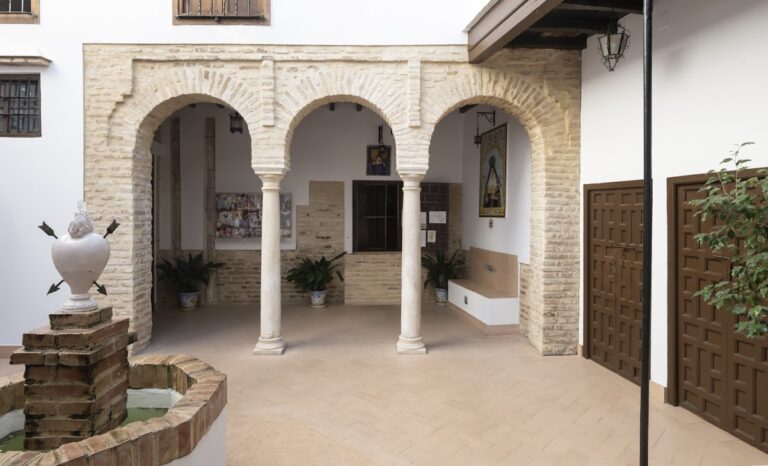
The Chapel of Nuestra Señora de Montserrat belongs to the former convent enclosure and is now used by the Brotherhood of Montserrat. It is one of the surviving elements of the Dominican complex, together with the church and sacristy. The chapel preserves the institutional continuity of the brotherhoods that occupied it, having first been used by the Brotherhood of Our Lady of Antigua and the Seven Sorrows before becoming the chapel of the Brotherhood of Montserrat in 1938.