Fort Siloso: Singapore’s Coastal Artillery Battery
Site at a Glance
- Rating
- 4.6
- Popularity
- Medium
- Country
- Singapore
- Primary era
- Modern
- External website
- Open
- Eras represented
- Modern
- Civilizations
- British
- Site type
- Military
- Remains
- Fort
On this page12 sections
History
Fort Siloso is a decommissioned coastal artillery battery on Sentosa, Singapore, built by the British in 1878 to defend the approaches to Keppel Harbour. A coastal artillery battery is a fortified installation designed to use guns against threats approaching by sea. The fort formed part of Fortress Singapore, a network of twelve coastal batteries at the beginning of the Second World War, and it is the only one of the twelve reported to have survived.
Origins and British coastal defence
The name Siloso derives from a Malay word meaning “rock,” referring to a large rock at the mouth of Singapore Harbour that endangered shipping. After the opening of the Suez Canal in 1869 helped expand Singapore’s trade, the British moved to strengthen the defence of the harbour. Following a report by Major Edward Lake of the Royal Engineers, they planned a fort on Pulau Blakang Mati, the island now called Sentosa, in 1874.
Mount Siloso was partly levelled by blasting its summit, creating platforms for coastal artillery. Fort Siloso was built in 1878, and by the 1880s the batteries on Mount Siloso and Mount Serapong had become a major element of Singapore’s British naval defences. Fort Siloso was intended primarily to guard against an invasion approaching from the sea to the south.
Expansion and modernisation
By the 1880s, the fort was equipped with 7-inch guns and two 64-pounder guns. Five 10-inch guns were added during the 1890s. These larger weapons operated automatically and received power from an underground powerhouse. Further changes in the 1930s added twin 6-pounder guns, quick-firing weapons intended to stop torpedo boats, five large searchlights, an operational tower for command and control, two machine-gun nests, and two twin Lewis anti-aircraft machine guns.
War and occupation
During the Battle of Singapore in February 1942, the campaign in which Japanese forces defeated the British-led defence of the island, Fort Siloso’s guns were turned inland towards the north. They fired on Japanese positions and troops advancing northwest from Tengah Airfield. British and local troops retreating from the captured Pasir Laba Battery were mistaken for Japanese forces, and the resulting fire caused casualties.
During the Japanese occupation from 1942 to 1945, Fort Siloso served as a small prisoner-of-war camp. After Japan surrendered in 1945, the Royal Navy occupied the fort in 1946. The 1st Malay Coast Battery and the Royal Artillery initially manned its guns. After the Malay battery was disbanded and British gunners withdrew, Gurkha detachments took over. Gurkhas were soldiers recruited from Nepal who served in British and other Commonwealth forces.
Post-war use and preservation
From 1963 to 1965, during Konfrontasi, Indonesia’s political and military opposition to the formation of the Federation of Malaysia, the 10th Gurkha Rifles manned Fort Siloso. Their task was to prevent Indonesian military-trained saboteurs from landing on Sentosa or at nearby Keppel Harbour. The fort later became a Catholic retreat for British forces stationed locally.
After the British military withdrawal from Singapore began in 1967, Sentosa was transferred to the Singapore government and the Singapore Armed Forces took control of the site. Fort Siloso became a military museum in 1974, displaying its history and naval guns. Restoration began in 1975 and was completed by the end of the 1980s. The fort was gazetted as a national monument of Singapore on 15 February 2022.
In February 2006, a former display about the British surrender of Singapore was moved to the Former Ford Factory in Bukit Timah, identified as the actual surrender site. The Surrender Chambers at Fort Siloso reopened in June 2017 with a refreshed exhibition. During the Japanese occupation, the fort also held Singaporean political prisoner Chia Tai Poh from 1989 to 1993.
Remains
Fort Siloso occupies the western part of Sentosa, on and around Mount Siloso. The summit was blasted and flattened to create coastal-artillery platforms, while the surviving complex includes gun positions, bunkers, storage buildings, tunnels, ammunition-storage areas, and an underground electric powerhouse. These spaces form a renovated military museum in which the fort’s defensive structures and weapons are interpreted together.
Artillery positions and underground works
Gun platforms and weapons
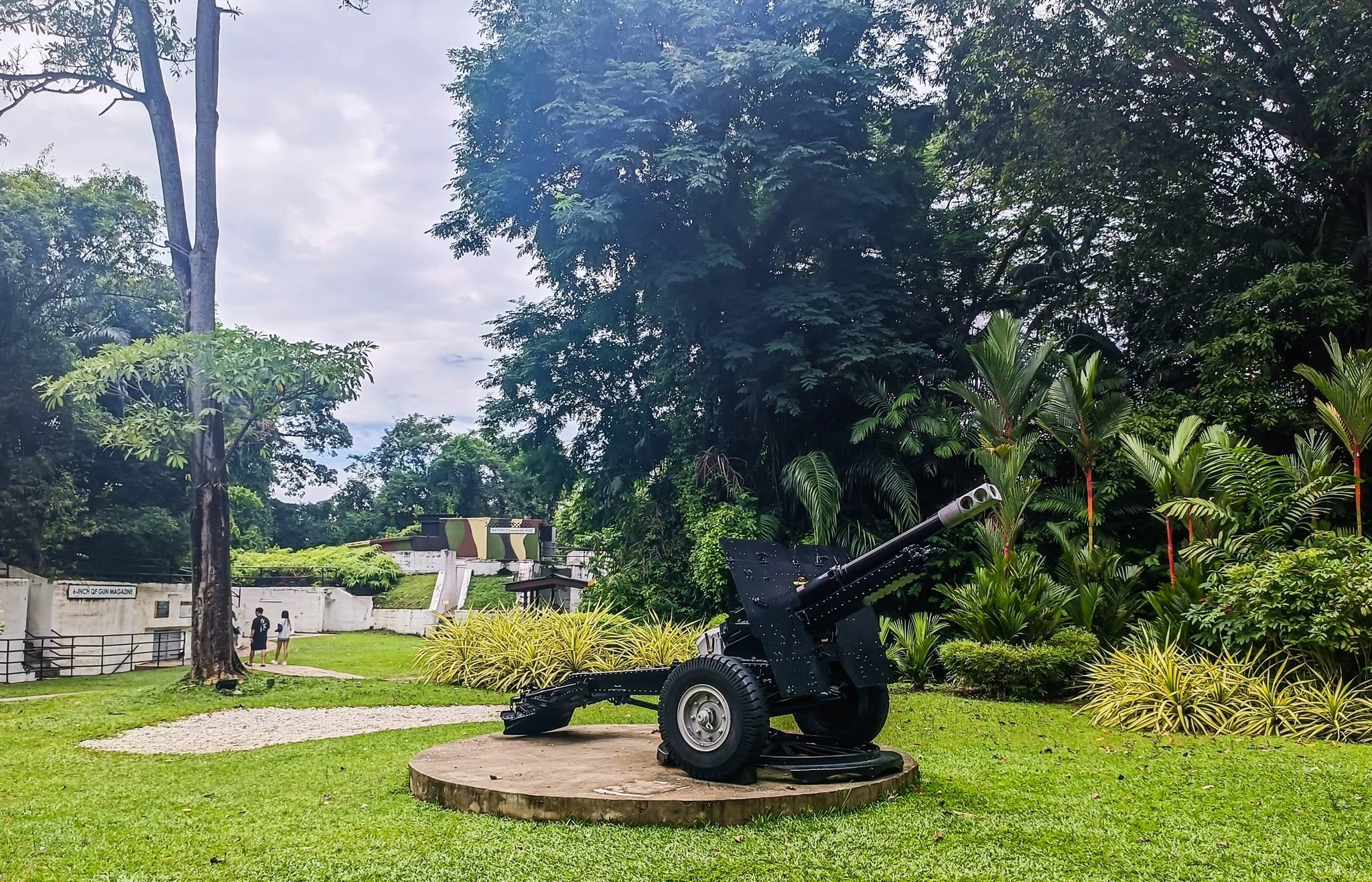
The fort’s artillery represents several phases of coastal defence. The earlier installations included 7-inch guns and two 64-pounder guns, followed in the 1890s by five 10-inch guns powered by the underground system. The 1930s modernisation introduced twin 6-pounder guns, quick-firing anti-torpedo-boat guns, searchlights, machine-gun positions, and twin Lewis anti-aircraft machine guns. The museum also displays British and Japanese coastal weapons transferred from elsewhere in Singapore, including two Japanese naval cannons recovered at Mandai. Its collection includes weapons dating from the seventeenth century through the Second World War.
Bunkers and underground facilities
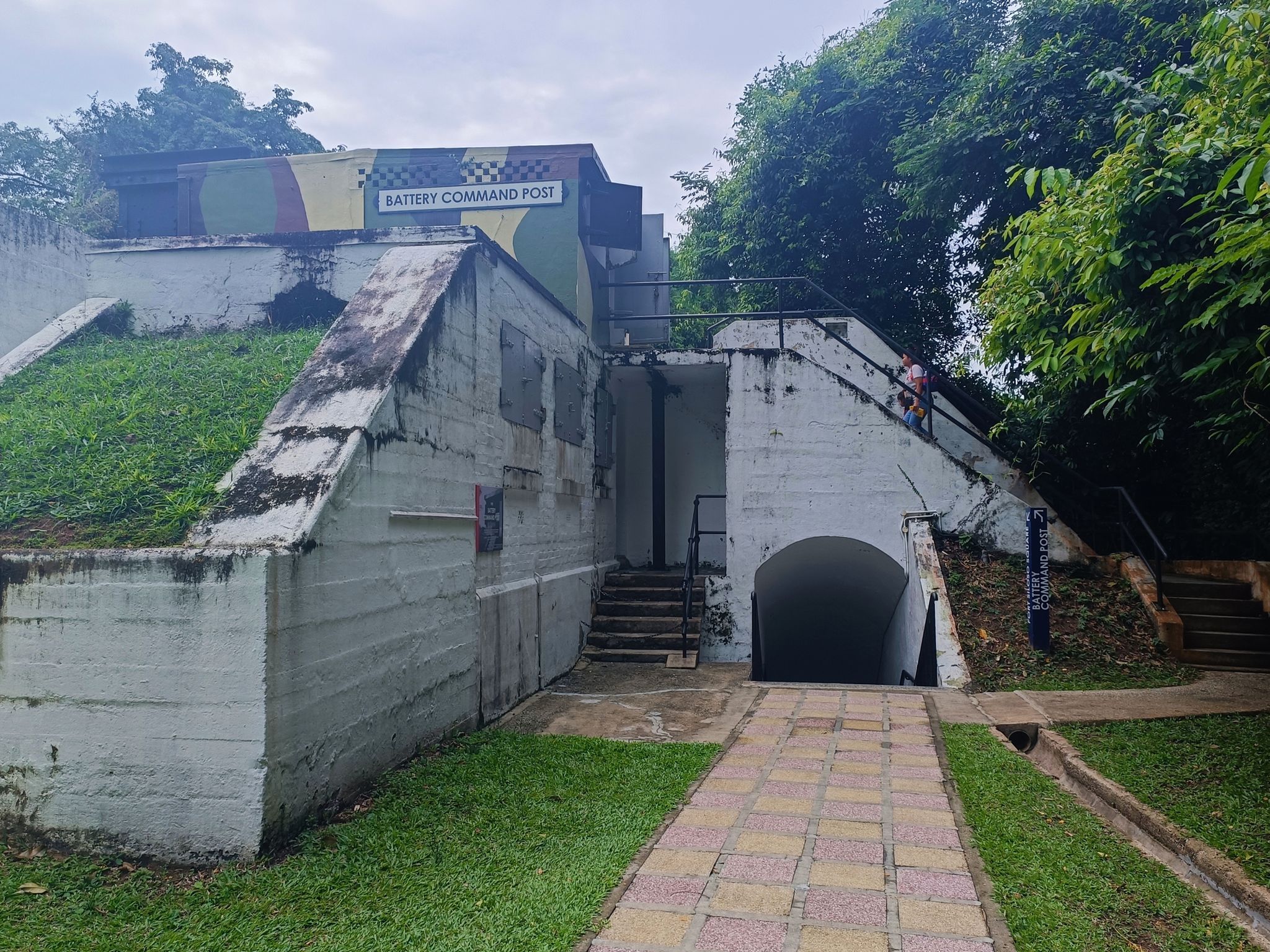
Bunkers, ammunition-storage areas, storage buildings, tunnels, and the underground electric powerhouse survive as parts of the fort complex. Their preserved spaces show how weapons, supplies, power, and defensive operations were arranged around the artillery platforms. The structures have been opened for public interpretation as part of the military museum.
Interpretation spaces
Surrender Chambers
The entrance building is now known as the Surrender Chambers, an interpretation space presenting the capitulations of British and Japanese forces during the Second World War. Its upper storey uses actual wartime footage in an interactive depiction of the two surrenders. The ground floor has been converted into a souvenir shop.
Military museum displays
Mannequins of British soldiers and officers recreate conditions of life and service at the fort. A separate exhibition presents wartime photographs and documents, while the displayed artillery includes weapons from different periods and from both British and Japanese forces. Together with the surviving defensive spaces, these exhibits preserve Fort Siloso as a renovated military museum open to the public.