Arzamas Kremlin: A Russian Fortress-City Stronghold
Site at a Glance
- Rating
- 4.8
- Popularity
- Low
- Country
- Russia
- Primary era
- Early Modern
- Eras represented
- Early Modern
- Civilizations
- Russian
- Site type
- Military
- Remains
- Fortified Town
On this page13 sections
History
Arzamas Kremlin was a Russian fortress in Arzamas, Russia, founded in 1572 as the stronghold at the center of a new fortress-city. Its creation followed the capture of Kazan in 1552 and the end of the destructive Russo-Kazan wars, although raids from the southern steppes remained a danger. The site may have contained an earlier fortified Mordovian settlement, whose name was inherited by the new fortress. Arzamas was first mentioned in 1572 in the spiritual charter of Ivan the Terrible, the common English name of Ivan IV, the sixteenth-century tsar whose reign expanded Russian power toward the Volga region.
Foundation and Early Conflict
The fortress secured a settlement in the sparsely populated southern part of the Nizhny Novgorod region. Its position gave the Russian government a military base in an area where the danger of nomadic attacks had not entirely disappeared. In 1606, Arzamas joined the Bolotnikov uprising, a major rebellion against the Russian government that lasted from 1606 to 1607. Tsarist commanders Grigory Pushkin and Sergei Adadurov besieged the town and captured it in early 1607.
Rebuilding and Military Use
The fortifications were restored in 1618 under Ivan Izmailov, a voevoda, meaning a senior Russian military and administrative official who could command a town or fortress. The walls and towers were rebuilt again in the mid-seventeenth century, with reconstruction and expansion taking place in 1650. During this period, the Kremlin retained oak walls, a substantial garrison, and a considerable body of armament.
By the second half of the seventeenth century, the decline of nomadic raids in the region reduced the fortress’s military importance. It nevertheless served as an important base for government forces suppressing the Razin uprising, a large Cossack and peasant revolt in the late seventeenth century. The wall separating the Kremlin from the adjoining fortified outer settlement was demolished during the second half of the seventeenth century, after which the enlarged fortress assumed the defensive role formerly performed by the Kremlin alone.
Destruction and Later Development
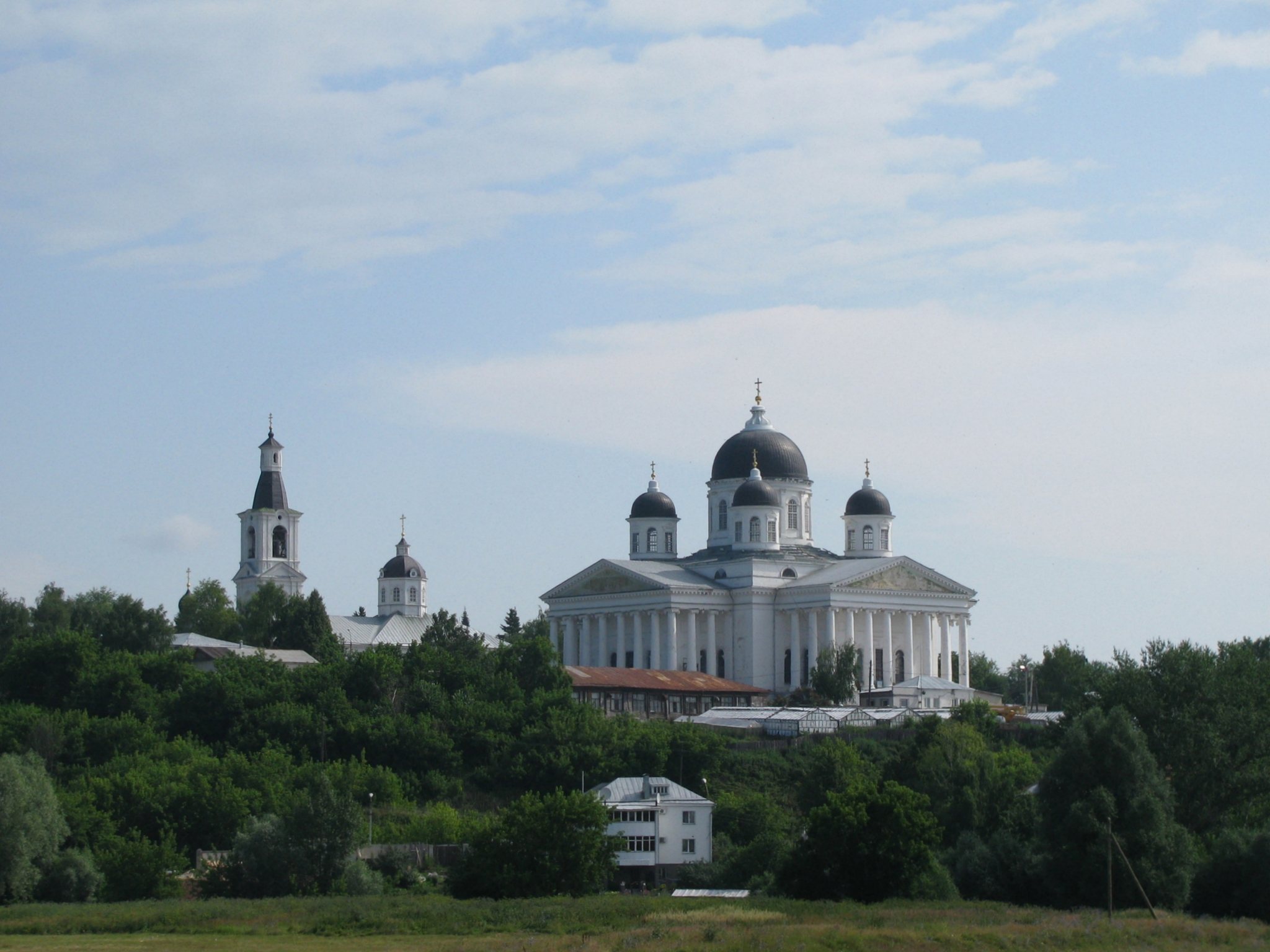
The Kremlin survived until 1726, when fire destroyed it. Its remaining earthworks were removed at the end of the eighteenth century as Arzamas was rebuilt according to a new regular plan. The fortress therefore no longer survives as a standing structure.
Religious institutions also occupied the fortified area. The female Saint Nicholas Convent, founded outside the Kremlin in 1580, was located within it during the eighteenth century. The male Vvedensky Monastery existed inside the Kremlin from 1651 until 1774.
Remains
The Kremlin occupied a high promontory shaped by the Tesha River and a ravine carrying the Soroka River. In the sixteenth and seventeenth centuries, the settlement consisted of a small wooden Kremlin at the tip of the promontory and a fortified outer settlement to the north. A surviving plan from the beginning of the eighteenth century shows an irregular triangular fortress whose shape followed the terrain. The walls and towers together extended for approximately 2,350 metres.
Fortress Layout and Defences
The defensive system combined timber walls with natural slopes, a rampart, and ditches. The walls were built from gorodnya, timber framework sections used to form Russian defensive walls. Their original height and thickness are unknown. The ground shaped the fortress’s different sides, giving each one a distinct defensive arrangement.
Western Hill
Along the western side, the walls and towers followed the crest of a high hill above the Tesha River and its floodplain. The steep terrain made an organized assault almost impossible, so this side had neither a rampart nor a ditch.
Northern Ditch and Rampart
The northern landward side was protected by a ditch and rampart, with the wall running along them. The rampart has been levelled, while the former ditch survives through a series of depressions in the ground. At the point where it reached the bank of the Tesha, the ditch became a ravine. An upper dam apparently allowed the northern ditch to be partly filled with water.
Southern Ravine
The southern boundary followed the ravine of the Soroka River. Its rampart has disappeared, but a chain of successive artificial ponds marks the line of the former ditch. Together with the northern earthworks, these surviving terrain features indicate how the fortress used existing watercourses and constructed barriers to protect its landward approaches.
Towers and Entrances
The fortress originally had eleven hexagonal towers. After the rebuilding of 1650, the number rose to twelve, including four gate towers. Their form and dimensions resembled those of the gate towers at Lyskovo Fortress. Three gate towers are known by name: Streletskaya, Kuznechnaya, and Anastasiinskaya.
The Anastasiinskaya Tower was named for Anastasia Romanovna, the deceased wife of Ivan the Terrible. A descent from the tower down the hillside toward a bridge over the Tesha survives. The eastern side initially had no entrance, but a breach gate was added there during the seventeenth century.
Buildings Within the Fortress
Churches and Monasteries
A church dedicated to the Archangel Michael stood in the southern part of the Kremlin from its foundation. The Archangel Michael is a major Christian archangel traditionally associated with defending the faithful. In the mid-seventeenth century, a Resurrection Cathedral was built on the same site, first in wood and later in stone. The cathedral was dedicated to the Resurrection of Christ.
Government and Civic Buildings
The Kremlin contained the voevoda’s court, an assembly hut, a powder magazine, and a prison. The remaining area held a marketplace together with the residential and siege yards used by the local population. These buildings placed military administration, storage, public activity, and civilian life within the same fortified enclosure.