Corjuem Fort: A Portuguese Defensive Battery in Goa
Site at a Glance
- Rating
- 3.9
- Popularity
- Medium
- Country
- India
- Primary era
- Early Modern
- Eras represented
- Early Modern
- Civilizations
- Portuguese
- Site type
- Military
- Remains
- Fort
On this page8 sections
History
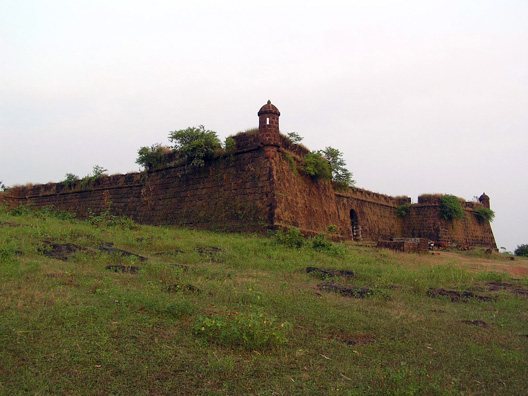
Corjuem Fort is a Portuguese fortress battery in India, on Corjuem Island near Aldona in Goa. Built in 1705 under Caetano de Melo e Castro, the Portuguese viceroy of Portuguese India, it helped defend Portuguese territory against Maratha expansion and later supported the protection of Panjim.
Portuguese frontier defence
The fort was constructed when control of Corjuem Island returned to Portuguese India, the territory administered by Portugal in the Indian subcontinent. During the eighteenth century, it guarded the town of Corjuem and helped protect Portuguese territory from rival kingdoms positioned beyond the Mandovi River. It was later rebuilt and strengthened as part of the defensive system around Panjim.
Portuguese control continued until Goa became part of India in 1961. In the early nineteenth century, the fort was used as a Military School and held a battery of four guns. It was decommissioned in 1834. The later Portuguese expansion known as the Novas Conquistas, or “New Conquests,” reduced its importance as a frontier defence, and the fort subsequently fell into disuse.
Custodianship and local traditions
Since the early 1800s, Joao Filippe Ferreira and his descendants have served as custodians of the island and fort. Ferreira installed the altar of Saint Anthony inside the fort. A local tradition also links the site with Ursula e Lancastre, a Portuguese woman said to have disguised herself as a man, taken up navigation and military duties, and served as a soldier at Corjuem before voluntarily revealing her identity so that she could marry.
The fort is also associated with the Dekhni song “Hanv Saiba Poltoddi Voitam,” written by Carlos Eugenio Ferreira, a grandson of Joao Filippe Ferreira. The song concerns crossing the river near the fort. Corjuem Fort is protected under the Goa, Daman and Diu Ancient Monuments and Archaeological Sites and Remains Act. The Directorate of Archaeology of the Government of Goa is restoring it with support from the Alvares Ferreira and Ferreira Rangel families.
Remains
Island fortress and battery
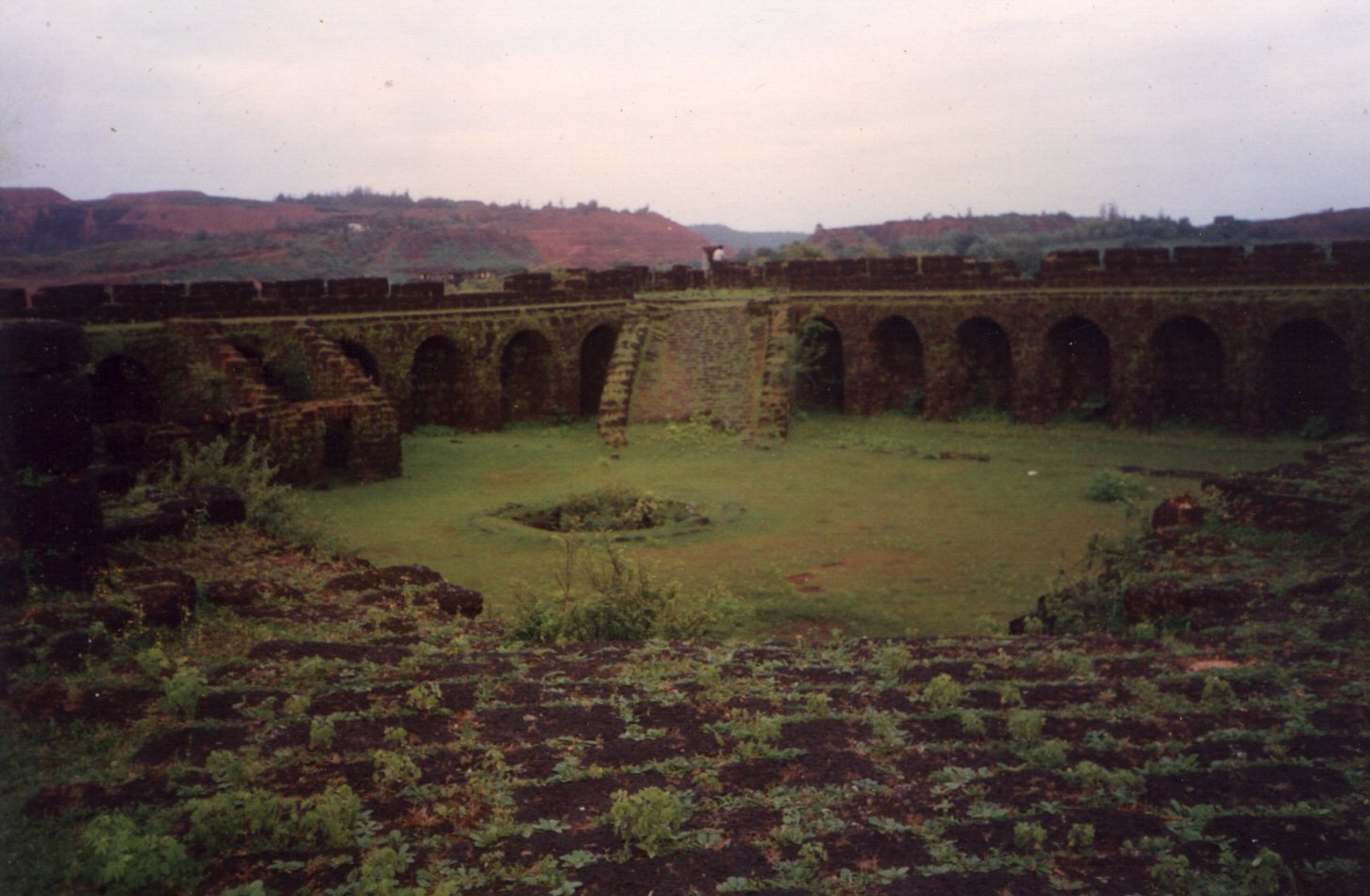
Corjuem Fort is a small fortress battery on Corjuem Island in Bardez, east of Aldona. The island is separated from Aldona by the Mapuçá River, a tributary of the Mandovi. Built from pitted laterite, an iron-rich tropical stone with a rough, cavity-marked surface, the fort belongs to a small group of surviving inland forts in Goa made from this material. Its defensive arrangement included four guns, and its position provided views across the surrounding river and land.
Religious features
Chapel
A chapel associated with the parochial church of Aldona stands within the fort. Its presence forms part of the religious use of the fortified enclosure alongside the military remains.
Shrine of Saint Anthony
Inside the fort walls at the entrance is the Shrine of Saint Anthony of Lisbon, owned by the Parish of Aldona and regularly renovated. The shrine has been a place of devotion for almost 200 years. In years of poor rainfall, villagers traditionally walk from the Chapel of Mae de Deus to the altar and pray to Saint Anthony, a widely venerated Franciscan preacher associated with communal and personal petitions.