Kloster Schlüchtern: A Former Benedictine Abbey in Germany
Site at a Glance
- Rating
- 4.7
- Popularity
- Very Low
- Country
- Germany
- Primary era
- Medieval
- External website
- Open
- Eras represented
- Medieval, Early Modern, Modern
- Civilizations
- Carolingian, Holy Roman Empire
- Site type
- Religious
- Remains
- Monastery
On this page13 sections
History
Kloster Schlüchtern is a former Benedictine abbey dedicated to Saint Mary in Schlüchtern, Germany. Its foundation is conventionally placed in the eighth century, and its early development belongs to the Carolingian period, the era of the Frankish dynasty associated with Charlemagne and his successors. The monastery stood in the upper Kinzig valley near the southwestern end of the mountain crossing of the Via Regia toward Fulda. Its beginnings before the surviving early Carolingian fabric remain uncertain, but its position and later history made it an important religious and territorial institution in Hesse.
Carolingian origins and medieval prosperity
The earliest surviving documentary evidence dates from 993, when the monastery was transferred to the Diocese of Würzburg on the basis of a forged document dated 788. Fulda is identified as Schlüchtern’s mother monastery. The abbey’s early church was later expanded, and the institution reached its greatest prosperity during the twelfth and thirteenth centuries.
A serious dispute with Abbot Bero led to his departure from office in 1116. The conventuals then elected their own abbot. St. Michael’s Church was incorporated into the monastery in 1213, during a period when the abbey was extending its buildings and strengthening its religious position.
The monastery was drawn into the contested election of the Würzburg bishop in 1333. It supported Hermann II Hummel von Lichtenberg against Otto II von Wolfskeel, rival candidates for the bishopric. Schlüchtern was excommunicated in 1334. After Hermann’s death in 1335, Otto refused to recognize Hartmann II, whom the convent had elected as abbot. Hartmann resigned, while his successor Hermann I, who came from Fulda, could not establish his authority and transferred in 1344 to the Benedictine abbey of St. Stephen in Würzburg.
Hanau control and internal conflict
The monastery’s bailiwick, a territorial jurisdiction administered by a bailiff, was held by several regional noble families. Hanau gradually brought this authority into its own territorial rule. In 1316 Ulrich II of Hanau purchased half of the Schlüchtern court and bailiwick, including the monastery’s jurisdiction, from the Counts of Rieneck. The transaction was approved by the Bishop of Würzburg, from whom the territory was held as a fief. In 1377 Hanau acquired the remaining half in exchange for Büttert Castle and thereby controlled the entire bailiwick.
Economic changes also weakened the monastery. As the local economy shifted from subsistence production toward the use of money, the abbey became increasingly indebted. Financial decline was accompanied by the secularization of the conventuals and by disputes between the convent and the abbot over the distribution of monastic income.
In 1413 Abbot Dietrich II submitted the dispute to arbitration by Johann II von Brunn, Bishop of Würzburg, and Reinhard II of Hanau, the monastery’s bailiff. The settlement failed to end the conflict. Accusations in the 1430s claimed that Dietrich had neglected his religious duties. Under pressure from Reinhard, who had by then become a count, Dietrich resigned in 1436, and Reinhard presented Johann II as his successor. From this point, the bailiff increasingly influenced the succession of abbots.
Count Philipp I of Hanau-Münzenberg played a major role in the election of Johann III in 1457. Johann was probably elected by the convent, but he had to acknowledge Philipp’s influence and grant him extensive powers of control. The Bishop of Würzburg nevertheless confirmed the appointment. In 1470 the prior and convent opposed Johann III, accusing him of extravagance and a worldly way of life. Proceedings before the Roman Curia and mediation attempts by the count and the bishop failed, and Philipp removed Johann from office on 22 October 1470. Christian I was probably elected under Hanau pressure, and Hanau envoys were present at the election of Christian II in 1498.
Reformation and the end of the abbey
The German Peasants’ War of 1525, a widespread uprising involving rural communities and towns in parts of the Holy Roman Empire, caused the monastery to be temporarily abandoned. From about 1540 the Reformation, the sixteenth-century movement that challenged Roman Catholic authority and produced Protestant churches, was introduced gradually in Schlüchtern. The marriage of the conventual Johannes Widmann, also known as Salicetus, to Elisabeth Nothacker was its first outward sign. Widmann left the monastery and later served as a pastor in Windecken until his death in 1555.
The monastic constitution remained in force until 1609, although the institution continued to operate as a Latin school. Petrus Lotichius, also known as Peter Lotz, introduced reforms that partly corresponded with ideas linked to the Reformation and humanism. He did not formally convert to Lutheranism, the Protestant tradition associated with Martin Luther, and is regarded as the last Catholic abbot. The Protestant abbots Siegfried Hettenus and Nikolaus I, who served from 1567 to 1585 and from 1585 to 1592 respectively, had to swear allegiance to the Count of Hanau when they took office.
The monastery’s status as a Würzburg fief caused a prolonged dispute between Hanau and the Diocese of Würzburg after the Reformation. The case before the Imperial Chamber Court, a principal supreme court of the Holy Roman Empire, lasted from 1571 to 1624. It ended with a restitution mandate in Würzburg’s favor, ordering the restoration of rights or property judged to belong to the diocese. Würzburg occupied the monastery and the Schlüchtern district from 1628 to 1631 and again from 1637, while Hanau held them from 1631 to 1637. A settlement in 1656 confirmed Hanau’s position, with Orb ceded to Würzburg.
During the guardianship of the underage Count Philipp Ludwig II of Hanau-Münzenberg, the last abbot, Johann IV, was prevented from using his own seal. He thereby became a Hanau official, and the monastery was integrated into the Hanau territorial administration. After Johann’s death in 1609, Philipp Ludwig II appointed no successor because his strictly Reformed policy made the continuation of the monastery undesirable. Melchior Goldast, who had sought the position, instead received the honorary title of councillor.
Secular administration and later educational use
After the death of the last Count of Hanau, Johann Reinhard III, the monastery and the Schlüchtern district passed with the County of Hanau to the Landgraviate of Hesse-Kassel. Its ruler was raised to electoral rank in 1803. Schlüchtern belonged to the Grand Duchy of Frankfurt from 1810 to 1813 under Grand Duke Karl Theodor von Dalberg. Dalberg’s school reforms led to the abolition of the monastery’s Latin school in 1812.
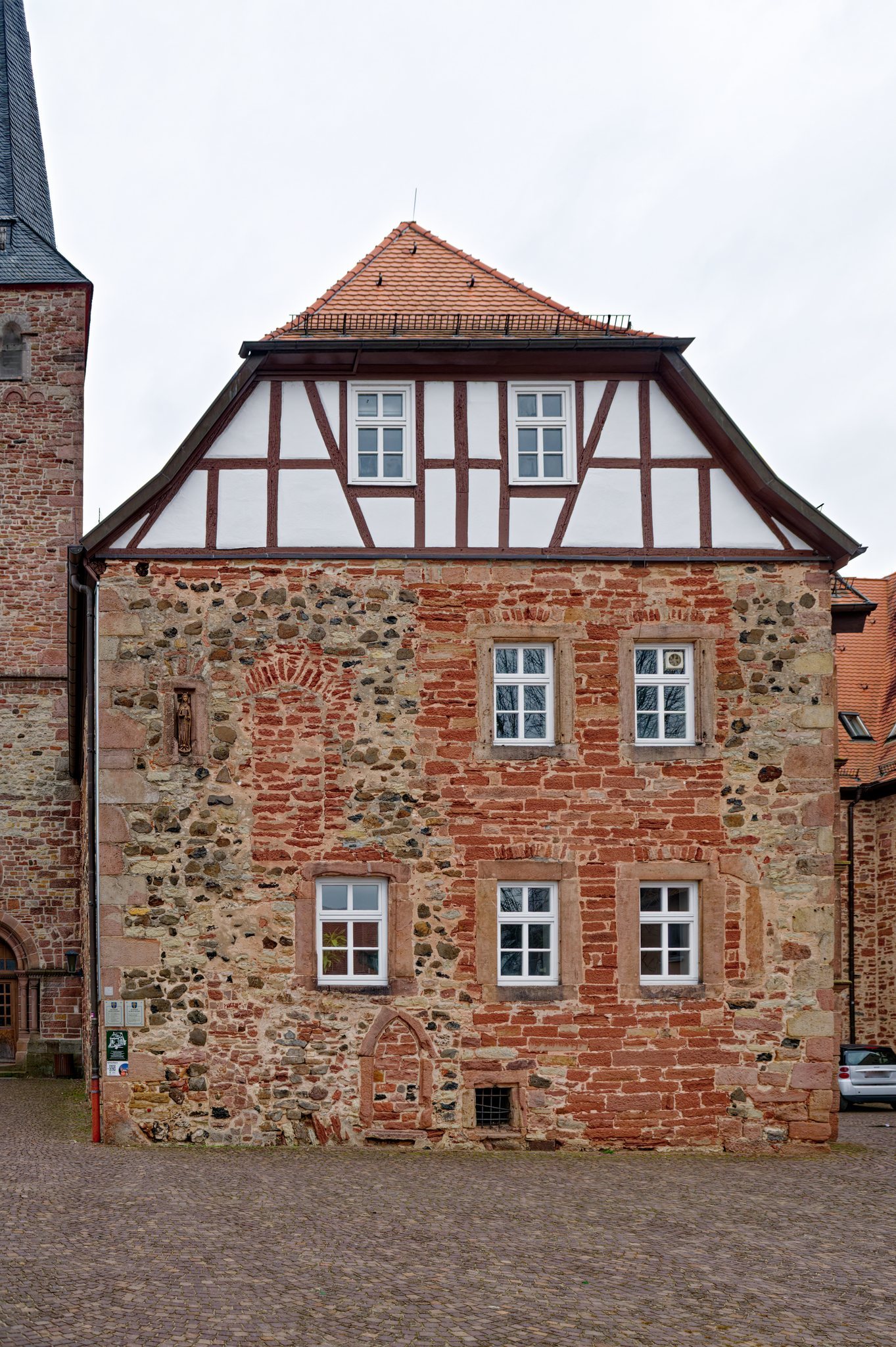
The monastic church was destroyed during the Seven Years’ War of 1756 to 1763, a major European conflict involving several great powers, and its choir was demolished in 1820. In 1836 a teachers’ seminary, an institution for training schoolteachers, was installed in the complex. The conversion caused extensive alterations and damage to the medieval fabric, but it also avoided complete demolition and preserved many traces of the earlier buildings. The former monastery now houses the Ulrich-von-Hutten-Gymnasium and the Church Music Academy of the Evangelical Church of Kurhessen-Waldeck. The complex is recognized as a historic monument of Hesse and remains an important archaeological ground monument, although later school extensions have substantially affected the monastery grounds. St. Michael’s Church is used by the Evangelical parish of Schlüchtern within the Kinzigtal church district.
Remains
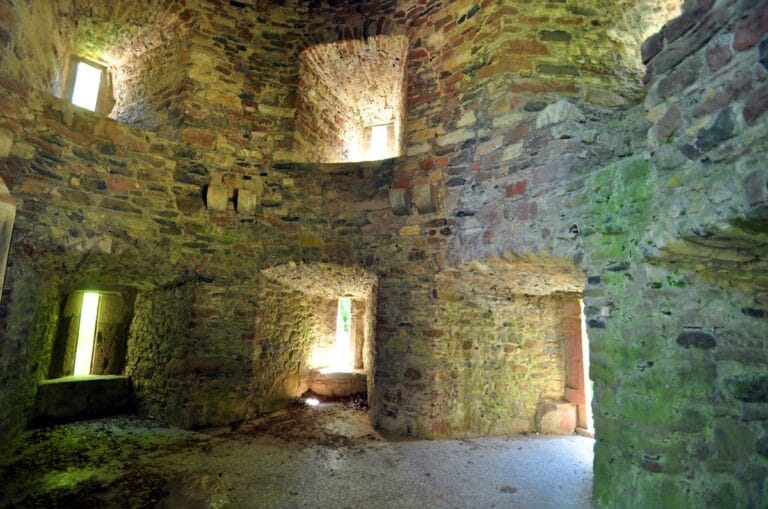
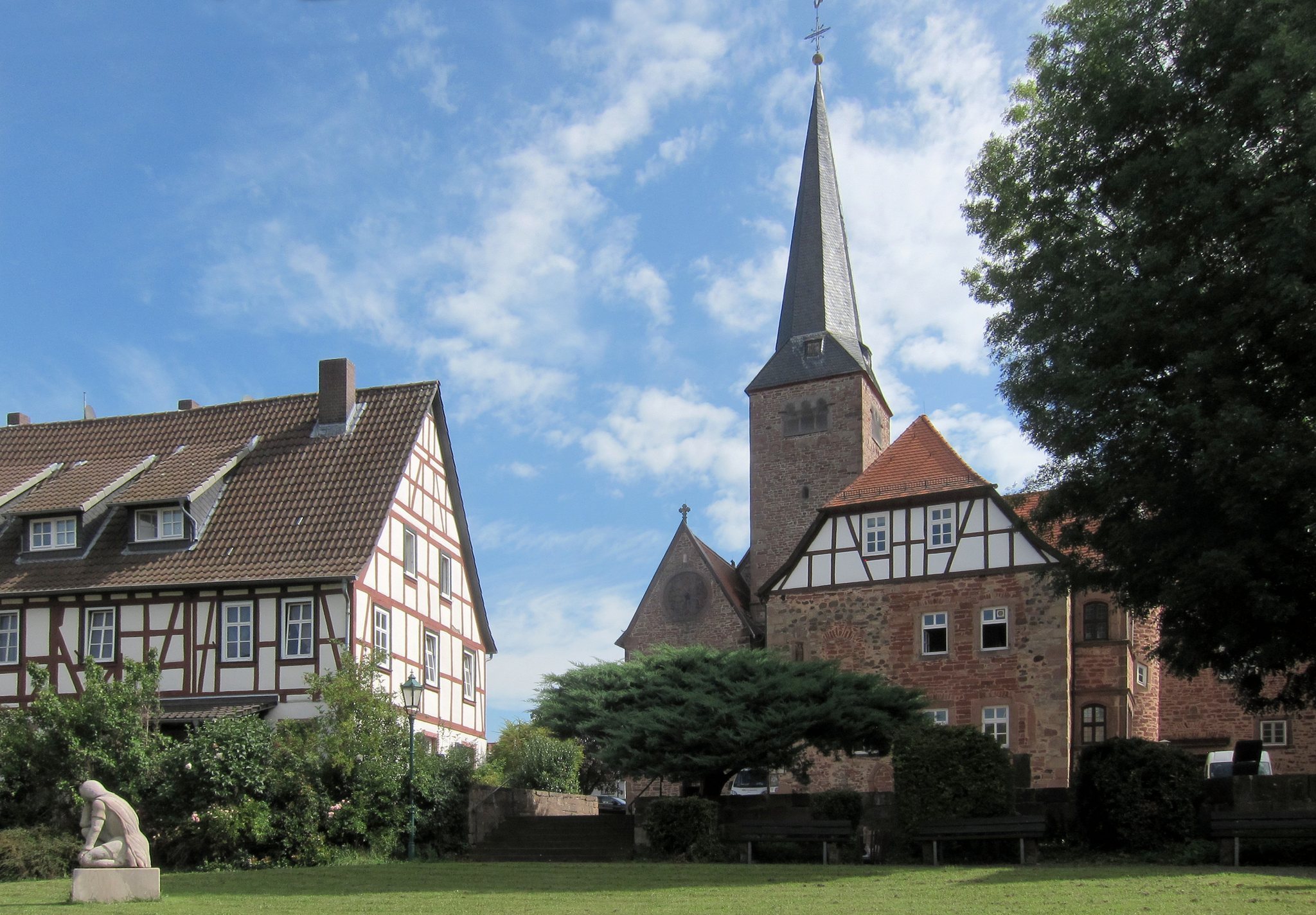
The surviving complex brings together early Carolingian, Romanesque, Gothic, Renaissance, and later historicist fabric. Its principal remains are organized around the former monastery church and cloister, with the oldest surviving element in the church’s western crypt. Medieval foundations, reused architectural elements, chapels, tower fabric, and later alterations reveal the building’s repeated reconstruction.
Church and chapels
Carolingian crypt and early church
The western section of an early Carolingian crypt is the oldest surviving part of the complex. A crypt is a vaulted space associated with a church choir that could serve worship or burial. The design is related to comparable structures at the Benedictine monastery of Petersberg near Fulda and at the Einhard Basilica in Michelstadt-Steinbach. Archaeological evidence indicates that the Carolingian church was a three-aisled building.
Romanesque and Gothic extensions
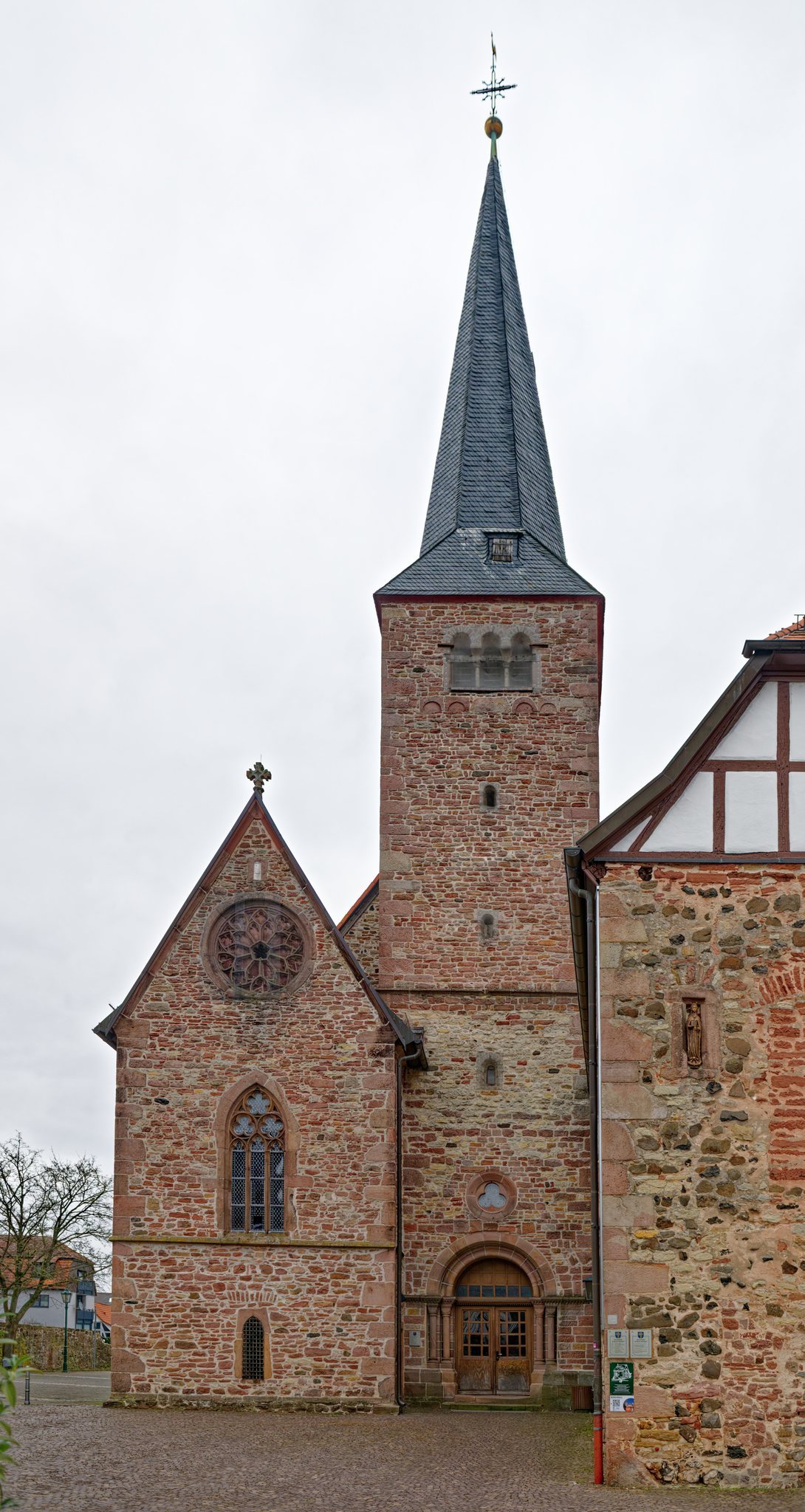
In the eleventh century the church was extended westward in the Romanesque style, characterized by rounded arches and massive construction, and ended in a tower. The tower was later rebuilt in Gothic form, with older architectural elements reused in its fabric. The Catherine Chapel was also built in the eleventh century as a western continuation of the south aisle. Its grave slabs include those of Tamburg von Hutten, who died in 1354, and Abbot Petrus Lotichius, who died in 1567.
At the beginning of the thirteenth century, the church was extended eastward. A barrel-vaulted niche created a new eastern end for the crypt, the choir was lengthened, and the side-aisle choirs were converted into side chapels. The northern chapel, known as the Andrew Chapel, survives. Remains of the thirteenth-century choir wall, including pilasters and rounded-arch friezes, are incorporated into the otherwise Gothic northeastern tower.
Hutten Chapel and Gothic hall church
In the mid-fourteenth century the north aisle was extended westward by the two-story Hutten Chapel. Frowin von Hutten and his wife Tamburg founded the chapel. During the first half of the fifteenth century, most of the nave was demolished and replaced by a Gothic hall church, a church in which the central and side aisles have broadly similar height. It was consecrated in 1446. Some nave pillars reused Carolingian foundations, and the northeastern tower was built during the same period.
Another Gothic chapel was incorporated into the later west wing of the cloister. Recorded burial places connected with the former monastery include Margarethe von Ebersberg, who died in 1356; Frowin von Hutten, who died in 1377; Rabe von Hutten, who died in 1529; Abbot Christian Happ, who died in 1534; Count Albrecht von Hanau, who died in 1614; Katharina von Hutten, who died in 1617; and Kunigunde von Trümbach, who died in 1621, as well as Tamburg von Hutten and Petrus Lotichius.
Cloister and monastery buildings
Renaissance rebuilding
Most of the monastery buildings were rebuilt between 1508 and 1519 in the Renaissance style, which revived classical forms. The west front has a richly designed stepped gable and a round stair tower. An oriel was added in 1583. The cloister is the covered passage surrounding a monastic courtyard, and a Gothic chapel was incorporated into its later west wing.
Kitchen and later alterations
The well-preserved monastery kitchen is reached from the southwest corner of the cloister. It has a groin vault and its own well. During the nineteenth-century conversion into a teachers’ seminary, intermediate ceilings were inserted into the church, medieval window openings were blocked, and new openings were cut into the walls to meet the institution’s requirements. Parts of the complex were also altered in historicist forms. The west tower, for example, received a Neo-Romanesque portal.