Fyodorovskaya Church: A Russian Orthodox Parish Church in Yaroslavl
Site at a Glance
- Rating
- 4.8
- Popularity
- Low
- Country
- Russia
- Primary era
- Early Modern
- External website
- Open
- Eras represented
- Early Modern, Modern
- Civilizations
- Russian
- Site type
- Religious
- Remains
- Church
On this page13 sections
History
Fyodorovskaya Church is a Russian Orthodox parish church in Yaroslavl, Russia, built between the early 1680s and 1687 in the mature Yaroslavl architectural tradition. It stands in the Tolchkovo settlement on the right bank of the Kotorosl River and originated as part of the former Nikolo-Pensky parish. Today it belongs to the Fyodorovskaya Bishop’s Metochion, a subsidiary ecclesiastical compound administered by a bishop or church institution, and remains an active church of the Yaroslavl Eparchy, the Orthodox ecclesiastical diocese of the region.
Foundation and consecration
An eighteenth-century parish chronicle connects the church’s foundation with Ivan Pleshkov, a local resident who became seriously ill in 1669. After experiencing a vision, he travelled to Kostroma to venerate the Feodorovskaya Icon of the Mother of God, a revered Orthodox image of Mary associated with Kostroma and traditionally linked with the Romanov dynasty. Pleshkov commissioned a copy from the prominent Kostroma icon painter Guriy Nikitin. The image was brought to Yaroslavl by boat, and several healings were associated with its arrival and veneration.
The construction site was donated on 27 September 1683 by Ivan Moiseev Denisovsky from his household property. Pleshkov placed a large stone found in a field into the foundations. Parishioners selected the Church of the Ascension as their principal model, dug the foundation trenches, drove in oak piles, and laid the rubble foundation themselves. Professional masons were hired after this work was complete, while Rodion Leontiev Eremin financed the building once the walls had reached window level. Construction is generally dated from 1682 or 1683, and the church was consecrated on 24 July 1687 with the blessing of Metropolitan Jonah Sysoevich.
The church was therefore a collective undertaking of the Nikolo-Pensky parish. Many of the parishioners were local leatherworking craftsmen, whose labor and contributions shaped the building and its early furnishings. The parish chronicle also preserves episodes from the community’s life, including the theft of church property in 1707 and the pilgrimage of the leatherworker Matvey Nechaev to the Church of the Holy Sepulchre in Jerusalem.
Parish development in the eighteenth and nineteenth centuries
The church continued to expand after its consecration. A stone church dedicated to Saint Leo of Catania was reportedly built in 1709 over the graves of members of the Eremin family, with the blessing of Demetrius of Rostov, an Orthodox bishop and religious writer later venerated as a saint. The southern chapel dedicated to the Tikhvin Icon was added in 1776 by the merchant I. Ya. Kuchumov in memory of the Feodorovskaya Icon brought from the Dormition Cathedral.
During the nineteenth century, the parish maintained a church board and a school. Battalions of military cantonists, state-supported soldiers’ children, were attached to the church until 1834. A pond was dug to its west. In 1884 N. N. Sveshnikov built a chapel beside the southern side of the enclosure for an old large icon of the Feodorovskaya Mother of God. A second chapel, dedicated to Saint Nicholas of Myra, was consecrated six years later. Neither chapel survives.
Soviet closure and ecclesiastical revival
During the Soviet period, Fyodorovskaya Church was closed and looted. From 1946 to 1986, the building was adapted for housing and used to store materials, changing both its institutional status and its practical use. The church was returned to the Russian Orthodox Church in 1987.
From 1987 until the consecration of the reconstructed Dormition Cathedral in 2010, Fyodorovskaya Church served as the cathedral of the Yaroslavl and Rostov Veliky Eparchy. A cathedral is the principal church of an eparchy and contains the bishop’s seat. Restoration of the wall paintings and iconostasis began during this cathedral period, although the work remained incomplete. A new brick baptistery dedicated to Equal-to-the-Apostles Vladimir was consecrated at Christmas in 1999.
Two years after the reconstructed Dormition Cathedral was consecrated, the relics of Saints Theodore the Black, David, and Constantine were transferred from the Yaroslavl Museum-Reserve to Fyodorovskaya Church. In 2011 they were moved to the new cathedral, while fragments remained associated with Fyodorovskaya Church. The complex continues to include a bishop’s residence and the graves of Yaroslavl bishops, including John and Micah. The church is a federally significant cultural-heritage monument of the Russian Federation.
Remains
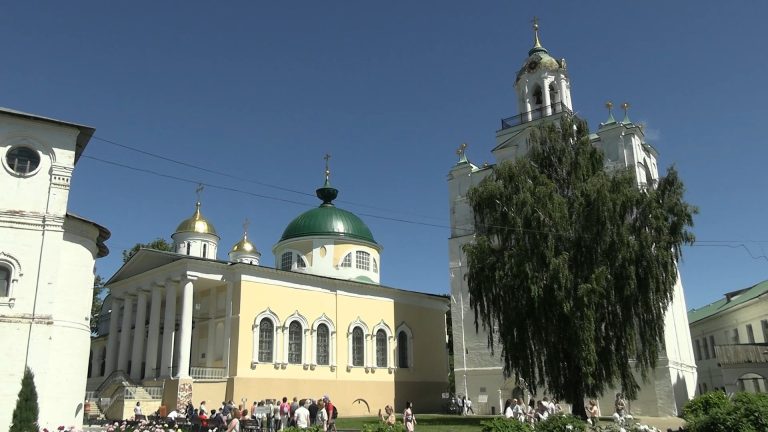
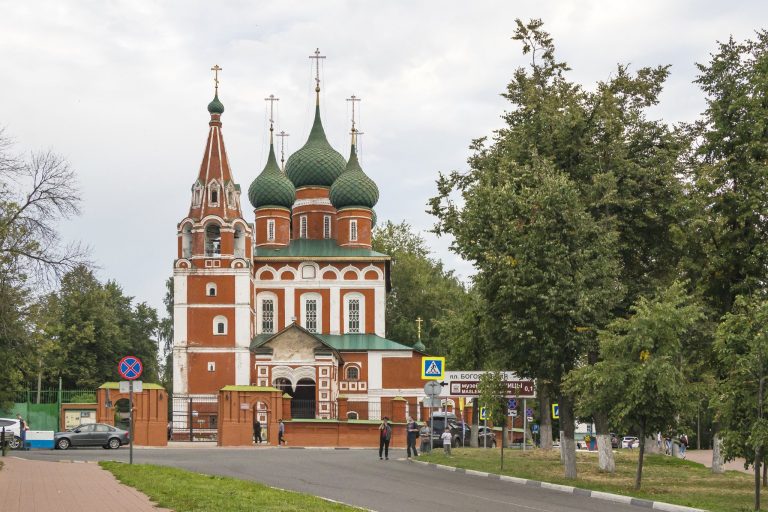
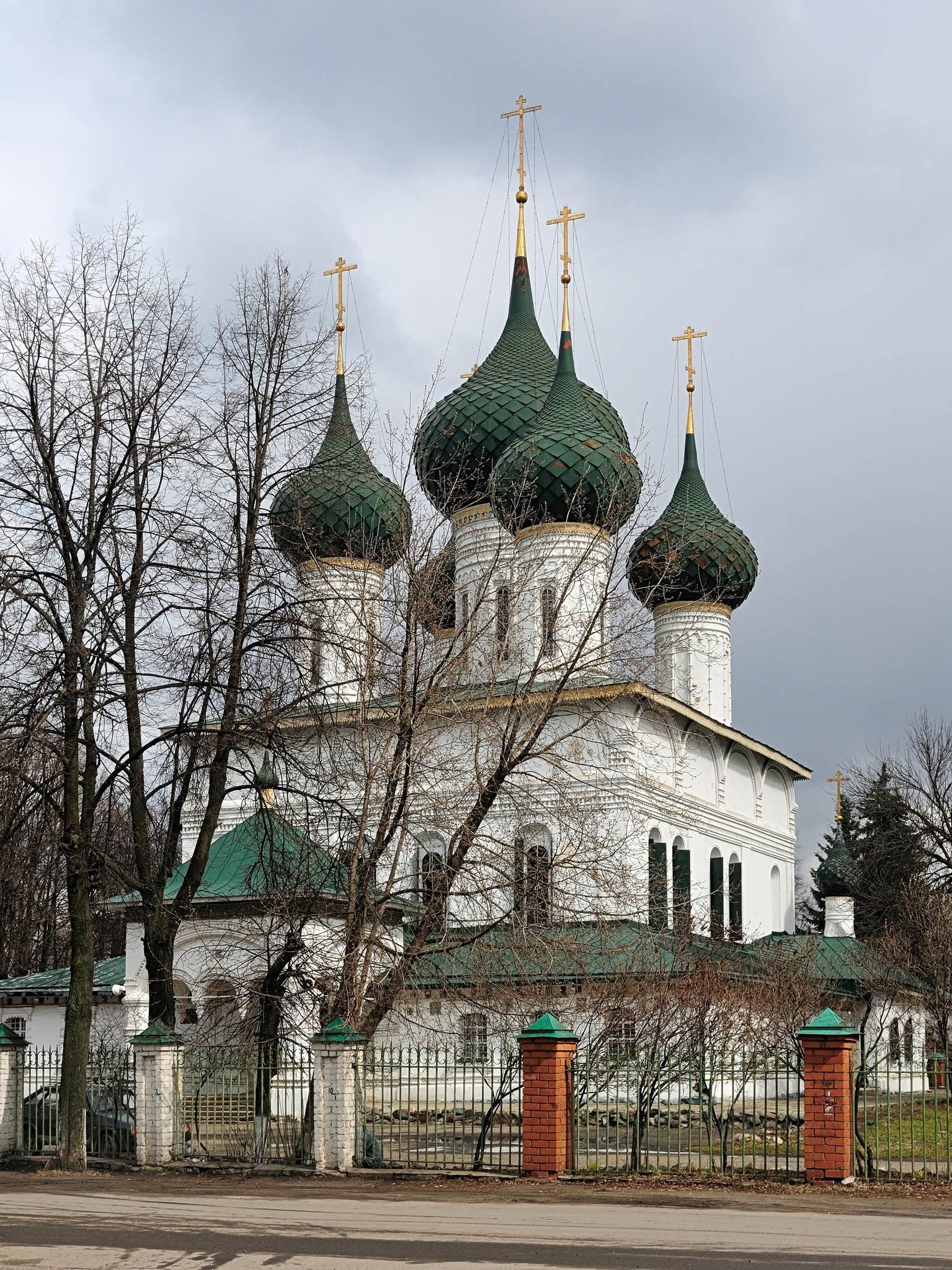
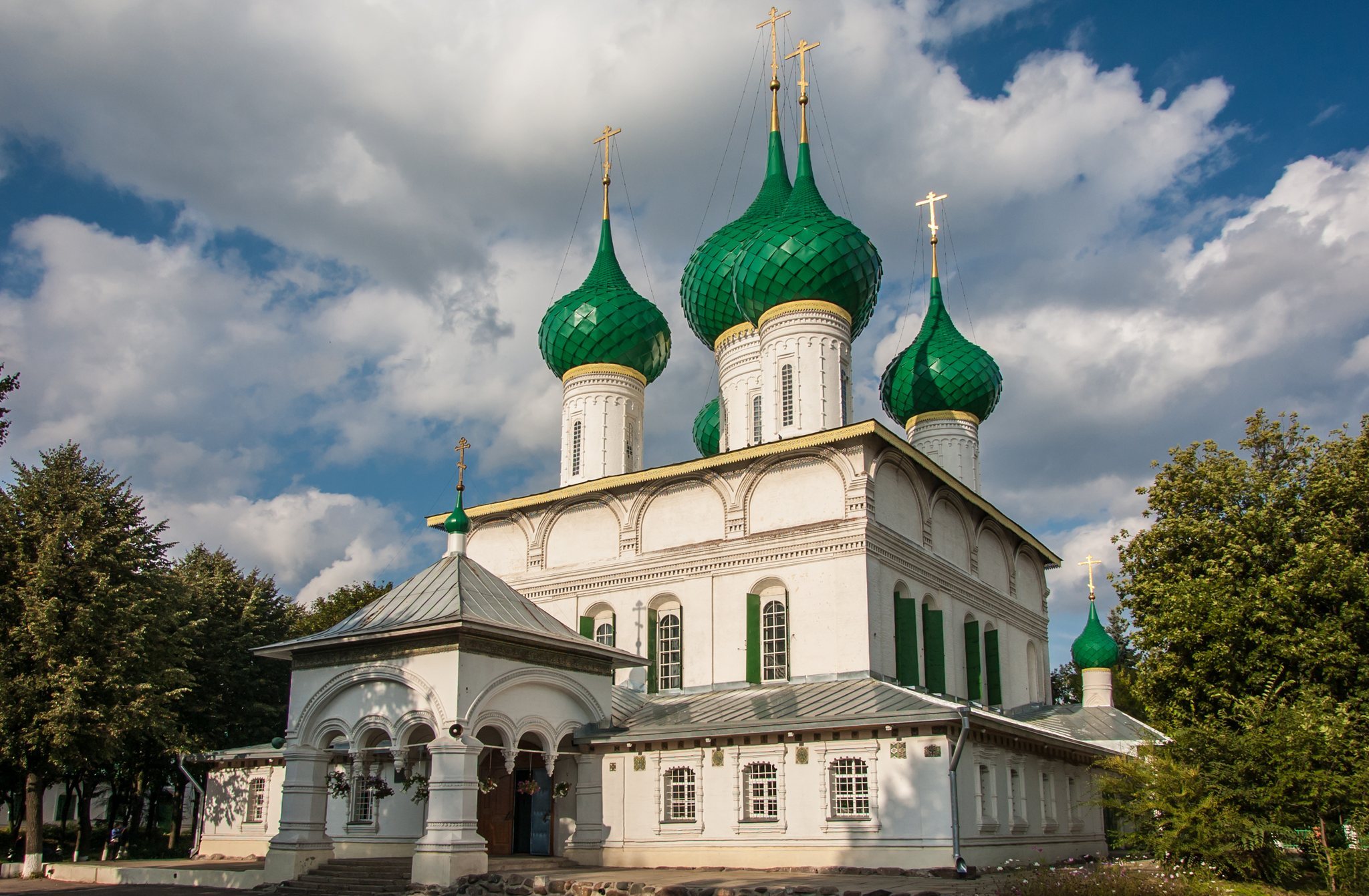
Fyodorovskaya Church is a brick, four-pier building organized around a large central cube measuring approximately 18 by 24 metres. Five domes rise above its restrained main body, while the enclosed compound also contains the neighboring Nikolo-Pensky Church, its bell tower, and a modern baptistery. The church’s austere walls, elaborate upper brickwork, decorated drums, and onion domes combine into a distinctive silhouette characteristic of late seventeenth-century Yaroslavl architecture.
Main church building
Exterior and roof
The main body of the church is about 14 metres high. Its drums and onion domes reach approximately 22 metres without the crosses, and the total height is about 36 metres. Pilasters on the exterior mark the four-pier structure inside. The arched windows originally had no surrounding frames, while blind arches and a complex belt of projecting brick courses run around the upper walls.
The four-slope roof makes the zakomaras, curved gable-like forms traditionally following the shape of a roof vault, purely decorative. They do not correspond to the pilasters and instead rest on an elaborately profiled brick belt. The tall decorated drums and domes contrast with the severe central cube, giving the building its graceful vertical emphasis.
Entrances and galleries
The original church was entered from the west, north, and south through small porches. These were dismantled in the early eighteenth century, when low covered galleries were built around the central cube. In 1736 a tall western porch with a triple arch and a band of ceramic tiles was added. The same period brought a spacious vestibule and gallery.
Interior furnishings and paintings
The church has two altars and two iconostases. An iconostasis is the screen separating the sanctuary from the main worship space in an Eastern Orthodox church, and its Royal Gates are the central doors leading toward the altar. The existing iconostasis was commissioned in 1705. Vasily Komar and other peasants from the nearby village of Mikhailovskoye carved its columns and Royal Gates, while Stepan Vorona and his associates made the icon cases.
Before the consecration, parishioners supplied the iconostasis with icons, including 67 brought from Tolga Monastery. Its imagery uses complex calendar and cosmological symbolism. A large composition called the “Image of the Fatherland,” surrounded by nine orders of angels and saints arranged through the twelve months, is now preserved in the Yaroslavl Museum-Reserve. Guriy Nikitin painted the image of Christ Pantocrator and the image of the Saviour placed to the right of the Royal Gates. The Yaroslavl painter Ilarion Sevastyanov, known as Bashka, painted the icons of the Trinity and Saint Nicholas the Wonderworker.
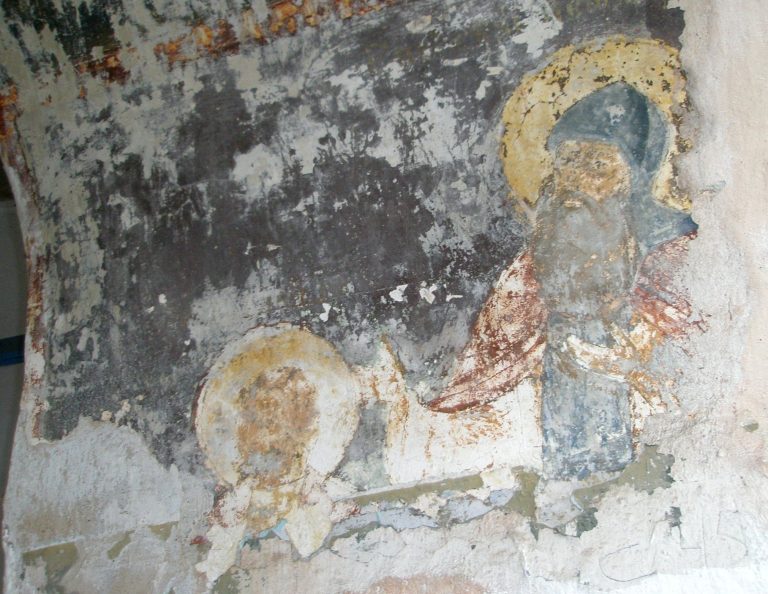
Wall paintings were commissioned in 1715 from the icon painters Fyodor Ignatiev and Fyodor Fyodorov and their assistants. They were completed on 28 June 1716. Much of the surviving fresco program concerns the history and miracles of the Feodorovskaya Icon, the glory of the Mother of God, and miraculous military victories. Scenes show the icon’s appearance on a pine tree, victory over Batu Khan, the Mongol ruler who founded the Golden Horde in the thirteenth century, the burning of Kostroma during the Mongol wars, the saving of Moscow from Tamerlane, the Lithuanian siege of the Kiev Pechersk Monastery, and the liberation of Constantinople. The paintings are notable for their detailed treatment and include a depiction of the Crucifixion of Saint Peter. Damage during the Soviet period affected both the frescoes and the iconostasis, and restoration has remained partial.
Devotional and liturgical objects
The central devotional image is the Feodorovskaya Icon, a copy of the miraculous Kostroma image associated with the church’s foundation and identity. A large historic version was formerly kept in the southern chapel built for it. The church also received valuable liturgical furnishings. Among them was a silver ladle donated by Rodion Eremin, a gift from Tsars Ivan and Peter Alexeyevich dated 25 January 1686. Its base bears a double-headed eagle, while a pelican feeding its young appears on the handle. Other furnishings included embroidered altar cloths, a shroud, and a Gospel in a silver binding dated 1697. Nikifor Yakovlev of the Romanov district made the church’s bells and clock.
Enclosure and associated buildings
Parish gates and almshouse
The Holy Gates of the parish enclosure were built at the expense of Joseph Eremin in 1714. A stone almshouse was constructed in the same year, and a register from 1717 listed 16 male and 39 female residents. These buildings formed part of the wider parish compound around the church.
Nikolo-Pensky Church and baptistery
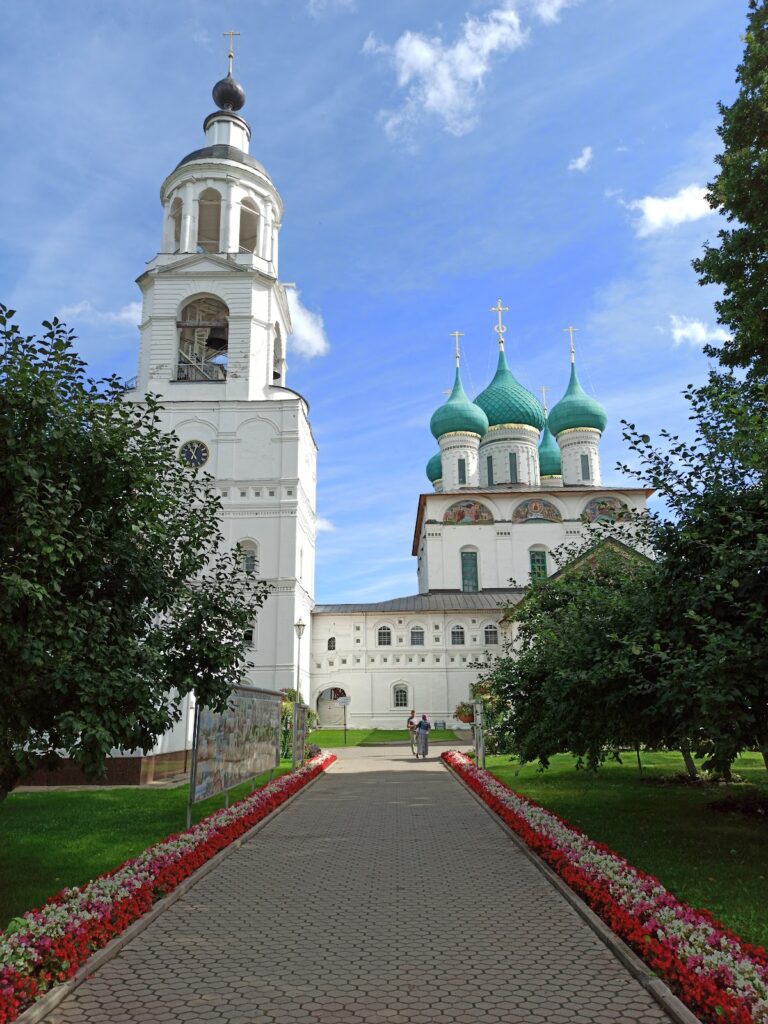
The enclosed complex includes the warm Nikolo-Pensky Church, which served as the winter church of the former parish, together with its bell tower. It also contains the modern single-dome baptistery dedicated to Equal-to-the-Apostles Vladimir. A city hospice was built opposite the baptistery. The complex further preserves the graves of several Yaroslavl bishops and fragments of the relics of Saints Theodore the Black, David, and Constantine.