Assumption Cathedral in Smolensk: Cathedral of the Smolensk Bishopric
Site at a Glance
- Rating
- 4.8
- Popularity
- Low
- Country
- Russia
- Primary era
- Early Modern
- External website
- Open
- Eras represented
- Early Modern
- Civilizations
- Russian
- Site type
- Religious
- Remains
- Cathedral
On this page16 sections
History
Assumption Cathedral in Smolensk, Russia, is an Eastern Orthodox cathedral built on the site of a stone church founded in 1101 by Vladimir Monomakh, the grand prince of Kievan Rus and a major patron of stone church construction. Standing on Cathedral Hill, it became the principal church of the Smolensk bishopric and later the cathedral of the Smolensk Metropolitanate. For about 800 years, it has served as the diocesan center of Smolensk.
The medieval cathedral
The first stone cathedral on the site was the only stone church in Smolensk for almost half a century. Its construction marked the beginning of monumental architecture in the Principality of Smolensk. The building was complete by the establishment of the Smolensk diocese in 1136 or 1137, when Manuel the Greek became its first bishop and the cathedral became the diocesan cathedral.
Further work took place during the rule of Rostislav Mstislavich, Vladimir Monomakh’s grandson and a twelfth-century prince of Smolensk. The cathedral was reconsecrated in 1150, possibly after this expansion. Archaeological research later showed that the medieval building had been erected in more than one phase. Thin bricks found around the present cathedral belong to two distinct groups. The earlier group is associated with Vladimir Monomakh’s construction, while the later group, which makes up more than 70 percent of the finds, resembles bricks from the Cathedral of Boris and Gleb at Smadyń Monastery, founded under Rostislav in 1145.
Vladimir Monomakh brought an icon of the Mother of God from Chernigov. He had inherited it from his mother, and it became known as the Smolensk Icon of the Mother of God. The icon remained in the cathedral until it disappeared during the German occupation in 1941.
The cathedral also had a practical role in the city’s commercial life. During the thirteenth and fourteenth centuries, the bishop kept one of Smolensk’s two standard wax poods there. A pood was a traditional Russian unit of weight, while a wax pood served as a recognized standard for the trade and assessment of wax.
Destruction and rebuilding
The cathedral suffered severe damage during the siege of Smolensk from 1609 to 1611, a military struggle in which the city resisted Polish and Lithuanian forces during the period of political conflict known as the Time of Troubles. An ammunition store in or near Cathedral Hill exploded, bringing down part of the building and burying many women and children in the ruins. A later tradition says that surviving defenders deliberately ignited the powder on 3 June 1611, but both the cause of the explosion and the identities of those killed remain uncertain.
Polish and Lithuanian authorities restored the damaged cathedral, which then became the seat of an archbishop of the Russian Uniate Church. This Eastern Christian church retained Byzantine worship while recognizing the authority of the Roman Catholic Church. After Smolensk returned to the Russian state under the peace settlement of 1667, the cathedral was inspected for urgent repairs. Its old bricks had deteriorated too far for reuse, and the medieval building was completely dismantled between 5 May and 13 July 1674.
A new cathedral was begun in 1677 under the supervision of the architect Alexei Korolkov. Work stopped in 1679 and did not resume until 1732. The building was completed in 1740, commemorating Smolensk’s defense during the siege of 1609 to 1611. The identity of the architect responsible for the completed cathedral is uncertain. In 1924, the local historian S. D. Shiryaev attributed a role to Anton Shedel, but no other evidence connects Shedel with the work.
In 1761, the central and western cupolas collapsed. Pyotr Obukhov rebuilt the upper part of the cathedral between 1767 and 1772, preserving its traditional five-domed arrangement. He also designed the bell tower that forms part of the cathedral ensemble.
War, occupation, and later use
Smolensk was drawn into the fighting during Napoleon’s invasion of Russia in 1812. The cathedral reportedly escaped damage even though combat took place around it. Impressed by the building, Napoleon ordered guards to protect it and, according to local tradition, threatened to kill any soldier who stole from the cathedral. The iron helmet associated with Saint Mercury of Smolensk disappeared during the occupation.
When German forces entered Smolensk in 1941, the central and left parts of the cathedral were used for an anti-religious museum, while worship continued in the right half. The building was found intact at the beginning of the occupation, although valuable furnishings had been gathered inside and needed protection. The original Smolensk Icon of the Mother of God disappeared during this period, as did the spear associated with Saint Mercury.
Assumption Cathedral now functions as an Orthodox place of worship. It is also a federally significant cultural-heritage property of the Russian Federation. Excavations and architectural study have clarified the relationship between the medieval cathedral and the later building, while the surviving interior and ecclesiastical treasures preserve the cathedral’s continuing religious role.
Remains
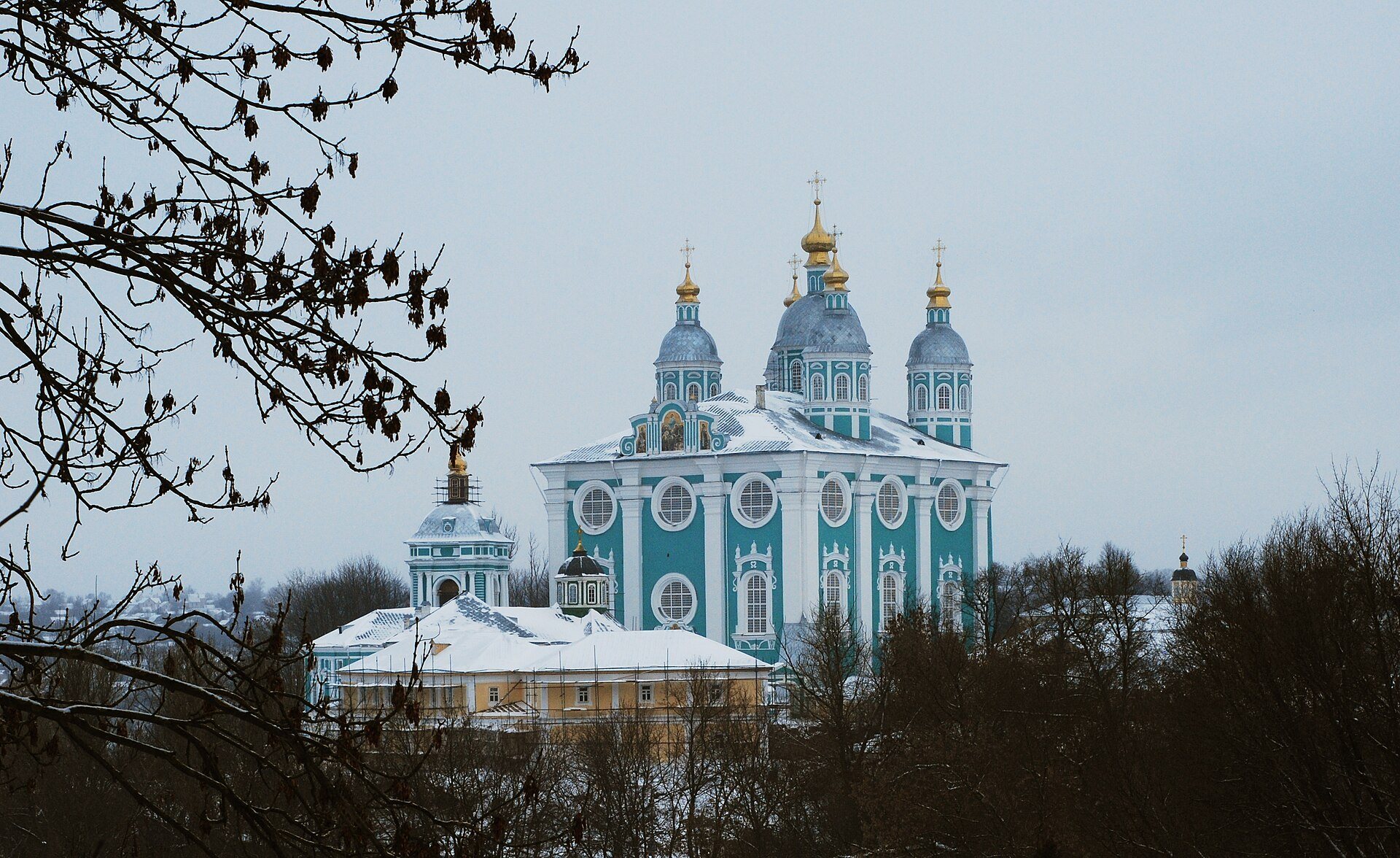
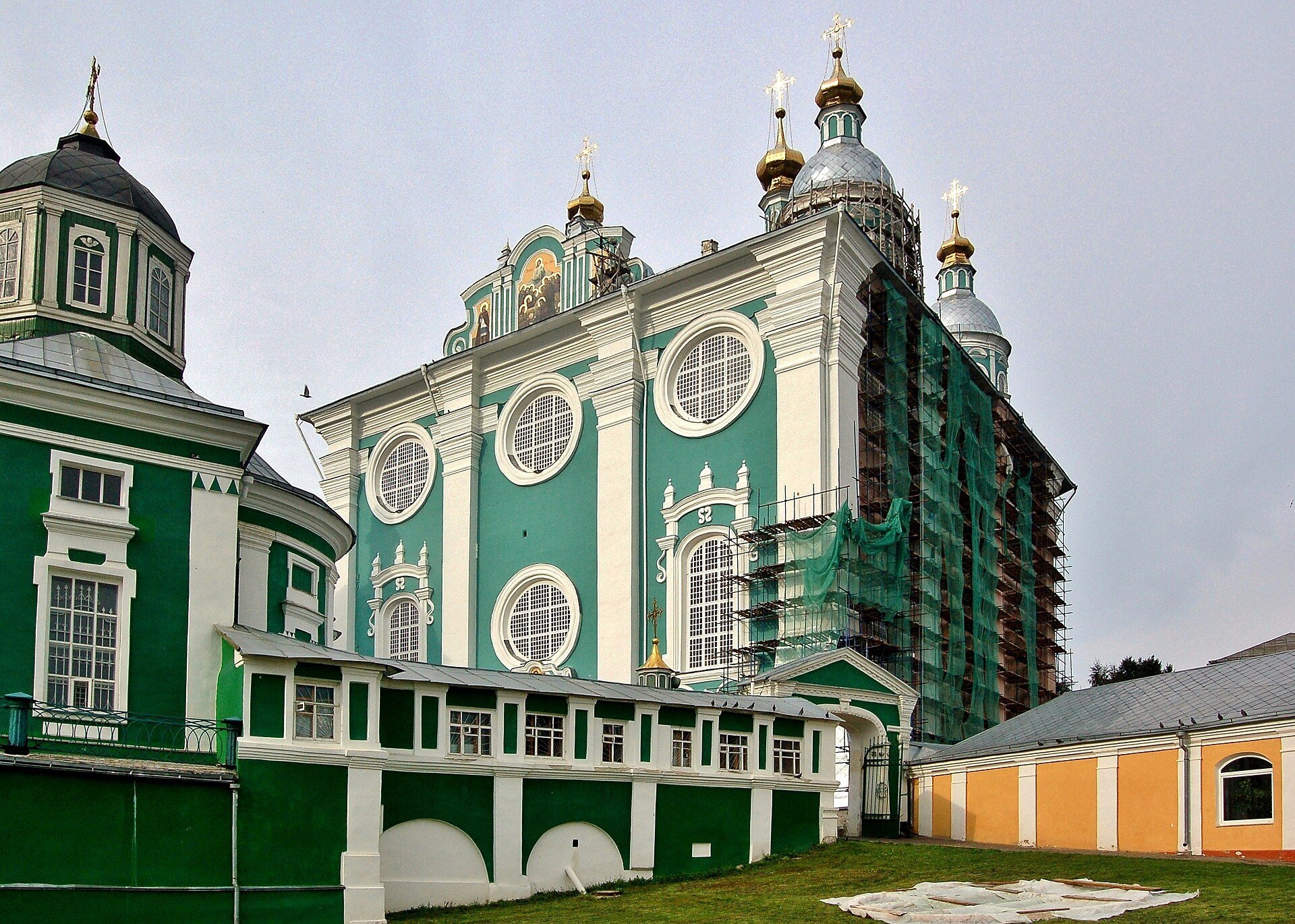
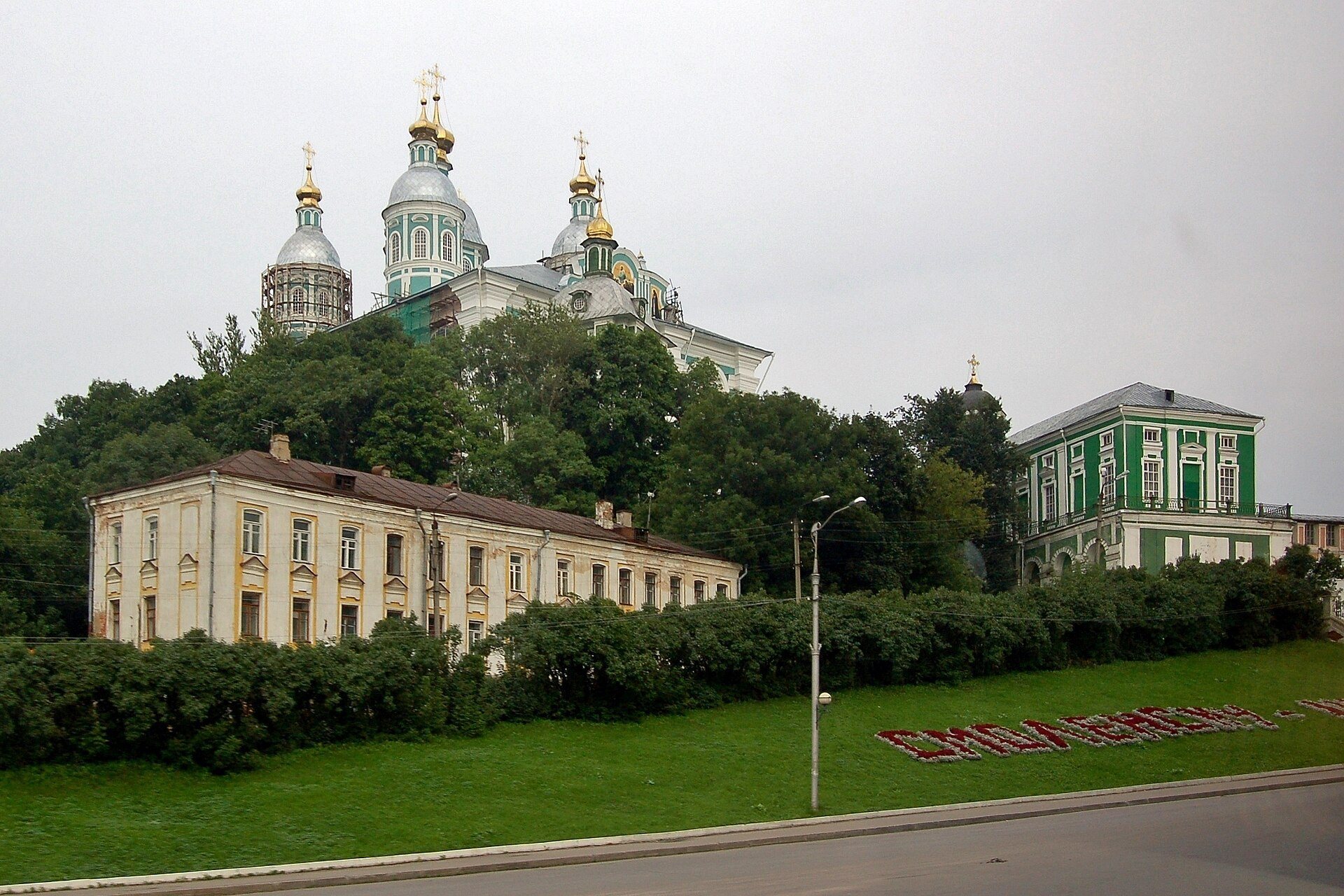
The cathedral occupies the central part of Smolensk on Cathedral Hill, southeast of the Church of the Annunciation. Built of brick, the present structure belongs to the late seventeenth- and eighteenth-century rebuilding campaign. Its exterior is described as Russian Baroque, a regional form of Baroque architecture developed in Russia, while much of its surviving interior follows the related Kiev Baroque style.
The cathedral building and interior
Main cathedral
The medieval cathedral was a large six-pillared church, and the present building follows the same six-pillared arrangement. Its enlarged design placed the tall apses, the rounded or polygonal eastern ends of the sanctuary, apart from the main volume of the church. The building was initially crowned by seven blue cupolas decorated with golden stars. After the reconstruction of 1767 to 1772, it retained five domes in the traditional arrangement.
Iconostasis and sanctuary
The principal altar is dedicated to the Dormition, also called the Assumption, the Eastern Christian feast commemorating the death and glorification of the Virgin Mary. A five-tier iconostasis, the decorated screen separating the sanctuary from the main worship space, rises nearly to the full height of the interior. It was made by a carving workshop led by S. Trusitsky, with P. Durnitsky, F. Olitsky, and S. Yakovlev. The screen combines icons with gilded carved wood, cherub figures, and columns entwined with vine branches. Its icons were renewed more than once, and the cathedral interior was painted in the Baroque style during the 1740s.
Archaeological remains
Excavations around the present cathedral in 1965 revealed numerous remains of the medieval building. The finds included thin, flat bricks known as plinth bricks, construction marks, and stamps. The bricks formed two materially and geometrically distinct groups. One corresponds to the early twelfth-century work associated with Vladimir Monomakh, while the other relates to the later construction carried out under Rostislav.
Cathedral ensemble
Church of the Epiphany
The gateway Church of the Epiphany was built between 1785 and 1787. Its upper section was completed in wood, allowing services to be held there during the cold season. The church forms part of the architectural ensemble surrounding Assumption Cathedral.
Bell tower
The bell tower dates from 1767 to 1772 and was designed by Pyotr Obukhov during the same period in which he rebuilt the upper part of the cathedral after the collapse of its central and western cupolas.
Bishop’s court
South of the cathedral is the bishop’s-court complex, which includes the Church of Saint John the Baptist. That church was built between 1699 and 1703 and rebuilt in the 1780s, preserving a separate part of the ensemble’s late seventeenth- and eighteenth-century development.
Relics and treasures
Saint Mercury of Smolensk
The cathedral contains the relics of Saint Mercury of Smolensk, regarded as the heavenly patron of the city. His surviving iron sandals are displayed there. The cathedral is also associated with an iron spear and an iron helmet connected with his veneration. The spear disappeared during the German occupation, while the helmet was later reported missing.
Smolensk shroud
The Smolensk shroud, made in 1561 in the workshop of the Staritsky princes, is preserved as one of the cathedral’s major treasures. It measures 177 by 277 centimeters and is distinguished by its age, detailed decoration, and workmanship.