Flixton Priory: An Augustinian Nunnery in Suffolk
Site at a Glance
- Rating
- 4.6
- Popularity
- Very Low
- Country
- United Kingdom
- Primary era
- Medieval
- Eras represented
- Medieval
- Civilizations
- English
- Site type
- Religious
- Remains
- Monastery
On this page14 sections
History
Flixton Priory was an Augustinian nunnery in Flixton, United Kingdom, founded in 1258 by Margery de Creke for women living under the Rule of Saint Augustine, a medieval religious code based on teachings attributed to Saint Augustine. The house was dedicated to God, Saint Mary, Saint Katherine, and All Saints, and was governed by a prioress. Its foundation formed part of the religious and landholding history of South Elmham, on the plateau above the River Waveney valley.
Foundation and endowment
Margery gave the whole manor of Flixton, inherited through her family, to establish the community. She intended the foundation to benefit herself, her parents Geoffrey de Hanes and his wife, her deceased husband Sir Bartholomew de Creke, her children, and other relatives. Her eldest son and heir, Robert de Creke, consented to the arrangement. A licence issued in 1256 by Robert, son of Sir Robert de Tateshal, had already permitted Margery to establish a religious house on her Flixton estate.
Alianora became the first prioress, and the foundation was limited to a prioress and 18 nuns. Bishop Simon de Wanton, elected in 1257 and consecrated in 1258, assisted Margery during the priory’s early benefactions. Bishop Roger Skerning later confirmed the foundation. Flixton lay within the historic group of parishes known as The Saints in South Elmham, while the moated episcopal palace at St Cross stood about two miles to the south. The area had formed part of the Bishop of East Anglia’s feudal possessions recorded in Domesday Book in 1086. A possible connection between the name Flixton and Saint Felix, the first known bishop of the East Anglian see at Dommoc, provided a further historical association, although the etymology remains uncertain.
Margery and other benefactors built the priory’s resources through grants of land, rents, churches, and rights of appointment. In 1260 Margery gave it a house, two carucates of land, and her half of the advowson of Flixton church. An advowson was the legal right to appoint a parish priest. Rannulf de Combs added 20 acres at Flixton, while the advowsons of Dunston and Shipmeadow came to the priory in 1264 and 1269. The house also acquired the advowsons of North Creake and Helmingham.
Around 1275 Margery granted a house, land, and the advowson of Combs church. In 1280 she placed the patronage of the priory with the Bishops of Norwich. Further grants and regrants followed family inheritances and escheats, including property in Flixton, Helmingham, Wilby, and North Creake, together with the advowsons of Dunston and Fundenhall. The priory also received the watermill at Flixton and a mill at Combs. In 1292 its recorded temporal possessions were valued at £43 18s. 2d., and it granted Adam de Walpole a free chantry at his manor chapel in Shipmeadow. A chantry was an endowed foundation supporting prayers or masses for particular souls.
Resources and episcopal oversight
The extinction of the main line of the de Creke benefactors, combined with the relatively small endowment, left Flixton among the poorest nunneries in the Diocese of Norwich. In 1310 the priory received permission to acquire land worth up to £10 a year because its rents and possessions could not adequately maintain the nuns.
In 1321 Bishop John Salmon exchanged his half of the Flixton advowson for the priory’s right at Helmingham. This united the two halves of the Flixton advowson and gave the priory the church’s appropriation, meaning that it received the church’s income and assumed responsibility for providing a vicar. Flixton acquired the church tithes and lands, as well as the former rector’s manse and croft, while becoming responsible for the chancel and the vicar’s support.
The priory’s financial difficulties continued during the Great Mortality, the fourteenth-century plague pandemic commonly called the Black Death. In 1348 it could not meet its tithes and other charges, so it received a two-year pardon. Many inhabitants of Dunston had died and its land had been left untilled. At the request of Henry of Grosmont, 1st Duke of Lancaster, the priory was therefore licensed to appropriate Fundenhall church.
Bishop William Bateman, patron of Flixton and a reforming Bishop of Norwich who also founded Trinity Hall, Cambridge, issued new statutes for the priory during the 1350s. By 1359 the community was stable enough to acquire houses and land in South Elmham and Flixton worth 46s. 4d. annually in mortmain. Mortmain was the holding of land by a religious or other corporate body, which required specific legal permission because the property did not normally pass through ordinary inheritance.
Community and later medieval administration
Flixton continued in an orderly manner despite its limited resources and apparently never restored the full number of nuns permitted by its foundation. A lay community lived within or around the precinct, and the obedientiary system, through which particular officers administered parts of the priory’s affairs, remained in use.
A dispute over the repair or rebuilding of Fundenhall church in 1370 brought the priory additional lands, houses, and rents in Stuston, Broome, Thrandeston, Oakley, and Great Yarmouth. These possessions supported a chaplain who celebrated a Monday service in the conventual church for the souls of the faithful departed. In 1381 Alice, widow of John Brakenest of Halesworth, took a vow of chastity at Flixton and received a corrody, a grant of maintenance such as food, lodging, or other provisions from a religious house.
By the early fifteenth century the community comprised 12 nuns and two chaplains, supported by domestic servants, craftsmen, agricultural workers, and other dependants. Several people also received corrodies. The succession of prioresses included Emma de Welholm, who served from 1301 until at least 1328, followed by Margery de Stonham, Isabel Weltham, Joan de Hemynhall, Joan Marshall, Margery Howell, Katherine Herward, Elizabeth Moor, Katherine Pilley, Maud Rycher, Mary Delanio, Cecilia Creke, Helen, Margery Artis, Elizabeth Virly or Isabella, Margaret Punder, and Elizabeth Wright. Katherine Pilley resigned in 1432 because she had become old and blind, and Bishop William Alnwick arranged rooms, food, fuel, candles, and assistance for her.
Decline and dissolution
By 1493 the community had declined to six nuns, including the prioress and sub-prioress. They were attending Flixton parish church instead of the conventual church because their priest had broken his arm, but the bishop found no reform necessary.
In 1514 eight nuns were involved in serious disputes over food, discipline, accounts, allowances, alms, obedience, and the prioress’s relationships. The bishop ordered John Welles, a relative of Prioress Margaret Punder, to leave the parish and never meet her again. By 1520 there were seven nuns. Complaints then concerned withheld provisions and fuel, treatment of sick sisters, the prioress’s sleeping arrangements, missing accounts, dogs, and suspected meetings between members of the community and men connected with the priory. The diocesan authorities ordered the prioress to keep only one dog and required Richard Carr to be sent away.
At the 1526 visitation, the sisterhood had fallen to six. The roofs of the refectory and cloister leaked. Flixton had earlier been listed for suppression by Thomas Wolsey in 1527–28, when he sought to use the resources of selected smaller religious houses for educational foundations at Oxford and Ipswich. The priory survived Wolsey’s fall and death, but it was later closed under the Suppression of Religious Houses Act 1535, part of Henry VIII’s dissolution of the monasteries.
Because its annual possessions were valued at less than £200, Flixton fell within the act’s provisions for smaller houses. Commissioners inventoried its vestments, altar cloths, silver and pewter vessels, furniture, livestock, hay, corn, and barley in August 1536. Elizabeth Wright surrendered the priory on 4 February 1536–37. The Crown granted the house and its holdings to Richard Wharton in July 1537, and John Tasburgh purchased the priory manor from him in 1544. Much of the masonry may already have been removed by that time.
Charters, deeds, manorial rolls, rentals, and related records preserve substantial evidence for Flixton’s history. Important groups include 84 charters formerly collected by Thomas Martin and Thomas Astle, now associated with the British Library’s Stowe and Carta Antiqua collections, a series in the Lord Frederick Campbell collection, and records among the Adair papers at the Suffolk Record Office. The site was scheduled as an ancient monument in 1953.
Remains
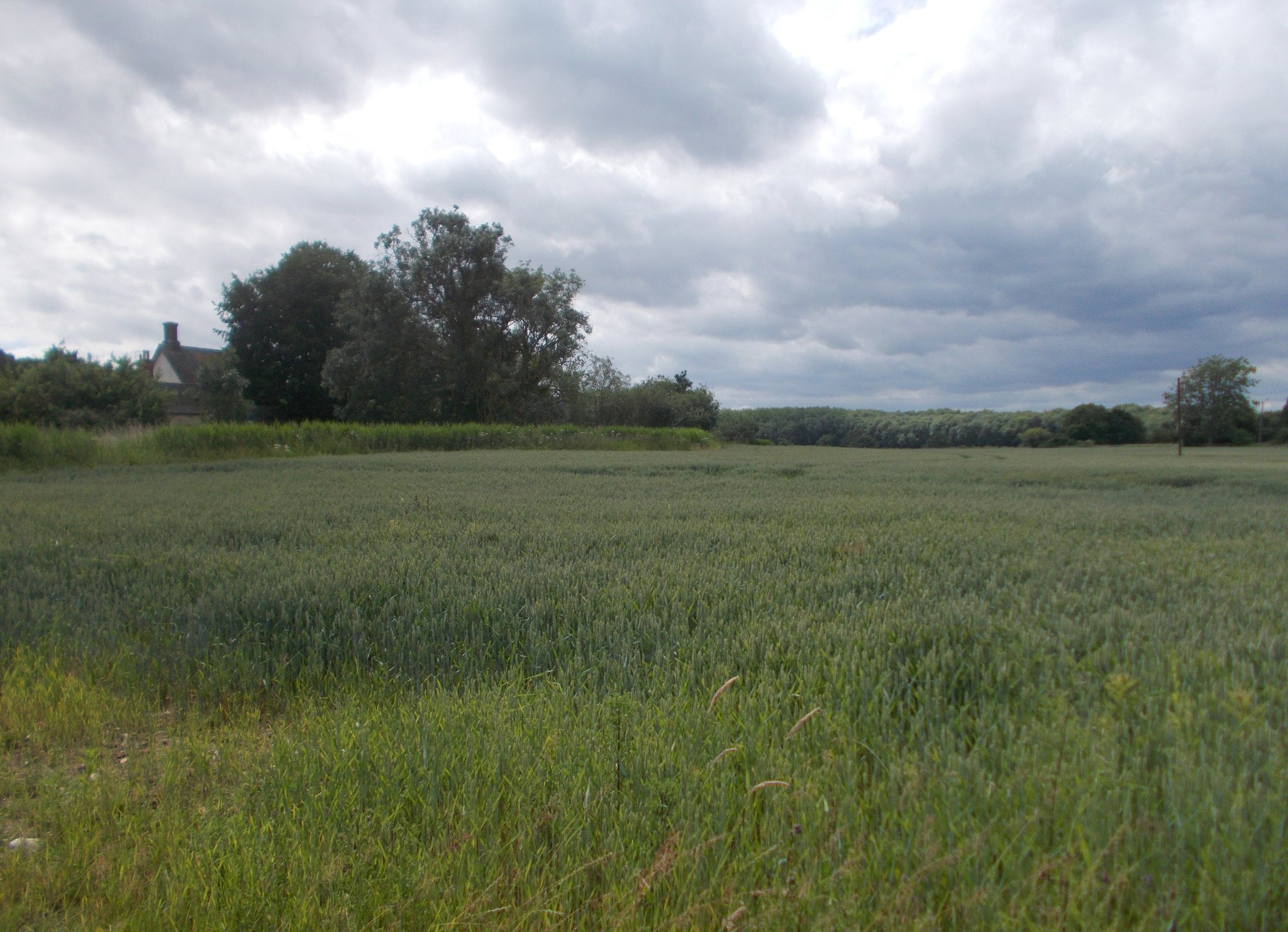
Flixton Priory occupied a roughly rectangular moated precinct at the present Abbey Farm. The surviving layout is defined chiefly by the moat, ponds, landscape position, buried building footings, and a small section of standing wall. The central buildings were arranged within the enclosure, with the church and farmhouse aligned east–west, the cloister to the south, and further ranges forming the conventual complex.
Moated precinct and water features
The northern arm of the moat, facing the lane from Flixton village, extends for about 110 metres and measures approximately 15 to 20 metres across. At its north-west corner it turns south for about 30 metres before ending. From the north-east corner, another channel about 10 metres wide runs south for roughly 140 metres, turns south-west for about 100 metres, and then loops north-west for approximately 35 metres. It ends at a baulk beside a small pond, while the western side of the enclosure remains open in the surviving plan. This gap may have marked the entrance area.
A pond about 35 metres long lies within the southern arms of the moat, alongside indications of another pond. These water features were probably fishpools supplied through a sluice from the moat, linking the priory’s defensive boundary with its managed water resources.
Priory buildings
Church and farmhouse
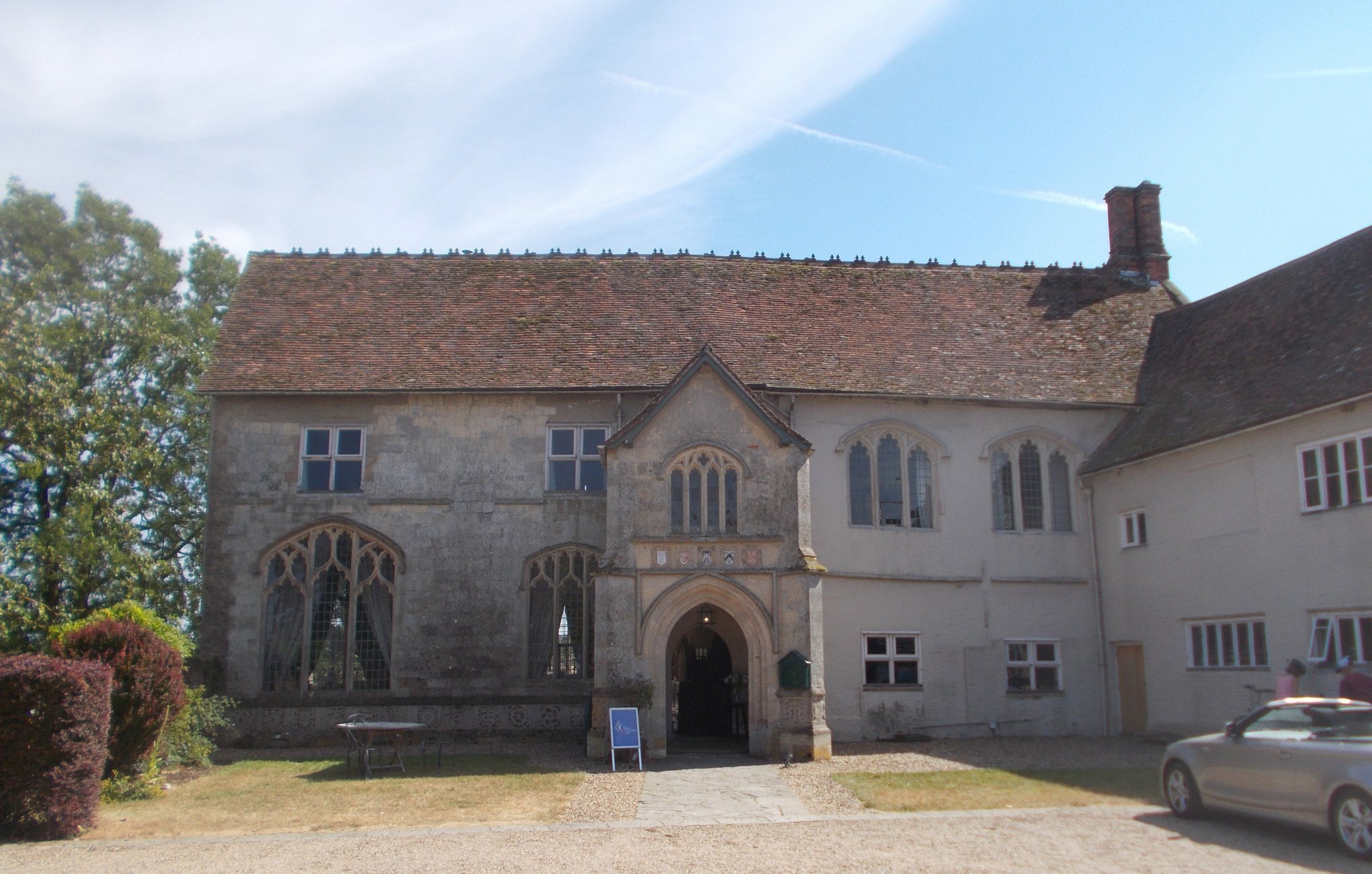
The present farmhouse stands on or near the site of the priory church. It is aligned east–west and contains rubble masonry with freestone quoins at its south-east corner. The position of the farmhouse helps define the central arrangement of the former conventual buildings.
Cloister and western range
The cloister lay south of the church. Buried footings identify its western range, which ran north–south in line with the western end of the farmhouse. The eastern range is less clearly defined, but the surviving footings establish the cloister as part of the planned relationship between the church and the southern buildings.
Southern range
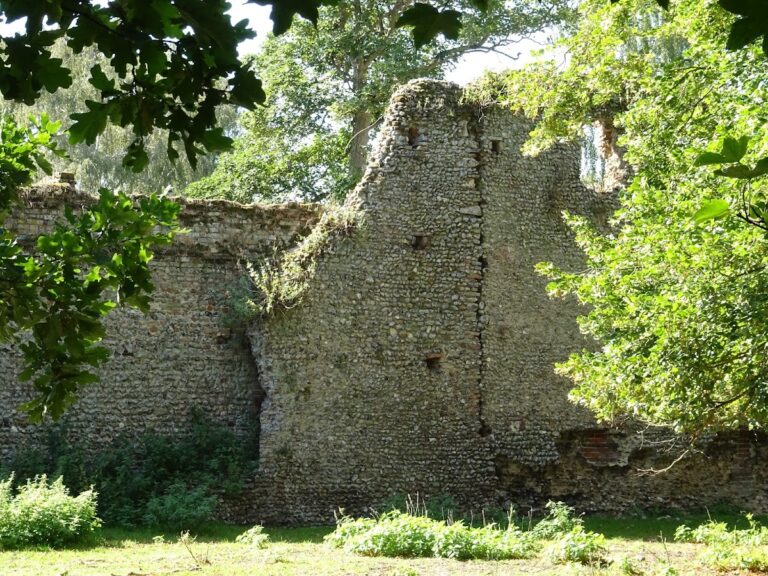
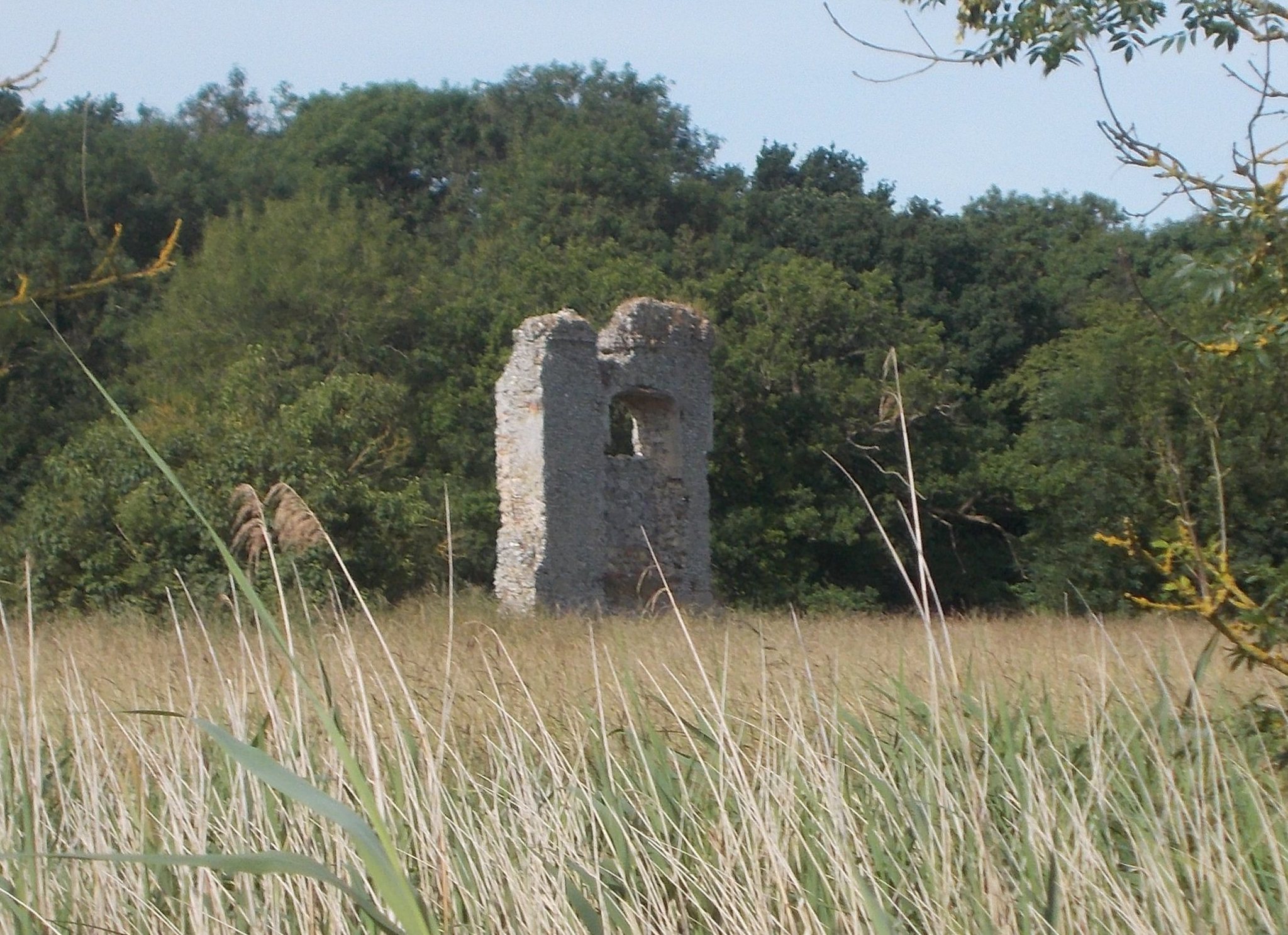
Buried footings and a central section of standing outer wall represent the southern range, probably the nuns’ refectory. The surviving wall reaches full height and contains a window with a late, shallow arch. Its surrounding masonry preserves traces of earlier arched windows with stone tracery. The distance between this wall and the farmhouse’s south wall is about 37 yards, representing the width of the southern range, the cloister, and possibly part of the church nave.
Reused architectural decoration
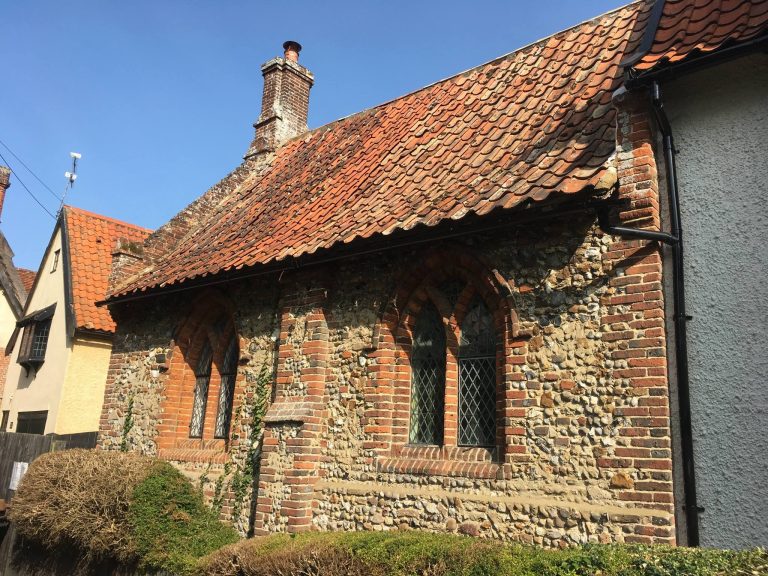
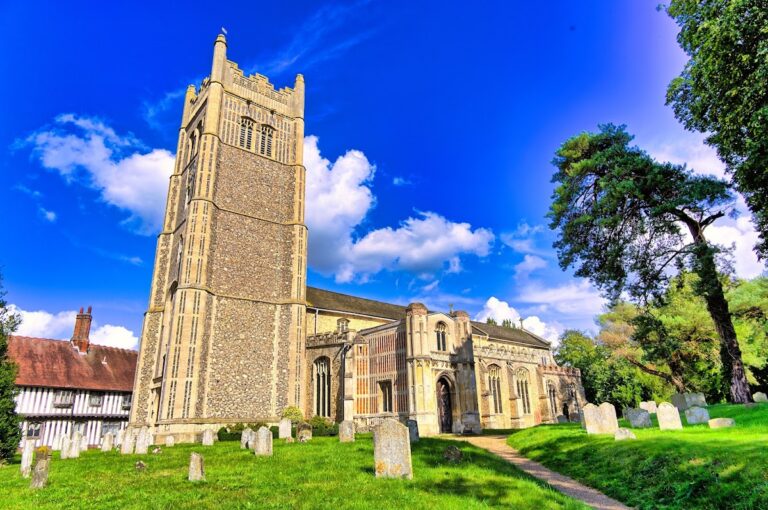
Arched doorways, windows with stone mullion tracery, and ornamental flint flushwork panels at St Peter’s Hall, South Elmham, may have been removed from Flixton after the Dissolution. Flushwork combines flint with dressed stone and is especially associated with medieval East Anglian architecture. The proposed transfer has been linked with building work for John Tasburgh around 1539, although the attribution remains uncertain. The window tracery is stylistically dated to the fourteenth and fifteenth centuries.
One flushwork panel at St Peter’s Hall contains the hooked wheel of Saint Katherine. If this masonry originated at Flixton, it may reflect substantial later medieval building activity at the priory.
Seal and heraldic identity
Flixton’s thirteenth- and fourteenth-century seal was lozenge-shaped, with a semicircular lobe on each side containing one of the four Evangelist symbols. The central field showed the Crucifixion, with Saint Mary and Saint John below and the sun and moon above. Beneath an arch at the bottom appeared the Agnus Dei, the Lamb of God.
The Crucifixion design on the Flixton seal, together with the corresponding design of neighbouring Bungay Priory, is described as unique among English nunnery seals of the period. The motif was more commonly associated with male mendicant orders from the later thirteenth century. The priory’s arms showed a Saint Katherine’s wheel with a Calvary cross projecting from it in chief, painted in silver on a blue field.
These arms appeared on the medieval rood-lofts of Fundenhall church and Flixton parish church. A rood-loft was a medieval gallery or screen carrying an image of the Crucifixion and often separating the nave from the chancel. Surviving panels at Fundenhall included shields connected with East Anglia, Saint Peter, Saint Nicholas, and the Saint Katherine wheel. The wheel shield expresses the priory’s heraldic identity, while the other shields belonged to the churches’ own religious and regional associations.
Inventory of the priory
The 1536 inventory gives a detailed picture of the goods associated with the priory at its surrender. Vestments and altar cloths included red and green silk decorated with gold swans and red silk decorated with white cranes. Sacred vessels included a parcel-gilt silver altar cross bearing figures of Saint Mary and Saint John, cruets, two chalices, three mazers, eight silver spoons, a covered salt, and a silver goblet.
Domestic equipment consisted mainly of pewter plates and dishes, basins, and ewers. The furniture was simple, most bedding was old and of little value, and the kitchen vessels were described as “trasshe.” The livestock comprised six cattle, five horses, ten pigs, and ten sheep. The inventory also listed ten loads of hay and ten acres each of corn and barley, recording the material resources of the community at the end of its existence.