St. Michael’s Church in Yaroslavl: An Orthodox Garrison Church
Site at a Glance
- Rating
- 4.9
- Popularity
- Low
- Country
- Russia
- Primary era
- Early Modern
- External website
- Open
- Eras represented
- Early Modern
- Civilizations
- Russian
- Site type
- Religious
- Remains
- Church
On this page7 sections
History
Medieval origins and princely use
St. Michael’s Church in Yaroslavl, Russia, is an Orthodox church beside the Kotorosl River and near the Transfiguration Monastery. A wooden church traditionally dated to 1215 is attributed to Prince Konstantin Vsevolodovich, who is said to have founded it together with Yaroslavl’s Dormition Cathedral. A late-eighteenth-century church manuscript instead places the first building between 1213 and 1216 and states that it remained standing until 1295.
In 1295, Anna, the wife of Prince Fyodor the Black, is traditionally said to have founded a new church on the site and endowed it with a richly decorated image of the Virgin Mary. The church then became a cathedral. Its dedication has been connected either with the Byzantine emperor Michael VIII Palaiologos or with Fyodor’s stepson Mikhail, who died prematurely. The identity of Fyodor’s father-in-law is also uncertain, with Mengu-Timur now generally preferred to Nogai. From the thirteenth to the fifteenth century, the church is described as the palace church of the appanage princes of Yaroslavl.
The seventeenth-century church
By the seventeenth century, St. Michael’s stood within a settlement of Streltsy, musketeers who formed a military service community in the Russian state. It became a garrison church, a role encouraged by its dedication to the Archangel Michael, the chief archangel in Christian tradition and a figure associated with protection and warfare.
The present brick church was built over twenty-five years, from 1657 to 1682. Military authorities provided only modest support, and the long construction period produced a building that combines features from two phases of seventeenth-century Yaroslavl church architecture. In 1731, an artel of painters from Yaroslavl and Galich, led by the icon painter Fedor Fedorov, decorated the interior with frescoes. Work began on 17 May and ended on 21 September. The inscription commemorating the work names Empress Anna Ioannovna, Tsarevna Evdokia, and Georgy, Archbishop of Rostov and Yaroslavl.
A fire damaged the domes in 1738, and replacement domes were erected in 1745. In 1781, the southern side chapel or gallery was rebuilt as the heated Church of the Annunciation. The parish counted 234 members at the end of the eighteenth century, but only 82 at the beginning of the twentieth century, reflecting the decline of the surrounding population.
Closure, restoration, and continuing religious use
Soviet authorities closed the church in 1924. The building subsequently deteriorated, while valuable liturgical objects and ancient icons were looted. Some of these objects later entered museum collections. The bells were melted down in 1925. The former church was first used as a warehouse and was later transferred to the Yaroslavl Historical, Architectural, and Art Museum-Reserve, established in 1959.
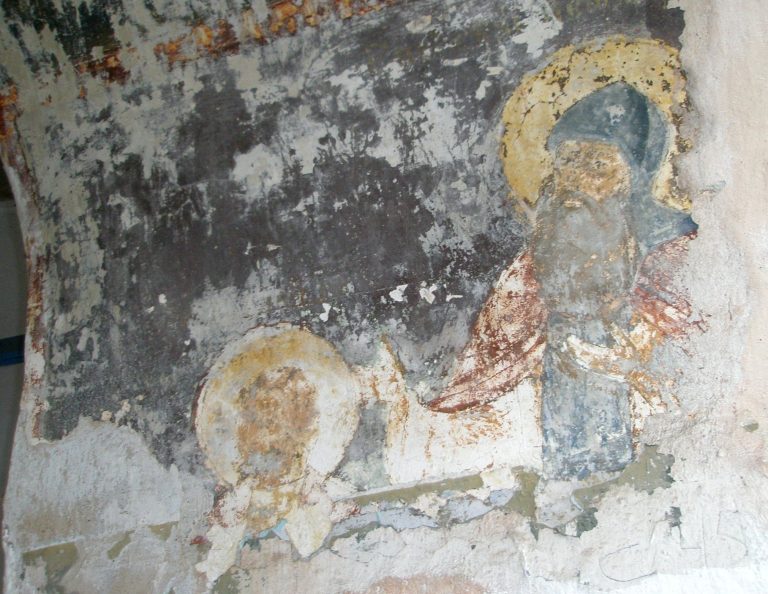
The Russian Orthodox Church recovered the building in 1992. Its first Divine Liturgy in seventy years was celebrated there in 1994, and since 1995 it has served as the seat of a garrison parish. Restoration began with the heated church and continued in the main, unheated church. By the early 2000s, the walls had been plastered and the stained-glass windows recreated. The wall paintings had suffered extensive damage during the decades of closure, and in 2020 the lost fresco above the entrance had not yet been restored.
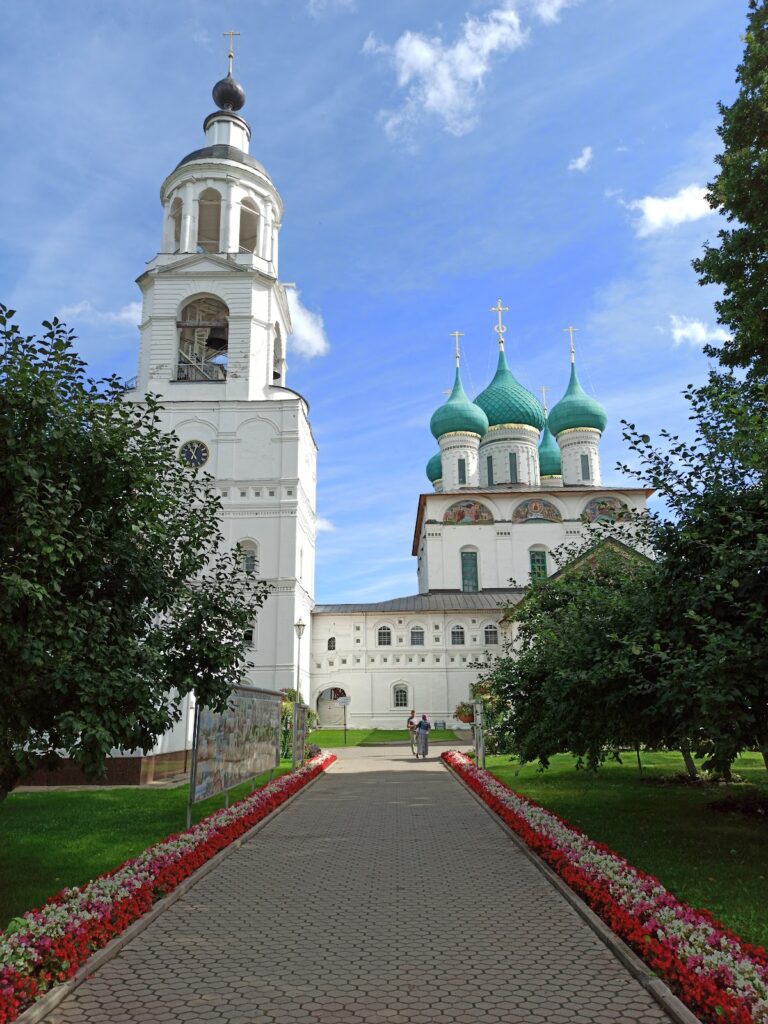
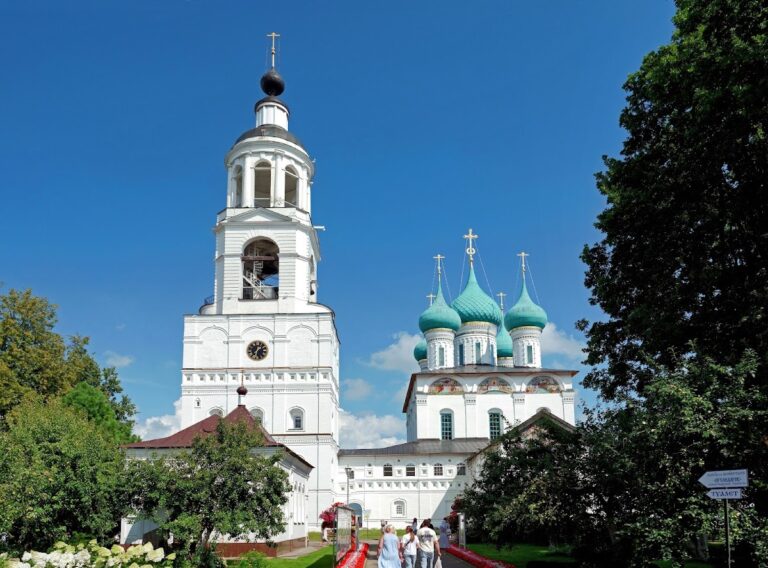
St. Michael’s Church is a federally protected cultural-heritage monument of the peoples of the Russian Federation. It also hosts the annual August Transfiguration Festival of choral and bell music. A small wooden belfry was established in the grounds for demonstrations by bell ringers.
Remains
Plan, exterior, and architectural form
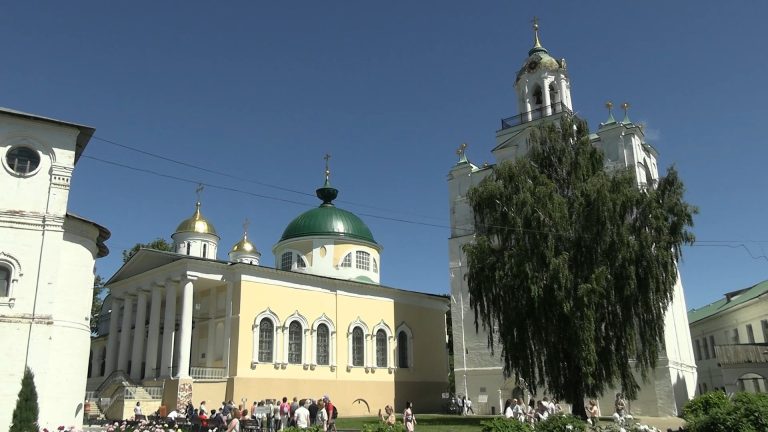
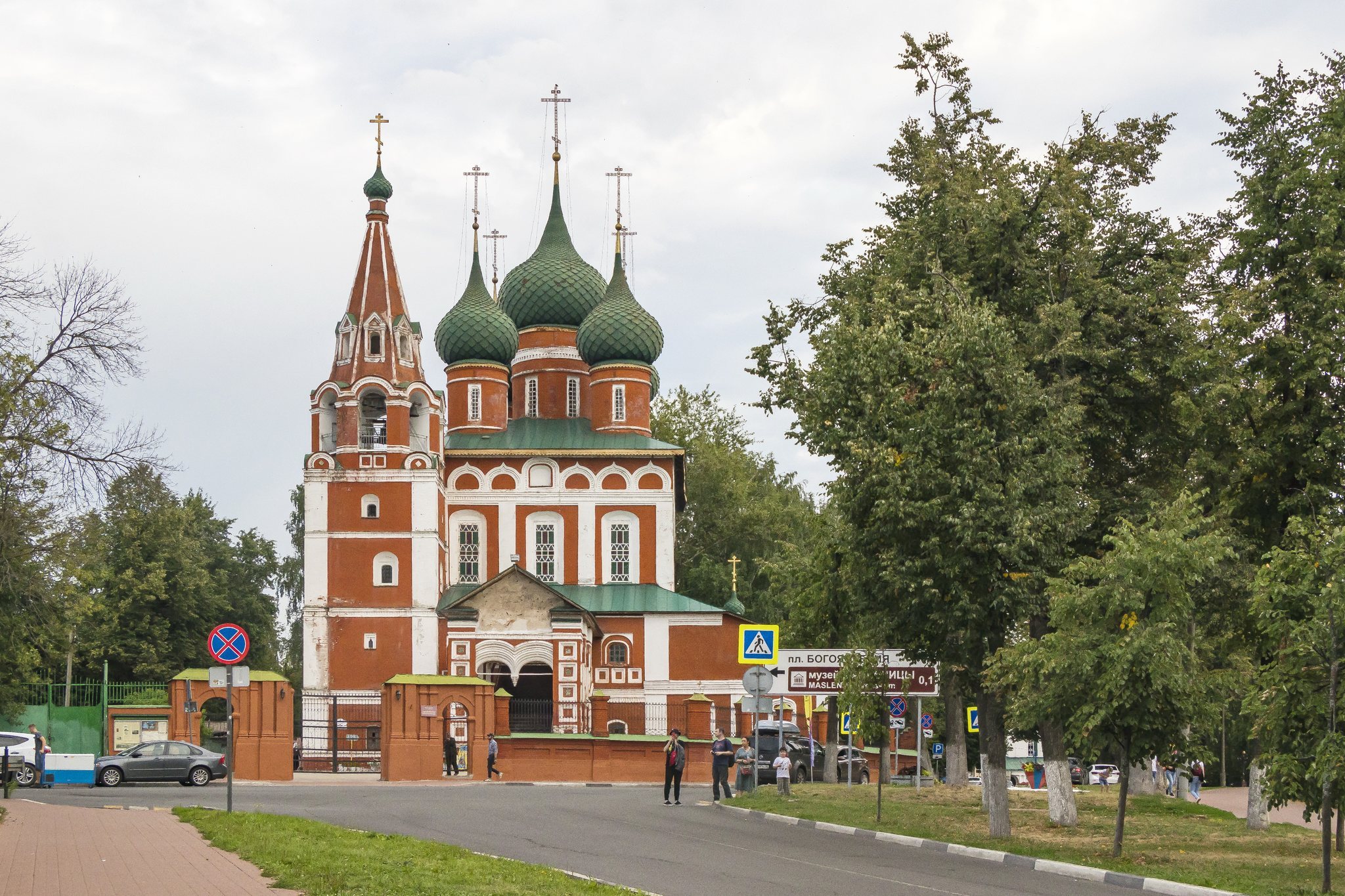
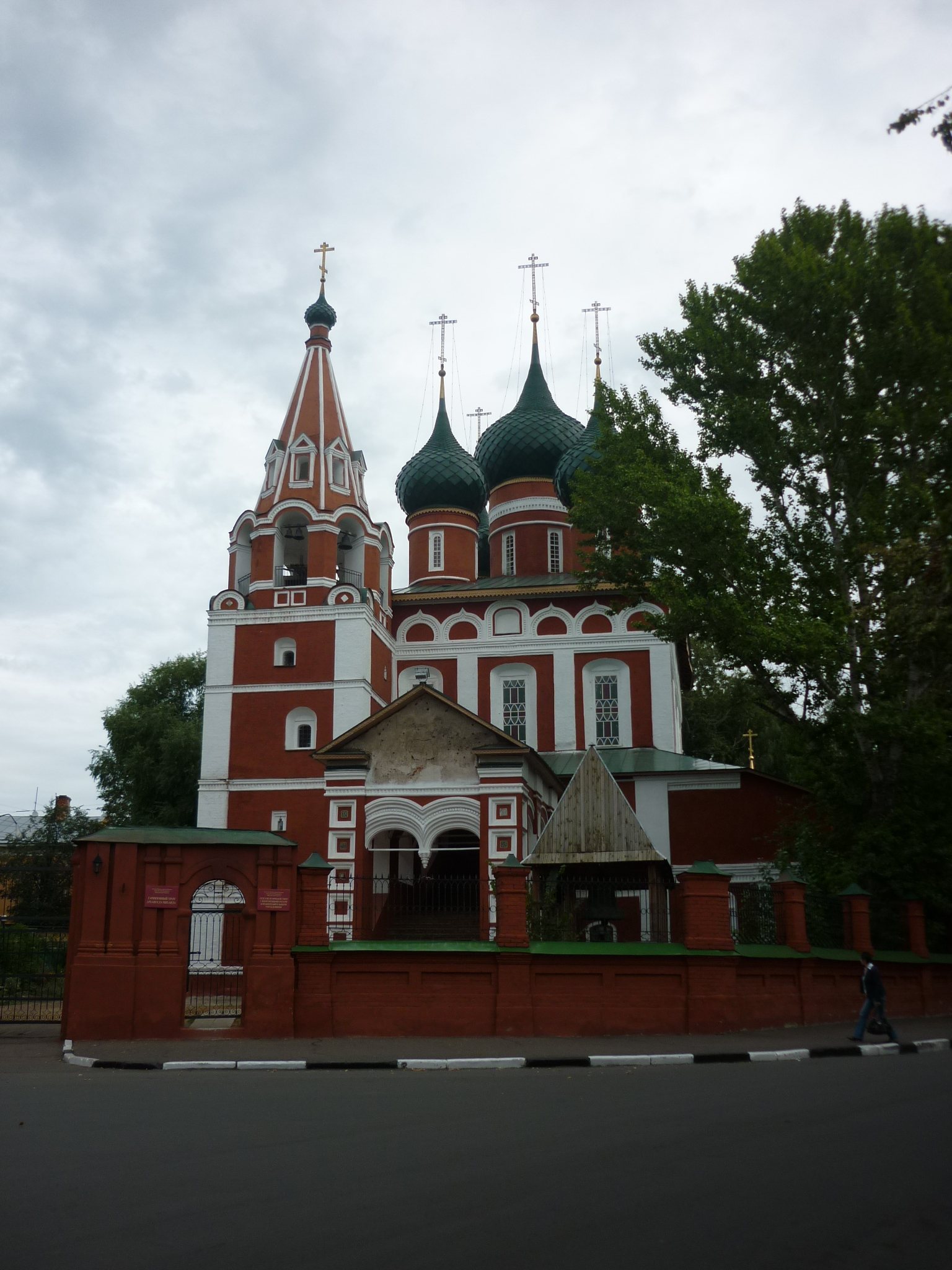
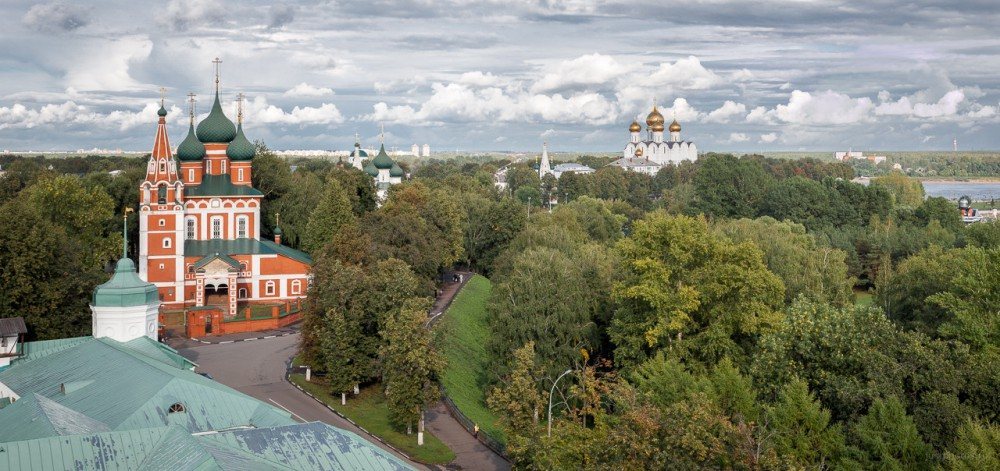
The surviving church is a brick, five-domed building of the Yaroslavl architectural school. Its main volume is a four-pillar church with three apses, the rounded or polygonal eastern ends that contain the sanctuary spaces. It stands on a high podklet, a lower level beneath the principal church space. This basement was used to store merchandise intended for the nearby market by the Church of the Savior in the City. The plan resembles those of the earlier churches of St. Nicholas Nadein and the Prophet Elijah.
Galleries originally surrounded the main quadrangular volume on its northern and western sides. Large entrance porches rested on high, house-shaped arches, but only the western porch survives. A massive square bell tower occupies the northwestern corner, following a characteristic Yaroslavl arrangement. It has a low tent-shaped roof, while the two side chapels occupy the northern and southern sides of the church.
The northern chapel is dedicated to the Solovetsky wonderworking saints Zosima and Savvaty, founders of the Solovetsky Monastery. The southern chapel began as a side space and became the heated Chapel of the Annunciation after 1781. The church contains three altars and three icon screens.
The upper part reflects Yaroslavl church architecture of the 1670s and 1680s, with five powerful domes and large windows. Instead of the earlier zakomar, a traditional curved roof-end form, the builders used a four-sided pitched roof that shed snow more effectively and stressed the building’s vertical lines. Small arcades beneath the eaves preserve a reference to the older form.
The facades feature traditional Yaroslavl window surrounds and recessed ornamental panels known as shirinki. These panels contain ceramic-tile inserts, and the porch has especially abundant tile decoration. Part of its tile ornament has been lost. A brick enclosure survives around the church, although its arched gateway has disappeared.
Frescoes and religious furnishings
The interior frescoes were painted in 1731 in a late Yaroslavl style. Their compositions are simplified and finely divided, with qualities compared to popular lubok prints, a form of inexpensive illustrated print. Part of the apse remains unplastered, and the fresco above the entrance was still missing in 2020.
Religious images traditionally associated with the church include an icon of the Archangel Michael, transferred to the Tretyakov Gallery in Moscow after the Revolution. Another is an approximately eight-vershok image of the Vladimir Mother of God set above the Royal Doors, the central doors of an Orthodox icon screen that open toward the altar. The image is covered by a silver riza, a metal covering that leaves selected parts of the painted surface visible, and has prophetic visions in its corners.
The church also possessed an icon of the Smolensk Mother of God, possibly brought by Fyodor the Black from Smolensk around 1283. An icon of Anthony the Great was formerly regarded as the church’s patronal icon, a connection that has been taken as evidence for an earlier altar dedicated to him. Before the Revolution, the church preserved silver crosses containing relics of Yaroslavl saints. One silver cross also held a fragment of the True Cross and thirty-two relic fragments of different saints, while three additional crosses contained saints’ relics.
The church now preserves a particle of the relics of the Apostle Andrew the First-Called and an icon containing a particle of the relics of Ilya of Murom. A small wooden belfry also stands on the grounds, continuing the site’s connection with bell ringing after the loss of the historic bells.