St. Peter’s Church in Lübeck: A Gothic City and University Church
Site at a Glance
- Rating
- 4.5
- Popularity
- Medium
- Country
- Germany
- Primary era
- Medieval
- External website
- Open
- Eras represented
- Medieval, Modern
- Civilizations
- Holy Roman Empire
- Site type
- Religious
- Remains
- Church
On this page13 sections
History
St. Peter’s Church is a medieval Gothic brick hall church in Germany, developed in Lübeck from the twelfth century onward. First mentioned with St. Mary’s Church in 1170, it probably began as a wooden church before a late Romanesque building was constructed between 1227 and 1250. A Gothic choir followed around 1290, and the church reached its present five-aisled form during the fifteenth century.
Medieval foundation and expansion
St. Petri served as Lübeck’s imperial church, a place where the emperor held confidential consultations. Together with St. Mary’s, it was also the city’s second market church. During the fourteenth century, population growth and economic prosperity encouraged wealthy families to establish vicarages, chapels, and side altars. These additions increased the need for space and contributed to the enlargement of the church during the fifteenth century, when Lübeck’s churches competed over size, decoration, and membership.
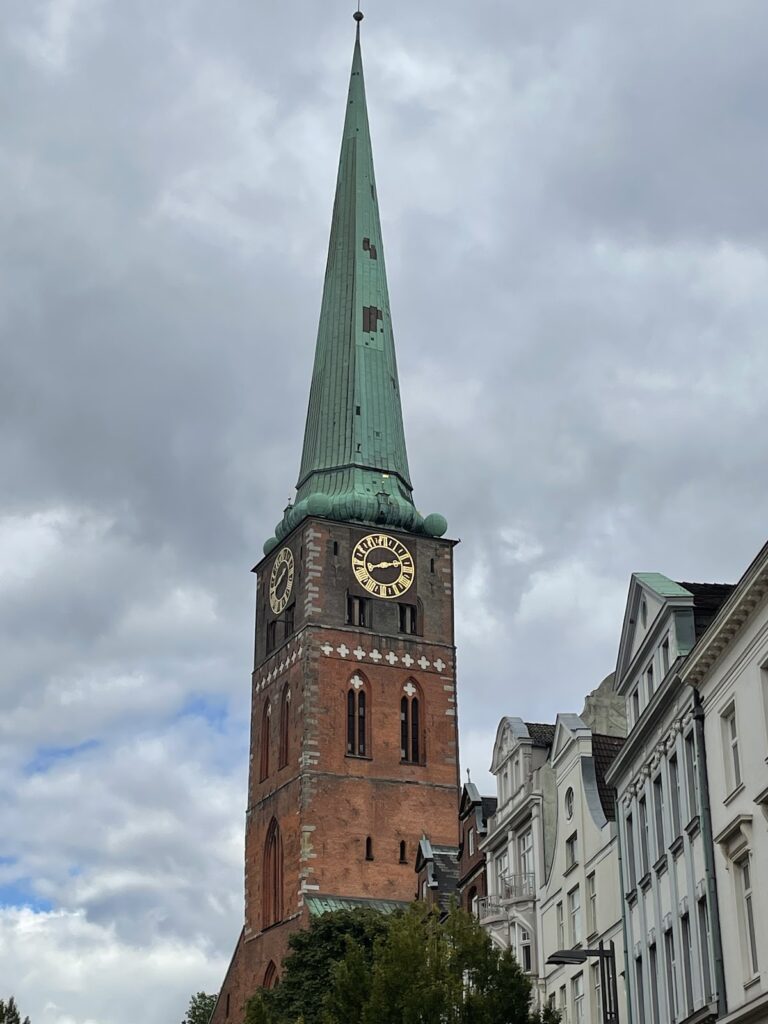
A double-tower design was apparently intended, and the unusually broad western front still reflects that plan. The reason the second tower was never built is uncertain. Lack of funds and possible pressure from the bishop have both been suggested. Construction of the existing Gothic tower began in 1413.
Reformation and later alteration
The Reformation, the sixteenth-century movement that brought Protestant forms of worship and church organization to many western European churches, reached Lübeck in 1529 and 1530. St. Petri subsequently became an Evangelical Lutheran church. In 1880, the floors throughout the five aisles were lowered by approximately 2.5 to 3 feet, increasing the interior height and exposing the bases of the pillars. The altar area, which was then the only part usable for worship, remained at its original level.
War damage and reconstruction
During the Palm Sunday air raid on Lübeck in March 1942, St. Petri was severely damaged and burned out completely. The roof, spire, organ front, and richly furnished interior were destroyed. Many medieval funerary monuments were also lost or can no longer be traced. The church’s former mortuary hall, built in 1600 in the Petrikirchhof, was destroyed in the same year.
After the war, the provisionally roofed church became a lapidarium, a place for preserving architectural and sculptural fragments recovered from damaged or demolished buildings. Rebuilding and restoration continued until 1987, and the tower was re-erected in 1961. The historical interior furnishings were not reconstructed because they had been destroyed. The church was externally restored in 1987 after proposals to convert it into a department store, parking garage, or concert hall had been rejected. It reopened as a city church without its own congregation, serving the whole city while remaining Evangelical Lutheran.
St. Petri is legally classified among the services and works of the Evangelical Lutheran Church District of Lübeck-Lauenburg. It has formed part of the UNESCO World Heritage property of Lübeck’s Old Town since 1987. Before the Second World War, the parish had declined to about 2,000 members as residents moved toward the outskirts after the city gates’ closing restrictions were lifted in 1864. After the war, the remaining parish was divided between the neighboring cathedral and St. Mary’s parishes.
City church, university church, and cultural centre
Under pastors Günter Harig and Bernd Schwarze, St. Petri developed a programme connecting church and culture, as well as religion and science, in response to increasing urban secularization. A public-life board of trustees oversees exhibitions, readings, lectures, panel discussions, fairs, concerts, theological events, experimental services, and liturgical experiments.
Since 2000, the church has hosted the monthly nighttime thematic performance series Petrivisionen. The solo verbo speech series addresses religious questions critically, while the artistically designed Maundy Thursday communion service Supper’s Ready was held in 2017. St. Petri became the university church of the University of Lübeck in 2004 and has cooperated since 2006 with Lübeck Technical University and Lübeck University of Music for academic ceremonies and related events. In 2016, its board of trustees concluded a cooperation agreement with the Overbeck-Gesellschaft art association.
Remains
Gothic church building
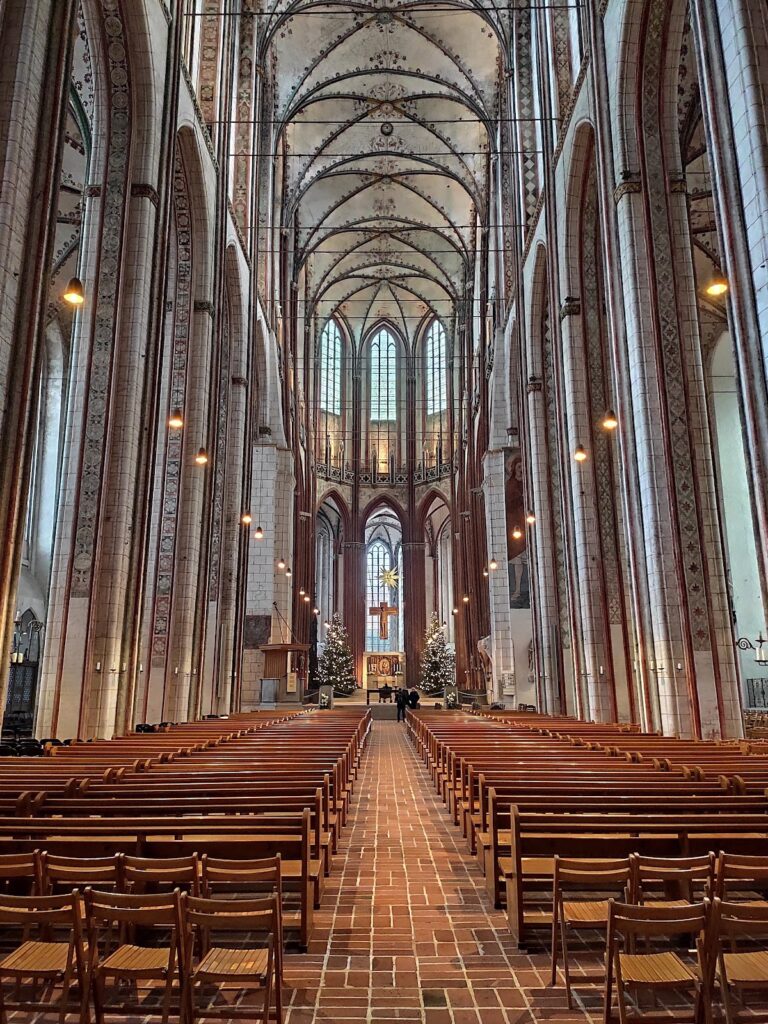
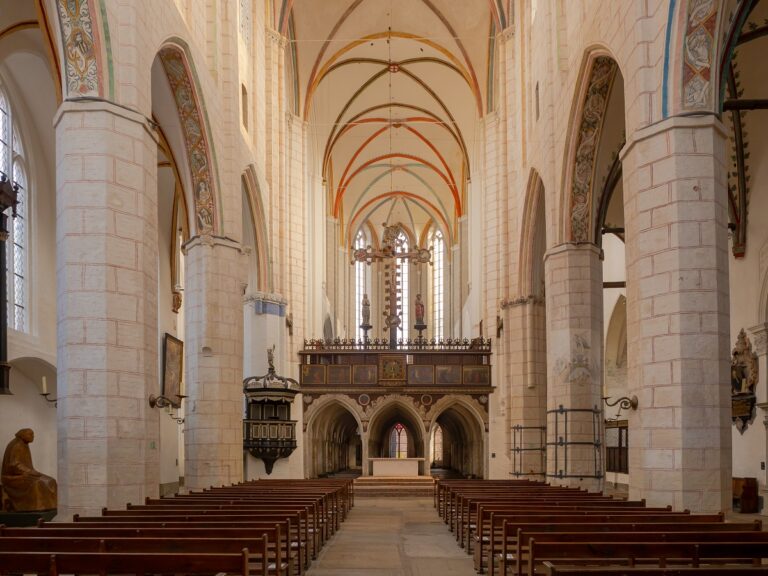
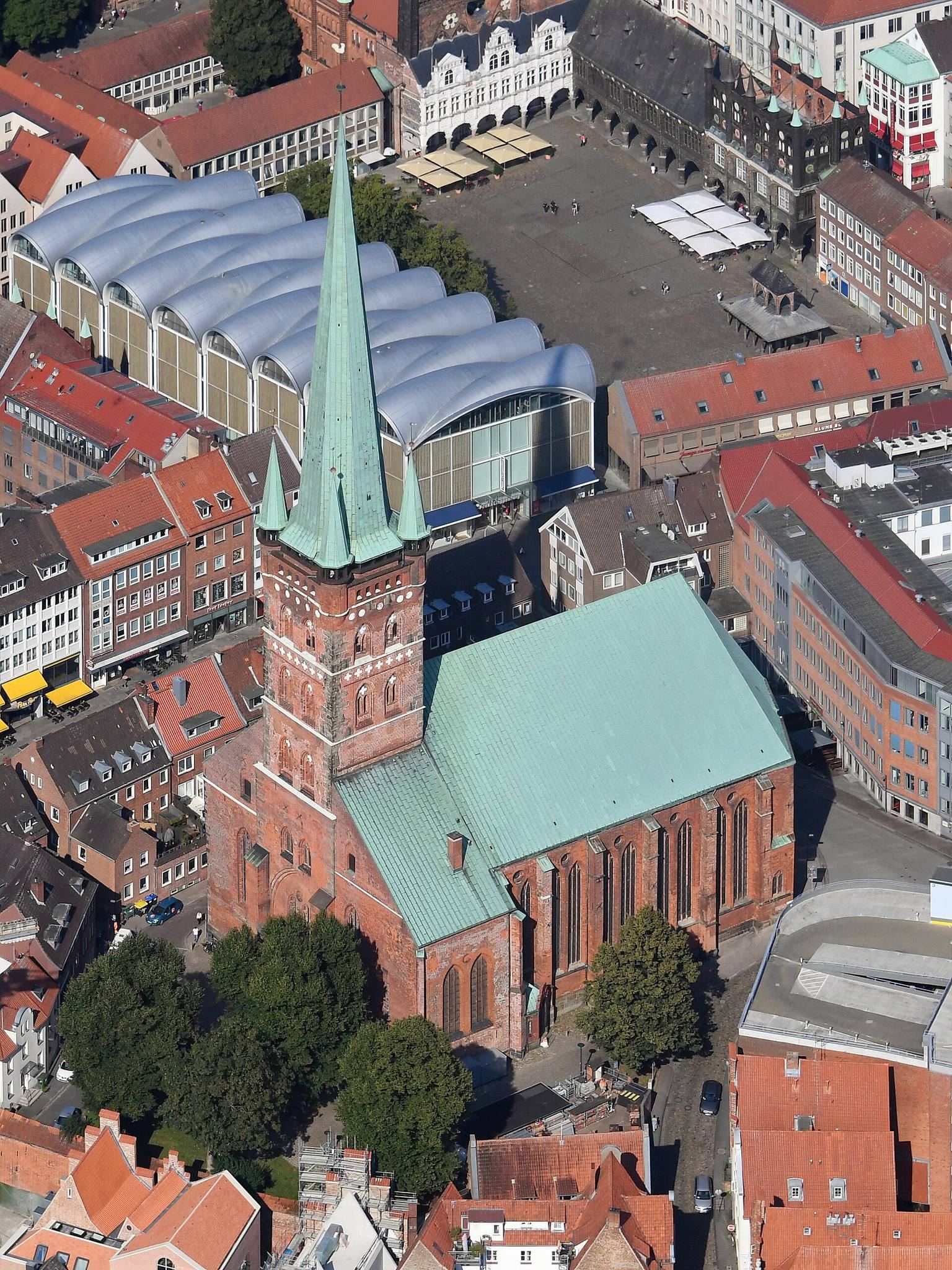
St. Petri is a Gothic brick hall church with five aisles and five bays. In a hall church, the principal aisles are approximately equal in height, creating a broad, unified interior rather than a dominant central nave. The building has three apses at the east end and a single western tower rising from a broad substructure. Its five-aisled arrangement is an unusually extensive surviving example of this type.
Earlier Romanesque structure
The late Romanesque predecessor had three aisles, four bays, and three apses. Its stated dimensions were approximately 29.80 metres plus an additional 3 metres in length and 21 metres in width. The later Gothic expansion transformed this earlier arrangement into the much broader building that survives today.
Western tower
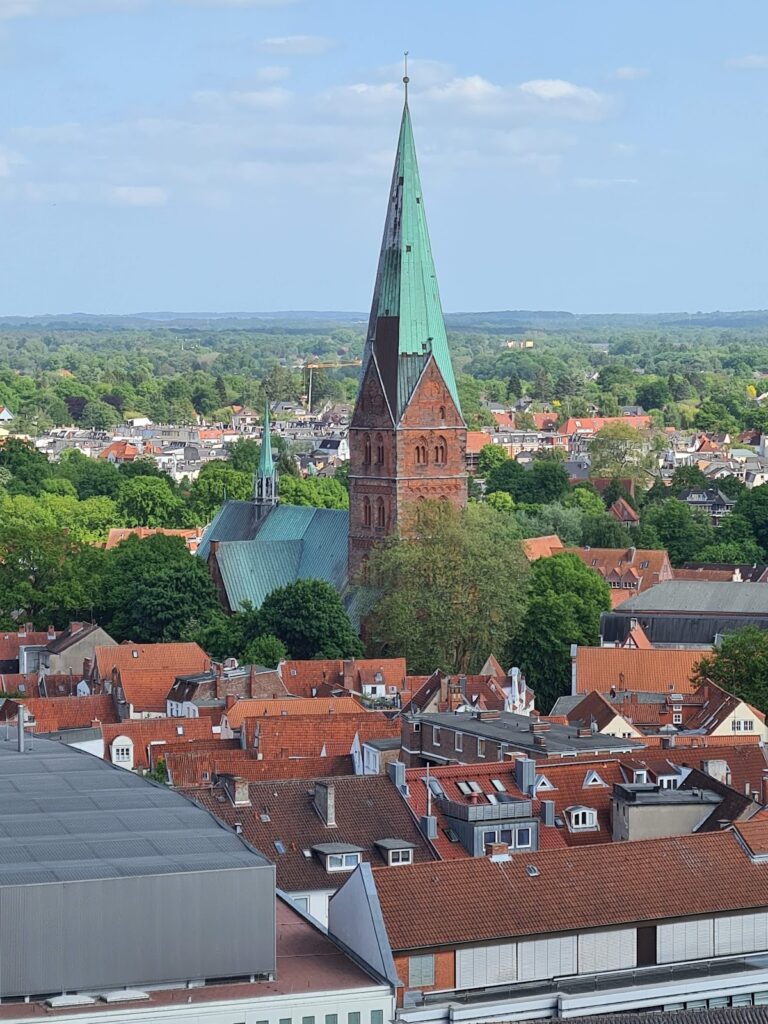
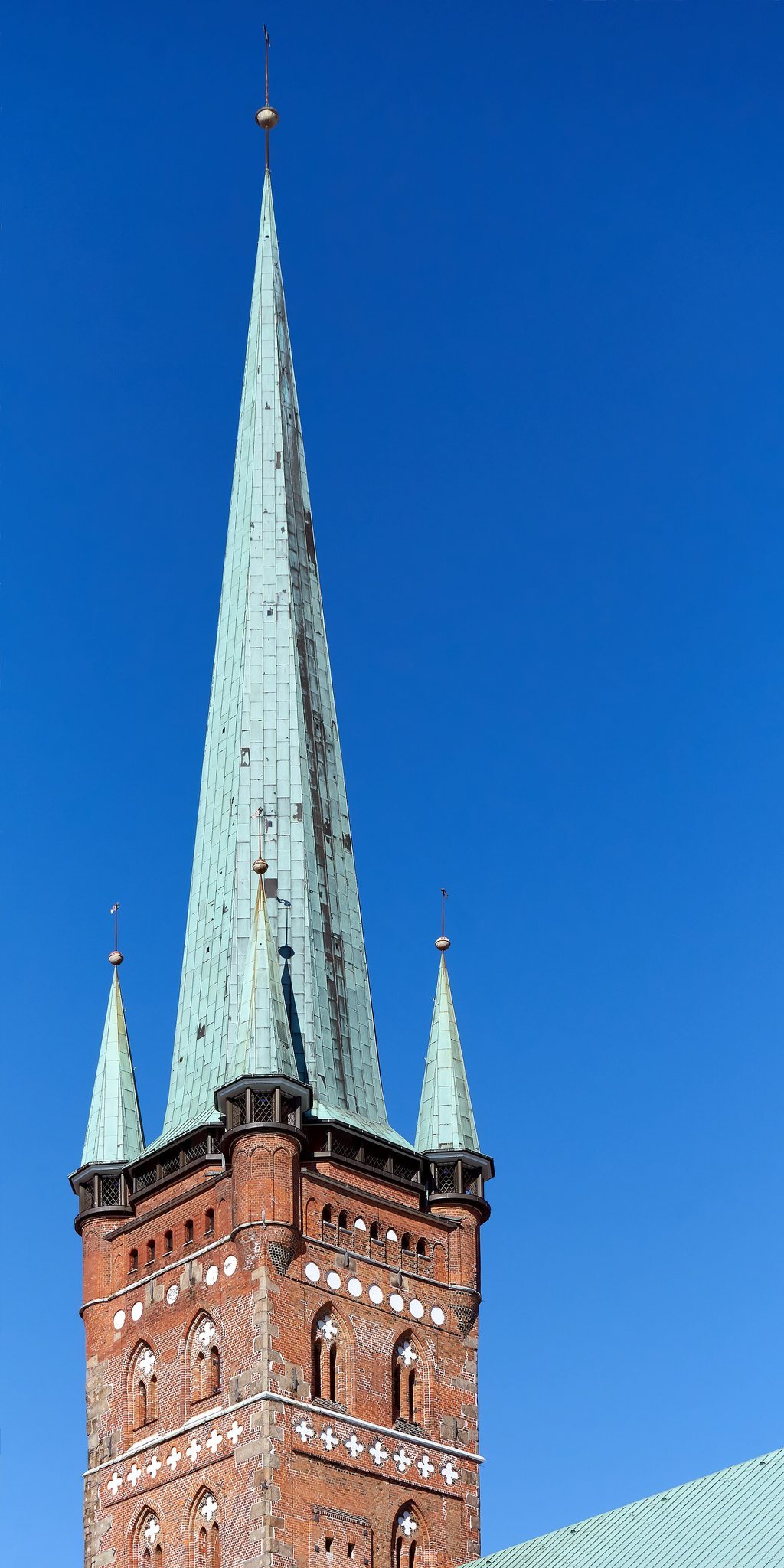
The present tower is approximately 108 metres high. Its observation platform, reached by elevator at a height of 50 metres, provides views across Lübeck’s Old Town, the surrounding area, and Lübeck Bay. The tower was re-erected in 1961 after the wartime destruction.
Interior and furnishings
The 1880 alterations lowered the floors in all five aisles by approximately 2.5 to 3 feet. The pillar bases were exposed and clad with brown-fired bricks. Walls and ceiling that had previously been whitewashed were painted light pink, while the vault ribs were painted bluish. Because the altar area remained at its original height, it is reached by steps.
Surviving and modern furnishings
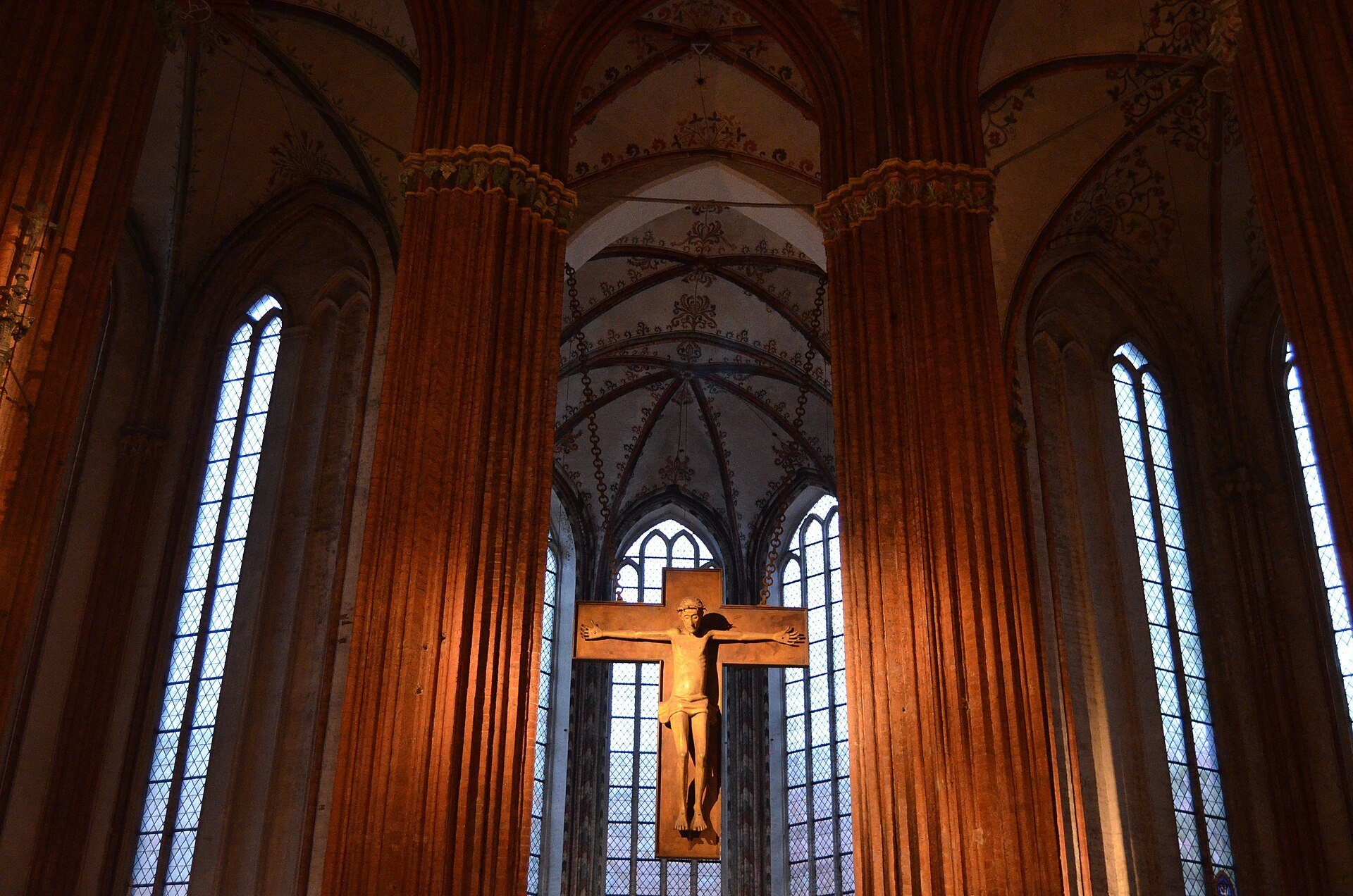
The present interior is largely undecorated, whitewashed, and light-filled. Principal furnishings include the altar, baptismal font, cross, and organ. The surviving Baroque baptismal font was donated by councilor Johann Philipp Lefèvre. In the choir, a crucifix by the Austrian artist Arnulf Rainer, made between 1980 and 1983 from rough planks with a corpus obtained from a devotional-goods dealer, measures 214 by 123 centimetres and is covered with thick layers of paint.
Other modern works include an illuminated neon cross by Hanna Jäger in the vault and Christian Jankowski’s neon installation Yes, it is a church! at the entrance to the church interior. The new organ, installed in 1992 in the northern aisle, was built by the Hinrich Otto Paschen organ-building company of Kiel. It has 19 stops across two manuals and a pedal, with mechanical playing and stop actions. Its console is integrated into the Positiv, a separate division of organ pipes and stops traditionally positioned as a smaller secondary section.
Lost furnishings and funerary remains
The historic organ front, made by the woodcarver Tönnies Evers the Younger, was destroyed in 1942, as was the brass funerary slab of councilor Johann Klingenberg. St. Petri had 48 recorded medieval funerary slabs, most of which are no longer extant or traceable. The former mortuary hall in the Petrikirchhof occupied a separate building constructed in 1600. Its site is now occupied by a modern building housing the Lübeck church-building workshop of the Evangelical Lutheran Church in Northern Germany.
Bells
A bell cast in 1507 by Gerhard van Wou and Johannes Schonenborch survived the 1942 fire and is now on loan to the church in Nusse. Another bell, repeatedly recast after 1507 and finally recast in 1906, was melted down in 1917.
Two bells standing before the main portal originally belonged to churches in Gdansk. During the Second World War, they were sent to the Hamburg bell cemetery for metal recovery, but escaped melting and were brought to Lübeck after 1945. Their possible restitution remains unresolved.