Convent of Madonna del Carmine: A Franciscan Sanctuary in Palmoli, Italy
Site at a Glance
- Rating
- 4.1
- Popularity
- Very Low
- Country
- Italy
- Primary era
- Early Modern
- Eras represented
- Early Modern, Modern
- Civilizations
- Italian, Kingdom of Naples, Spanish
- Site type
- Religious
- Remains
- Monastery
On this page10 sections
History
The Convent of Madonna del Carmine is a Franciscan convent and Marian sanctuary in Palmoli, Italy, established in its present complex in 1583. It grew from a rural church outside the town walls and became a centre of devotion, pilgrimage, burial, and religious formation. The sanctuary is dedicated to Madonna del Carmine, the Virgin Mary in her association with Mount Carmel and the Carmelite tradition.
Origins and early records
The sanctuary stands in the Santa Maria del Carmine district, in an area formerly called Vignali. Local tradition places its origins in the thirteenth century and regards it as the oldest sanctuary dedicated to the Virgin in the surrounding area, although the records connected with that early history were destroyed. The original church was small and rural, with its entrance on the side of the present building. It served as a grange and as an archpriestly ecclesiastical establishment belonging to the parish church of Santa Maria delle Grazie.
The church was first known as Santa Maria del Monte Carmelo. Under Spanish influence in the Kingdom of Naples, the title Santa Maria del Carmine became more common, although both names continued to be used. The earliest surviving written record dates to 14 May 1568, when Monsignor Oliva, archbishop of Chieti, inspected Santa Maria del Carmine and found it adequately maintained. Its rector at the time was Giovanni Antonio de Sangro.
Franciscan administration
In 1583, the parish of Santa Maria delle Grazie transferred the church to the Observant Friars Minor of the Province of San Ferdinando of Apulia. The Observant Friars Minor were a reform branch of the Franciscan Order that followed a stricter interpretation of its rule. They built the adjoining convent, first naming it Santa Maria di Loreto and later Santa Maria del Monte Carmelo. The completed complex was consecrated in 1583.
Franciscan administration increased the sanctuary’s prestige. Support from the Severino family of Naples, who held the titles of marquises of Gagliati and barons of Palmoli, helped provide religious artworks and furnishings. During the seventeenth century, the eighteenth century, and most of the nineteenth century, the sanctuary served both popular devotion and burial. Camillo Severino, the first baron of Palmoli, was buried there after an elaborate funeral on 26 January 1662.
The sanctuary was also associated with Blessed Girolamo of Palmoli, an Observant Franciscan friar who lived and died there on 18 January 1696. His presence formed part of the complex’s religious identity during the period of Franciscan care.
The nineteenth-century image and changing administration
The present statue of Madonna del Carmine replaced an earlier image that had deteriorated. Through the efforts of the guardian friar Sebastiano of Celenza and a donation from Domenico Severino Longo, the new statue reached the sanctuary on 30 April 1854. Its arrival strengthened the devotional focus that continues to shape the sanctuary’s religious life.
The convent and sanctuary were repeatedly opened and closed during the later nineteenth century. In 1869, the state took the complex into its ownership and transferred it to the municipality of Palmoli. The municipality appointed custodians or hermits but gave the buildings no other use. The convent then deteriorated severely, with about three quarters of it reduced to rubble. The sanctuary remained in comparatively good condition because pilgrimages continued.
Rebuilding and wartime use
In 1937, the Sons of the Holy Family requested the ruined convent as a house of formation for candidates to religious life and the priesthood. Founded in Spain by Blessed Giuseppe Manyanet, the congregation was dedicated to family service and to religious and priestly vocations. The Observant Franciscans of the Province of San Bernardino of Siena relinquished their claims, and the congregation paid the municipality 10,000 lire.
The rebuilt convent was inaugurated as the Holy Family College on 16 October 1938 by Father Antonio Samà, the congregation’s superior general, and Archbishop Giuseppe Venturi. On 3 May 1939, Venturi permanently transferred the convent and sanctuary, together with the garden and associated grounds, to the Sons of the Holy Family. Despite the difficulties of the Second World War and the responsibility of supporting 60 candidates, the congregation rebuilt and renovated the convent and embellished the sanctuary.
During the final years of the war, the complex was used first as a German military hospital and then as the headquarters of the Allied command. Work on the sanctuary began on 4 November 1942 and ended in 1943. Giuseppe Venturi consecrated the new altar on 15 August 1943.
Later devotional history
During repairs to the choir loft above the entrance in 1948, work directed by engineer Silvino Cieri revealed a small niche containing ampoules of oil, wine, and salt. The niche was marked with the date 1525. That date may refer to the construction of the choir loft or to an enlargement of the church, but its precise meaning remains uncertain.
On 28 July 1963, during the first centenary celebration in honour of Madonna del Carmine, the venerated image received a gold crown on behalf of Pope Paul VI. The crown was presented by his vicar, Luigi Traglia. During the night of 8 to 9 May 1976, thieves stole the crowns of the Virgin and Child, along with a valuable necklace and gold earrings.
In 1978, declining vocations reduced the congregation’s Nazareth Institute in Rome to only a few candidates. The college at Palmoli was consequently reduced to two or three priests caring for the sanctuary and parish. Pilgrimage and processional traditions nevertheless continued, including walking pilgrimages from Dogliola and other nearby communities, the July feast of Madonna del Carmine, processions between the sanctuary and Palmoli, offerings made by participants in traditional dress, and the August Carmine Fair. Before 1956, the main July procession carried the statue from the sanctuary to the parish church in the morning. Afterward, the celebration took place at the sanctuary, while the statue was taken to the parish church in the evening.
Remains
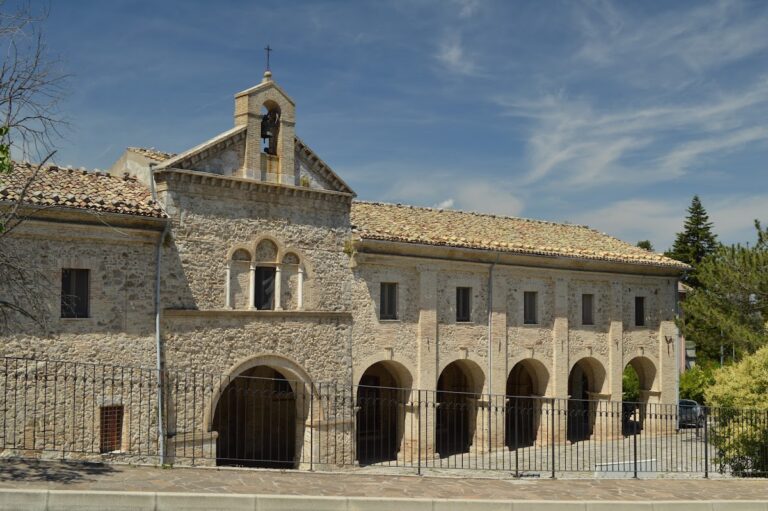
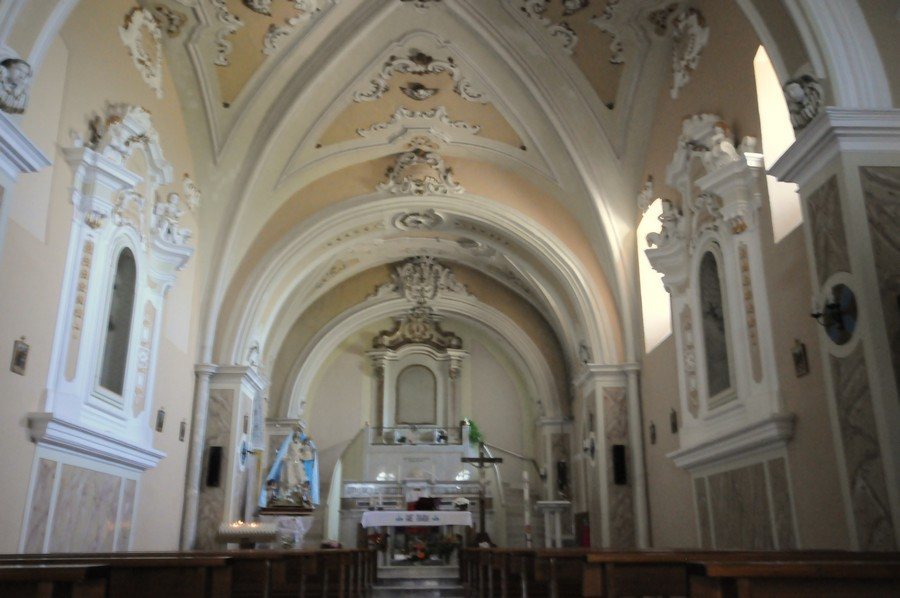
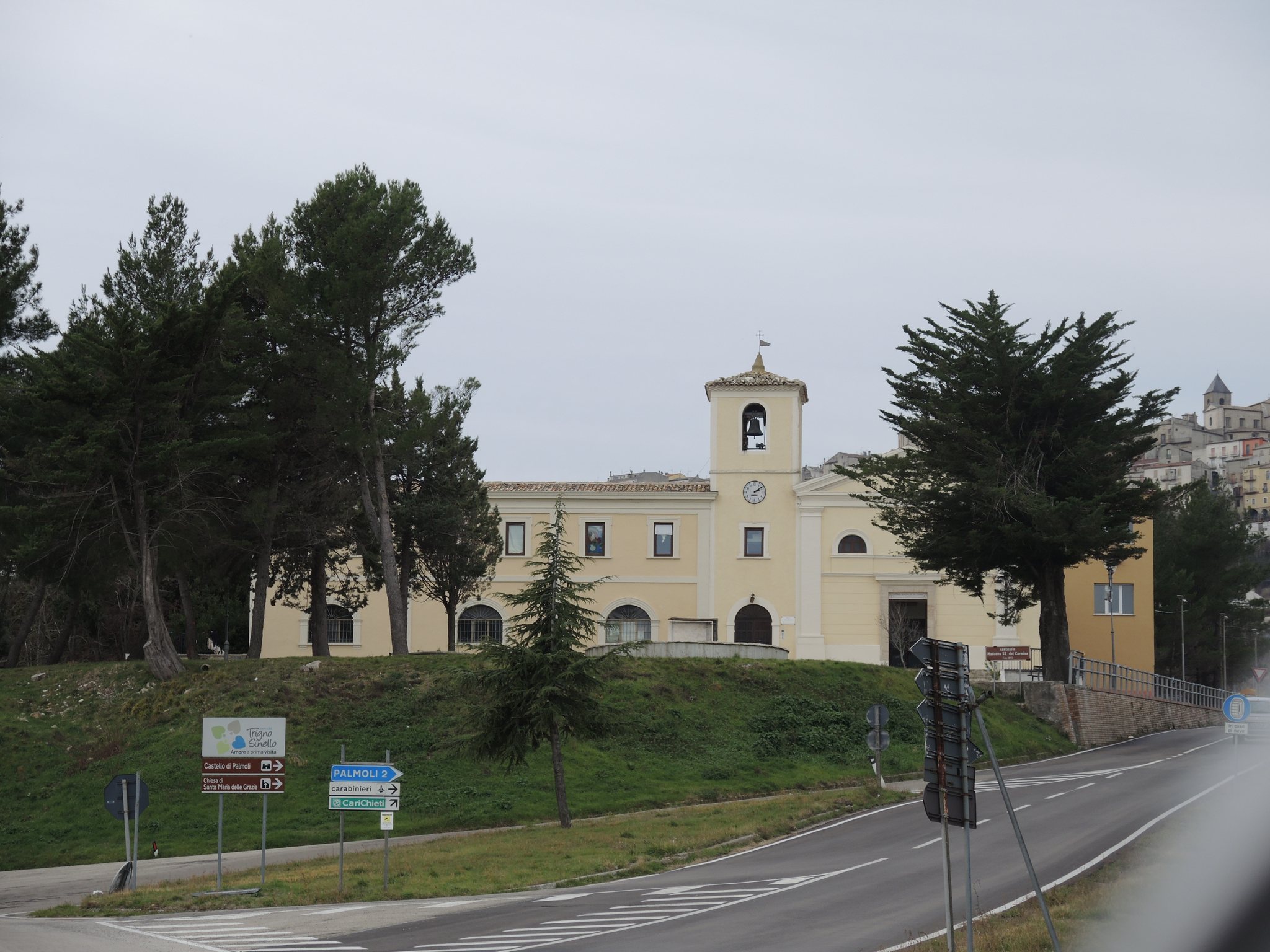
The complex combines a rural church with the adjoining convent. The sanctuary has a single nave, a trussed roof supported by connected structural members, an apse, and a cross vault formed by the intersection of two barrel vaults. Its surviving interior includes wall paintings, votive frescoes, wooden minor altars, and several religious artworks. The convent is arranged over three levels and preserves the architectural form created through its Franciscan foundation and later rebuilding.
The sanctuary church
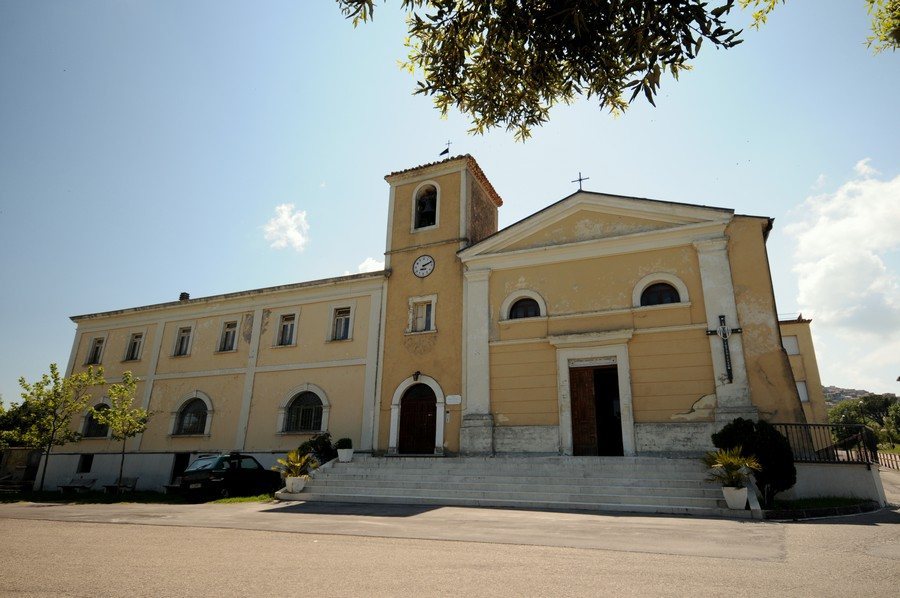
The church facade is gabled, with an entrance portal set between two pilasters, or flat wall-attached elements resembling columns. Two windows surmount the portal. A square bell tower stands to the left of the facade. Inside, the church contains wall paintings, votive frescoes, and wooden minor altars, together with paintings of the Virgin of Carmel with Saints Sebastian and Anthony of Padua, and of Our Lady of the Rosary with Saint Dominic and Saint Catherine of Siena.
A polychrome wooden statue of Saint Anthony of Padua is also preserved in the sanctuary. The choir loft above the entrance includes the small niche found during the 1948 renovation. Its ampoules of oil, wine, and salt remain associated with the date 1525, whose connection to the loft or to a possible enlargement of the church has not been resolved.
The convent building
The convent has windows distributed across three levels. Those on the two upper floors are divided by pilasters and framed, while the windows on the second level have segmental arches, which are arches formed from less than a semicircle. Much of the convent was rebuilt after its nineteenth-century deterioration, allowing the complex to resume use as the Holy Family College in the twentieth century.
The statue of Madonna del Carmine
The present statue is a nineteenth-century Neapolitan wooden work, dressed in garments and measuring about 1.40 metres including its base. The Virgin holds the Child in her left hand and offers the scapular in her right. The scapular is a devotional garment or badge especially associated with Carmelite devotion. Two nude angels stand at her feet on small clouds, one seated and one standing, holding a silver rose and a lily.
The original mantle was made of light-blue ornesino fabric, lined with Carmelite-coloured levantine fabric, and embroidered with 30 stars. Later acts of popular devotion added further mantles and new gold crowns. In early April 1854, the statue was transported from Naples to San Giuliano and then carried to Palmoli by 20 men assisted by two foremen. It arrived at the sanctuary on 30 April. During festivals, women carry the dressed image in procession.