Kondapalli Fort: A Medieval Fort and Palace Complex in India
Site at a Glance
- Rating
- 4.3
- Popularity
- Medium
- Country
- India
- Primary era
- Medieval
- Eras represented
- Medieval, Modern
- Civilizations
- British
- Site type
- Military
- Remains
- Castle
On this page14 sections
History
Kondapalli Fort is a fourteenth-century fort and palace complex in India, west of Kondapalli in Andhra Pradesh, built in the territory of the Reddi Kingdom, a medieval Telugu-speaking state in the Andhra region. Its foundation is attributed to Prolaya Vema Reddy, while another tradition dates its construction to 1360, when Anna Vema Reddy captured Kondapalli from the Mudigonda Chalukyas. The fort initially served as a leisure place and business center before becoming a military base, prison, and cemetery under British rule.
Reddi and Gajapati control
Kondapalli passed from the Reddi rulers to the Gajapati dynasty of Odisha, which governed extensive areas of Odisha and neighboring eastern India. Its control became closely tied to a succession dispute within the Gajapati dynasty during the 1470s. Hamvira Deva sought assistance from the Bahmani Sultanate, a major medieval Muslim state in the Deccan, during his struggle with his brother Purushottama Deva for the Gajapati throne.
After Hamvira’s victory in 1472, Kondapalli and Rajahmundry were ceded to the Bahmani Sultan. In 1476, Purushottama regained the Gajapati throne, while the fort’s garrison is said to have revolted during a famine in the Bahmani kingdom and transferred control to Hamvira. Purushottama later recovered Kondapalli and Rajahmundry amid the political disorder that followed the death of the Bahmani Sultan Mahammad. After Purushottama died in 1497, his son Prataprudra Deva succeeded him.
Vijayanagara and Golconda rule
Krishnadevaraya, emperor of the Vijayanagara Empire, captured Kondapalli in June 1515 during his war with Prataprudra Deva. The Vijayanagara Empire was a powerful South Indian imperial state whose campaigns brought much of the region into its sphere. After another Vijayanagara victory in 1519, a treaty returned territory south of the Krishna River, including Kondapalli, to the Gajapati kingdom.
Between 1519 and 1525, Prataprudra Deva defended the territory against Sultan Quli Qutb Shah of Golconda. The Qutb Shahi rulers governed the Golconda Sultanate, whose centers included Golconda and later Hyderabad. Following a final assault in 1531, Kondapalli came under Golconda rule, and the conflict with the Gajapati kingdom ended in a treaty.
Mughal, Hyderabad, and British periods
The area entered the Mughal Empire during the seventeenth century. When Mughal authority weakened in the early eighteenth century, control passed to the Nizams of Hyderabad, the hereditary rulers who governed Hyderabad after the decline of Mughal power. The East India Company, a British trading corporation that acquired territorial and military authority in India, then took control through treaties with Nizam Ali and the company.
A treaty dated 12 November 1766 granted the British control of the territory in return for stationing troops at the fort to support the Nizam, at an annual cost of 90,000 pounds. The fort is also described as having been stormed and captured by British forces under General Caillaud in 1766. A second treaty, signed on 1 March 1768, confirmed the British grant through the Mughal emperor Shah Alam, while the East India Company agreed to pay the Nizam an allowance of 50,000 pounds. In 1823, the company obtained total control of the surrounding Sarcars, administrative territorial divisions used in Mughal and later regional systems, through an outright purchase from the Nizam.
During the British period, Kondapalli served as a military training base and also contained a prison and cemetery. The fort was later described as abandoned and reconstructed. Restoration and renovation by the Archaeological Department of Andhra Pradesh included strengthening historic walls and repairing the prison house and Koneru pond. The Government of Andhra Pradesh manages the fort, which is protected as a state monument. A museum and interpretive work form part of the continuing presentation of its history.
Remains
Setting and defensive layout
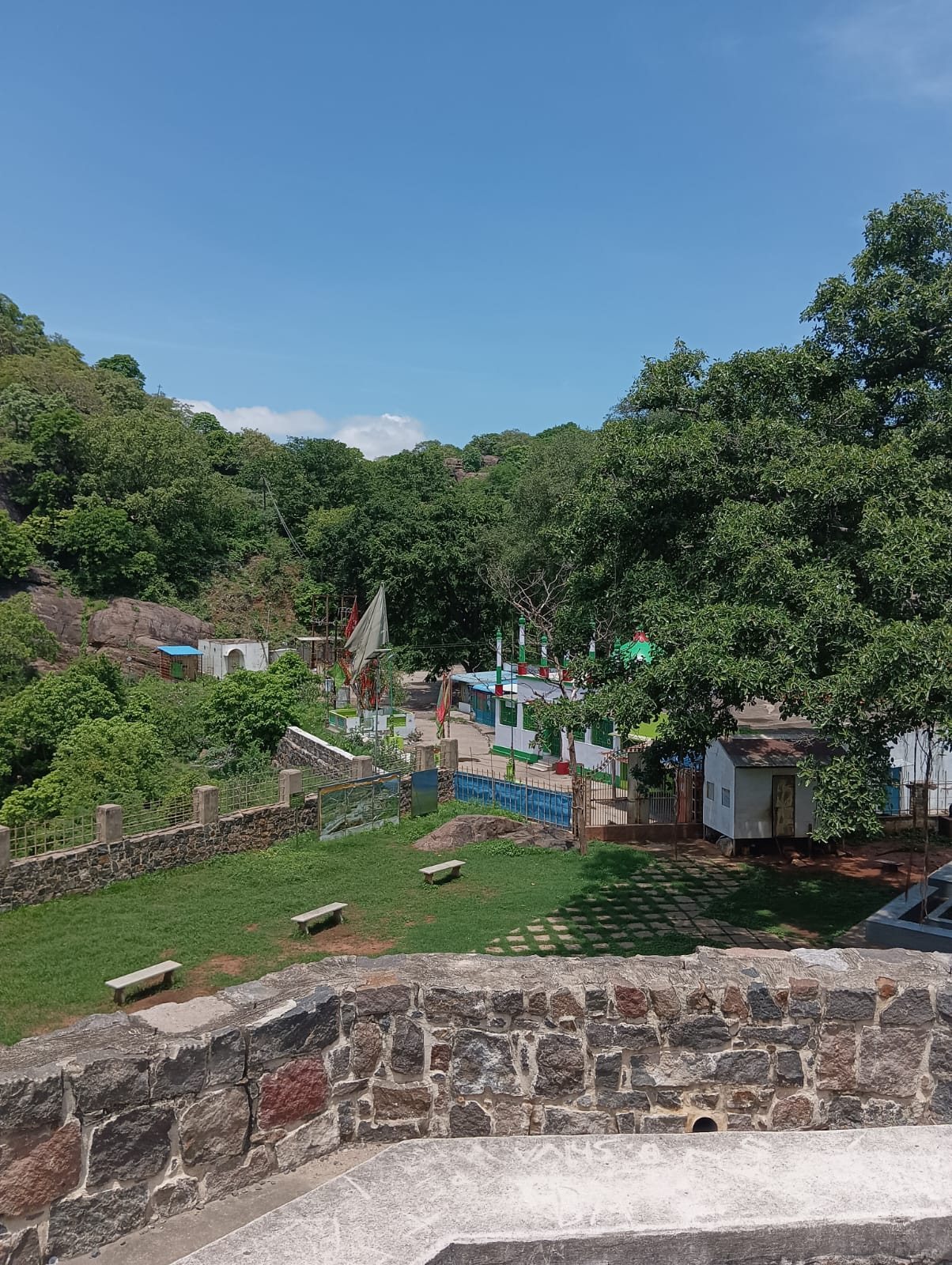
Kondapalli Fort stands on the southeastern edge of the forested Kondapalli hill range, which extends for about 24 kilometres between Nandigama and Vijayawada. The fort occupies a position roughly 300 metres above sea level. The range is composed mainly of charnockites, together with pyroxene granulites, granites, khondalites, pyroxenites, and dolerites. The surrounding forest contains ponuku lightwood, used in making Kondapalli toys, as well as medicinal plants and trees.
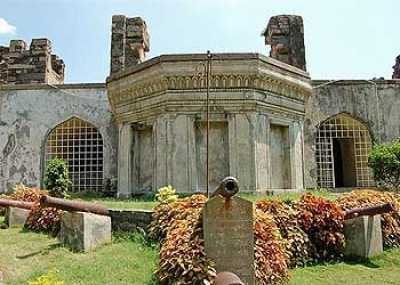
The complex is enclosed by rectangular walls fitted with towers and battlements. A battlement is a protective parapet along the top of a defensive wall, divided into raised sections and openings. Three successive entry gates structure access through the fort and palace complex.
Dargha Darwaja
The principal entrance, called Dargha Darwaja, is formed from a single granite block. It measures approximately 12 feet wide and 15 feet high. Its name refers to the tomb of Gulab Shah, who was killed in battle at the fort.
Golconda Darwaza
Golconda Darwaza stands at the opposite end of the hill and leads toward Jaggaiahpet village. Together with the other gates, it forms part of the fort’s successive entrance system across the hilltop complex.
Palace and water structures
Tanisha Mahal
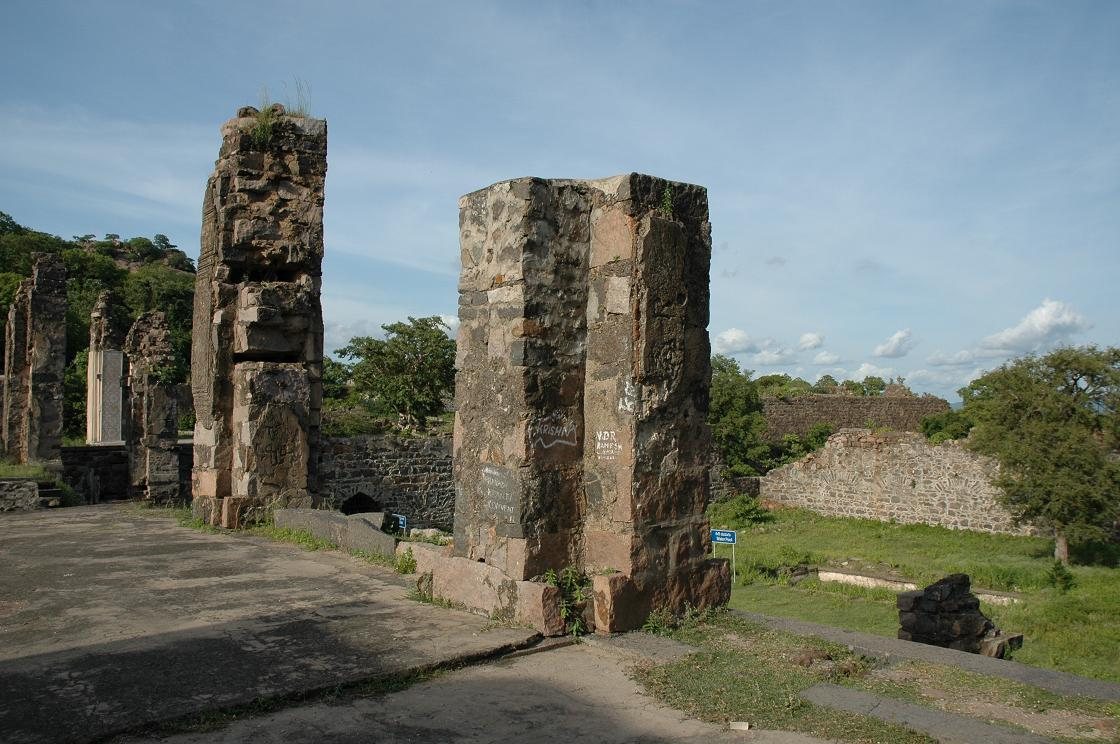
Tanisha Mahal, the palace, occupies a crest between two hills at the far end of the fort. Its ground floor contains many chambers, while the upper floor has a large hall. Several other buildings within the complex survive as ruins, preserving the palace area’s relationship to the wider fortified enclosure.
Reservoirs and granary
A deep reservoir near the palace receives water from a spring. Other water tanks are distributed around the fort, and the water system consists of open reservoirs or basins. The tanks dry out during summer. Beyond the reservoir, an old granary survives in ruined condition. A granary is a building intended for storing grain, and the surviving structure is inhabited by bats.
British-period structures and interpretation
English barrack and cemetery
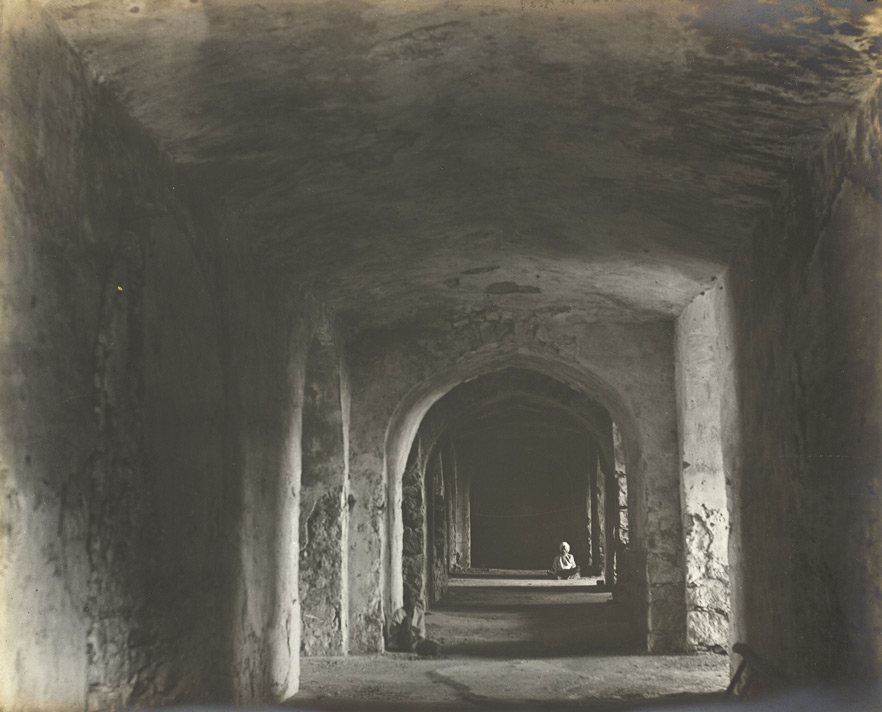
An English barrack remains within the fort. It contains eight large rooms and an annexed house. An English cemetery is also located within the fort area, reflecting the complex’s military use under British control.
Prison house and museum
The prison house and Koneru pond were among the structures repaired during restoration work, while the historic walls were strengthened. The museum contains relics found at the site, displays of Kondapalli toys, and historical material. Since 2019, projection mapping using graphics, animation, and laser displays has presented the fort’s history across its irregular terrain, ruins, and surviving buildings.