Abbey of the Dunes: A Cistercian Monastery in Koksijde, Belgium
Site at a Glance
- Rating
- 4.3
- Popularity
- Low
- Country
- Belgium
- Primary era
- Medieval
- External website
- Open
- Eras represented
- Medieval, Modern
- Civilizations
- County of Flanders
- Site type
- Religious
- Remains
- Monastery
On this page13 sections
History
The Abbey of the Dunes in Koksijde, Belgium, began as an eremitical community founded by the hermit Ligerius in 1107. The early settlement consisted of huts and a small chapel among the dunes. Around 1120, the community adopted the Rule of Saint Benedict, the basis of Western monastic life, and it became an abbey during the following decade. Under Abbot Fulco, the settlement acquired more substantial buildings and a larger chapel.
Foundation and Cistercian affiliation
In 1138, Fulco submitted the monastery to Bernard of Clairvaux, a leading Cistercian abbot and religious leader. The Cistercian Order developed from the Benedictine tradition and emphasized communal discipline, manual work, austerity, and strict observance of the monastic rule. Clairvaux became the Abbey of the Dunes’ mother house, and Robert of Bruges, a monk from Clairvaux, became its first Cistercian abbot in 1139.
Saint Idesbald became abbot in 1155. During his leadership, the community expanded quickly, received an early papal confirmation of its possessions, established the foundations of the Synthe estate near Dunkirk, and began contacts with England. In 1175, Ter Doest Abbey became a daughter house, a monastery founded or administered in dependence on a parent abbey.
Medieval expansion
The Abbey of the Dunes reached its medieval peak during the thirteenth century. Around 1250, its community included about 370 people, among them choir monks and lay brothers. Lay brothers were members of a monastery who generally undertook agricultural, craft, and administrative work while following a distinct form of religious life. The abbey’s estates eventually covered about 10,000 hectares across parts of present-day Belgium, France, the Netherlands, and England.
Land reclamation and farming strengthened the abbey’s economy. Sheep raising and wool production contributed to its wealth, while numerous granges, or monastic agricultural estates, supported the institution. The abbey also held tenant farms, refuge houses, leased lands, and a trading fleet. An English dependent house was later sold to Boxley Abbey. Its abbots maintained regional political influence and were regularly associated with the entourages of the counts of Flanders and, later, the dukes of Burgundy.
Decline and destruction
From the late thirteenth century, the abbey faced mounting financial and institutional difficulties. Flooding damaged its possessions in Zeeland, warfare disrupted its estates, monastic vocations declined, and discipline weakened. The Hundred Years’ War and the loss of income from several granges increased the pressure. Large estates were gradually leased and divided. By about 1450, the monks were considering departure, and around 1550 only about twenty monks remained at Koksijde.
Calvinist iconoclasm, a sixteenth-century Protestant movement opposed to religious images, brought further destruction in 1566. Furnishings and works of art were damaged, and much of the library was burned. Calvinist forces and the Sea Beggars caused additional damage in 1578. Troops occupied the abbey, parts of the complex were dismantled and sold, and its goods were seized. The monks were forced to flee.
The community regrouped in 1583 but spent several decades in temporary locations. In 1601, Abbot Laurent van den Berghe established the remaining community at Ten Bogaerde, where a new monastery was begun. The abbey later moved to Bruges, settling in 1627 in the former refuge of Ter Doest. Ter Doest had been reunited with the Abbey of the Dunes in 1624, along with its possessions, archives, manuscripts, farms, estates, and Bruges refuge.
Bruges and the final suppression
The Treaty of Münster in 1648 recognized the independence of the northern Netherlands. For the Abbey of the Dunes, it meant the loss of many possessions in Zeeland and contributed to the growth of its debts. French-Spanish warfare disrupted its western estates, while a dispute during the reign of Louis XIV temporarily divided the community. Abbot Martin Collé restored his authority in 1683.
The eighteenth century brought recovery. Several farms were extensively rebuilt, and the abbey church in Bruges was completed. The French Revolution then ended the institution. The abbey was suppressed in 1796, its goods were confiscated and publicly sold, and its monks were expelled. At the time of suppression, the community comprised 18 monks, including Abbot Maur de Mol, and five lay brothers.
The Bruges buildings subsequently served as the central school of the Lys department from 1798 to 1803, an imperial lycée from 1808 to 1814, and a military hospital. From 1833, they housed the Grand Seminary of the Diocese of Bruges. Its academic year opened there on 1 October 1833 with 122 seminarians. Nicolas de Roover, the last surviving former monk, died in 1833 and left the Bruges buildings, which had become his personal property, to the Diocese of Bruges. The diocese later acquired manuscripts and archives connected with the Abbey of the Dunes and Ter Doest. The former institution belonged successively to the dioceses of Thérouanne until 1559, Ypres from 1559, and Bruges from 1627.
Memory and archaeological recovery
A lead coffin discovered in 1623 contained what was identified as the well-preserved remains of Idesbald. The discovery led to a devotional cult associated with reported miracles, and Idesbald continues to be venerated. In 1819, former monks established a chapel over the chapter house of the old Koksijde abbey, preserving a place for this devotion at the original site.
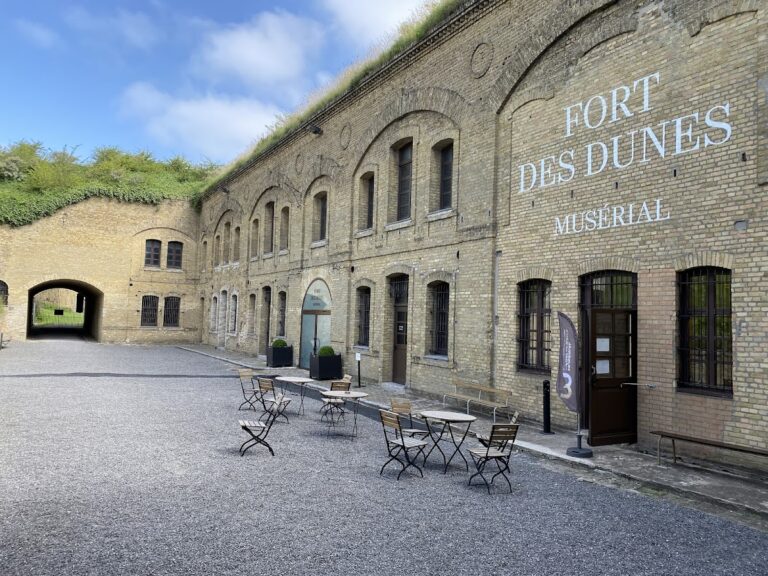
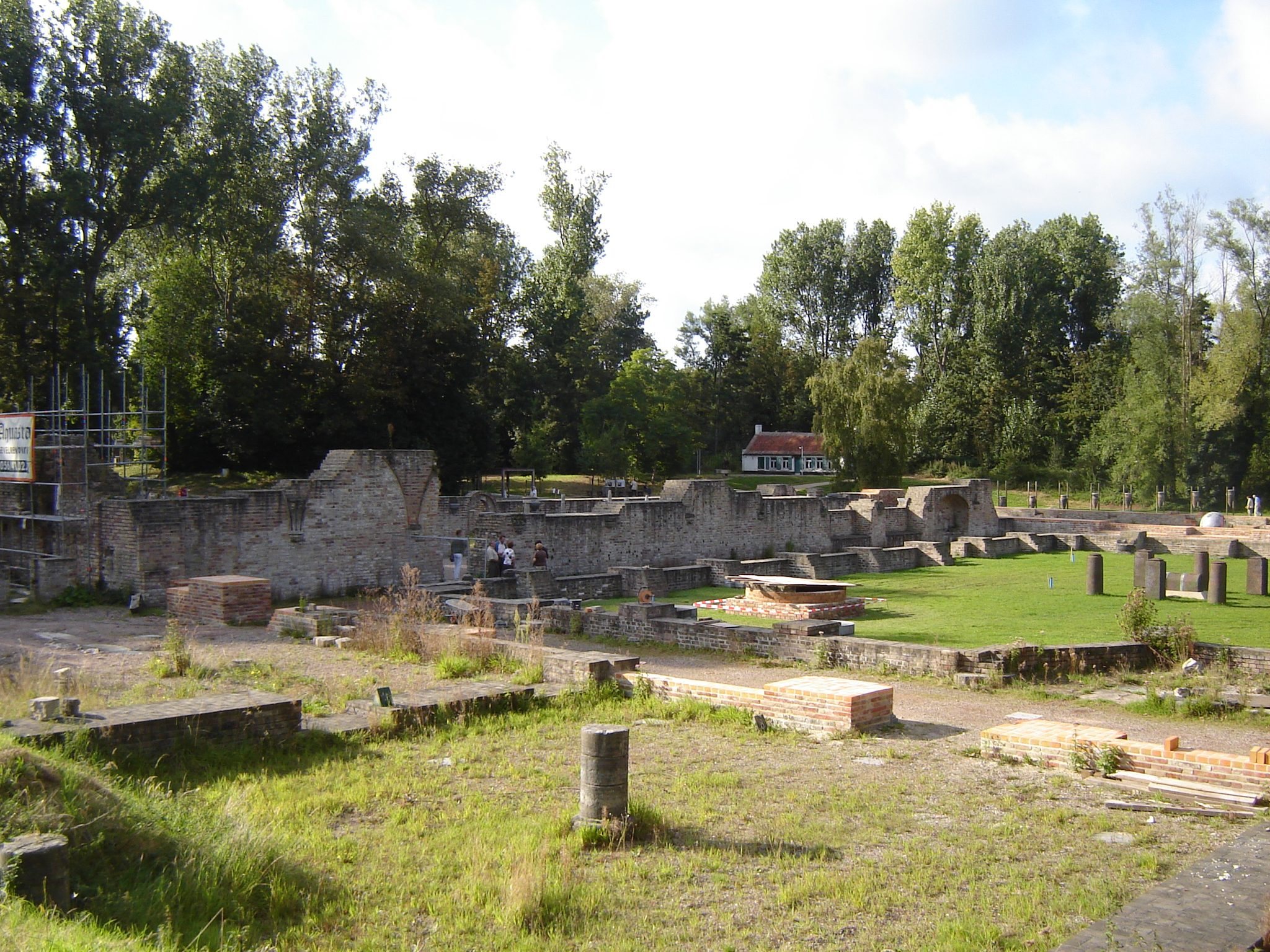
Excavation and recovery of the abandoned Koksijde ruins began in the late nineteenth century. Major later campaigns took place in 1949, 1955, and 1987 to 1988. The former domain is now an open-air museum and archaeological site with listed built-heritage status. The Bruges complex continues to function as a seminary.
Remains
The medieval complex at Koksijde
The original hermitage occupied a sandy dune setting and consisted of several huts and a small chapel. Under Fulco, it developed into a more substantial monastic settlement. The medieval buildings were constructed largely of brick, including bricks made by the abbey itself. A plan painted by Pieter Pourbus in 1580 shows a large outer court threatened by drifting sand and a principal enclosure containing the abbey.
Church and principal enclosure
The principal enclosure contained a gate building, an enclosing wall, and a very large church. New monastic buildings were begun in 1214 and completed in 1237 for a community of approximately 400 monks and lay brothers. The church was consecrated on 13 October 1262 by the bishops of Thérouanne and Tournai. Its nave and sanctuary extended for about 115 metres, and archaeological dating places the surviving church remains around 1250.
Cloisters and monastic ranges
The main cloister was surrounded by the monks’ wing and chapter house on the east, the lay-brothers’ wing and storage cellar on the west, and the refectory and kitchen on the south. The wider complex included a smaller cloister, an infirmary, a library, service buildings for workers, a water house, a brewery, and a guesthouse probably provided with its own kitchen, refectory, and dormitory. Two windmills and a horse mill formed part of the working settlement.
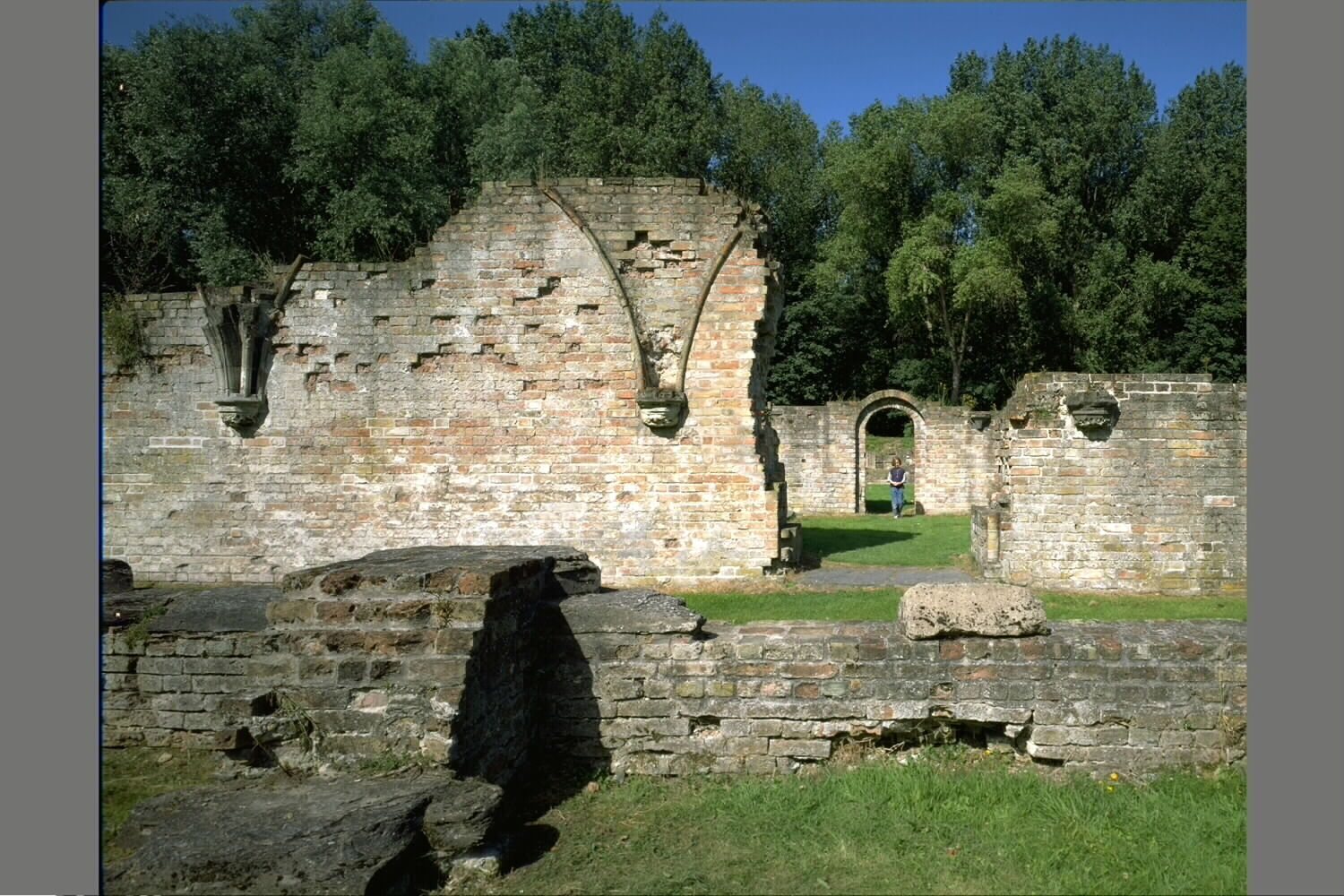
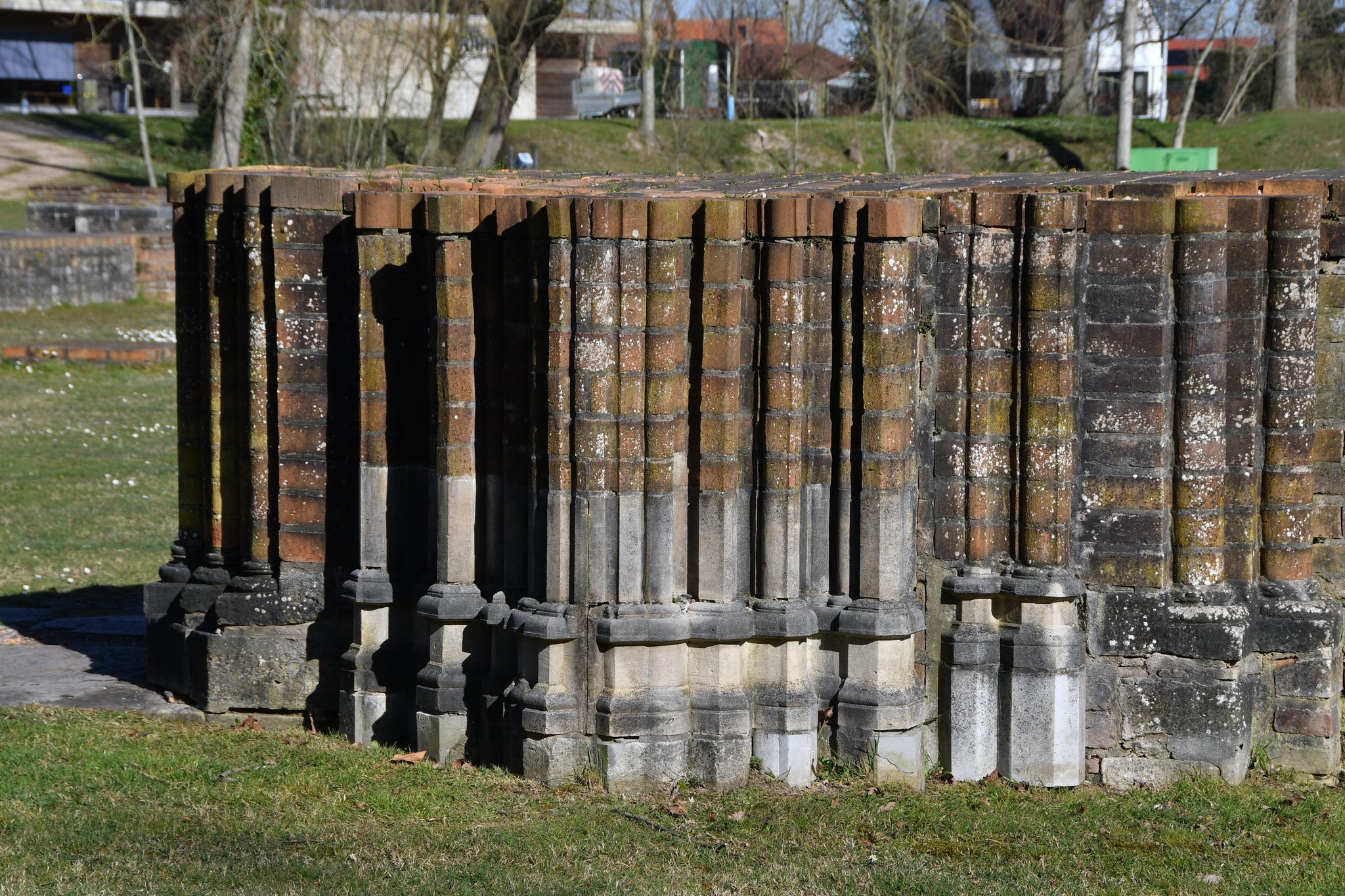
Windblown dune sand progressively buried the Koksijde buildings. Excavation has brought to light bricks, colonnettes, pillar bases, and other architectural remains. These remains are displayed across an open-air archaeological museum and park, where the exposed ruins preserve the organization of the medieval abbey.
The Bruges monastery
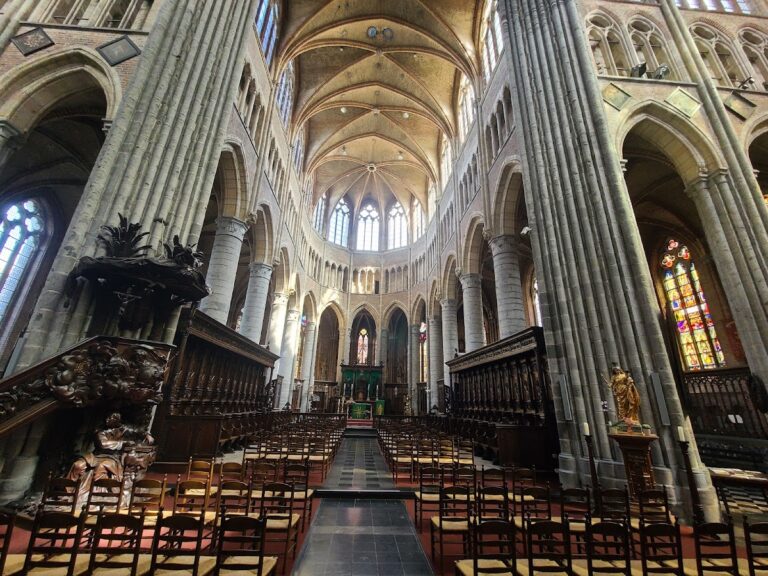
The Bruges complex was built between 1628 and 1642 after the community settled in the former Ter Doest refuge. Its large cloister dates from about 1628 and contains 29 wall paintings from the late seventeenth century. The church was constructed between 1775 and 1788. Thirteen large portraits of abbots survive in the Bruges refectory, linking the later monastery with the succession of its leaders.
Ten Bogaerde and the agricultural estate
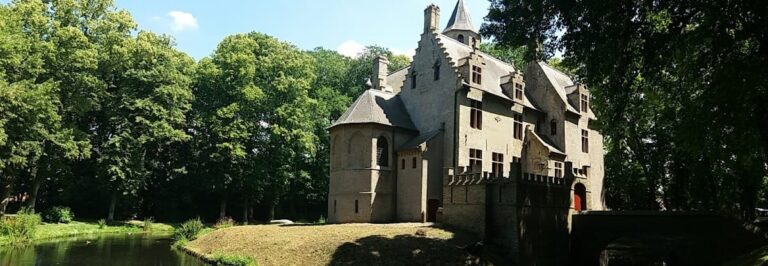
The former outlying farm of Ten Bogaerde preserves buildings from several periods of the abbey’s history. The Great Barn and entrance gate recall the medieval grange. The abbot’s building and the Church Barn belong to the seventeenth-century establishment created after the community left Koksijde. The pigsties, originally sheep sheds, reflect the farm’s eighteenth-century use.
The former Church Barn later served as a barn, while Ten Bogaerde remained connected with the abbey’s administrative and agricultural estate. A modern mill known as the South Abbey Mill was erected on an older mill mound. Ten graves were discovered in the eastern cloister walk in 2002.
Library and archival remains
The abbey possessed archives, a large library, and many illuminated manuscripts. Most of the manuscripts were copied at the abbey and display the restrained decoration associated with Cistercian book production. In 1638, the antiquarian Sandérus listed 1,025 manuscripts as well as numerous printed works. By the time of suppression, the library held more than 12,000 volumes.
The surviving manuscripts are divided principally between the library of the Grand Seminary of Bruges and the Biekorf municipal library. The archaeological museum at Koksijde contains finds recovered from the site, while the ruins and surrounding park preserve the exposed physical remains of the medieval abbey.