Taku Forts: Defensive Strongholds at the Hai River Estuary
Site at a Glance
- Rating
- 4.2
- Popularity
- Very Low
- Country
- China
- Primary era
- Modern
- Eras represented
- Modern
- Civilizations
- Unclassified
- Site type
- Military
- Remains
- Fort
On this page9 sections
History
The Taku Forts are a Chinese defensive complex at the Hai River estuary in Tianjin, China, built and expanded to protect access to Tianjin and its upstream port. Their history began in the Ming period, when the first fort was constructed between 1522 and 1527 during the reign of the Jiajing Emperor. The military commander Qi Jiguang directed its construction to defend Tianjin against wokou, maritime raiders who operated along the coasts of China, Korea, and Japan.
Expansion under the Qing
In 1816, the Qing government built two forts on opposite sides of the estuary as seaborne threats from Western powers increased. During the First Opium War, a conflict between Qing China and Western powers over trade, diplomacy, and access to Chinese markets, the defenses were expanded in 1841. The system then included five large forts, 13 earthen batteries, and 13 earthworks. Earthen batteries were gun positions formed mainly from packed earth, while earthworks were defensive structures made from shaped or piled soil.
In 1851, Imperial Commissioner Sengge Rinchen carried out a comprehensive renovation and enlarged the system to six large forts. An Imperial Commissioner was a senior Qing official appointed to undertake important military, administrative, or diplomatic duties. The forts subsequently became a major battlefield during the Second Opium War, which lasted from 1856 to 1860.
The Opium Wars
British and French gunboats attacked the forts in May 1858. The attack came shortly before the Treaties of Tianjin were signed in June, opening Tianjin to foreign trade. In 1859, a British naval force commanded by Admiral James Hope attacked again, but the defenders repulsed it. On 21 August 1860, an Anglo-French force landed in the area and captured the forts. They were severely damaged, and Sengge Rinchen’s troops withdrew.
After taking the forts, the allied force advanced towards Beijing. It reached the city on 26 September and captured it by 13 October 1860. The Taku Forts therefore formed part of the military route through which the Second Opium War reached the Qing capital.
Destruction and preservation
During the Boxer Rebellion, an anti-foreign and anti-Christian uprising in China, the forts were captured by the Eight-Nation Alliance in June 1900. Most of the fortifications were dismantled after the uprising, and the forts were largely demolished during the same year.
Two forts survive, the former Wei Fort on the southern bank of the Hai River and the former Hai Fort on the northern bank. The southern Dagu Fort was restored in 1988 and opened to the public in June 1997. The Dagukou Forts were included in China’s third batch of National Priority Protected Sites in 1988, a designation that places important cultural heritage under formal state protection. The restored fort also contains a Chinese-language exhibition on the Opium Wars and the forts’ role in those conflicts.
Remains
Estuary defenses
The forts occupied the Hai River estuary in the Binhai area of Tianjin, approximately 60 kilometres southeast of central Tianjin. Their position controlled the river approach to Tianjin and its port. By 1851, the six large forts were arranged on both sides of the estuary and on a small ridge along the northern shore. Wei and Zhen stood to the south, while Hai, Men, and Gao occupied the northern side. Shitoufeng, whose name means “Stone Seam,” stood on the northern ridge.
Each large fort carried three large guns and 20 small-calibre guns. Wood and brick formed the main construction, while an external concrete curtain about two feet thick was intended to reduce the scattering of masonry and limit penetration by artillery fire. The forts rose approximately 10 to 15 metres above the surrounding ground, giving them an elevated position in the otherwise very flat landscape.
Surviving forts
Southern Dagu Fort
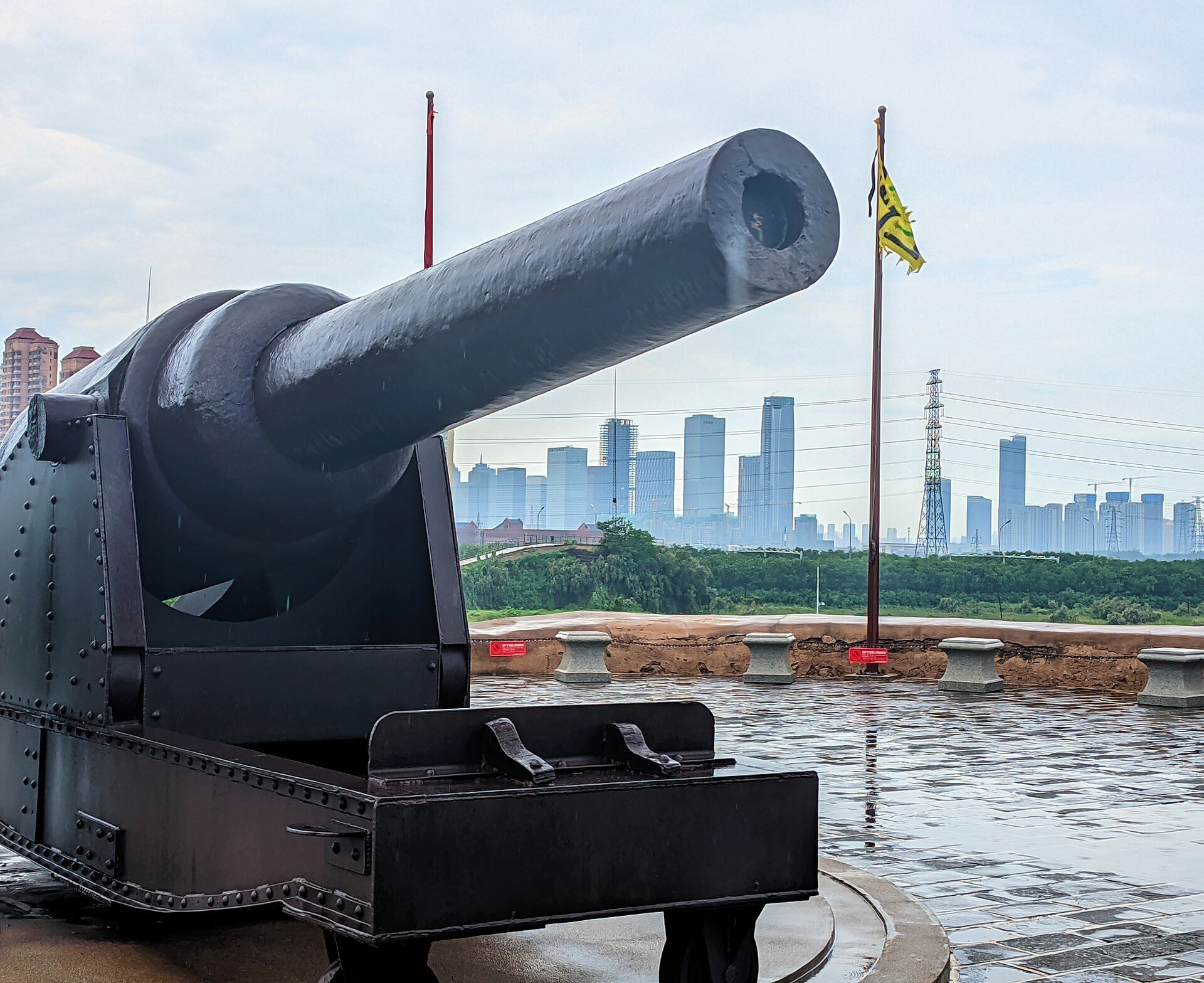
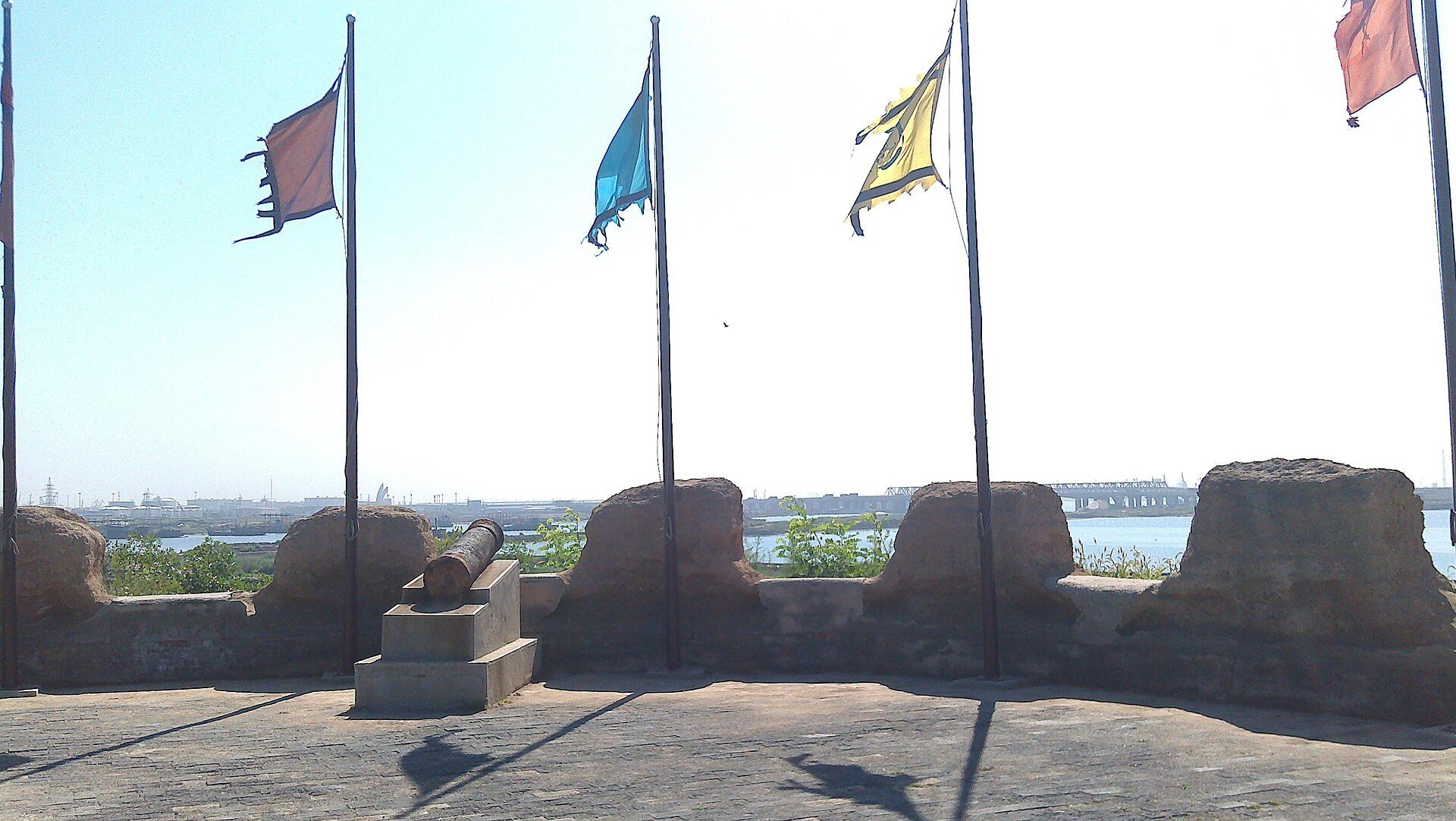
The restored southern fort is the former Wei Fort. Its present form has been substantially altered from the active gun battery that defended the estuary. Land reclamation has placed it some distance from the modern shoreline. The restoration reconstructed gun embrasures, openings through which cannons could be fired, and installed a number of cannons in them to evoke the fort’s former military function. This work presents the defensive arrangement without fully recreating the fort’s historical appearance.
Northern Hai Fort
The former Hai Fort survives on the northern bank of the Hai River. It remains unrestored and can be seen from Haifang Road north of the restored southern fort. Together, the surviving southern and northern forts represent the remains of a larger estuary defense system that once included six major forts, earthen batteries, and earthworks.