Fort Schanskop: A Historic Fortification and Military Museum
Site at a Glance
- Rating
- 4.4
- Popularity
- Low
- Country
- South Africa
- Primary era
- Modern
- External website
- Open
- Eras represented
- Modern
- Civilizations
- Unclassified
- Site type
- Military
- Remains
- Fort
On this page7 sections
History
Fort Schanskop is a late nineteenth-century fortification in South Africa, located near Pretoria and built by the Zuid-Afrikaansche Republiek, also called the South African Republic or Transvaal Republic. Constructed in 1897 in response to fears of external attack after the Jameson Raid, it formed part of a defensive system intended to protect the capital and the railway toward Johannesburg shortly before the Second Boer War.
Planning and construction
The Jameson Raid was an unsuccessful armed incursion into the South African Republic in 1895 and 1896. Its aftermath heightened concern about Pretoria’s security, leading the government to approve a plan for eight forts on 24 March 1896. Limited funds allowed only four to be completed: Fort Schanskop, Fort Klapperkop, Fort Wonderboompoort, and Fort Daspoortrand.
President Paul Kruger initiated the construction of Fort Schanskop, which was formally handed over on 6 April 1897. The German engineering and armaments company Krupp produced the design, with Otto Albert Adolph von Dewitz and Heinrich C. Werner as engineers and Christiaan Kuntz as architect. Much of the labor came from African and Italian workers, supported by German and Dutch specialists.
The Second Boer War
The fort originally held one officer and 30 men, but its garrison had fallen to 17 by October 1899. During the Second Boer War, the 1899–1902 conflict between the British Empire and the Boer republics, personnel and weapons were gradually withdrawn. When British forces captured Pretoria on 5 June 1900, only one man remained at Fort Schanskop and its cannon had been removed. The fort therefore surrendered without a fight and was occupied by the 2nd Battalion of the Royal Dublin Fusiliers.
Military use and museum history
Fort Schanskop continued as a military installation after the war. It passed to the government of the Union of South Africa in 1922 and was later used by the Union Defence Force. The fort was declared a National Monument together with Fort Klapperkop on 8 July 1938, and it is also a provincial heritage site of Gauteng.
In 1962, Fort Schanskop became a military museum, followed by renovation in 1978. A proposed plan to incorporate it into the Fort Klapperkop Military Museum was not carried out. Budget cuts in 1994 led the South African Defence Force to return both museums to the state. The Voortrekker Monument heritage organization acquired Fort Schanskop from the City of Pretoria in June 2000, after which the site was renovated and enlarged. Since 2000, it has formed part of the Voortrekker Monument complex. The present museum, also known as the Anglo-Boer War Museum, covers the Second Boer War and the period that followed through 1914.
Remains
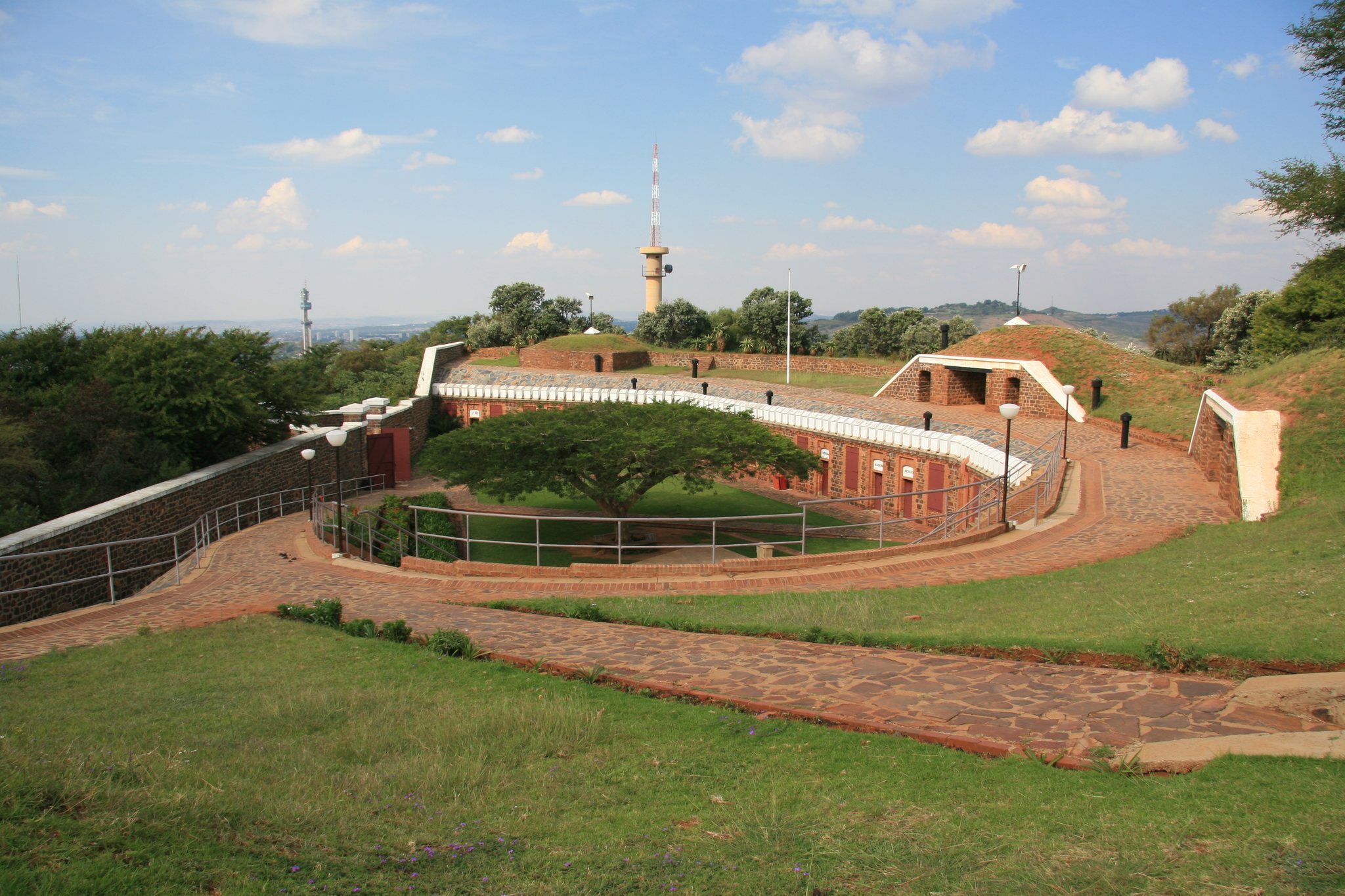
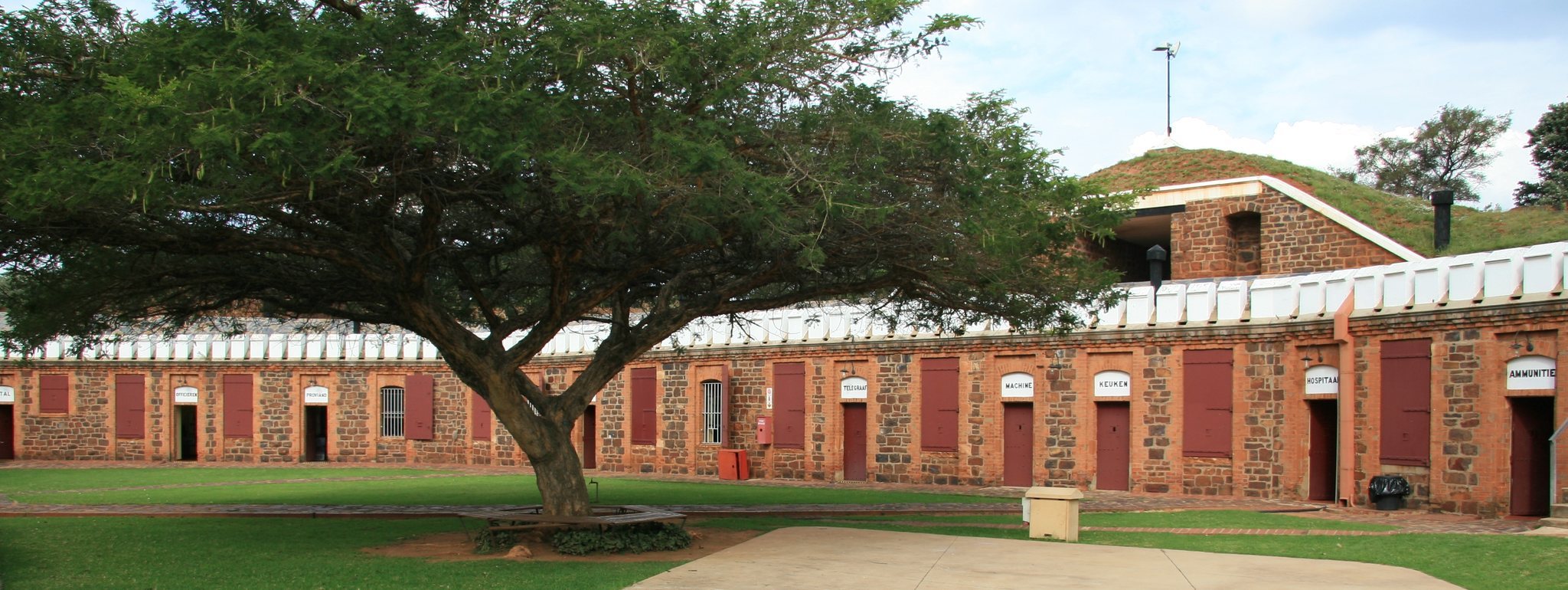
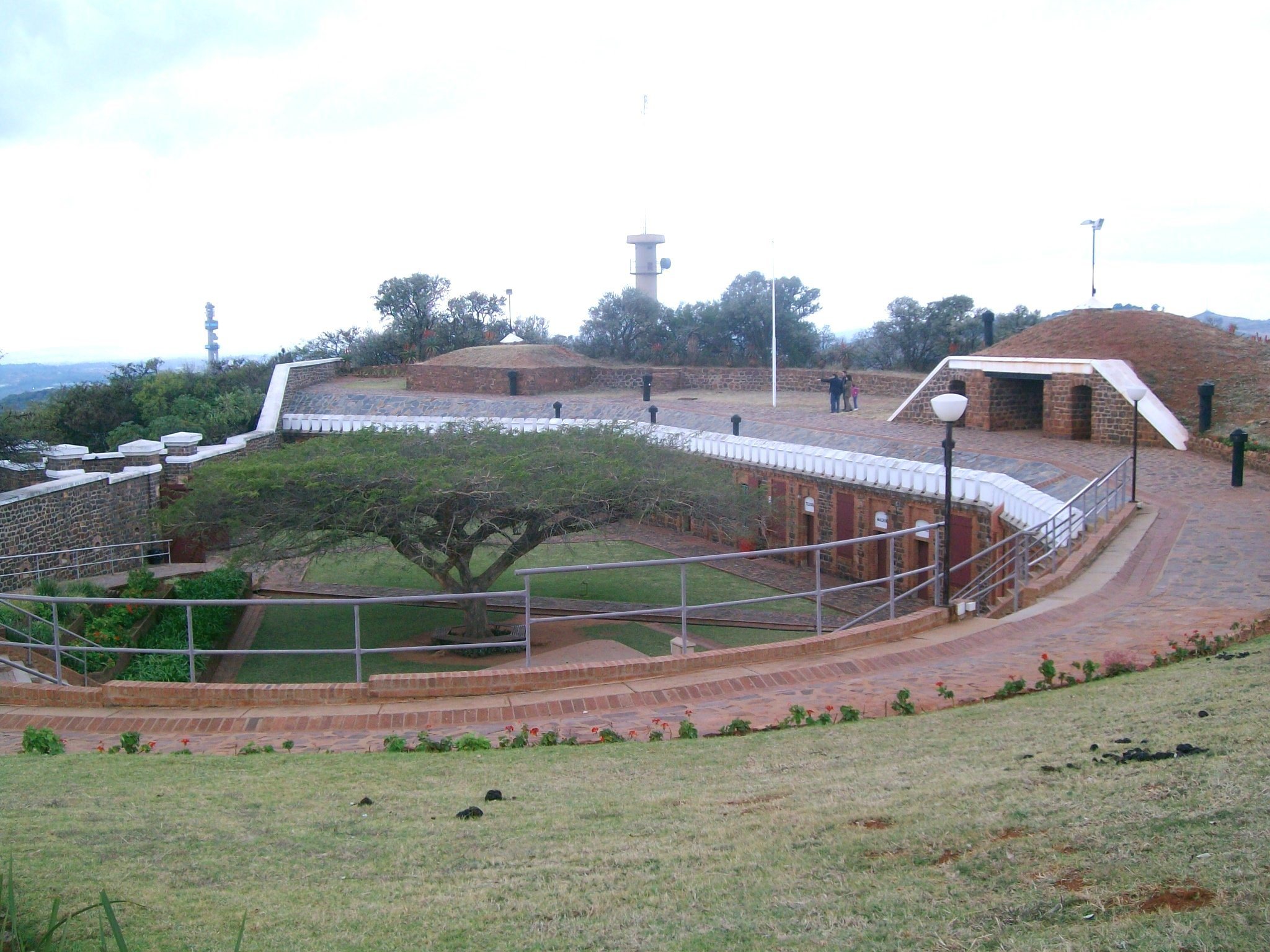
Fort Schanskop is a south-facing, pentagonal fortification on a hill south of Pretoria, within the grounds of the Voortrekker Monument and west of Groenkloof. Fort Klapperkop stands to its east. The surviving complex combines partly subterranean fortified rooms with defensive works intended to protect the position from attack in any direction.
Fortifications and defensive systems
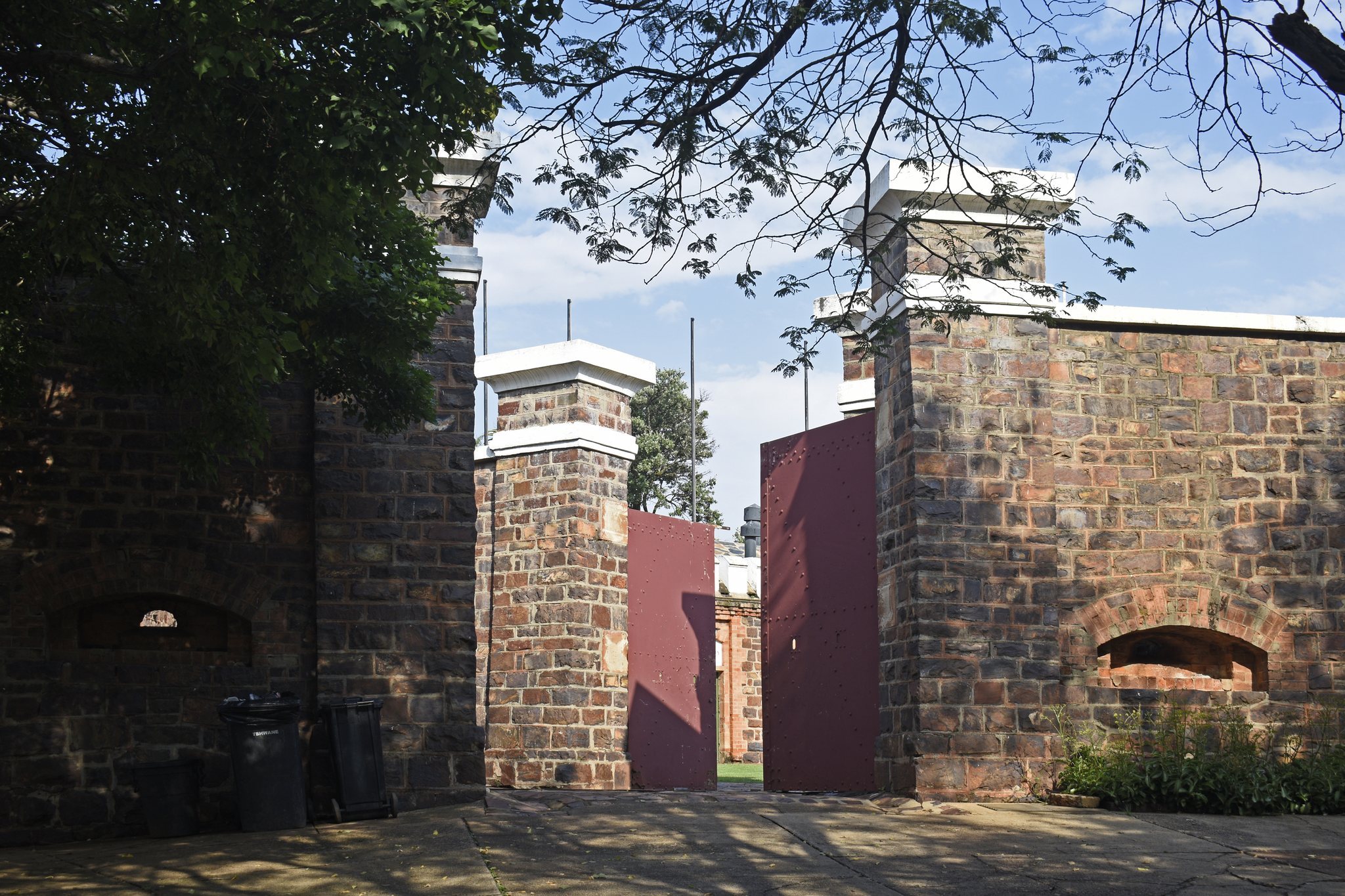
A ditch, trenches, and barbed-wire entanglements formed part of the fort’s defenses. Narrow firing openings, or loopholes, allowed defenders to fire from protected positions while covering the surrounding terrain. Fortified rooms and an artillery battery strengthened the defensive arrangement, while several guns of different calibers provided its firepower. These included a 37 mm Maxim-Nordenfeldt cannon, crank-operated Maxim machine guns, Martini-Henry weapons, and a 75 mm Creusot cannon known as a Long Tom.
A pumping station was shared with Fort Klapperkop, and running water reached the fort from the Apies River. The partly below-ground rooms provided protected interior spaces, while the combination of trenches, wire, artillery, and loopholes linked the fort’s construction to its intended role in defending Pretoria and the railway toward Johannesburg.
Museum collections and memorial features
The museum inside the fort contains weapons, paintings, portraits of Boer generals, and photographs relating to the fort and the Second Boer War between 1899 and 1914. A 200-kilogram bronze bust of General Piet Joubert stands inside the fort. Joubert was a leading military commander of the South African Republic and served as its commandant-general.
A statue of Danie Theron stands at the entrance. It was moved there in 2002 from the Danie Theron Combat School in Kimberley and inaugurated in the presence of Nelson Mandela, the South African anti-apartheid leader and later president. The entrance also contains a scale replica of the Trek Monument, described as reproducing a monument inaugurated on 16 December 1954 in what was then Tanganyika, now Tanzania.