Holy Name Church: A Jesuit and Old Catholic Church in Bonn
Site at a Glance
- Rating
- 4.6
- Popularity
- Low
- Country
- Germany
- Primary era
- Early Modern
- External website
- Open
- Eras represented
- Early Modern, Modern
- Civilizations
- Holy Roman Empire
- Site type
- Religious
- Remains
- Cathedral
On this page16 sections
History
Holy Name Church is a post-Gothic Jesuit church in Bonn, Germany, built between 1686 and 1717 in a style that combines Baroque forms with Romanesque and Gothic elements. Its construction was initiated by Maximilian Heinrich of Bavaria, Elector and Archbishop of Cologne, after the traditional discovery in 1681 of a piece of beechwood bearing or resembling the Christian monogram IHS, an abbreviation of the name of Jesus. The church was dedicated to the Holy Name of Jesus and became an important center for the Jesuit community and its nearby school.
Foundation and Jesuit construction
Maximilian Heinrich laid the foundation stone on 14 September 1686. He reportedly contributed 50,000 thalers and ordered that the new church bear its devotional dedication. The architect was Giacomo de Candrea of Graubünden, whose design used the architectural language later described as Jesuit Gothic. This approach combined Baroque planning and decoration with forms drawn from Romanesque and Gothic architecture.
The unfinished church was severely damaged by a mortar attack on 24 July 1689 during the War of the Palatine Succession, a conflict over territory and dynastic claims in western Europe. The building survived, but construction was interrupted after the Jesuits were expelled from Bonn by the French later that year. They were regarded as supporters of Joseph Clemens of Bavaria, Elector and Archbishop of Cologne. After the Allied reconquest, the Jesuits returned and work resumed around 1692.
The church was usable by 3 December 1694, the feast of Saint Francis Xavier, and its main structure was completed in 1698. Furnishing continued until 1704, when the high altar, side altars, and confessionals had received their decoration. Joseph Clemens consecrated the church in 1717. Until the Jesuits left Bonn in 1774, it served both their religious community and their educational institution.
From the French period to the twentieth century
After the Jesuits departed, the church stood empty. During the French period from 1794 to 1800, much of its furniture was destroyed, and the interior was converted for use as a horse stable and soldiers’ accommodation. Church property other than parish churches was confiscated, leaving Holy Name Church in state ownership. Ownership later passed from the French state to Prussia and ultimately to North Rhine-Westphalia.
From 1877 to 1934, the building served as the parish church of Bonn’s Old Catholic congregation. The Old Catholic Church is a Catholic tradition that separated from Roman Catholic structures after rejecting papal infallibility associated with the First Vatican Council of 1869 to 1870. Holy Name Church then became a Roman Catholic university church. Joseph Ratzinger preached there at the beginning of the 1960s, and the building later served the Catholic university community.
War damage and later religious use
Allied air raids at the end of the Second World War severely damaged the church. The roof covering of the nave and towers was destroyed, while the structure suffered especially on its south side. Shell fragments damaged the facade and window tracery, the southern sacristy burned out, the vault was struck, and the gable began to lean westward.
Reconstruction was substantially complete by the end of 1950, was finalized in 1954, and included the furnishings by 1957. Major restoration and conservation work carried out by North Rhine-Westphalia from 2006 to 2012 repaired the towers, stabilized the facade, removed dampness, renewed the roof, and restored the interior colors. These measures secured much of the church’s surviving historic fabric.
The Archdiocese of Cologne gave up use of the church in 2009. Since 2012, Holy Name Church has served as the diocesan and cathedral church of the German Diocese of the Old Catholics, as well as an Old Catholic city church. The Name-of-Jesus Church Foundation maintains the building and supports its liturgical and cultural use. The church remains state-owned and is legally protected as a historic monument.
Remains
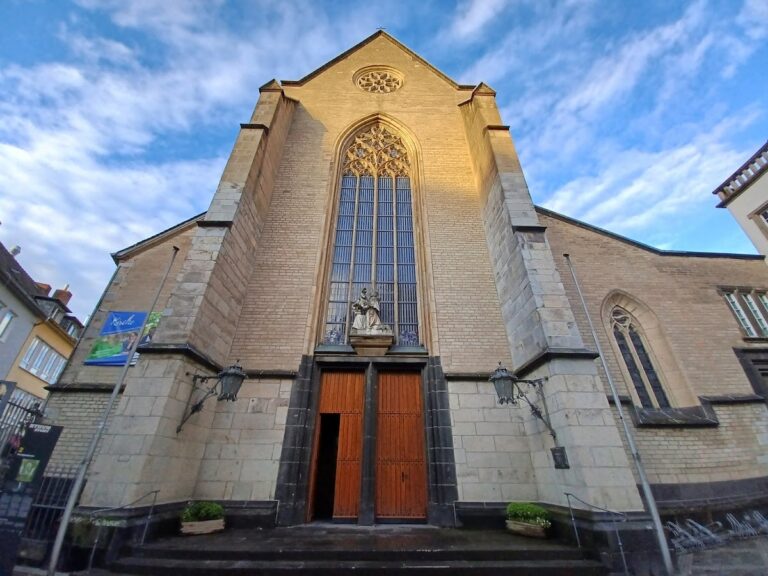
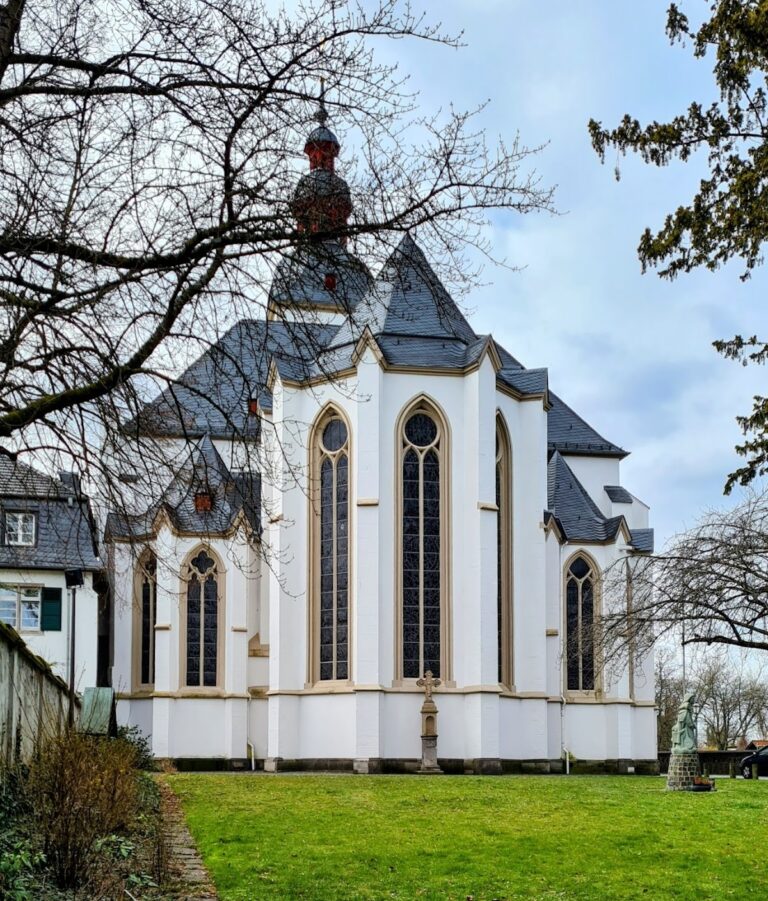
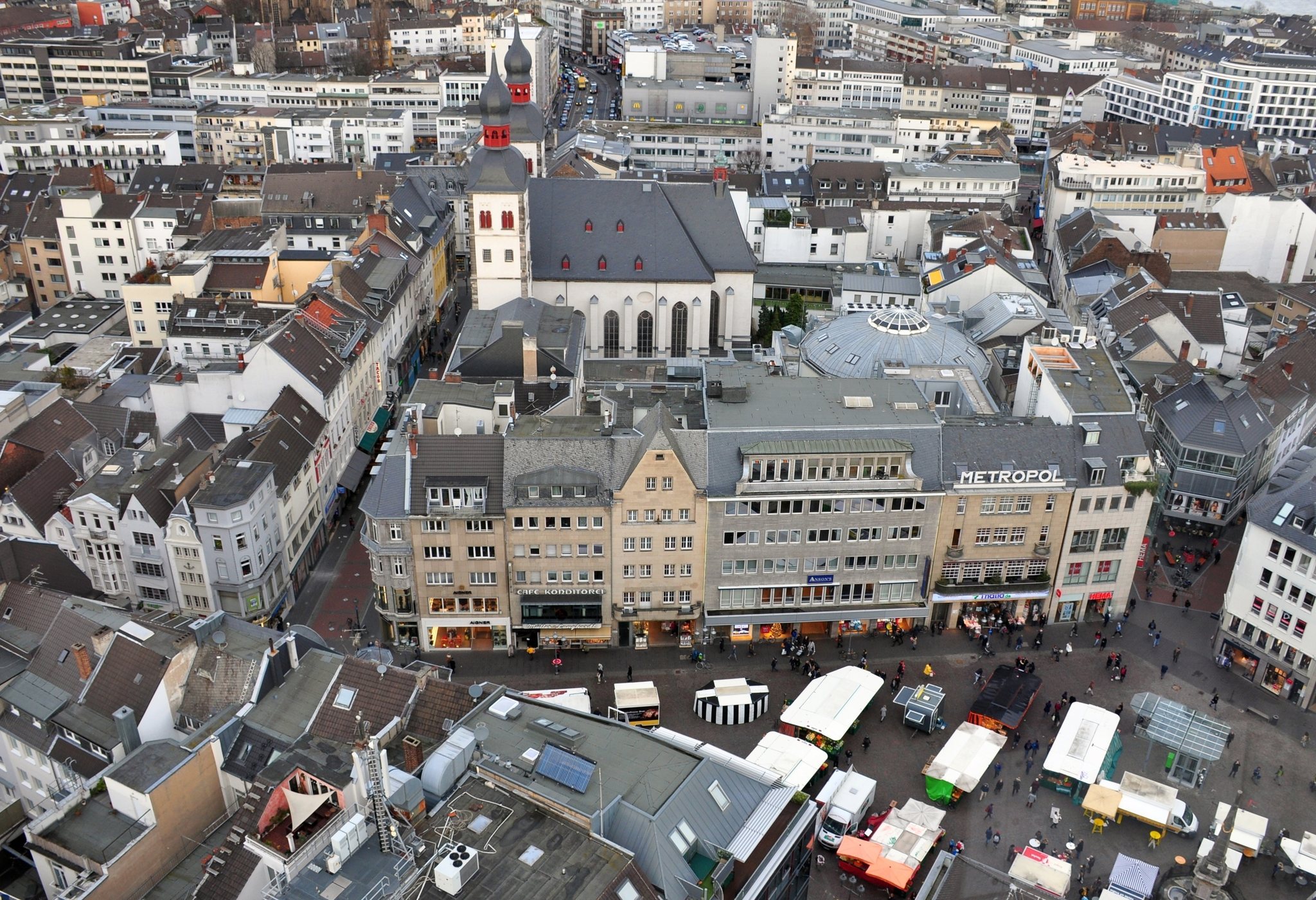
Holy Name Church presents a unified hall-like interior beneath a facade that combines Romanesque, Gothic, and Baroque features. The building is 33.5 meters long and 16.5 meters wide, including a central nave 8.5 meters wide. The nave rises 16 meters, while the two towers reach approximately 53 meters. The surviving structure, furnishings, crypt, organ, and bells preserve evidence of the church’s Jesuit origins, later adaptations, wartime destruction, and subsequent restoration.
Facade and structure
Towers and central facade
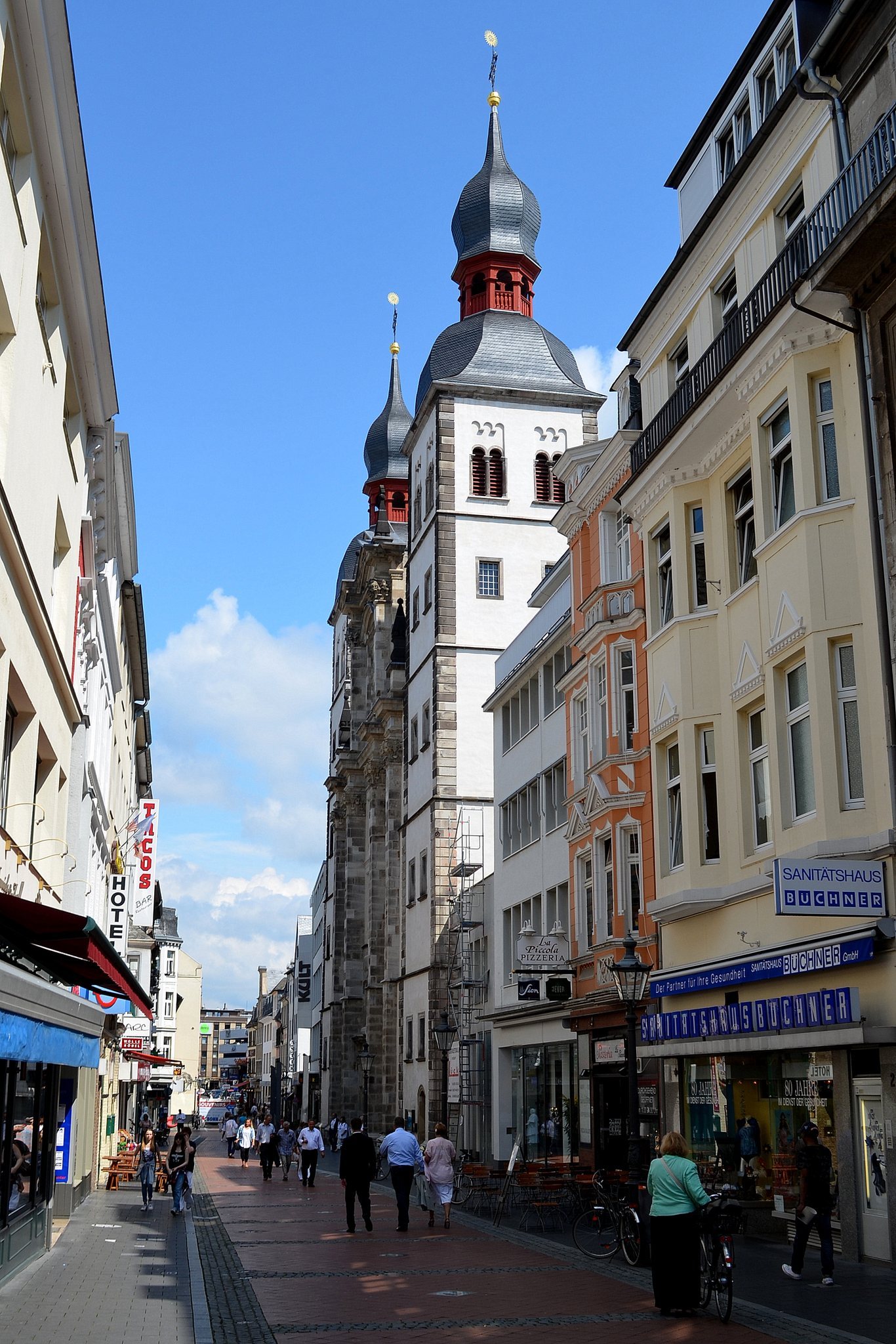
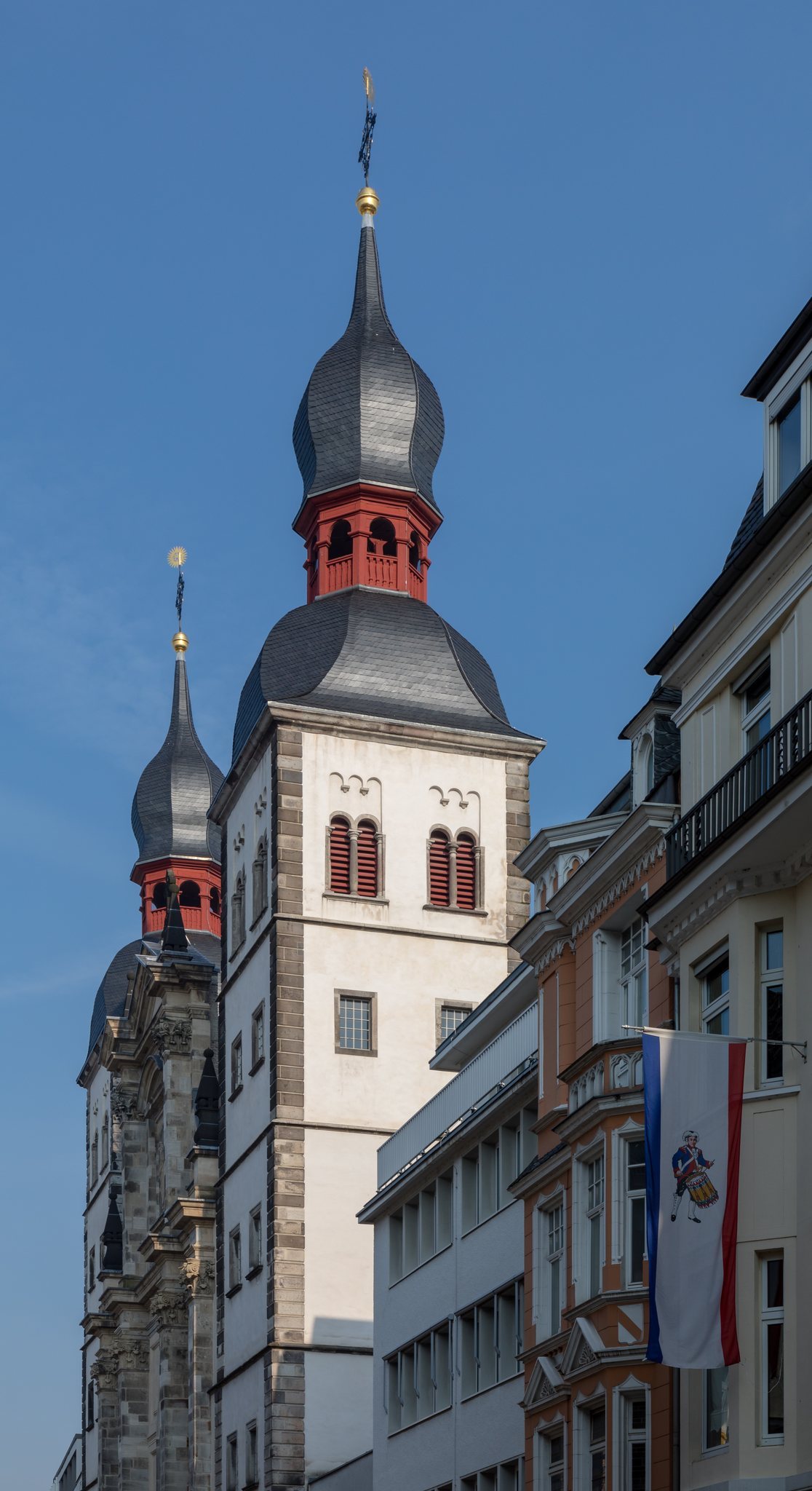
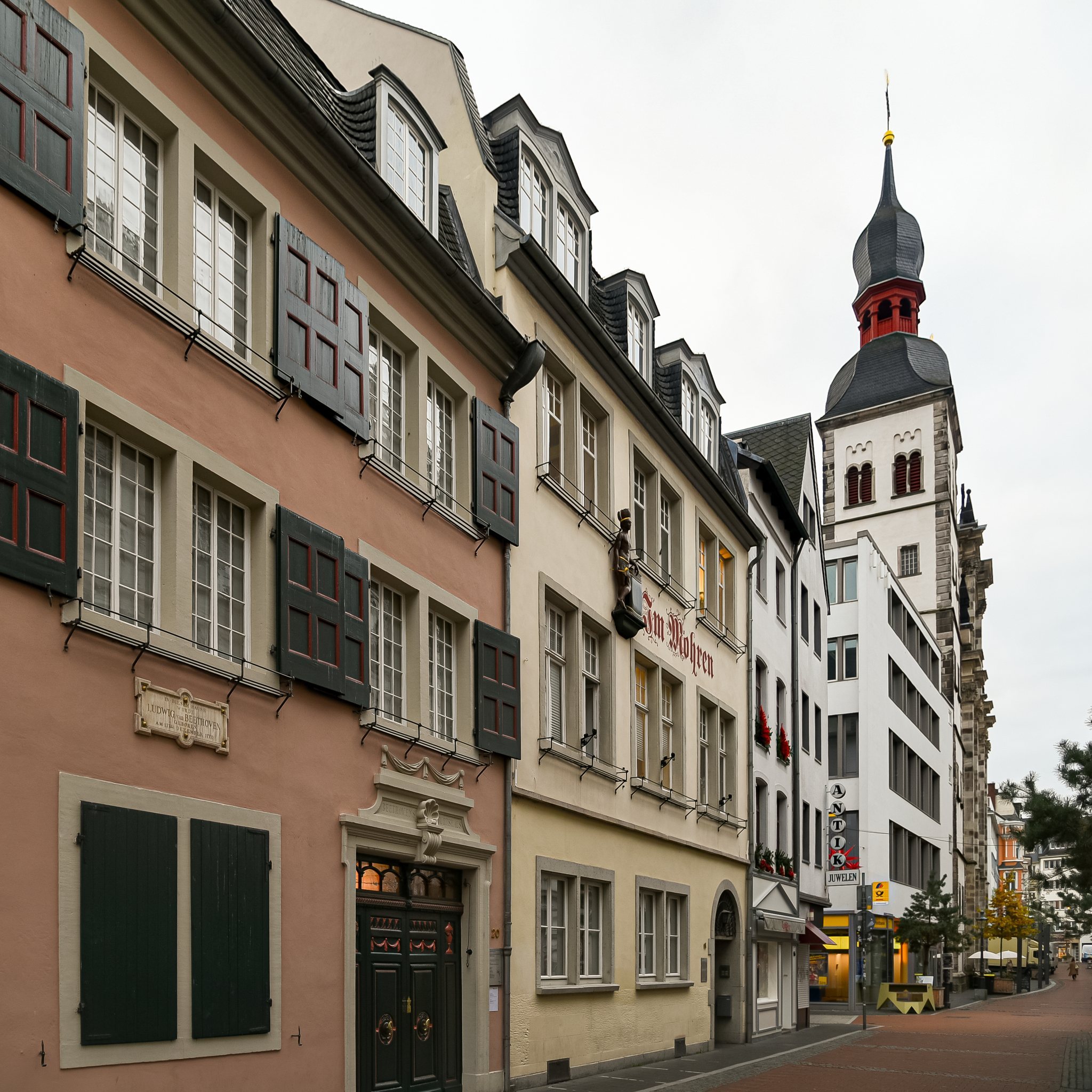
The facade is formed by two towers and a central section. The towers contain Romanesque double windows and are crowned by welsche hoods, bulbous or curved roofs associated with Baroque architecture. The central section has pointed Gothic windows, while the columns carry Baroque decoration. A former inscription above the main portal contained a chronogram, an inscription whose selected letters encode a date as Roman numerals. It yielded the year 1717 and included the IHS monogram associated with the church’s dedication.
Crypt and burials
A barrel-vaulted crypt lies beneath the altar area. It contains the surviving burial places of 66 Jesuit fathers from the period of the Jesuit monastery before 1774. Since 2012, the crypt has also included an Old Catholic urn cemetery, a burial facility for cremation urns, for people connected with the church. Among those buried there is the university teacher Ulrich Heifer, who died in 2018.
Altars and liturgical furnishings
High altar
The high altar was made by Bartholomäus Dierix around 1755. Its white-and-gold antependium carries a radiant cross, while a tabernacle stands above the altar table. The carved upper structure uses pilasters, projecting columns, and drapery held by putti. Above it, God the Father is shown enthroned in clouds with a globe, putti, and angels.
The altar’s framed eighteenth-century painting depicts the Holy Family. Joseph sits in the foreground, while Mary stands behind him holding the Christ Child, who looks toward a cross in Joseph’s hand. An electoral coat of arms with an electoral hat is mounted above the painting. Sculptures of Saint Felix and Saint Elisabeth of Thuringia stand on the two wooden bridges that close the altar toward the choir wall.
Side altars
The two side altars are made of limewood. Their paintings were long believed to have been lost, but they were restored and returned to the church in 2013. The painting on the right represents Saint Anthony of Padua, while the painting on the left represents Saint Francis of Assisi.
Pulpit and confessionals
The Baroque pulpit dates from 1698. Its sounding board is crowned by a figure of the archangel Michael killing a dragon. The confessionals set into the side walls date from the middle of the eighteenth century and are characteristic of Jesuit church furnishings. Because the Old Catholic Church does not require them for confession, they now serve as places for listening to music or reading.
Contemporary wooden furniture
In 2011, Klaus Simon made a new altar, lectern, Easter candle stand, bishop’s chair, and other seating from a section of a fallen 300-year-old oak known as the Thick Oak. The tree, a natural monument in the Kottenforst near Bonn, fell on 27 December 2010 after surviving two lightning strikes. The furniture preserves elements of the tree’s life history and uses its wounds as a reference to human wounds.
Organ and bells
Organ
The first documented organ was built by Georg Stahlhuth in 1870. It had 19 stops on two manuals and pedal, but was so badly damaged during the Second World War that it was dismantled in 1951. Johannes Klais of Bonn built the replacement in 1958 as opus 1147. It has 25 stops on two manuals and pedal, mechanical key action, electric stop action, and slider chests, in which sliding strips admit air to the pipes of individual stops. Its equipment includes the couplers II/I, I/P, and II/P, two free combinations, one free pedal combination, a tutti control, and four individual reed-stop cancelers.
Historic and modern bells
The south tower contains a historic softwood bell frame dating from the completion of the towers. Its beams are embedded in the tower walls, and its three-bay arrangement apparently never previously carried bells because it lacks recesses for the required yoke bearings.
A 1535 fire bell, probably transferred from the Remigius Church demolished in 1806 to 1807, was formerly kept in the lantern of the south tower. It was hung for ringing there in 2012. Attributed to the Cologne founder Johan von Coellen, although its maker is not named in the inscription, it has unusually heavy rib construction. The bell weighs about 155 kilograms, measures 590 millimeters in diameter, and has a striking-ring thickness of 60 millimeters.
Other historical bells associated with the church include one cast in 1732, consecrated in 1733, and recast in 1896, with the inscription “Glory to God in the Highest.” A small bell cast in 1771 by the Cologne founder Johann Fuchs carried inscriptions glorifying God, an image of the Immaculate Virgin with an “Ave Maria” inscription, and a relief of the Holy Name of Jesus.
Three additional bells were cast by Rudolf Perner in Passau in October 2011 and dedicated on 1 January 2012. Dedicated to the Creator, Christ, and the Holy Spirit, they echo the older fire bell in their inscriptions and decorative friezes. Together with that bell, they form a four-bell peal in the south tower. Their sound is coordinated with the peals of Bonn Minster Basilica and Saint Remigius, producing a continuous B-flat major scale. Documented ringing includes the Angelus at 9:00, 12:00, and 19:00, a late-evening bell for the night watch, Friday ringing at the traditional hour of Christ’s death, funeral ringing, and announcements of Sundays, services, and selected feast days.