Isca Augusta: Roman Legionary Fortress in Wales


Site at a Glance
- Rating
- 5
- Popularity
- Very Low
- Country
- United Kingdom
- Primary era
- Classical
- External website
- Open
- Eras represented
- Classical
- Civilizations
- Roman
- Site type
- Military
- Remains
- Camp
On this page12 sections
History
Isca Augusta is a Roman legionary fortress in the United Kingdom, established around AD 75 beneath parts of modern Caerleon in Newport, South Wales. The Romans built it during the final campaigns of Governor Sextus Julius Frontinus against the Silures, an indigenous people of south-eastern Wales who had resisted Roman conquest for more than a generation. Positioned near the mouth of the River Usk, the fortress became the headquarters of Legio II Augusta and formed the centre of a large military and civilian community.
Foundation and the Legionary Base
Legio II Augusta had taken part in the Roman invasion of Britain under Emperor Claudius in AD 43. At Isca, it established a permanent base within Silurian territory, close enough to the River Usk for sea-going ships to bring reinforcements and supplies. The fortress was surrounded by an extensive settlement, cemeteries, and supporting facilities that may have covered about 100 hectares in total.
Isca remained the legion’s headquarters until at least AD 300 and continued to be occupied in some form throughout the Roman period. By about AD 120, detachments known as vexillations, temporary units drawn from a larger legion, were being sent to other parts of the province. Isca consequently operated increasingly as a military base rather than as the permanent home of the full legion, although each cohort is thought to have retained a presence there.
Late Roman Rebuilding and Decline
After Septimius Severus seized power during the political struggles of the 190s, Isca was refurbished and Legio II Augusta returned while recovering from heavy losses on the Continent. Under his son Caracalla, the south-west gate was rebuilt, the amphitheatre was remodelled, and the barracks were repaired and reroofed. These works formed part of wider military campaigns and rebuilding programmes by the two emperors in Britain.
The legion may have been withdrawn during the political conflicts of the late third century to support one of the rival emperors. Much of the fortress was then left empty, although a caretaker force is thought to have maintained its facilities. Reoccupation and rebuilding continued as late as the 270s. The main military buildings were probably demolished by the usurpers Carausius or Allectus, who controlled Britain during the late-third-century political crisis, when the legion was needed for defence against a possible invasion from the Continent. Stone from Isca may subsequently have been reused in coastal defences in southern Britain.
An occasional military presence probably continued into the early fourth century. Afterward, the surrounding civilian settlement appears to have taken over parts of the fortress, and the basilica of the bath complex was used as a cattle pen. Roman occupation of some kind continued as late as about AD 380, according to recent finds.
Memory and Archaeological Investigation
Isca is one of only three permanent legionary fortresses in later Roman Britain, alongside Chester and York. Its remains are relatively undisturbed beneath fields and the modern town, making the site especially valuable for studying the Roman conquest, pacification, and colonisation of Britain.
Early medieval tradition associated Caerleon with the “City of the Legions.” Gildas and Bede connected that place with the martyrdoms of Aaron and Julius during the persecution of Christians under Diocletian, probably in AD 304. Two medieval chapels dedicated to the martyrs reinforced the identification. The rounded amphitheatre was later known traditionally as King Arthur’s Round Table, although no connection with Arthur is known.
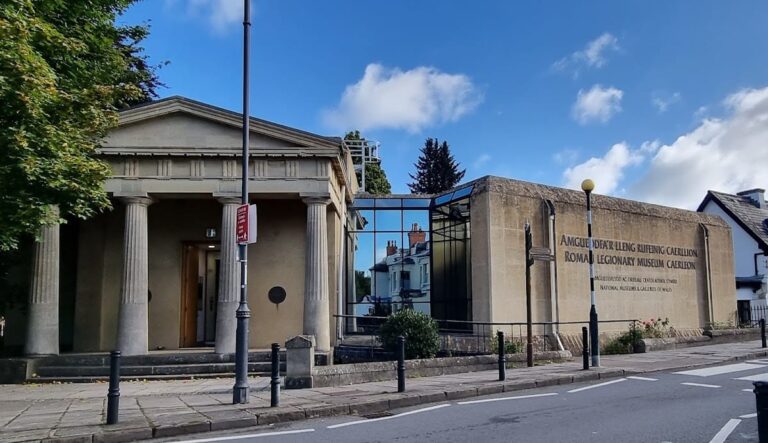
Investigation of the amphitheatre began in 1909, and full excavation started in 1926 under Victor Erle Nash-Williams. Later excavation, archaeological research, and geophysical survey revealed much of the fortress plan and uncovered a previously unknown group of very large monumental buildings in the civilian settlement between the River Usk and the amphitheatre. A Roman harbour was also uncovered at Caerleon in August 2011. Cadw administers and protects the surviving Roman remains, while finds from Caerleon and nearby Burrium, including coins, weapons, and military equipment, are exhibited at the National Roman Legion Museum in Caerleon.
Remains
Isca Augusta occupied a tongue of raised ground projecting across the Wye floodplain. The fortress followed a rectangular playing-card plan with rounded corners and enclosed about 9.2 hectares. Its military buildings stood within defences that later formed the framework for the surrounding civilian settlement, roads, and cemeteries.
Fortress Defences and Roads
The earliest defences consisted of an earth or turf bank and a timber palisade made with turf, clay, and timber. Around AD 99 to 100, an inscription of Trajan records their replacement or strengthening with a stone revetment. The later rampart combined a stone wall about 5 to 5.5 feet thick with a clay bank behind it and a single ditch in front.
Sections of the fortress wall survive on the south-west side, rising to about 12 feet, or 3.7 metres, and another surviving section on the south side remains close to its original height. Turrets, cookhouses, ovens, and a latrine have been found in association with the fortress road system. Modern Caerleon partly follows the Roman street plan. Broadway occupies the line of the via principalis, the main cross-route through a fortress, while High Street follows the via praetoria, the principal road leading toward the headquarters area and the River Usk crossing.
Military Buildings
Headquarters and Service Buildings
The fortress contained a headquarters building, a residence for the legion’s commander, houses for tribunes, a hospital, workshops, bath facilities, and granaries. The workshops served legionary craftsmen, including blacksmiths, carpenters, and shoemakers. Together, these buildings provided the administrative, medical, manufacturing, storage, and domestic infrastructure required by a permanent Roman legionary base.
Prysg Field Barracks
The barracks were arranged in long, narrow blocks for ordinary soldiers, with a separate area for officers’ quarters. At Prysg Field, consolidated footings preserve the plan of the barracks and are visible for public display. They are described as the only Roman legionary barracks visible in Europe.
Bath Complex
Part of the large military bathhouse survives beneath a cover building, while another section remains in situ above the excavated structures. The bath basilica, a substantial hall within the complex, was later reused as a cattle pen. Its surviving remains therefore preserve both the Roman military arrangement and a later change in the use of the building.
Amphitheatre
An unusually large amphitheatre stood immediately outside the fortress walls. Its oval arena had eight entrances and could accommodate approximately 5,000 to 6,000 spectators. The building hosted gladiatorial entertainments and probably also served for displays and exercises by the garrison.
The first amphitheatre was constructed around AD 80 as a Period I building. Fire destroyed it in the early second century, and a Period II structure replaced it around AD 138. That building was destroyed around AD 196 to 197. A third and final structure was erected during the campaigns of Septimius Severus and Caracalla in Britain, around AD 197 to 211. The amphitheatre fell out of use around the middle of the fourth century, when the fortress was evacuated. A coin of Emperor Valens, who ruled from AD 364 to 378, provides its latest recorded coin date.
Settlement, Harbour, and Cemeteries
The civilian settlement, or canabae, extended around the fortress and provided services, trade, manufacturing, and accommodation for the military community. Large monumental buildings occupied the area between the River Usk and the amphitheatre. Cemeteries fringed the settlement, while roads led north toward Brecon and west toward Cardiff. Another road passed through the settlement at Bulmore, about 2 kilometres east of Caerleon, before continuing toward Venta at Caerwent.
The remains of a Roman harbour uncovered at Caerleon in 2011 add evidence for the site’s connection with the River Usk and wider transport networks. Today, the fortress and its settlement lie beneath parts of the modern town, fields, and publicly displayed archaeological areas. Surviving features include the fortress walls, consolidated barrack foundations, the bath complex, and the amphitheatre.