Castle Clinton: A Historic Fort and Public Landmark in New York Harbor
Site at a Glance
- Rating
- 4.4
- Popularity
- Very High
- Country
- United States
- Primary era
- Modern
- External website
- Open
- Eras represented
- Modern
- Civilizations
- Unclassified
- Site type
- Military
- Remains
- Fort
On this page14 sections
History
Castle Clinton is a historic fort in New York City, United States, built by the United States for the defense of New York Harbor in the early nineteenth century. Constructed between 1808 and 1811 on an artificial island, it formed part of a harbor-defense system planned during renewed tensions with Britain before the War of 1812, the 1812–1815 conflict between the United States and Britain. The fort later became an entertainment venue, the first immigrant-processing depot in the United States, New York City’s first public aquarium, and a national monument.
Harbor Fortification
Castle Clinton stands slightly west of Fort Amsterdam, the Dutch fort built in 1626 when Manhattan was New Amsterdam. Fort Amsterdam was demolished by 1790. As concern about another conflict with Britain grew, planning for new defenses began in 1805 under Lieutenant Colonel Jonathan Williams of the United States Army Corps of Engineers. In 1807, Williams and two other commissioners recommended a coordinated system of harbor fortifications that included the future Castle Clinton.
Construction began in 1808 on an artificial island just offshore. The fort was originally called the West Battery, and it was also known as the Southwest Battery. John McComb Jr. designed it, with Williams serving as consulting engineer. Its position was intended to complement Castle Williams, a separate three-tiered fortification on Governors Island. Although the fort was completed in 1811, modifications continued into the 1820s.
The fort was garrisoned in 1812 but never fired its guns in combat. After the peace treaty between Britain and the United States in February 1815, it was renamed Fort Clinton in honor of DeWitt Clinton, a New York political leader who had served as mayor of New York City and later became governor of New York. The Army used the building as an administrative headquarters, a paymaster’s residence, and a storage area. By 1821, military use had ended, and Congress ceded the fort to New York City in March 1822.
Castle Garden and Public Entertainment
New York City leased the former fort in June 1824 and subleased it to Francis Fitch, Arthur Roorbach, and J. Rathbone. It reopened as Castle Garden on July 3, 1824, as a beer garden, exhibition hall, and theater. The venue quickly became a major site for public gatherings. In September 1824, it hosted an event attended by 6,000 people in honor of General Lafayette.
Castle Garden also welcomed political figures and public demonstrations. Presidents Andrew Jackson, John Tyler, and James K. Polk appeared there, as did Lajos Kossuth, the Hungarian governor-president. In 1835, Samuel Morse demonstrated a telegraph machine at the venue. Around 1845, the interior was roofed and converted into a theater with approximately 6,000 seats. The program included Jenny Lind’s first performances in the United States in 1850, appearances by Lola Montez and Louis-Antoine Jullien, and New York premieres of Gaetano Donizetti’s Marino Faliero in 1851 and Giuseppe Verdi’s Luisa Miller in 1854.
Immigration Depot, 1855–1890
Castle Garden became the first immigrant-processing depot in the United States in 1855. New York State’s Board of Emigration Commissioners took over the lease in May, and the Emigrant Landing Depot opened on August 1. Processing began two days later. The depot was intended in part to protect new arrivals from fraudulent ticket agents and other intermediaries, although its operation brought continuing disputes among city, state, and federal authorities over ownership, jurisdiction, funding, and repairs.
Immigrants were first medically examined at the Marine Hospital on Staten Island. People considered ill were quarantined there. Those who passed inspection traveled by steamship to Castle Garden, where they underwent a second inspection and were registered by state emigration clerks. They received advice about their destinations and a bottle of bathwater, collected their baggage, and could purchase railroad tickets on site.
More than 7.5 million immigrants, or approximately eight million by some estimates, passed through Castle Garden between 1855 and 1890. Most came from European countries, particularly Denmark, England, Germany, Ireland, Italy, Russia, Scotland, and Sweden. The depot later added a labor exchange, information services, and offices for transportation companies and other businesses. A United States military recruitment center operated beside it during the Civil War, while German and Irish immigrant societies later helped operate the labor bureau.
Battery Park was expanded with landfill around 1869, connecting the artificial island to Manhattan. During the immigration period, the depot was increasingly affected by overcrowding, poor sanitation, deteriorating structures, staff reductions, and complaints of mistreatment. A fire on July 30, 1876, destroyed the interior while leaving the exterior and northern outbuildings largely intact. Reconstruction added windows in the fortified wall openings and two additional doorways. The depot reopened on November 27, 1876.
Castle Garden closed as an immigration depot on April 18, 1890, after federal officials selected Ellis Island for a new facility. Processing temporarily moved to the Barge Office, and Ellis Island’s registration building opened in 1892. New York State formally transferred Castle Garden to New York City on December 31, 1890. Many original passenger records were later stored at Ellis Island and destroyed in its 1897 fire.
Public Aquarium and Preservation
New York City proposed converting the abandoned fort into an aquarium in 1891. After legislative authorization and planning in 1892, the aquarium opened on December 10, 1896, as New York City’s first public aquarium. The New York Zoological Society took over its operation in October 1902, with Charles Haskins Townsend as director. Townsend introduced new tanks, piping, a classroom, a large underground saltwater reservoir, and other improvements. The aquarium remained open until 1941, when its acting director considered the building too small for its needs. Some fish and turtles were moved to other aquariums, while other fish were released into the Atlantic Ocean.
In 1941, parks commissioner Robert Moses proposed demolishing Castle Clinton during construction of the Brooklyn-Battery Tunnel. Preservationists, including the New-York Historical Society, George McAneny, Albert S. Bard, and Walter D. Binger, opposed the plan and supported restoration or adaptive reuse. Demolition was authorized several times between 1942 and 1948. Some metal and the original door were removed, and partial demolition began in 1947, but insufficient funding and continued legal and political opposition prevented the fort’s destruction.
Representative Sol Bloom introduced legislation to preserve Castle Clinton as a national monument, a federally protected historic, cultural, or natural site. President Harry S. Truman signed the legislation on August 12, 1946. New York City transferred the fort and its land to the federal government on July 18, 1950, and the National Park Service assumed control. The monument was formally dedicated on October 24, 1950. Castle Clinton is also a New York City landmark, a National Register of Historic Places property, and a New York State historic property.
The National Park Service began exterior restoration in 1952 and carried out broader campaigns in 1968 and around 1972. The work restored exterior and interior walls, officers’ quarters, the parade ground, ammunition-storage areas, and other surviving elements. Aquarium-related installations were removed, and a shingle roof was added. Castle Clinton reopened on May 25, 1975, with a performance of Beethoven’s Ninth Symphony, and subsequently hosted concerts, exhibitions, and guided tours.
The fort closed again for renovations in December 1985 and reopened around July 4, 1986, as a visitor center and ticket office for the Statue of Liberty National Monument. Since 1986, it has served as a departure point and ticketing facility for ferries to the Statue of Liberty, with ferry service to Ellis Island beginning in 1990. After the September 11, 2001 attacks, the National Guard occupied the fort temporarily and security-screening facilities were installed for ferry passengers. Excavations for the South Ferry station in late 2005 uncovered stone walls dating from the late seventeenth or eighteenth century, and part of one wall was later exhibited inside Castle Clinton.
Remains
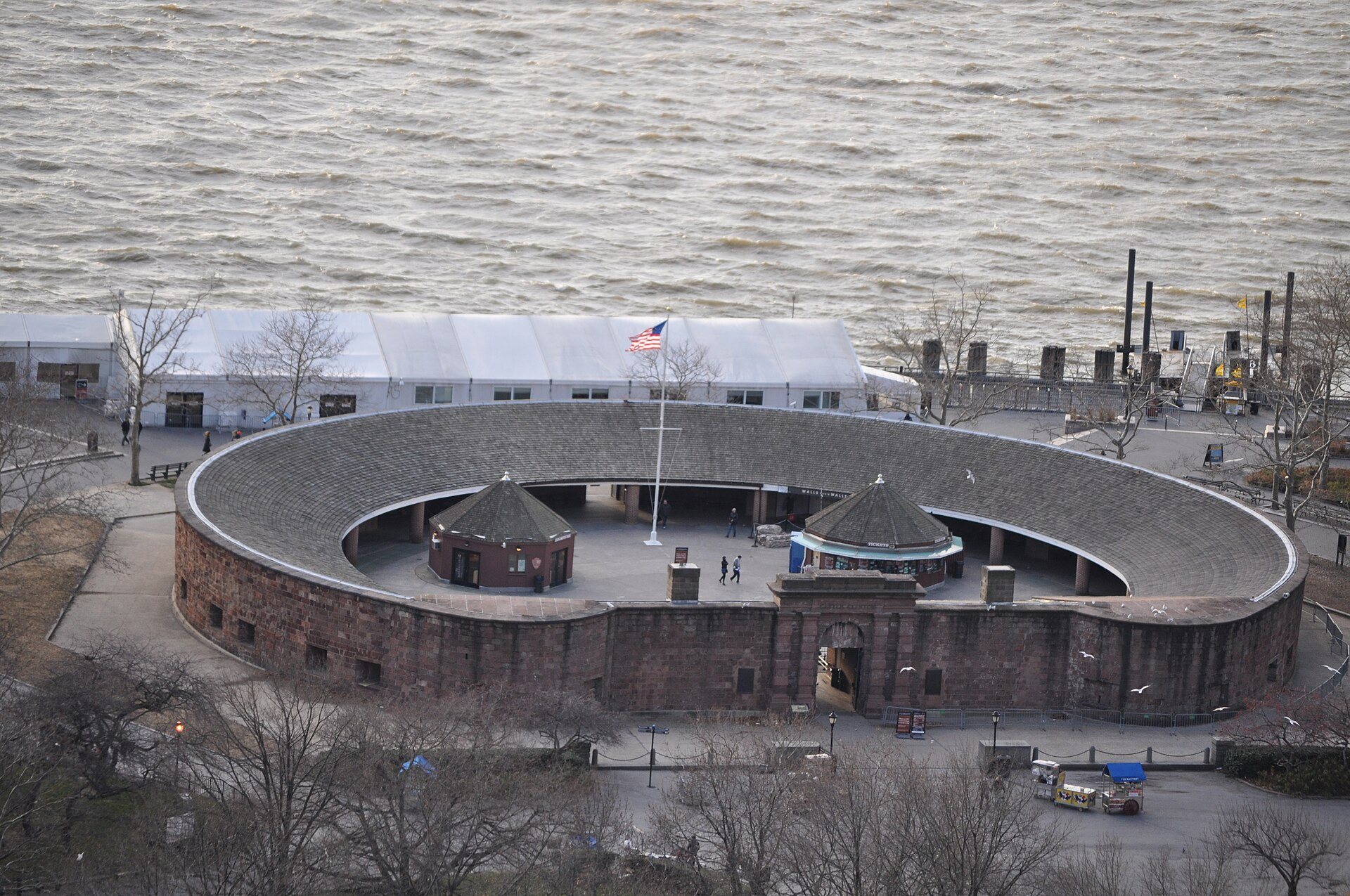
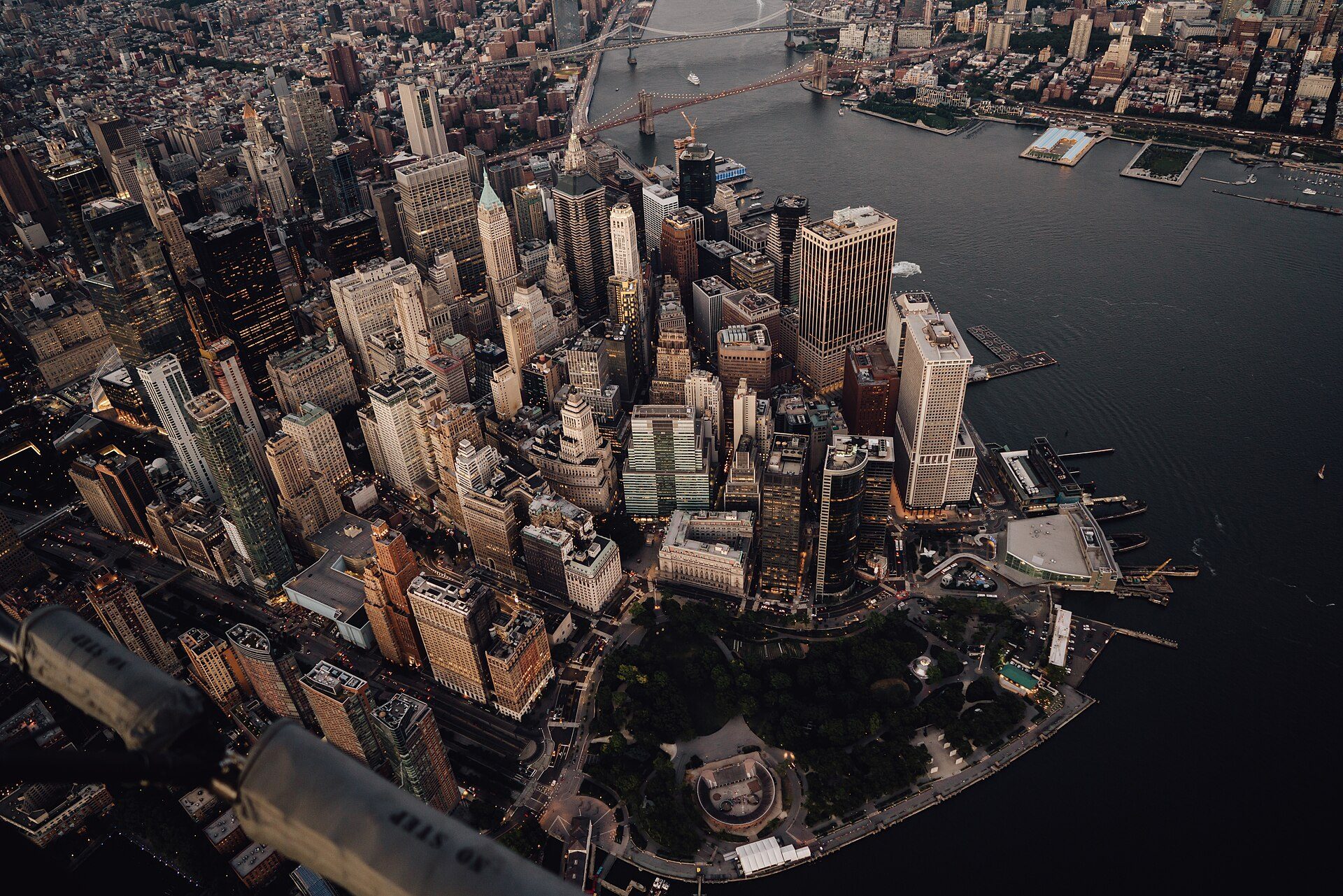
Castle Clinton is a roughly circular sandstone fort within Battery Park at the southern end of Manhattan. Its original plan had a radius of about 92 feet, or 28 meters, with one-eighth of the circumference formed by a straight wall. Built on an artificial island, it was connected to Manhattan by a wooden bridge. The surviving one-story structure encloses an open-air, nearly circular parade ground with walls approximately 8 feet, or 2.4 meters, thick.
Fortification and Military Features
Walls and Parade Ground
The exterior consists of brownstone and ashlar masonry over a rough-stone foundation. Brownstone is a reddish-brown sandstone, while ashlar consists of regularly shaped stone blocks with relatively even faces. The walls were built from red sandstone quarried in New Jersey. National Park Service restoration removed later stucco and returned the exterior to an appearance intended to reflect the original fort.
Military Interior
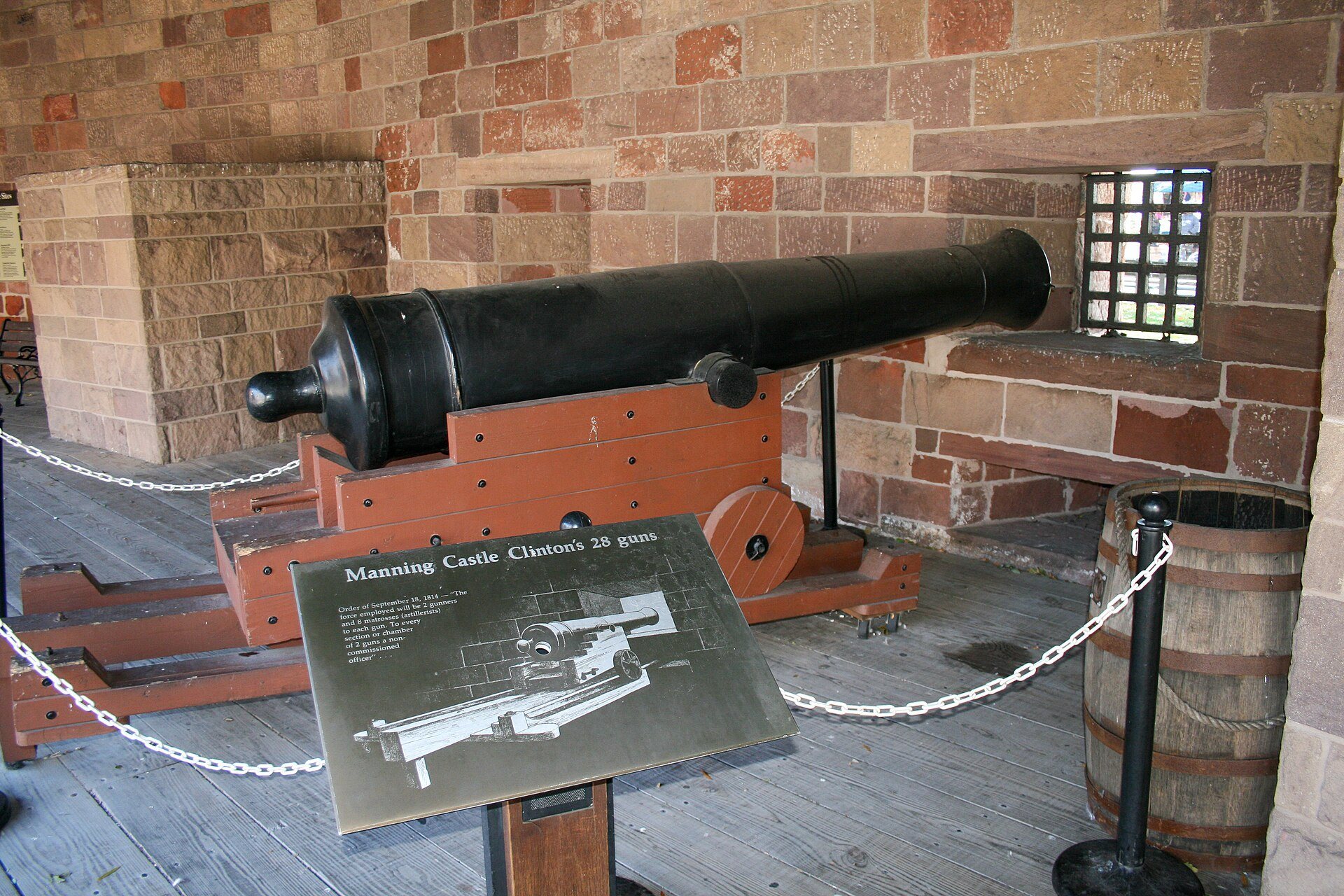
The fort originally held 28 thirty-two-pounder cannons. Surviving or reconstructed military elements include a gravel courtyard, officers’ quarters, ammunition-storage areas, brick powder magazines, and two underground water tanks covered by wooden trapdoors. A powder magazine, a secure chamber for gunpowder and other ammunition, now contains a historical exhibit. A portico with wooden columns and a canopy surrounds the circumference of the fort.
Castle Garden and Immigration Facilities
Entertainment Venue
During the Castle Garden entertainment period, the interior contained 50 boxes, each furnished with a table and eight seats. A circular promenade with a canopy and a surrounding gravel promenade with shrubbery stood above the seawall. The roof added around 1845 enclosed the central space and created the large theater used for musical and dramatic performances.
Immigrant-Processing Depot
During the immigration period, much of the fort was enclosed by a wooden fence about 1,000 feet, or 300 meters, long and 12 to 13 feet, or 3.7 to 4 meters, high. The fence was intended to prevent unauthorized departures. The central waiting area, known as the rotunda, was a circular or nearly circular hall. A quadrangle of registration desks surrounded it, restrooms flanked the main entrance, and wooden benches provided seating. The waiting area could hold an estimated 2,000 to 4,000 people.
An enclosed wooden balcony was installed around the rotunda around 1869. Former residential outbuildings became offices, and later additions included a labor-exchange building, a waiting room, and an information office. A dock on the northern side received immigrant steamships and faced away from Battery Park. During the transition to Ellis Island, the Barge Office temporarily handled immigrant processing and baggage examination, while baggage collection later returned to Castle Garden.
Aquarium Alterations
During the aquarium period, the fort was extensively altered and roofed to several stories, although its original masonry remained. Two circular colonnades supported a roof with skylights, and a green-and-yellow dome rose above the center. A verse from Habakkuk 1:15 was inscribed at the base of the dome.
The ground floor contained a large circular pool surrounded by six smaller elliptical pools. The perimeter originally held about 100 tanks of different sizes on two levels. By 1907, the aquarium contained seven large central tanks, 94 large wall tanks, 26 smaller wall tanks, and 30 reserve tanks. The tanks could reach 6 feet, or 1.8 meters, in depth and had 1-inch, or 2.5-centimeter, plate-glass panes with white-tiled surfaces. The aquarium could accommodate about 10,000 fish and other aquatic species.
Fresh water came from New York City’s municipal supply, while salt water was drawn from the Hudson River. Two bronze filters treated the salt water and two copper filters treated the fresh water. Together, they could process more than 200,000 U.S. gallons, or approximately 760,000 liters, per day. Later alterations included rock coverings over the tiled tank surfaces, reconfigured pipes, a 100,000-gallon, or approximately 380,000-liter, underground saltwater tank, additional stories, laboratories, a metal dome installed in 1940, and other mechanical facilities.
Restored Interior and Present Features
Restoration removed the moat and other aquarium installations, repaired the parade ground and officers’ quarters, restored the fort’s walls, and reconstructed the original door. The modern interior contains a small history exhibition, an information kiosk, ticket booths, and facilities associated with ferry service to the Statue of Liberty National Monument and Ellis Island. The Battery Conservancy also occupies space within the fort. The National Park Service exhibits part of the stone wall found during the 2005 South Ferry excavations, while the SeaGlass Carousel is located just southeast of the building.