Jorasanko Thakur Bari: Ancestral Home of the Tagore Family in Kolkata
Site at a Glance
- Rating
- 4.6
- Popularity
- High
- Country
- India
- Primary era
- Early Modern
- Eras represented
- Early Modern, Modern
- Civilizations
- British
- Site type
- Domestic
- Remains
- Elite Residence
On this page12 sections
History
Jorasanko Thakur Bari is the ancestral home of the Tagore family in Kolkata, India. The complex dates to 1784 and developed in the traditional Bengali Dalan architectural form, becoming closely associated with the Bengal Renaissance and with Rabindranath Tagore.
Foundation and Expansion
The name Jorasanko refers to two small bridges that once stood on marshy land. In Bengali, the term means “paired bridges.” The land was donated by the Sett family of Burrabazar to Dwarkanath Tagore, while Nilmoni Tagore established a residence there in 1784 after leaving the family home following disputes. Dwarkanath, a prominent Bengali businessman and industrialist and the grandfather of Rabindranath Tagore, later enlarged the residential complex.
The principal residence, Bhadrasan Bari, is associated with 6 Dwarakanath Tagore Lane. Rabindranath Tagore was born there in 1861, spent his childhood in the house, and made it his usual residence, although he also spent about thirty years at Shantiniketan. He died at Jorasanko in 1941.
Nineteenth-Century Cultural Life
During the nineteenth century, Debendranath Tagore made the family residence an active centre of the Bengal Renaissance, a period of cultural, intellectual, artistic, and social change in Bengal. His religious activities and involvement in the Brahmo Samaj, a reform movement that sought major changes in Hindu society and religious practice, connected the household with important religious and cultural developments.
An adjacent building, Boithak Khana Bari, was built in 1823 to receive European visitors. It later became the home of Girindranath Tagore and his family, as well as a workspace for the artists Abanindranath and Gaganendranath Tagore. The building was demolished in 1943.
University and Museum
The Government of West Bengal established Rabindra Bharati University in 1961 under the Rabindra Bharati Act to commemorate Rabindranath Tagore’s birth centenary and promote culture and the arts. The university was installed at the Tagore residence by 1962 and remains associated with the site.
The Rabindra Bharati Museum was established in 1962, and the restored residence was arranged to evoke the household’s appearance during the Tagore family’s occupation. The museum presents the family’s role in the Bengal Renaissance and the Brahmo Samaj. Jorasanko is also associated with cultural programmes held for Rabindranath Tagore’s birthday, death anniversary, and the Bengali New Year, including poetry, dance, Tagore songs, theatre, and the Aban Mela arts festival. The complex is classified as a Grade I heritage building by the Kolkata Municipal Corporation.
Remains
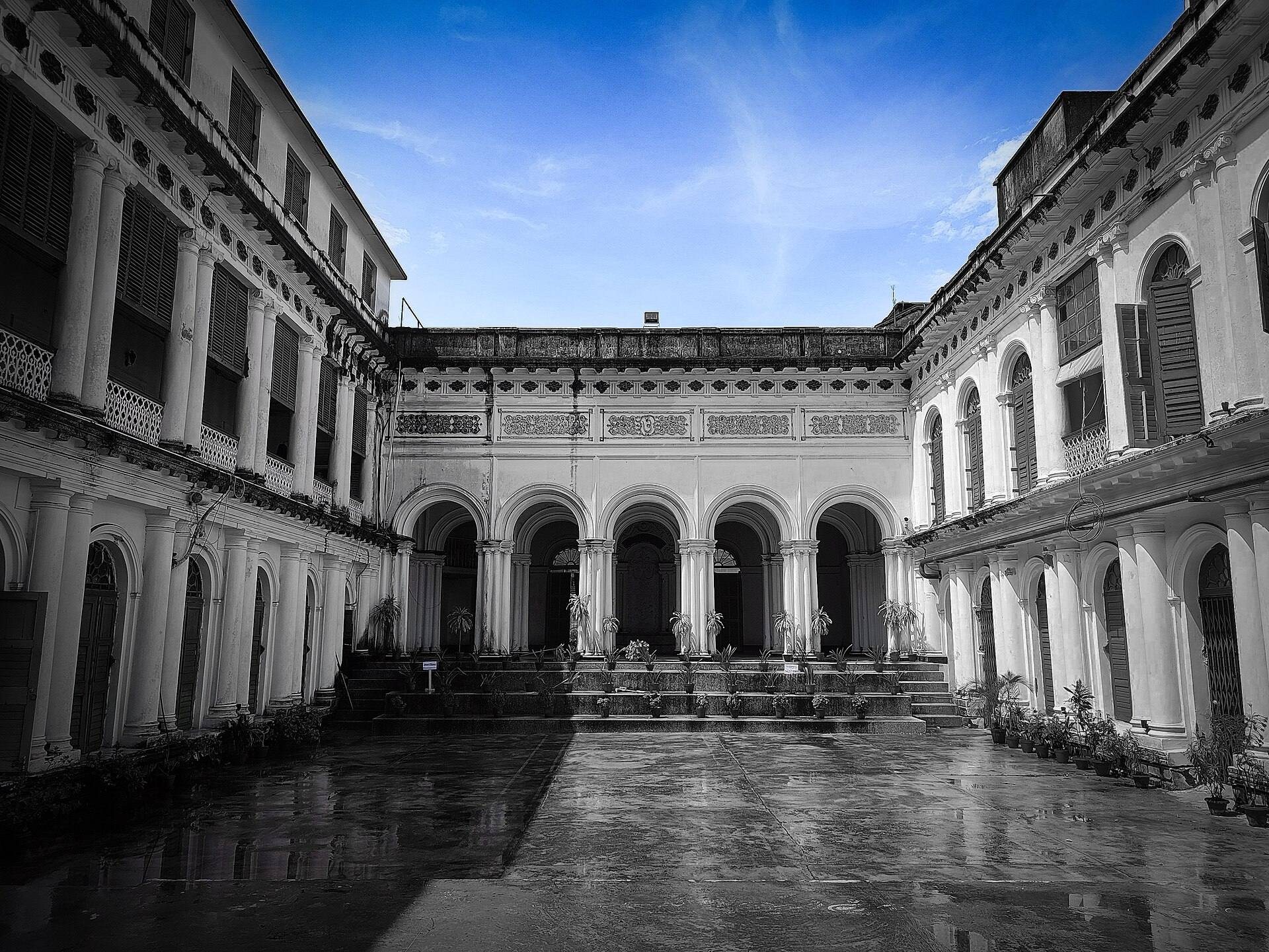
Jorasanko Thakur Bari is a large residential complex organized in the traditional Bengali Dalan form, with substantial rooms and halls arranged around courtyards. Its stated floor area is approximately 35,000 square metres. The complex includes the principal historic residence, later buildings associated with the Tagore family, an interior courtyard used for theatrical and cultural performances, and a gate opening onto Rabindra Sarani.
Residential Buildings
Bhadrasan Bari
Bhadrasan Bari, also known as Maharshi Bhavan, is the principal historic residence at 6 Dwarakanath Tagore Lane. It is associated with Rabindranath Tagore’s birth and with the family’s occupation of the complex. The restored residence has been arranged to evoke its appearance during that period.
Boithak Khana Bari
Boithak Khana Bari stood beside Bhadrasan Bari at 5 Dwarakanath Tagore Lane. Built in 1823, it served as a building for receiving European visitors before becoming the residence of Girindranath Tagore and his family and an art workspace for Abanindranath and Gaganendranath Tagore. It was demolished in 1943.
Bichitra Bhavan
Bichitra Bhavan stands west of Maharshi Bhavan and was built by Rabindranath Tagore in 1897. The red-brick building follows a colonial architectural style and is partly plastered and painted white. It is set among trees including frangipani, champa, Spanish cherry, and ashoka.
Courtyard and Museum Collections
Interior Courtyard
An interior courtyard forms part of the complex and has been arranged for theatrical and cultural performances. A gate associated with Jorasanko Thakur Bari stands on Rabindra Sarani.
Rabindra Bharati Museum
Bichitra Bhavan houses the museum and archives, with exhibitions on the first floor. The galleries cover the Tagore family, leading figures of the Bengal Renaissance, and the Bengal School of Art, an Indian art movement associated with Abanindranath Tagore and an alternative to academic colonial art. Other displays include portraits and paintings of the Tagore family and galleries on Rabindranath Tagore’s life, works, ideas, travels, influence, and international relationships.
The museum displays approximately 750 drawings by Rabindranath Tagore and more than 700 photographs of him. Its collections also include a Western Art Gallery and galleries concerning Tagore’s connections with Japan, China, Hungary, and the United States.