Castle of Kinský in Valašské Meziříčí: An Aristocratic Residence and Museum
Site at a Glance
- Rating
- 4.4
- Popularity
- Low
- Country
- Czechia
- Primary era
- Modern
- External website
- Open
- Eras represented
- Modern
- Civilizations
- Habsburg, Holy Roman Empire
- Site type
- Domestic
- Remains
- Castle
On this page8 sections
History
Castle of Kinský in Valašské Meziříčí, Czechia, is a Classicist aristocratic residence completed between 1802 and 1803 under Ludvík Antonín, Count of Žerotín. It developed from earlier farmsteads and a wooden administrative building serving the officials of the Rožnov–Krásno estate, and later became a Kinský and Seilern residence before passing into municipal and regional museum use.
From estate farmsteads to a masonry residence
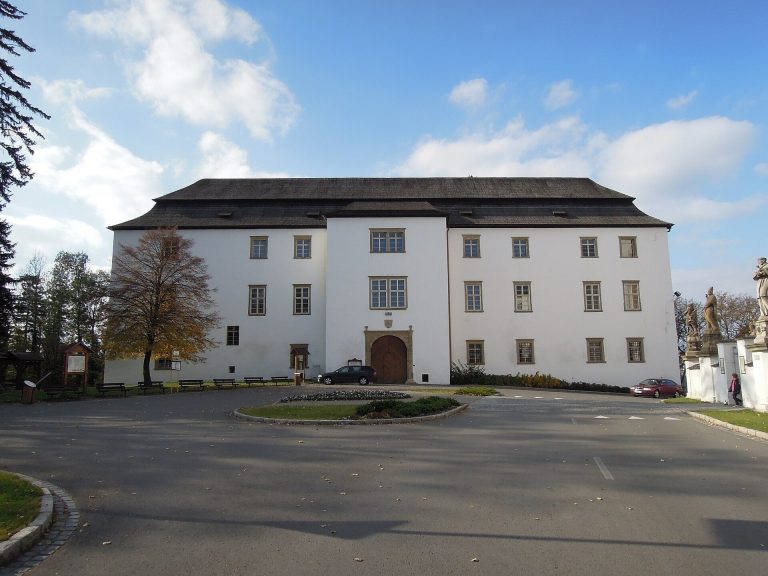
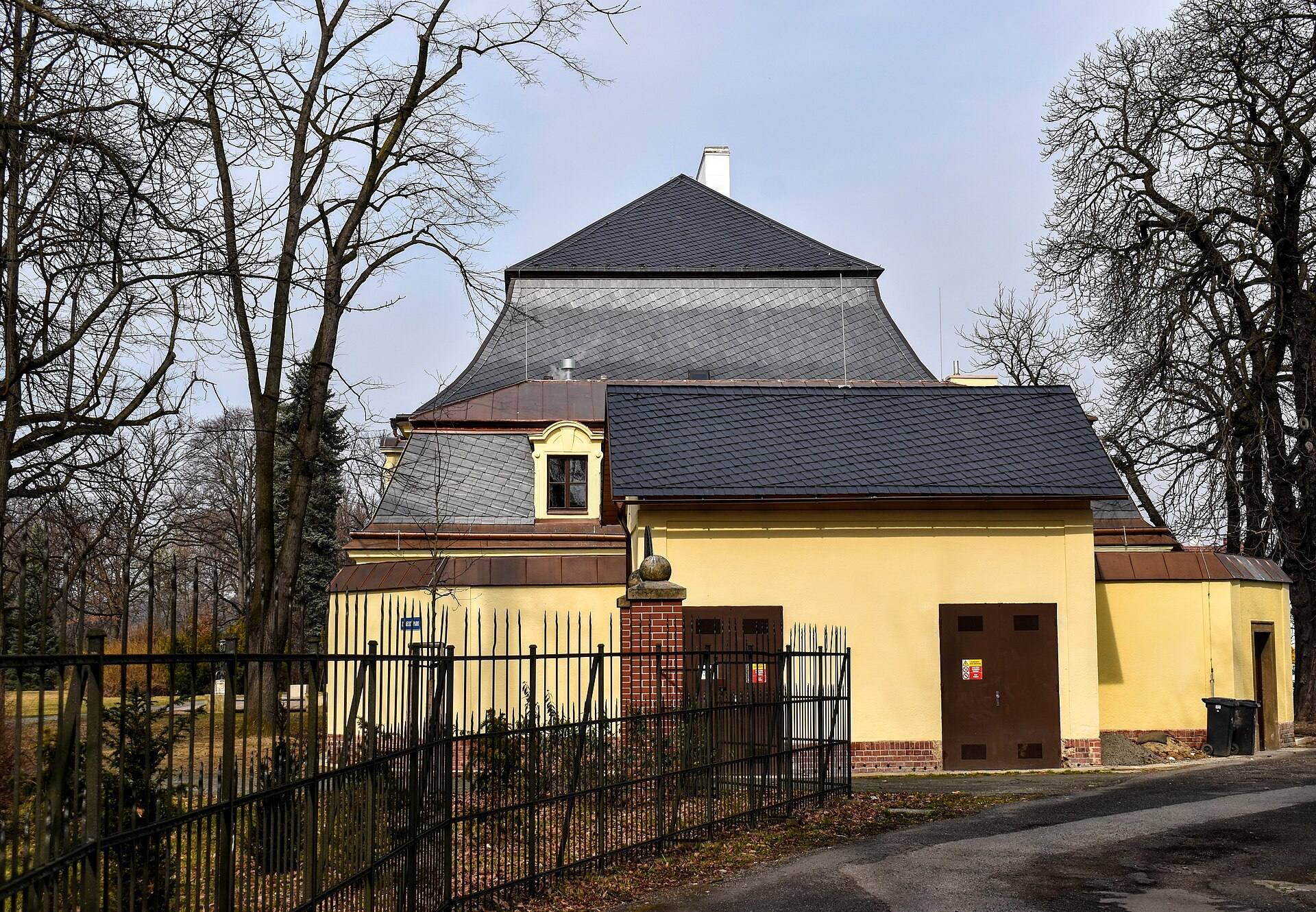
The site originally contained farmsteads purchased by the estate authorities in the 1670s. During the eighteenth century, these buildings were replaced by a wooden administrative structure for the management of the Rožnov–Krásno estate. Under Ludvík Antonín, Count of Žerotín, the timber building was rebuilt as a two-storey masonry residence with a mansard roof, a roof form with two slopes on each side and a steeper lower slope. The work was completed in 1802 or 1803.
After Ludvík Antonín died, the estate passed to his daughter Marie Josefa of Žerotín, a landgravine of Fürstenberg. She sold it in 1815 for 850,000 gulden to Franz de Paula Joseph, Count Kinský, the son of Franz Ulrich Kinský. When Franz de Paula Joseph died in 1823, the property passed to his five orphaned children. Eugen, Count Kinský, eventually became its sole holder.
The Kinský residence
By probably the 1830s, the former Žerotín administrative building was being used for occasional stays by members of the Kinský family. In 1854, Eugen Kinský sold the former Žerotín castle in Valašské Meziříčí to the state and definitively selected Krásno as his residence. He added a small servants’ wing on the south side and probably began creating the English park west of the building. An English park is a landscaped garden intended to appear relatively natural rather than geometrically formal.
Eugen’s son Rudolf Kinský continued the improvements and helped turn the building into a substantial aristocratic residence. He added a northern extension and cast-iron balconies to the entrance and garden facades. Rudolf was an honorary citizen of Krásno from 1880 and served as the town’s mayor from 1880 to 1893.
The Seilern-Aspang period
Financial difficulties led Rudolf Kinský to put the castle up for auction in 1913. Ladislav, Count Seilern-Aspang, won the auction and permitted the building to be used as a military hospital during the First World War. After the war, the castle faced possible confiscation under the first land reform. A decision issued in March 1926 allowed the Seilern family to retain it, and they used the property as a summer residence.
Tomáš Garrigue Masaryk, the first president of Czechoslovakia, stayed overnight at the castle from 25 to 26 June 1924 while travelling through eastern and southeastern Moravia. Ladislav Seilern sold the castle and park to the town of Valašské Meziříčí in 1943.
Municipal and museum use
After the Second World War, the building housed various educational institutions, apartments, offices, and the district archive. It became the seat of the town museum in the early 1950s. The first exhibition opened in 1951; the museum was transferred to the District National Committee in Vsetín in 1952 and, with its collections, to the District Museum in Vsetín in 1960.
Neglected maintenance led to a deterioration in the building’s technical condition. A major reconstruction begun in 1974 was completed in 1988. After 1989, the museum underwent several reorganizations and eventually became one of the workplaces of the Valašsko Regional Museum in Vsetín. Its permanent presentation focused on glass and tapestries from local manufactories, while part of the upper floor, from 2010, presented aristocratic domestic life and lifestyle around the turn of the nineteenth and twentieth centuries.
A further major reconstruction begun in 2019 cancelled the previous exhibitions and renewed the roof covering and exterior plaster. The castle has been protected as a cultural monument since 3 May 1958. It is owned by the Zlín Region and remains a workplace of the Valašsko Regional Museum.
Remains
The castle building
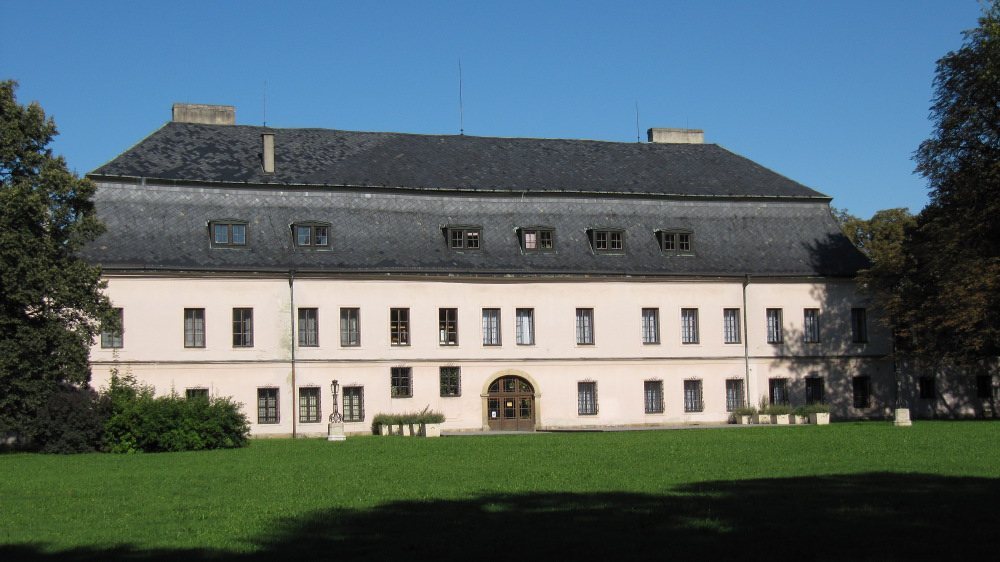
The castle is a one-storey Classicist building arranged with strict axial symmetry. Its principal entrance facade faces Zámecká Street. A three-axis projecting avant-corps, a section of the facade that extends slightly forward, marks the centre of the entrance front. It is crowned by a tympanum, the framed field above a classical facade, and bears a sandstone Kinský coat of arms. Rustication, which imitates emphasized masonry joints, decorates the avant-corps.
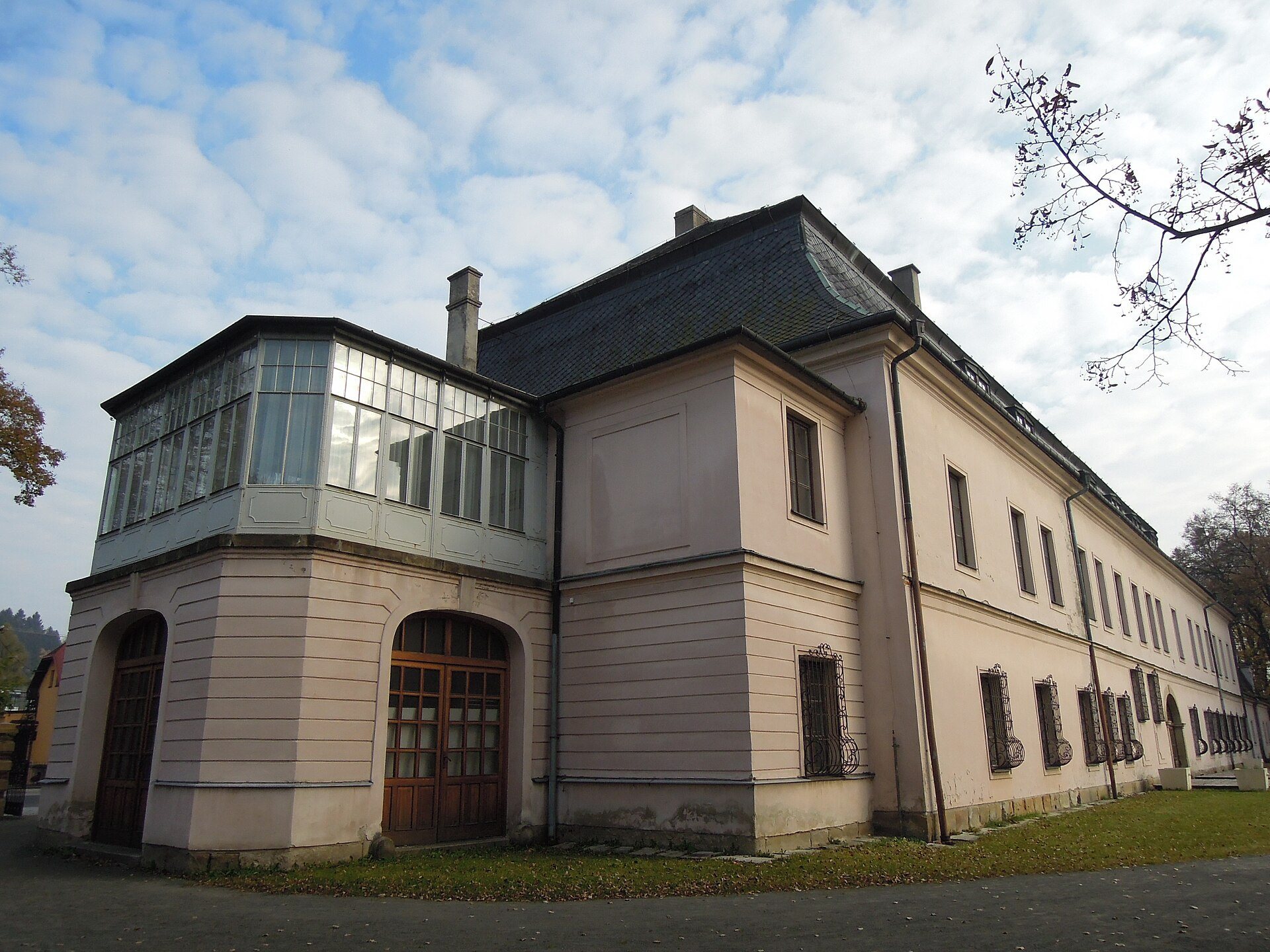
Annexes extend from the northern and southern sides. Eugen Kinský added the small, single-storey southern annex as a servants’ wing. Rudolf Kinský later built the northern annex, which has an upper floor, a passageway, and a glazed winter garden. He also installed cast-iron balconies on the entrance and garden facades. The balconies were removed during the reconstruction of 1974 to 1988.
The upper-floor arrangement described in the 1913 auction documentation contained 13 rooms. These included a ballroom, three bathrooms, two lavatories, and a dressing room. The interiors had stucco decoration and silk wallpaper, as well as electric lighting, hot-water heating, and a house telephone. From 1908, the residence was connected to its own water supply.
The reconstruction carried out between 1974 and 1988 repaired the mansard roof and created a new attic floor for museum workrooms. Other spaces were adapted as exhibition halls and storage rooms. Dormer windows facing the park were added, and the building received pink plaster. The reconstruction begun in 2019 renewed the exterior plaster and supplied new roof covering.
The park
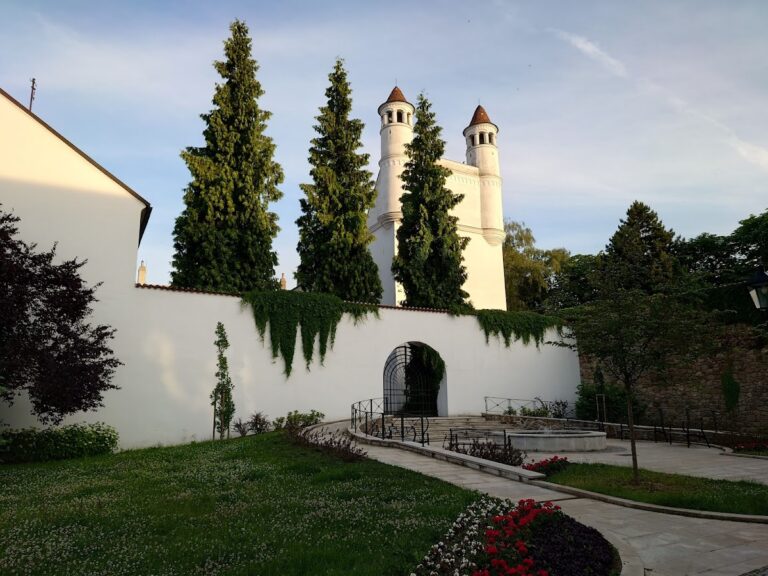
The park lies west of the castle. Its features include the so-called Jurkovič gazebo, a fountain, a modern open-air cinema, and a Baroque putto statue. A putto is a representation of a small, usually winged child in European decorative art. The statue probably came from the vanished French garden formerly associated with the Žerotín castle in Valašské Meziříčí.