Fortress Kostajnica: A Medieval River Fortification in Croatia
Site at a Glance
- Rating
- 4.7
- Popularity
- Low
- Country
- Croatia
- Primary era
- Medieval
- Eras represented
- Medieval
- Civilizations
- Hungarian
- Site type
- Military
- Remains
- Castle
On this page11 sections
History
Fortress Kostajnica is a medieval stone fortification in Croatia, in Hrvatska Kostajnica, developed on the Una as the seat of the Kostajnica estate and as a defended crossing. Its precise construction date is uncertain, but the fortress and settlement grew during the medieval period around a strategically important bridgehead.
Medieval Estate and Noble Families
Kostajnica first appears in written records in 1240. Around 1258, the estate was held by the nobleman Herenko, probably a form of Henrik. A settlement under King Béla IV resolved a dispute involving the Templars of Dubica and Hetink, the castle warden of Kostajnica. In 1272, King Stephen V confirmed the territory to Hetink’s sons Marin, Peter, and Ivan.
Peter succeeded Herenko, and Peter’s successor Dionysius began using the noble designation “Kostajnički” around 1312. The Kostajnički family held the estate throughout the fourteenth century. Their territory included present-day Hrvatska Kostajnica and Bosanska Kostajnica, together with lands extending toward Dubica and Dobrljin.
Late in the fourteenth century, Nikola Kostajnički fought with the neighboring Zrinski and Babonić families. After his death, the Kostajnički line ended and the estate reverted to the Hungarian crown under the legal practice of the period.
Competing Claims and the Frankopan Period
In 1424, King Sigismund granted Kostajnica to Ladislav Blagay and his brothers, but Frederick of Celje, the Slavonian ban, disputed the grant. Helena, the daughter of Nikola Kostajnički, transferred Kostajnica through marriage to Ladislav Tot of the Ača family. After Tot died in 1437, she transferred it to her second husband, Martin Frankopan. Frederick II of Celje again challenged the transfer on behalf of King Sigismund, who subsequently enfeoffed Ulrich II of Celje with Kostajnica. Ulrich took effective possession in 1440 and held it until his death in 1456.
After the Celje family became extinct, King Matthias Corvinus confirmed Kostajnica to Martin Frankopan. The Frankopans probably strengthened the fortress as the Ottoman threat grew. They held the estate until 1471, when it was sold to Ivan Benvenjud for 4,000 florins. In 1480, Matthias Corvinus forced Benvenjud to surrender Kostajnica, although Benvenjud recovered it after the king’s death. The Benvenjud brothers sold the estate in 1492 to Ban Ladislav Egervarski for 8,000 florins.
By that time, the estate was prosperous, contained 27 villages, and was associated with a market settlement. Kostajnica therefore served not only as a defensive position but also as the administrative center of a substantial landed territory.
Ottoman Expansion and the Fall of 1556
In the early sixteenth century, Kostajnica became ecclesiastical property belonging to the Vrana Abbey. King Ferdinand I granted it to Bishop and Ban Peter Berislavić after his victory over an Ottoman army near Dubica in 1513. In 1530, Ivan Tahi, the prior and administrator of the abbey, pledged the fortress and other castles to Nikola III Zrinski for 13,000 florins. After Nikola III’s death, the estate passed to his relatives Ivan I and Nikola IV Zrinski, who received permanent possession from Ferdinand I in 1541.
Nikola IV Zrinski became Ban of Croatia in 1542. He led major campaigns against the Ottoman Empire, the Muslim-ruled state expanding into southeastern Europe, in the Una region in 1544 and 1545. He strengthened Kostajnica and Novi in 1553 and sought royal military assistance as Ottoman attacks continued. In 1539, he also killed Hans Katzianer at Kostajnica. Katzianer had been a royal commander before defecting to the side of John Zapolya, a rival claimant to the Hungarian crown.
Ottoman attacks began in 1483, when an Ottoman army was defeated. Further campaigns and threats followed in 1537, 1538, 1539, 1550, and 1552. These operations caused extensive devastation, although Kostajnica initially remained in Christian hands. In 1554, the fortress was effectively assigned to the Military Frontier, the Habsburg defensive zone organized for permanent protection against the Ottoman Empire, and a German garrison commanded by Captain Peter Erdődy was stationed there.
In the summer of 1556, 60 soldiers defended Kostajnica against an Ottoman army led by Malkoč-beg. Pankrac Lusthaller of Ljubljana, the fortress captain, surrendered after the first day of the siege without a fight. A later tradition alleged that he accepted 2,000 ducats for the surrender. The fortress fell to the Ottomans in July 1556, after which an Ottoman garrison of 400 cavalrymen and 250 infantrymen occupied it.
Repeated Reconquest Attempts
Croatian forces repeatedly tried to recover Kostajnica during the frontier war of 1593 to 1606, a conflict between the Habsburgs and the Ottoman Empire along their military border. General Jurij Lenković briefly captured the fortress in 1594 but could not hold it. In 1596, General Sigismund Herberstein and Ban Ivan Drašković brought artillery from Petrinja and shelled Kostajnica for two days from Djed Hill, without taking it.
Jurij Zrinski briefly recaptured the fortress in 1624, but it returned to Ottoman control in 1630. Ban Nikola Zrinski made another unsuccessful attempt in 1651. Kostajnica remained under Ottoman rule for approximately 132 years.
Imperial Recapture and Frontier Administration
Imperial forces recovered Kostajnica during the Great Turkish War of 1683 to 1699, a major Habsburg-Ottoman conflict. An earlier attack led by Ban Nikola Erdődy had been halted because the attackers lacked adequate equipment. Forces commanded by Louis of Baden later arrived with 15 large-caliber guns and captured the fortress in the late 1680s. An Ottoman counterattack in 1688 was defeated near Kostajnica by Christian forces led by Erdődy and Louis of Baden.
The 1699 Treaty of Karlowitz fixed the frontier along the Una, Glina, and Korana rivers. Kostajnica was repaired after the fighting and served as a frontier fortress facing the Ottoman border. In 1703, Emperor Leopold placed the territory between the Kupa and Una under the military authority of the Croatian Ban, creating the Banovina, or Banska Krajina. A Ban military garrison occupied Kostajnica, while a larger fortress was built on Djed Hill across the Una. The older fortress consequently lost much of its former strategic importance.
Kostajnica remained under military administration from 1718 until the abolition of the Military Frontier in 1871, although the fortress continued in use until 1876. In 1749, the Banovina was divided into the Glina and Kostajnica regimental districts. Kostajnica became a market town in 1776 and was declared a free city by Emperor Joseph II in 1788.
Later Use and Conservation
Following nineteenth-century reorganization and the incorporation of Bosnia and Herzegovina into Austria-Hungary in 1878, the fortress ceased to perform its former military role and was used as an orphanage. It entered the register of cultural monuments in 1957. After a period of disrepair, conservation and renovation carried out by the Croatian Ministry of Culture restored the fortress and preserved its surviving medieval fabric.
Remains
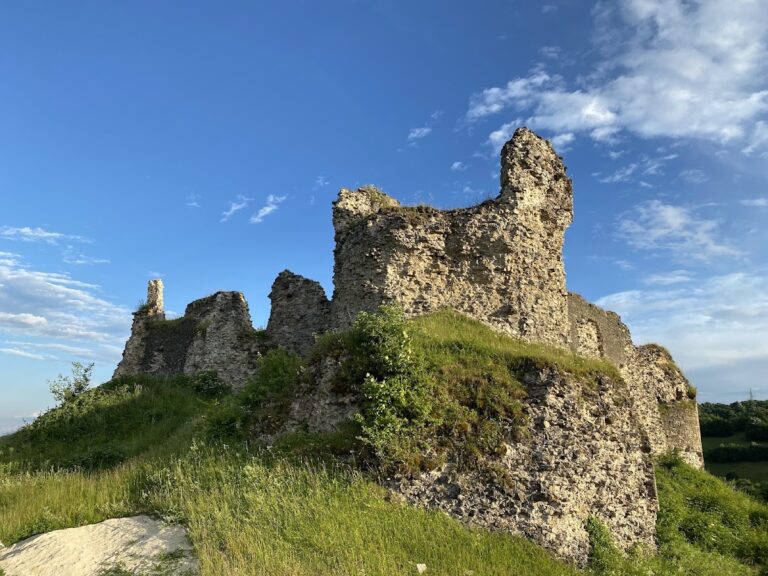
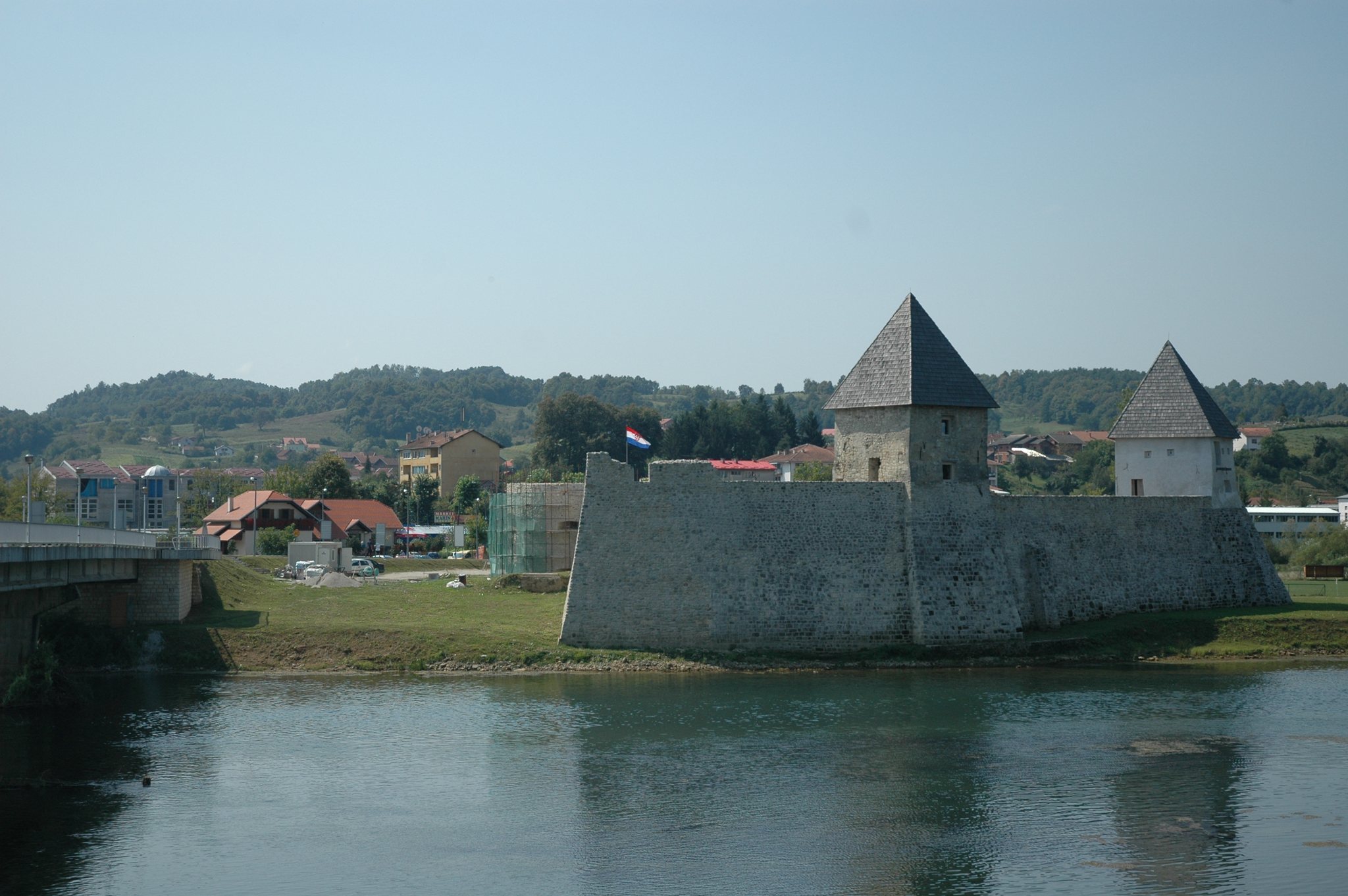
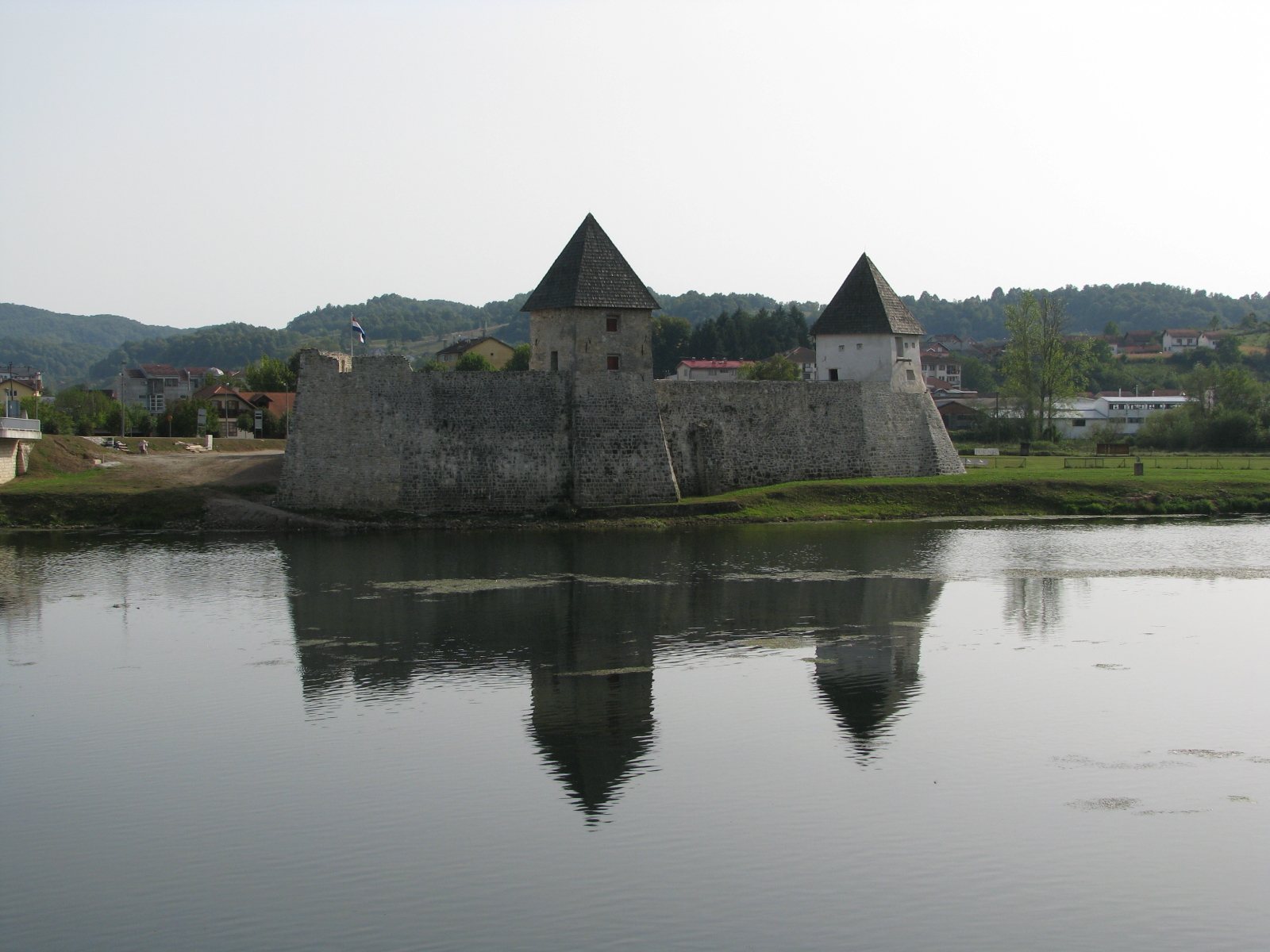
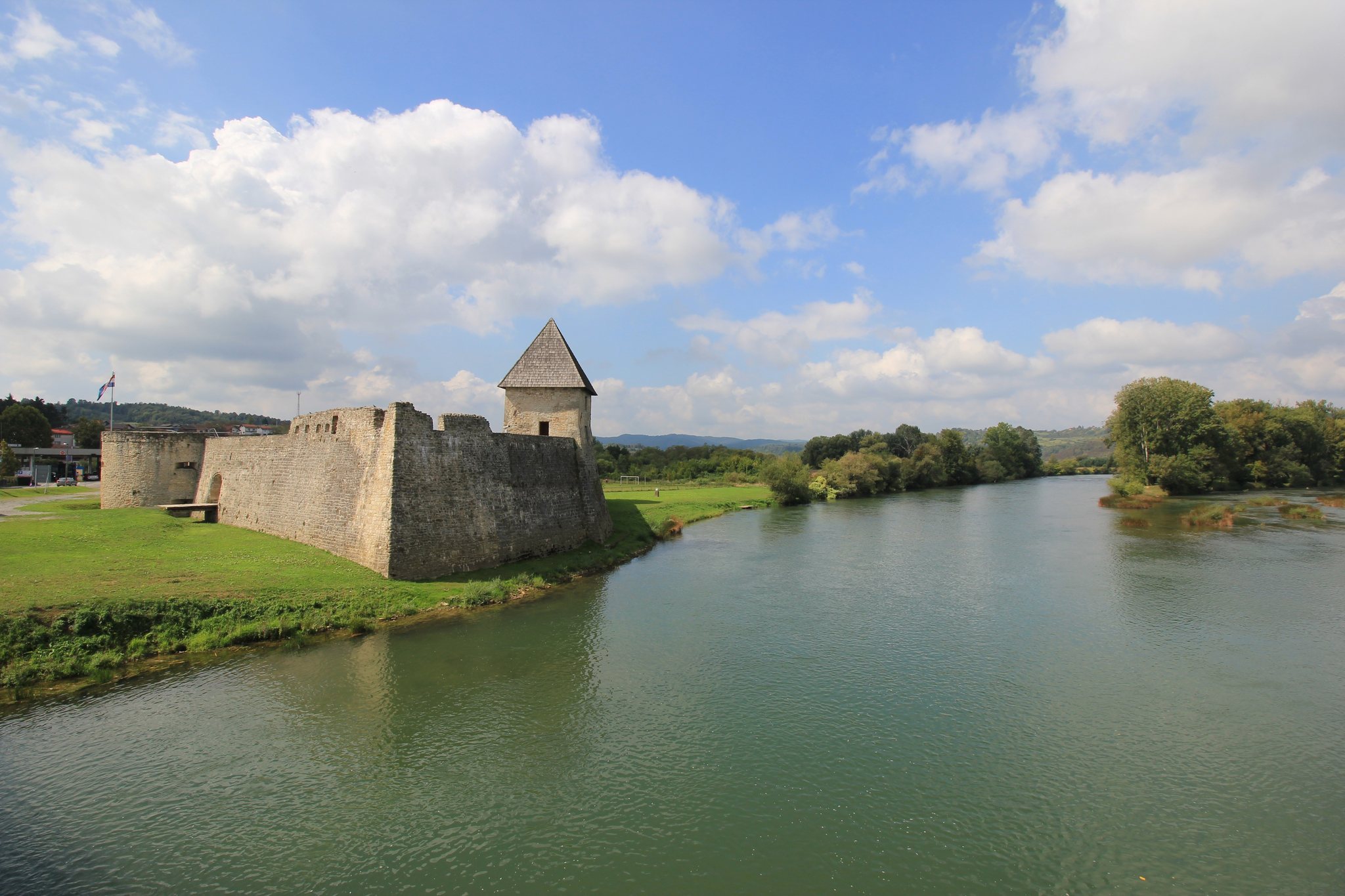
Fortress Kostajnica stands near the center of Hrvatska Kostajnica on the right bank of the Una, at an elevation of approximately 106 metres. It originally occupied an island and formed a bridgehead at a crossing of the river. The channel beside the island gradually silted up and was later filled, leaving the fortress on the present riverbank. Its surviving form is a stone fortification with strong defensive walls and three towers.
Fortification Walls and Towers
Inner Castle Walls
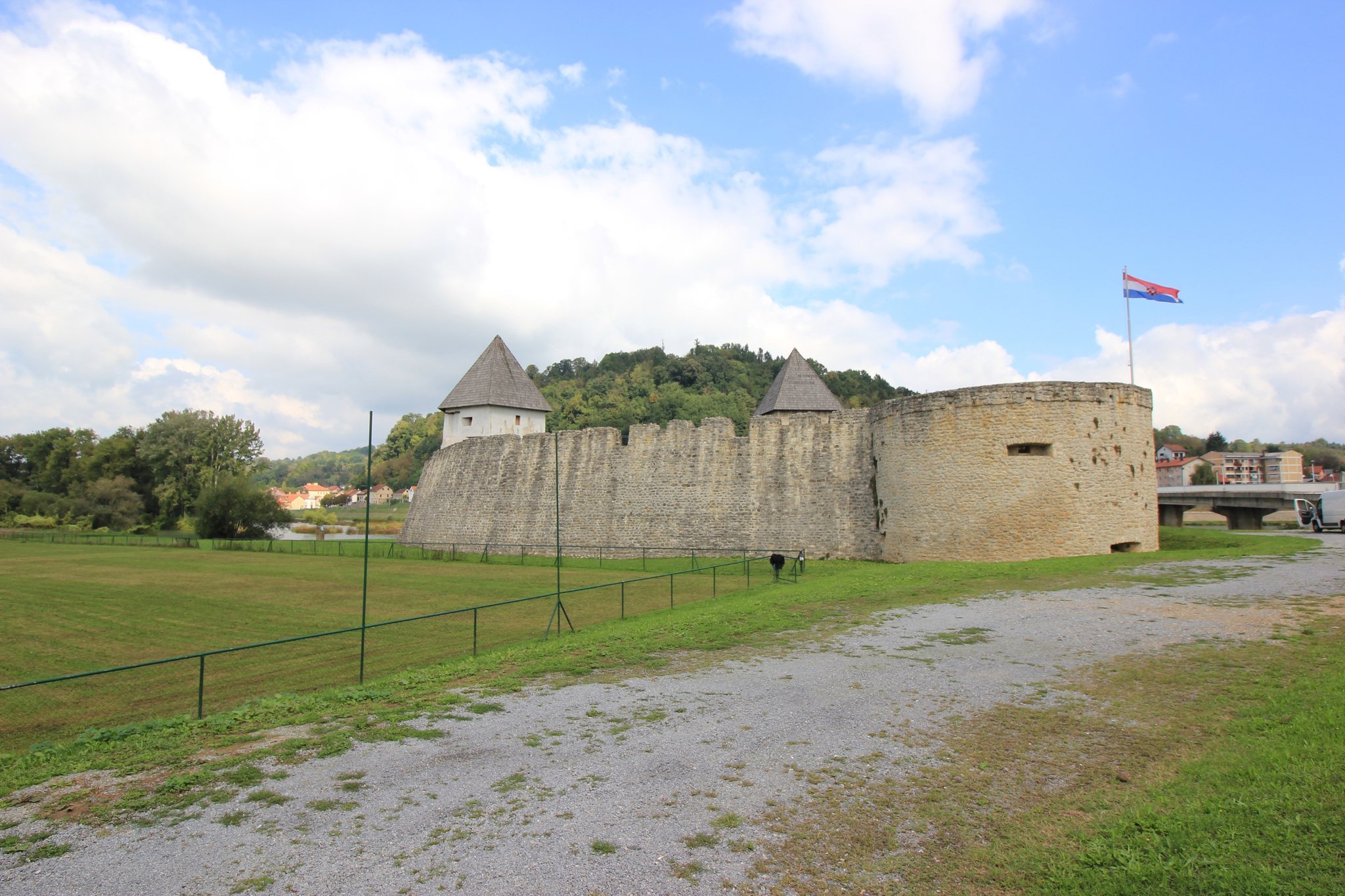
The walls of the inner castle survive to their full height. Built in stone, they preserve the principal defensive enclosure and express the fortress’s medieval construction. Later repairs followed the recapture of Kostajnica from Ottoman rule, while modern conservation and restoration have left the surviving masonry in renovated condition.
Towers and Southern Bastion
Two of the fortress’s three towers remain standing. A southern semicircular bastion, a projecting defensive platform, also survives as part of the fortification. Together with the walls, these structures preserve the principal elements of the former island stronghold and its defensive arrangement.