Santa Maria della Scala, Rome: A Discalced Carmelite Church in Trastevere
Site at a Glance
- Rating
- 4.7
- Popularity
- Low
- Country
- Italy
- Primary era
- Early Modern
- External website
- Open
- Eras represented
- Early Modern, Modern
- Civilizations
- Italian, Papal States
- Site type
- Religious
- Remains
- Church
On this page24 sections
History
Santa Maria della Scala is a Catholic church in Rome, Italy, built by the Discalced Carmelites between 1593 and 1610 in the Baroque period. Located in Trastevere, it was founded to house an image of the Madonna della Scala that was associated with a healing miracle. The church is both a rectoral church and a titular church, meaning that it is assigned to a cardinal as a symbolic title and ecclesiastical responsibility, and it remains served by the Discalced Carmelites under the parish of Santa Dorotea.
Foundation and the miraculous image
The church grew from devotion to an image of the Virgin Mary known as the Madonna della Scala. Tradition connects the image with an event in 1592, when a poor woman prayed for her sick child before an image displayed on the exterior staircase of a nearby house. The child was believed to have been healed or revived through Mary’s intercession. The image subsequently became the focus of a new church in a poor, lower-class part of Trastevere, an area without the large aristocratic palaces found elsewhere in Rome.
The plot had previously belonged to a house bequeathed to a charitable institution founded by Pope Pius IV in 1563 for reformed prostitutes. A nearby institution assisted poor, abandoned, and fallen women and later educated young girls. This charitable setting formed part of the social background to the church’s foundation under Pope Clement VIII.
Clement VIII commissioned Francesco Capriani da Volterra to design the building. Capriani died during the early construction, after which Ottavio Mascherino assumed the architectural direction. Cardinal Tolomeo Gallio supervised the work and provided material support. On 20 March 1597, the papal bull Sacrarum Religionum assigned the unfinished church to the Discalced Carmelites, the reformed branch of the Carmelite order associated with Saint Teresa of Avila and Saint John of the Cross.
The first Roman monastery
The Discalced Carmelites established their first monastery in Rome beside the church. From this foundation, the Teresian Carmelite movement was intended to spread through Italy. The transept, choir, and dome were built between 1607 and 1610, and the interior was completed in 1610. The facade followed later, reaching completion in 1624.
Santa Maria della Scala soon acquired importance within the Italian Carmelite congregation. In 1614, the congregation adopted it, together with Santa Maria della Vittoria, as a model for Carmelite churches in Italy. This model later influenced Carmelite churches in France, Belgium, Austria, Germany, and the Polish lands.
Artistic commissions and later changes
The church became associated with an important episode in the history of Baroque painting. In 1601, Laerzio Cherubini commissioned Michelangelo Merisi, known as Caravaggio, to paint an altarpiece of the Virgin Mary. Caravaggio completed Death of the Virgin in 1606, but the Carmelites rejected it because they considered the treatment of Mary insufficiently decorous and objected to the alleged use of a prostitute as the model. Vincenzo Gonzaga, Duke of Mantua, later acquired the painting, and Carlo Saraceni supplied the replacement altarpiece.
Renovation took place in the 1630s, and the floor was remade in 1739. In 1650, Carlo Rainaldi designed the high altar and its canopy. Pope Benedict XIII reconsecrated the altar in 1725. The church’s religious and institutional role also continued to develop. Pope Alexander VII elevated it to a cardinalitial deaconry, a titular church assigned to a cardinal deacon, on 14 January 1664. The title Titulus Sanctae Mariae Scalaris remains associated with the church. Ernest Simoni became its titular cardinal in 2016 and took possession in 2017.
War, confiscation, and the Carmelite pharmacy
During the final phase of the Roman Republic’s resistance to the French invasion in 1849, Santa Maria della Scala served as a hospital for soldiers of Giuseppe Garibaldi who had been wounded in fighting in Trastevere. Andrea Aguyar, one of Garibaldi’s associated fighters, died there.
The Discalced Carmelites retained the church when the adjoining convent and garden were confiscated by the government in 1873. The former convent was converted into a police station. The monastery’s pharmacy had long supplied medicines to popes, the papal court, and the Roman Curia. From the eighteenth century it also trained pharmacists. The associated production of medicines and distilled remedies continued into the modern period, although liquor production was later suspended.
In 2004, Cardinal Stanisław Nagy presented the church with a copy of the Płaszów Madonna during the ceremony marking his possession of the titular church. This later association added to the church’s continuing religious history without changing its principal Carmelite identity.
Remains
Santa Maria della Scala is a Baroque church laid out on a Latin cross, with a single nave, a short crosswise transept, a deep choir, a rounded apse, and three side chapels on each side of the nave. The crossing supports a dome set on an octagonal drum and topped by a tall lantern. A small, single-story bell tower stands at the far left of the presbytery. Large arches open from the nave into the side chapels, while Corinthian pilasters between the arches support an entablature with a modillion cornice that runs around the interior. Windows are placed above the arches.
Facade and entrance
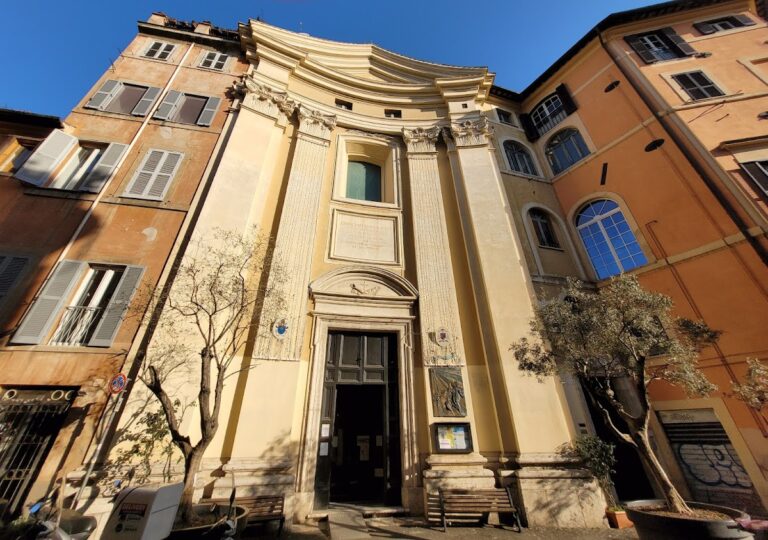
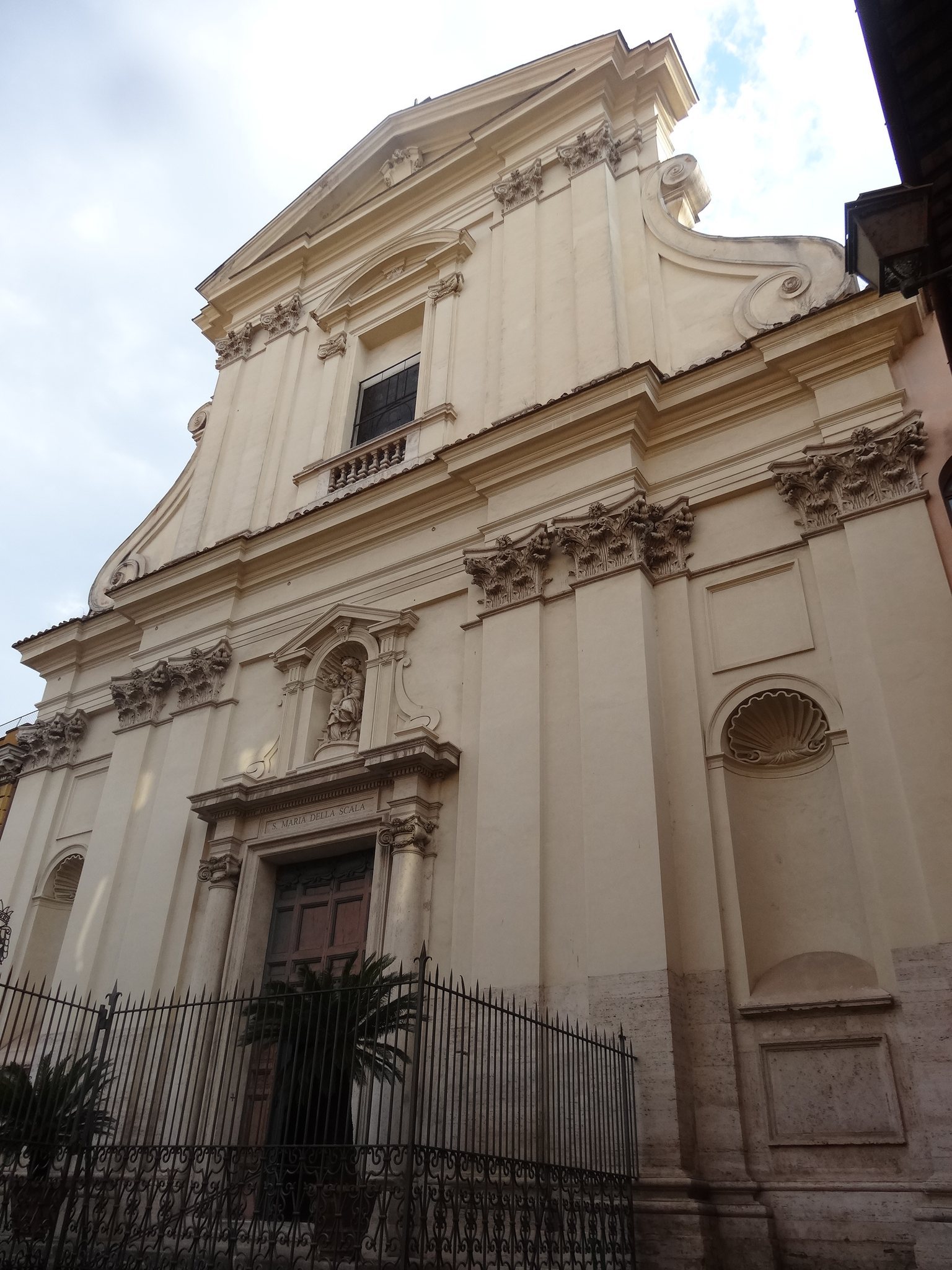
The two-story facade is built of travertine and rises above the nave behind it. Its slightly projecting central section has paired Corinthian pilasters, Ionic columns beside the entrance, a blank entablature, and a doorway reached by steps. The upper story contains paired pilasters, a rectangular window with a balustrade, Ionic columns, and a triangular pediment bearing a coat of arms. Volute scrolls frame the sides.
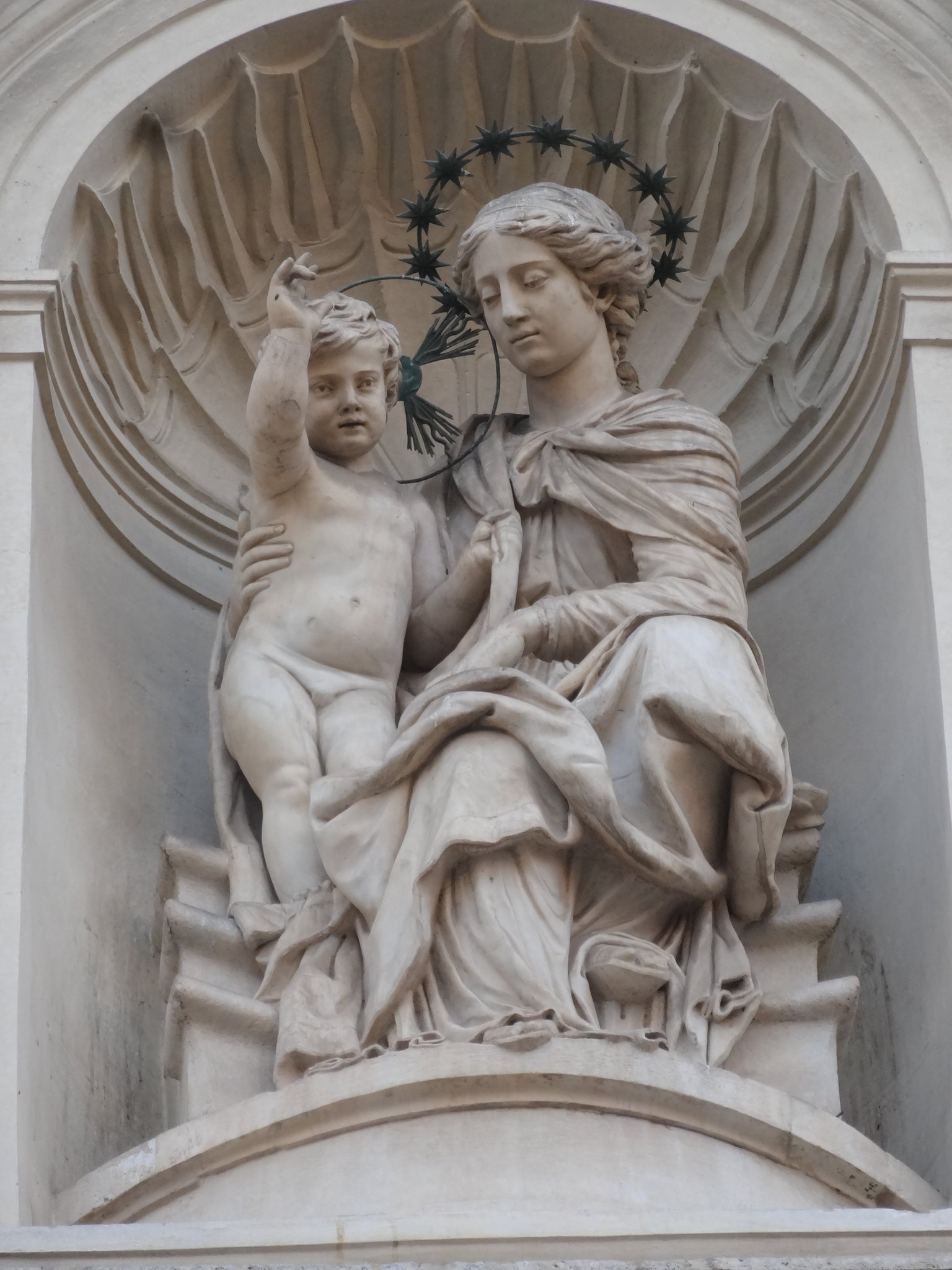
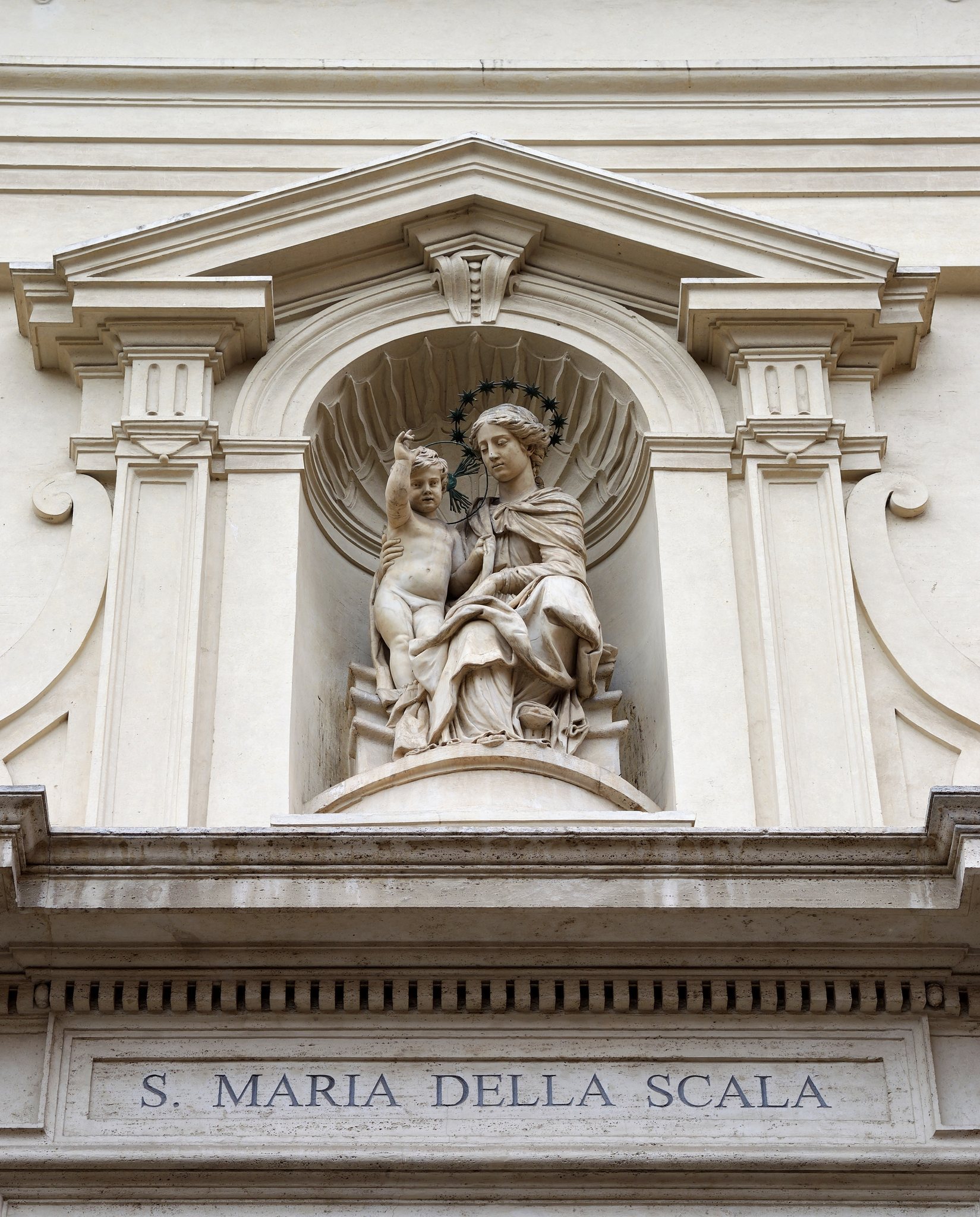
Girolamo Rainaldi designed the facade, which was completed in 1624. A niche above the entrance contains a Madonna and Child sculpted by Francesco di Cusart in 1633, while a statue of the Madonna was placed in the central pediment niche in 1634.
Choir, dome, and high altar
Painted interior and organ
The choir, nave, dome, and one arm of the transept have painted decoration that imitates architectural moldings and stucco. The other transept arm has genuine stucco relief moldings. The Baroque wooden entrance screen and two musicians’ galleries were made by Giuseppe Pannini around 1756. The lower gallery contains a pipe organ built by Carlo Vegezzi Bossi in 1908, opus 1282, with eleven stops on one manual and pedal.
High altar and apse
The high altar is dedicated to the Savior and made of jasper. It is surmounted by a tempietto-shaped baldachin, a canopy over the altar, supported by sixteen slender Corinthian columns of alabaster. Its bronze dome carries four terracotta statues of apostles, and a gilded bronze Lamb of the Apocalypse stands at the center of the altar. Carlo Rainaldi designed the altar in 1650, while the altarpiece is Giuseppe Peroni’s Madonna of Mount Carmel of 1737.
Doors on either side of the high altar lead to the monks’ choir. Above them are statues of Saint Joseph and Saint Teresa of Avila made by Simone Giorgini in 1706. At the center of the apse is Cavalier d’Arpino’s Queen of Heaven with the Child, dated 1612. Other paintings represent the Baptism of Christ, the Wedding at Cana, the Last Supper, and the Ascension. The apse vault contains a fresco of Christ enthroned with the Virgin Mary, Saint Joseph, and Carmelite saints.
Chapels on the right
Chapel of Saint John the Baptist
The first chapel on the right is dedicated to Saint John the Baptist. Its altarpiece, The Beheading of Saint John the Baptist, was painted by Gerrit van Honthorst and completed in the early seventeenth century. The altar combines black marble, alabaster, Sicilian jasper, and yellow Siena marble. Memorial slabs of the Sinibaldi family are set within the chapel.
Chapel of Saint Hyacinth
The second chapel on the right is dedicated to Saint Hyacinth. Its altar has red-marble columns and relief coats of arms associated with the Barisiani and Dionisi families. Antiveduto Grammatica painted the altarpiece, The Madonna with Saints Hyacinth and Catherine of Siena, in 1600. The chapel also contains transferred funerary monuments of the Sorbolonghi family and a venerated image of the Mater Purissima.
Chapel of Saint Joseph
The third chapel on the right is dedicated to Mary, Saint Joseph, and Saint Anne, though it is commonly called the Chapel of Saint Joseph. Its works include Giovanni Ghezzi’s Holy Family, Lodovico Antonio David’s Marriage of the Virgin, and Giovanni Odazzi’s Dream of Joseph. Odazzi also painted the vault fresco, The Glory of Saint Joseph. A copy of Pompeo Batoni’s Sacred Heart of Jesus, installed in 1780, is also preserved there.
Chapels on the left
Chapel of Our Lady of Mount Carmel
The first chapel on the left is dedicated to Our Lady of Mount Carmel. Cristoforo Roncalli painted its altarpiece, showing the Virgin giving the scapular to Saint Simon Stock with the Eternal Father above. A scapular is a devotional garment, or pair of cloth panels, worn by members and devotees of certain religious orders. A wooden statue of Our Lady of Mount Carmel with the Child, dressed in richly embroidered garments, has been venerated in the chapel since 1917.
Chapel of the Assumption
Girolamo Rainaldi designed the second chapel on the left, which is dedicated to the Assumption. It contains Giovanni Conca’s paintings of the Birth of the Virgin and the Marriage of the Virgin, a painted dove on the vault, and Carlo Saraceni’s Death of the Virgin. A statue of the Infant Jesus of Prague is recorded above the altar.
Chapel of the Crucifixion
The third chapel on the left is dedicated to the Crucifixion. Its painted wooden crucifix imitates bronze. A marble group of Saint John of the Cross and angels by Pietro Francesco Papaleo was made in 1726 after the saint’s canonization. The chapel has black-marble altar columns, alabaster-covered side walls, and paintings and vault decoration by Filippo Zucchetti.
Transept chapels
Chapel of Saint Teresa of Avila
The right transept chapel is dedicated to Saint Teresa of Avila, the sixteenth-century Spanish Carmelite reformer and mystic. Giovanni Paolo Pannini designed its altar in 1617. Four spiral-fluted marble columns support it, with angels by Giovanni Battista Maini and Francesco Mancini’s Ecstasy of Saint Teresa, dated 1745. Marble reliefs by René-Michel Slodtz and Filippo Della Valle depict episodes from Teresa’s mystical life, while Giuseppe Lironi made the stucco reliefs above the altar. The chapel has preserved the relic of Teresa’s right foot since 1617.
Chapel of Santa Maria della Scala
The transept chapel dedicated to Santa Maria della Scala contains the Madonna della Scala image for which the church was founded. Originally venerated on the high altar, the image is now set on an altar with four massive Corinthian columns of red Verona marble. The chapel also contains the cenotaph of the Marquis Santacroce by Alessandro Algardi, the tomb of Livia Santacroce by Domenico Guidi, and paintings of the Coronation of the Virgin and the Immaculate Conception by Lucas de la Haye.
Sacristy and former pharmacy
Sacristy
The sacristy contains papier-mâché statues of the Twelve Apostles. They were made after the original bronze figures were stolen during the Napoleonic period.
Carmelite pharmacy and liquor laboratory
The adjoining former Carmelite pharmacy, now a museum, retains an eighteenth-century interior with shelves, counters, display cases, medicine jars, herbarium material, recipes, scales, pill-making machines, oil mills, mortars, and alembics. An adjacent liquor laboratory dating from the first half of the nineteenth century preserves equipment used for distillation. Together, these rooms represent the practical medical and pharmaceutical work associated with the monastery as well as its religious functions.