San Carlos de Borromeo Fortress: A Colonial Coastal Defense in Venezuela
Site at a Glance
- Rating
- 4.6
- Popularity
- Medium
- Country
- Venezuela
- Primary era
- Early Modern
- External website
- Open
- Eras represented
- Early Modern
- Civilizations
- Spanish
- Site type
- Military
- Remains
- Fort
On this page6 sections
History
San Carlos de Borromeo Fortress is a colonial military fortress in Venezuela, built to defend Pampatar Bay and its port on the northeastern coast of Margarita Island. An earlier castle began construction in 1622, and the fortress took its later form through a reconstruction completed in 1684. For a long period, it was regarded as the island’s most advanced and important military construction.
Foundation and reconstruction
Pampatar, also known as Port Royal Mampatare, was founded in 1536 beside Margarita’s best-protected deep-water anchorage. Its irregular coastline divided the town into two parts. The first castle stood in the centre of the old town overlooking the bay. Together with La Caranta Fort on the opposite shore, it protected Pampatar, its port, and its customs facilities through crossfire, allowing weapons from the two positions to cover approaches from different directions.
Dutch pirates destroyed the original castle completely in 1662 while burning Pampatar. Captain Carlos Navarro began rebuilding it in 1664 according to a design by the military engineer Juan Betín, and the work was completed in 1684. Before the reconstruction ended, a French squadron partially destroyed the fortress in 1677. Juan Muñoz Gadea, who became governor of Margarita in 1676 and reached the island in August 1677 after a French privateering raid, directed available resources toward completing and garrisoning the stronghold, including part of his personal funds.
The fortress was destroyed and rebuilt several times during the colonial period and the Venezuelan War of Independence. La Caranta Fort had already been destroyed by pirates in 1626, although its ruins survive. The name San Carlos de Borromeo also has a disputed origin. Juan Marroquín de Montehermoso connected “San Carlos” with Charles II of Spain, while Governor Carlos Navarro associated it with Saint Charles Borromeo, a sixteenth-century Catholic saint.
Independence and later use
In August 1813, patriot forces led by General Santiago Mariño attacked Margarita Island and besieged the fortress. The Spanish governor Eusebio Antoñanzas was severely wounded by gunfire during the fighting. After evacuating Cumaná and Pampatar, he later died in the United States.
Luisa Cáceres de Arismendi, a Venezuelan independence heroine, was briefly detained at the fortress in 1816 while being transferred from Castillo de Santa Rosa in La Asunción to the prison at La Guaira on the mainland. On 3 November 1816, Spanish forces evacuated Margarita Island with their soldiers and supplies. They left a lit fuse connected to a pile of gunpowder, intending to destroy the fortress, but a patriot soldier noticed it and extinguished it before the powder exploded.
Spanish forces under General Pablo Morillo returned the following year and used the fortress as their headquarters during a campaign to regain control of Margarita. After six weeks, islanders resumed guerrilla warfare and the Spanish withdrew to the mainland. The fortress later entered new institutional phases: the Marine Infantry occupied it in 1945, followed by the National Guard in 1950. Venezuela declared it a National Historic Monument in 1965.
Restoration finished in 1968, after which the fortress became a museum. Its exhibits include paintings of heroes and events from the Venezuelan War of Independence, old weapons, a replica of Christopher Columbus’s ship the Santa Maria, and memorabilia associated with Luisa Cáceres de Arismendi. One prominent painting commemorates the Battle of Matasiete, fought on 31 July 1817, when revolutionary forces under General Francisco Esteban Gómez defeated Royalist troops commanded by Pablo Morillo outside La Asunción. Since 2001, the Corporation of Tourism of Nueva Esparta State has served as the fortress’s institutional guardian.
Remains
Fortification layout
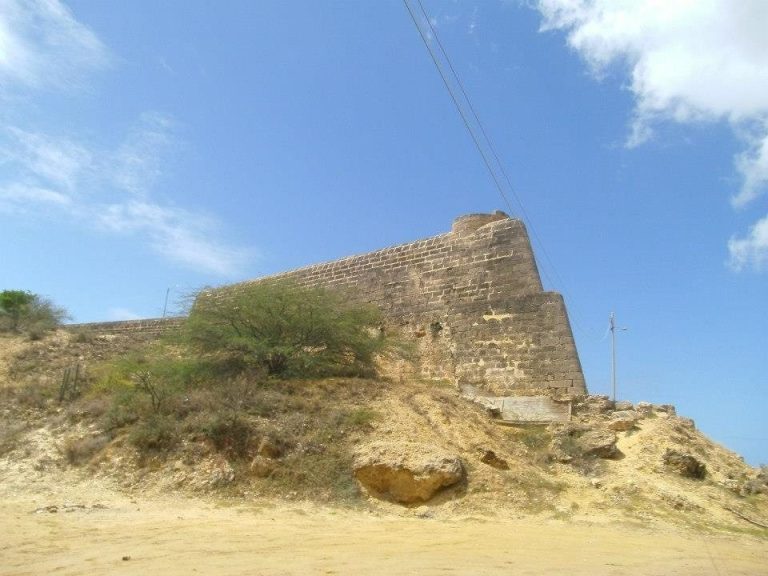
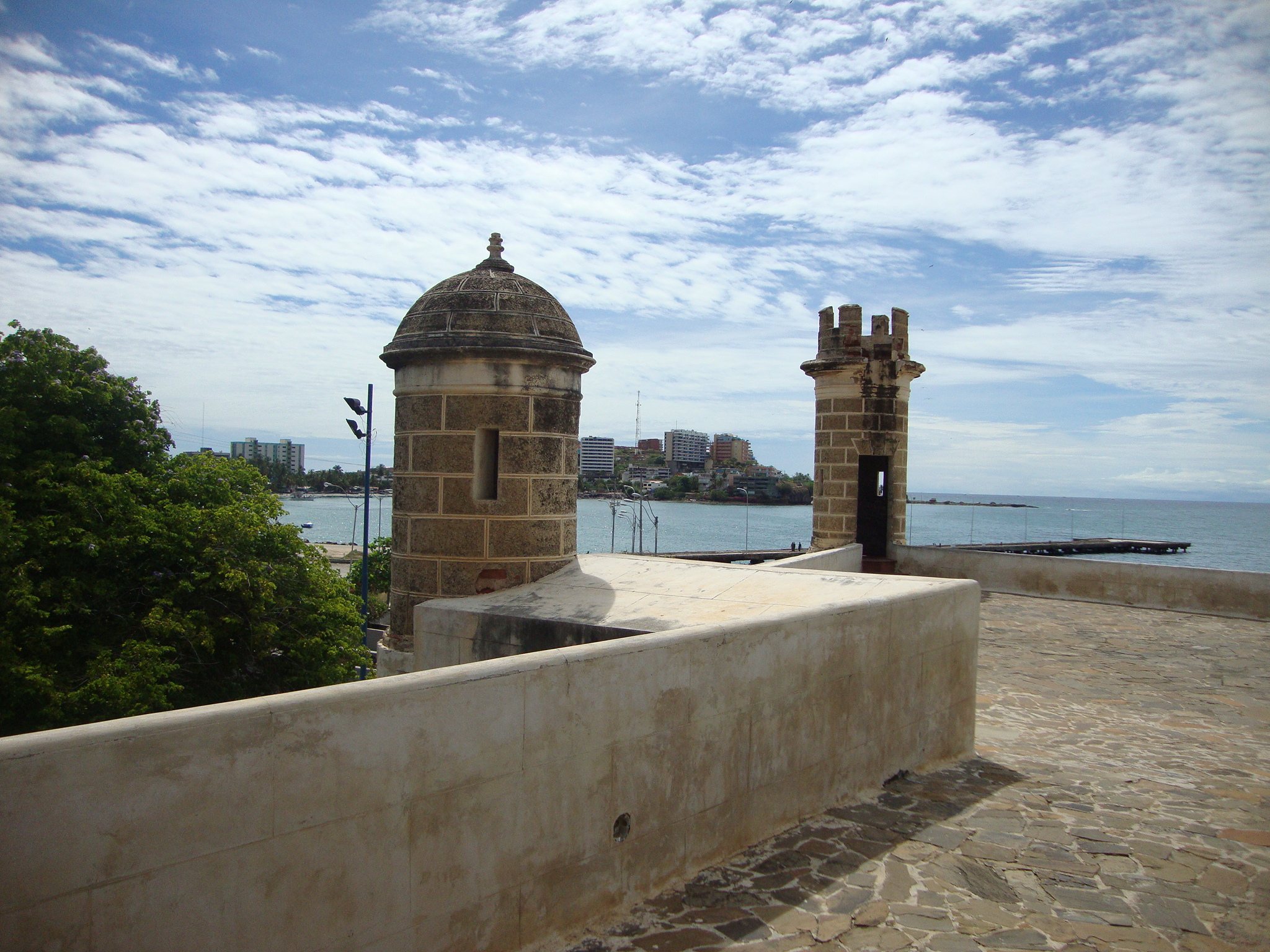
San Carlos de Borromeo Fortress is a square fortification with thick stone walls and a star-shaped plan. Its masonry consists of blocks made with mortar and mollusc-shell remains. Four observation towers occupy the corners, while four projecting bastions and four central curtain walls, the linking sections between bastions, form the defensive outline. The arrangement is described as a regular fortification because the bastions and curtain walls have equal or approximately equal dimensions, a result attributed to an architectural error.
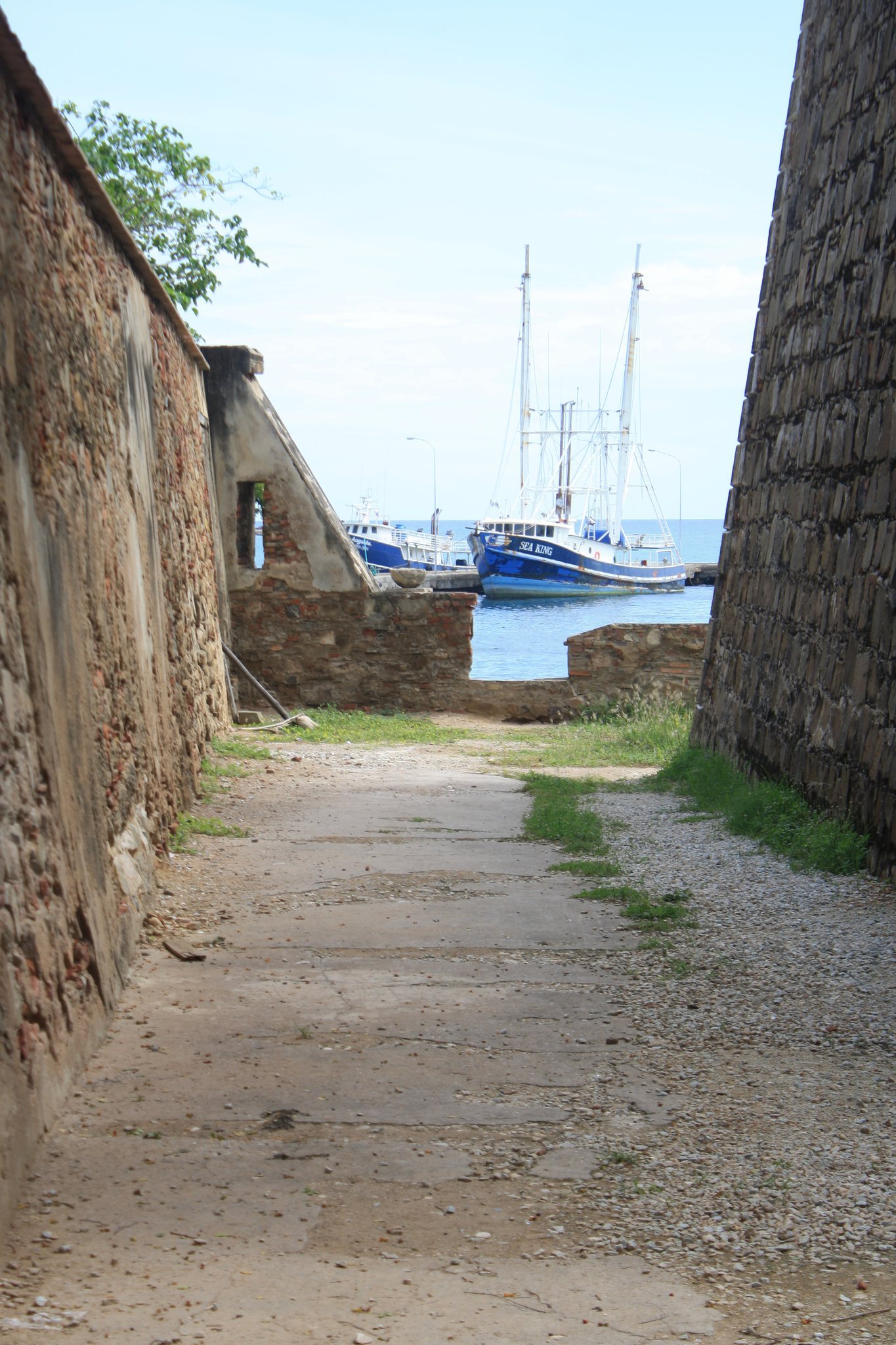
A drawbridge provides access to the interior. A moat surrounds the fortress, although it was built well above sea level and could never be filled with water, so it did not perform its intended defensive function. On the coastal side, a battery, meaning a group of artillery pieces positioned to defend a shoreline or harbor, originally held twelve cannons directed across Pampatar Bay. The fortress is regarded as a classical example of the military architecture of its period and as typical of coastal fortifications along the Venezuelan coast.
Restored interior
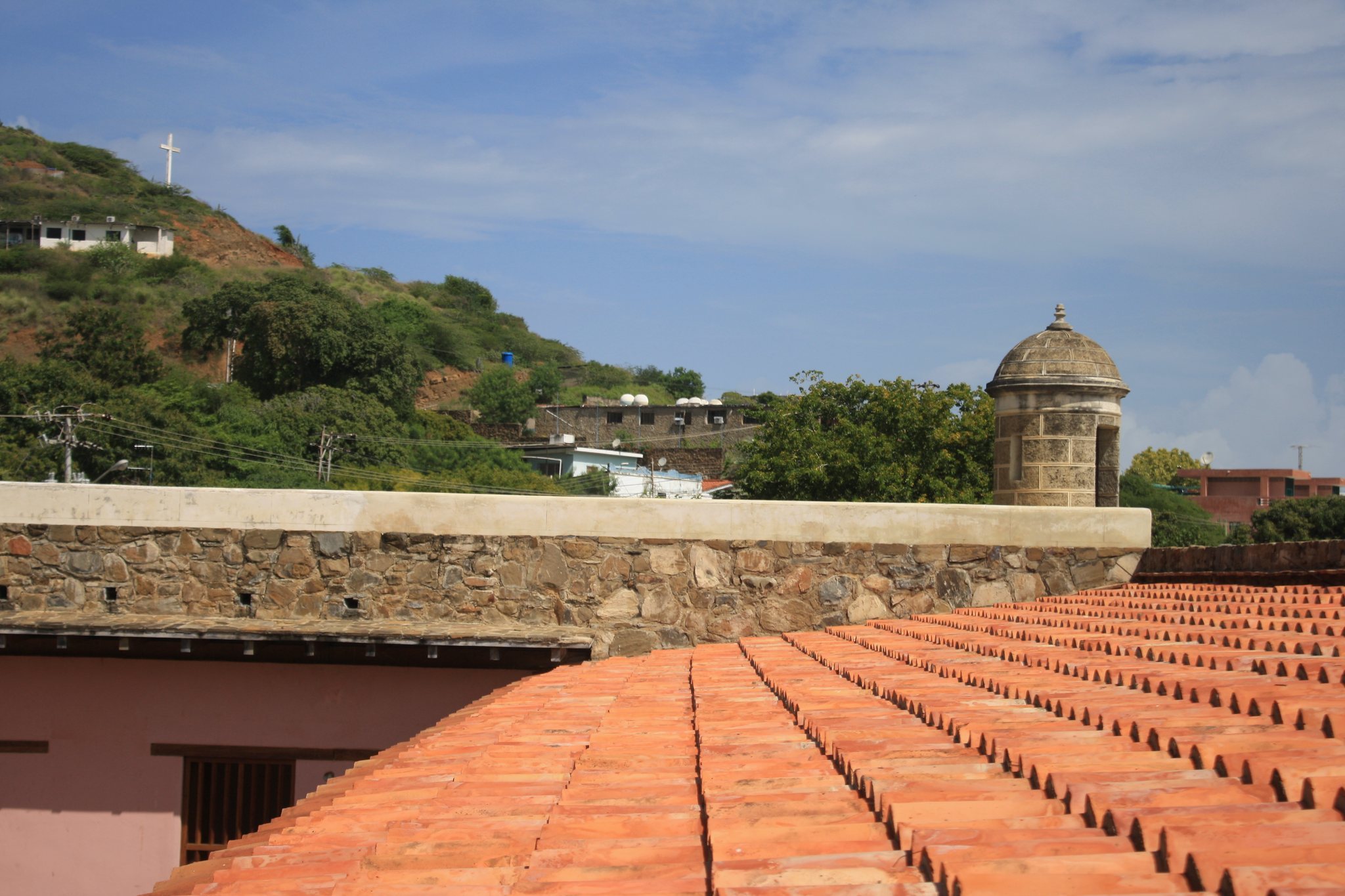
Many interior rooms were converted into exhibition halls during the restoration. The surviving museum spaces contain paintings, old weapons, the replica of the Santa Maria, and memorabilia connected with Luisa Cáceres de Arismendi. These displays occupy rooms within the historic defensive structure while presenting the fortress’s connections with the Venezuelan War of Independence.