Hyde Abbey: A Medieval Benedictine Monastery at Winchester
Site at a Glance
- Rating
- 4.5
- Popularity
- Very Low
- Country
- United Kingdom
- Primary era
- Medieval
- External website
- Open
- Eras represented
- Medieval
- Civilizations
- English
- Site type
- Religious
- Remains
- Monastery
On this page20 sections
History
Hyde Abbey was a medieval Benedictine monastery in Winchester, United Kingdom, developed by the Benedictine order from the New Minster and centred on a church consecrated in 1110. The Benedictines were a Western Christian monastic order governed by the Rule of Saint Benedict, which regulated communal worship, work, discipline, and prayer. The abbey stood immediately outside Winchester’s northern walls and became an important pilgrimage destination because it held the burials of Alfred the Great, his wife Ealhswith, and their son Edward the Elder.
From New Minster to Hyde Abbey
The community began as the New Minster, founded beside Winchester’s older cathedral community, the Old Minster, under Edward the Elder. It was consecrated around 903, and Grimbald, a learned monk from the monasteries of St Bertin and St Omer in Flanders, served as its abbot. Alfred the Great’s remains were transferred to the New Minster, where other members of the royal family were later buried.
In 1041, the reformed Benedictine house received the head of Saint Valentine from Queen Emma, the widow of Cnut. The community regarded this relic as one of its most valuable possessions. The New Minster also accumulated substantial estates. The Domesday Book, compiled in 1086, listed its lands at Addeston, Collingbourne, Pewsey, Manningford, and Chisledon.
In 1109, Henry I ordered the community to move to Hyde Mead, immediately outside Winchester’s northern wall and gate. The new abbey church was consecrated in 1110. Alfred, Ealhswith, and Edward the Elder were ceremonially reburied before its high altar, and their tombs drew pilgrims to the new monastery.
Rebuilding and prosperity
Winchester was burned during the Anarchy, the civil war between supporters of King Stephen and Empress Matilda that lasted from 1135 to 1154. The abbey church was damaged in the burning of 1141 and was subsequently rebuilt on a substantial scale. Hyde Abbey later prospered and acquired extensive landholdings, maintaining its position as an important religious house outside the city.
Dissolution and the loss of the royal burials
Henry VIII initiated the dissolution of England’s monasteries during his reign from 1509 to 1547. Hyde Abbey was dissolved in 1539. The monks received pensions, but the church and cloisters were dismantled within about a year, and their materials and other valuable items were taken away for reuse. Three years later, the antiquary John Leland found the abbey largely reduced to a memory.
The royal burial area gradually faded from knowledge between about 1538 and 1788. The southwestern part of the precinct became occupied by a large house, while the lower eastern ground beside the stream was used mainly for rough grazing and may also have received rubble. The royal graves were subsequently disturbed, and the remains of Alfred, Ealhswith, and Edward have not been securely identified.
Prison construction and archaeological investigation
In 1788, county authorities took over the land for a small prison. Prisoners digging its foundations exposed numerous abbey burials and associated objects. Dr. Milner, the local Catholic priest, described stone coffins, chalices, patens, rings, buckles, leather footwear, vestment textiles and gold, together with parts of a double-gilt crozier. A paten is a plate used to hold the bread in Christian Communion, while a crozier is a hooked ceremonial staff associated with a bishop or abbot.
During the nineteenth century, a local antiquary claimed that Alfred’s remains had been found after the royal crypt was disturbed and the bones were reburied outside St Bartholomew’s Church at Hyde. The identification remains unconfirmed. Archaeological work in 1999 examined the eastern end of the abbey church, identified two principal construction phases, and investigated earlier attempts to locate the royal tombs. Hyde Abbey received Grade I listed protection in 1950, the highest category of heritage protection in England for buildings of exceptional architectural or historic interest.
Remains
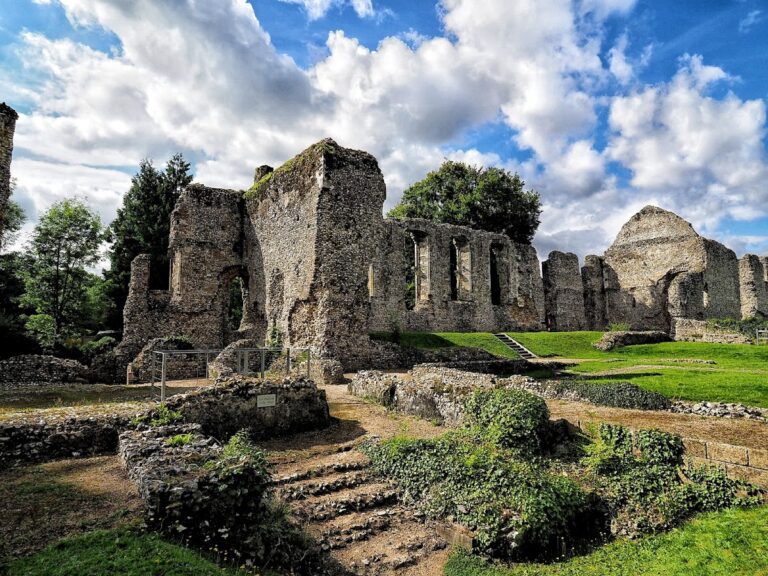
The surviving evidence represents a dispersed monastic complex whose principal elements included the abbey church, cloisters, precinct divisions, a millstream crossing, and burial areas. The 1110 church was built from flint and chalk rubble bonded with pale brown chalk mortar. Its choir was arranged around an ambulatory, a passage running around or behind the main body of the choir, allowing pilgrims to reach eastern shrines and chapels without crossing the central worship space.
The abbey church
Choir and pilgrimage arrangement
The choir was separated from the surrounding ambulatory by an arcade. This arrangement provided access to shrines and chapels at the eastern end of the church, including the area associated with the abbey’s royal burials. Deep, intersecting pits immediately in front of the high altar represent earlier attempts to locate Alfred the Great’s tomb.
Eastern chapel
The original eastern chapel of the 1110 church was replaced in the late twelfth or early thirteenth century. The later chapel used pale, honey-coloured, fine-grained limestone bonded with hard orange mortar. The earlier chapel remained standing while the replacement was built and was demolished only after the new structure was complete, probably to limit disruption to worship. Its construction may have been connected with activity surrounding miraculous events at the shrine of Saint Barnabas in 1182, although the precise date remains uncertain.
Side chapels
A chapel projecting from the church’s south side consisted of a small rectangular room ending in a semicircular apse, a rounded end of a church or chapel. Part of a similar chapel was identified on the north side. Together, these structures formed part of the eastern and lateral arrangements through which the monastic church served its worshippers and pilgrims.
Royal burial area
High-altar graves
At the dissolution, the graves before the high altar were reportedly marked by small lead tablets bearing the names Alfred and Edward. Later evidence suggests that the royal burials had not then been removed. A large excavated pit extends across the width of the high-altar area and reaches the water table. It corresponds to an account that prisoners broke open a coffin thought to have belonged to Alfred, discarded the bones, sold its lead covering, and dug down through the grave before reburying the fragments. Faint earlier cuts may represent three royal graves.
Burial finds
The 1788 disturbance of abbey burials produced stone coffins, chalices, patens, rings, buckles, leather footwear, vestment textiles and gold, as well as parts of a double-gilt crozier. These objects provide evidence for the character of the burials and the religious community that used the church.
Precinct structures
Gatehouse
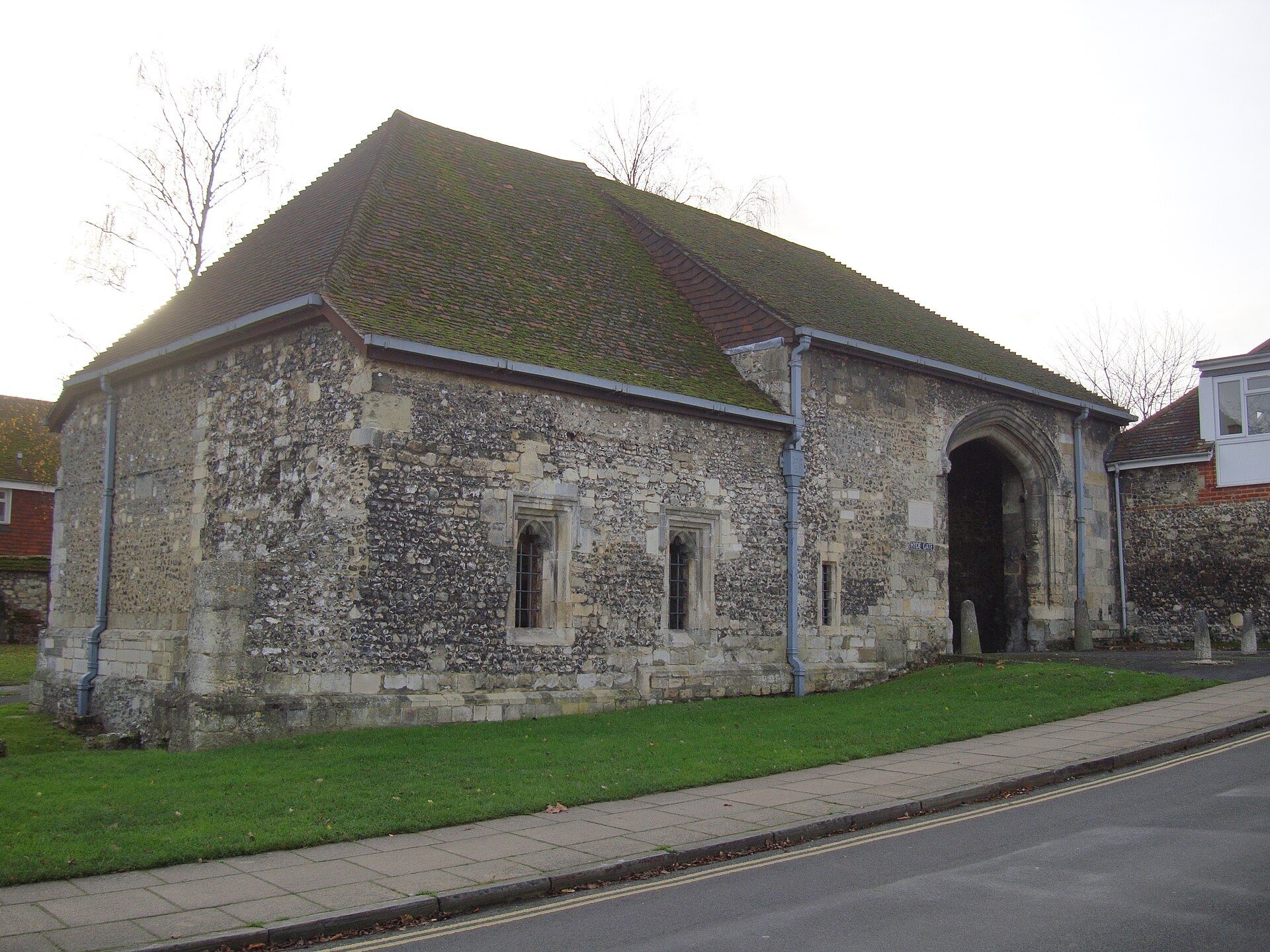
The surviving gatehouse once divided the abbey’s outer and inner precincts. It preserves part of the system by which movement between the wider grounds and the monastic enclosure was controlled.
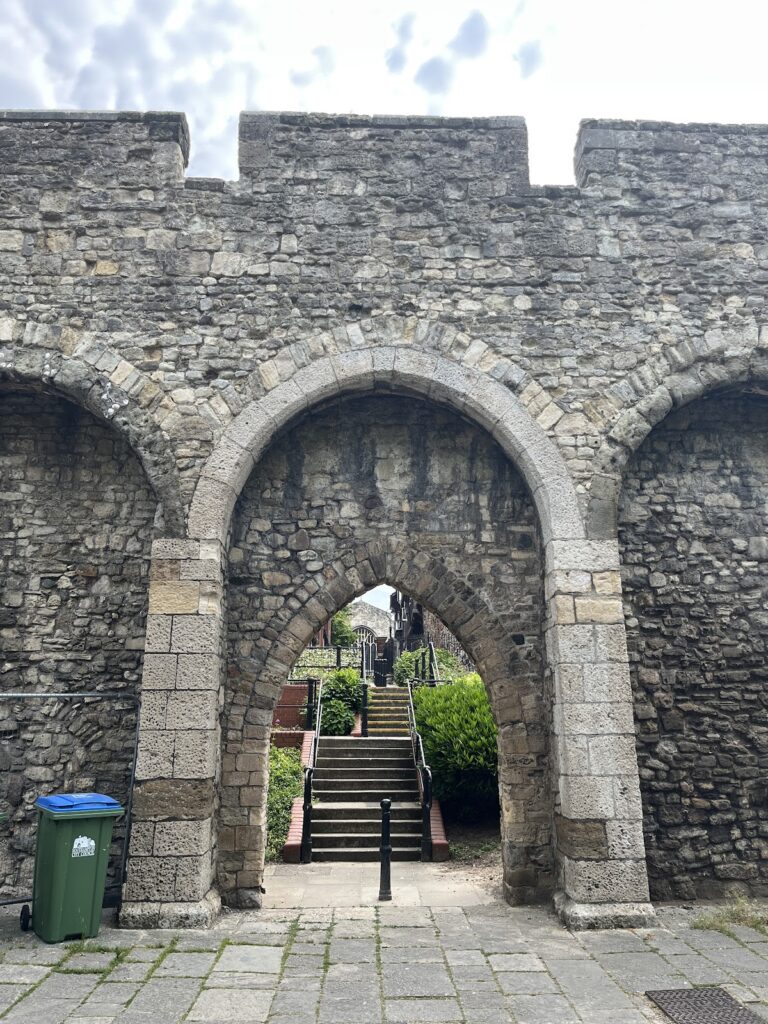
Millstream arch
An arch also survives from the abbey precinct. It formerly spanned the abbey millstream and represents one of the functional structures associated with the monastery’s watercourse and grounds.
Parish church fabric
The church built for pilgrims and lay brothers now forms the nave and chancel of St Bartholomew’s Parish Church. This surviving use preserves part of the abbey’s ecclesiastical fabric within a later parish setting.
Documentary and material remains
Abbey manuscripts
Surviving manuscripts from the abbey library include a cartulary now held in the British Library, a breviary dating from the late thirteenth or early fourteenth century, and a Liber vitae, a book listing people remembered in the community’s prayers. A cartulary preserves a religious house’s records of rights, lands, and legal documents, while a breviary contains texts for the daily liturgy.
Post-dissolution ground levels
Late-eighteenth-century maps show the former church site covered by mounds of rubble after the church and cloisters were dismantled. The surviving archaeological evidence, including the high-altar pit and the remains incorporated into later structures, has helped clarify the church’s layout and the repeated attempts to locate its royal tombs.