Admiralteyskaia Church: Voronezh’s Historic Naval Church
Site at a Glance
- Rating
- 4.7
- Popularity
- Low
- Country
- Russia
- Primary era
- Early Modern
- External website
- Open
- Eras represented
- Early Modern, Modern
- Civilizations
- Russian
- Site type
- Religious
- Remains
- Church
On this page15 sections
History
Admiralteyskaia Church, formally the Church of the Dormition of the Most Holy Mother of God and Ever-Virgin Mary, is the oldest surviving church in Voronezh, Russia. It probably originated during the first decade after the foundation of Voronezh Fortress, and its successive rebuilding phases combine pre-Petrine Russian architecture with later Classicism. Its history is closely connected with the formation of Russia’s regular navy and the shipyards established by Peter the Great along the Voronezh River.
Foundation and the Dormition Monastery
The earliest known reference to the church is a royal charter dated 5 August 1594. The charter ordered icons, bells, and liturgical books to be sent from Moscow for a church dedicated to the Dormition. The building initially served as a parish church, meaning that it provided worship for a local congregation.
A Dormition Monastery was established beside it around 1600 under Tsar Boris Godunov, who ruled Russia from 1598 to 1605. Hegumen Cyril is regarded as the monastery’s founder. Every building in the seventeenth-century complex was made of wood, leaving the church vulnerable to the recurrent spring floods of the Voronezh River. Floodwater damaged and rotted the structure, and after a particularly severe flood in 1616, officials proposed moving it to the former Kazar settlement. The church nevertheless remained in its original position.
On 29 June 1680, a major fire destroyed the monastery buildings and 80 nearby houses. Hegumen Titus subsequently planned a stone church with five domes and room for about 500 people. The date of its completion or consecration is uncertain. The years 1694, 1699, and 1703 have all been associated with the work, but a drawing from late 1694 shows a wooden three-domed building, while an engraving from 1703 also appears to depict a wooden church. Most Voronezh researchers therefore place the stone rebuilding after 1703. The completed church is regarded as Voronezh’s second-oldest stone building, after the 1674 construction at the Alexeev-Akatov Monastery.
Peter the Great and the Russian navy
The church gained a new role during Peter the Great’s efforts to create Russia’s regular navy. Peter, the Russian tsar and later emperor, developed Voronezh as a shipbuilding centre for campaigns against Azov. During his first visit to the city in February 1696, the area around the church was selected for shipbuilding. The naval complex included an admiralty with a fortress, a stone arsenal, and a sail yard. A German settlement, the tsar’s palace, and houses for his associates also grew around the shipyards.
The church divided the shipyard into right and left sections. On 2 April 1696, after a service there, galleys and ships of Russia’s first regular navy were launched, including the galley Principium. Peter accepted Russia’s first naval regulations aboard that vessel while travelling towards Azov. In 1700, one of the first officially approved Russian naval flags was consecrated in the church and raised on the first Russian ship of the line, Goto Predestinatsia.
The Dormition Monastery was dissolved in 1700 and merged with the Alexeev-Akatov Monastery because its position interfered with the shipyard. The church then became known as the Admiralty Church and served as a military and naval church. Mitrofan of Voronezh, the city’s first bishop and an important Orthodox leader of the period, conducted services connected with ship launches, including a service before the second Azov campaign. Peter repeatedly attended worship there, and local tradition holds that he sometimes joined the choir.
Parish use and nineteenth-century changes
Shipbuilding at Voronezh continued until 1711. Once the work ended, the church returned to ordinary parish use and lost the prominence it had held during the naval programme. A fire in 1748 damaged the nearby German settlement, while the movement of prosperous residents away from the river contributed to the church’s decline.
The building was enlarged in 1803. A new bell tower was added, and the vestibule or refectory was extended with side altars dedicated to the Epiphany and to Saints Anthony and Theodosius of the Caves. Repairs in 1880 and 1881 included repainting the iconostasis, enlarging the first-tier windows, replacing the river-side earthen rampart with a stone enclosure wall, and adding a guardhouse.
On 6 June 1885, thieves took vestments, sacred vessels, and a gold cross associated with Peter the Great. The robbery formed part of the church’s later history as a place where religious worship and memories of the early Russian navy remained closely linked.
War damage, secular use, and restoration
In 1940, the church was transferred to the city branch of the Society for Assistance to the Defense, Aviation, and Chemical Construction of the Soviet Union, ending its ecclesiastical use. During the Second World War, bombing destroyed the refectory roof and several domes and caused cracks in the nave arch and side walls. A German bomb destroyed Peter the Great’s arsenal in 1942.
In 1946, the building became a repository for the regional archive. High shelving and a small reading room were installed, while repairs enlarged the refectory windows and covered historic wall paintings with plaster. After the archive moved to a new building in 1967, the church passed in 1969 to the regional local-history museum, which used it for an exhibition on the history of the Russian navy.
Restoration began in 1970 under a design by the Moscow architect B. L. Altshuller. The building was threatened by flooding associated with a planned reservoir in 1972, and water entered the church. Brickwork repairs in 1973 did not stop the continuing damage. A proposal in the 1990s to raise the building by two or three metres and install a waterproof concrete foundation initially lacked funding.
Works undertaken in preparation for the tercentenary of the Russian navy provided waterproofing, raised the floor level, and began restoration of the iconostasis. The church was returned to the Russian Orthodox Church after 1991 and reconsecrated on 14 September 1996. In September of that year, Metropolitan Methodius led a procession from St Nicholas Church and ceremonially transferred a symbolic key to the building. Services resumed, and a naval flag was solemnly consecrated there.
After the church was attached to St Nicholas Church in 1997, regular worship was limited to feast days and weekends. A memorial plaque installed in 2002 commemorates Voronezh sailors who died aboard the submarines Komsomolets and Kursk. In 2003, the church received an Andreevsky naval flag, the blue Saint Andrew’s cross flag associated with the Russian Navy, and an icon of Theodore Ushakov, an eighteenth-century admiral later canonized as a righteous warrior. Restoration and foundation waterproofing were still continuing in 2006.
Admiralteyskaia Church remains an active parish of the Voronezh Eparchy, the administrative diocese of the Russian Orthodox Church. It is a federal-level cultural heritage monument of the peoples of Russia, with particular historical importance arising from its connection with the formation of the Russian navy. Catechetical courses operate at the church, and Priest Artemy Azovsky has served as rector since 29 June 2007.
Remains
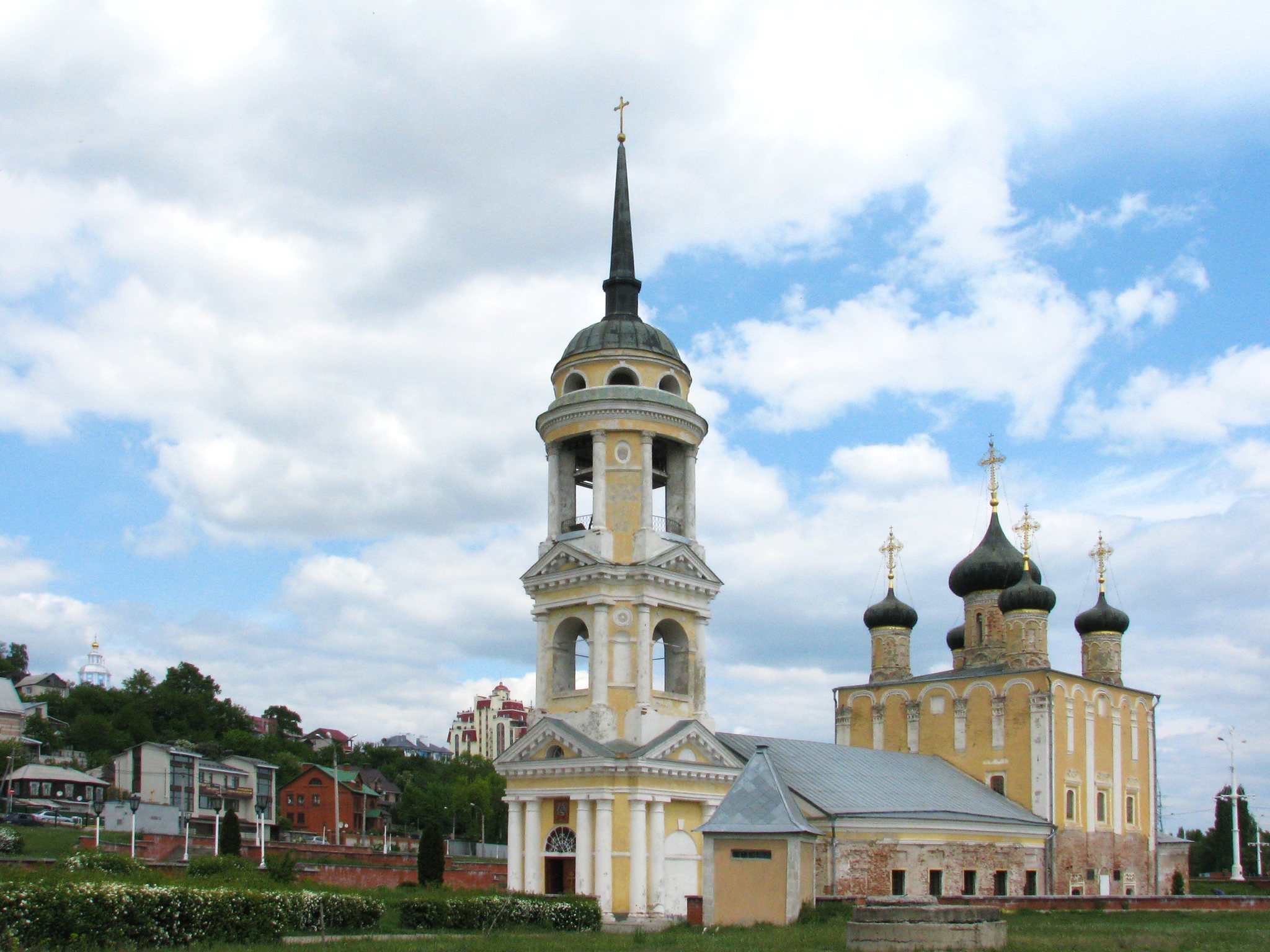
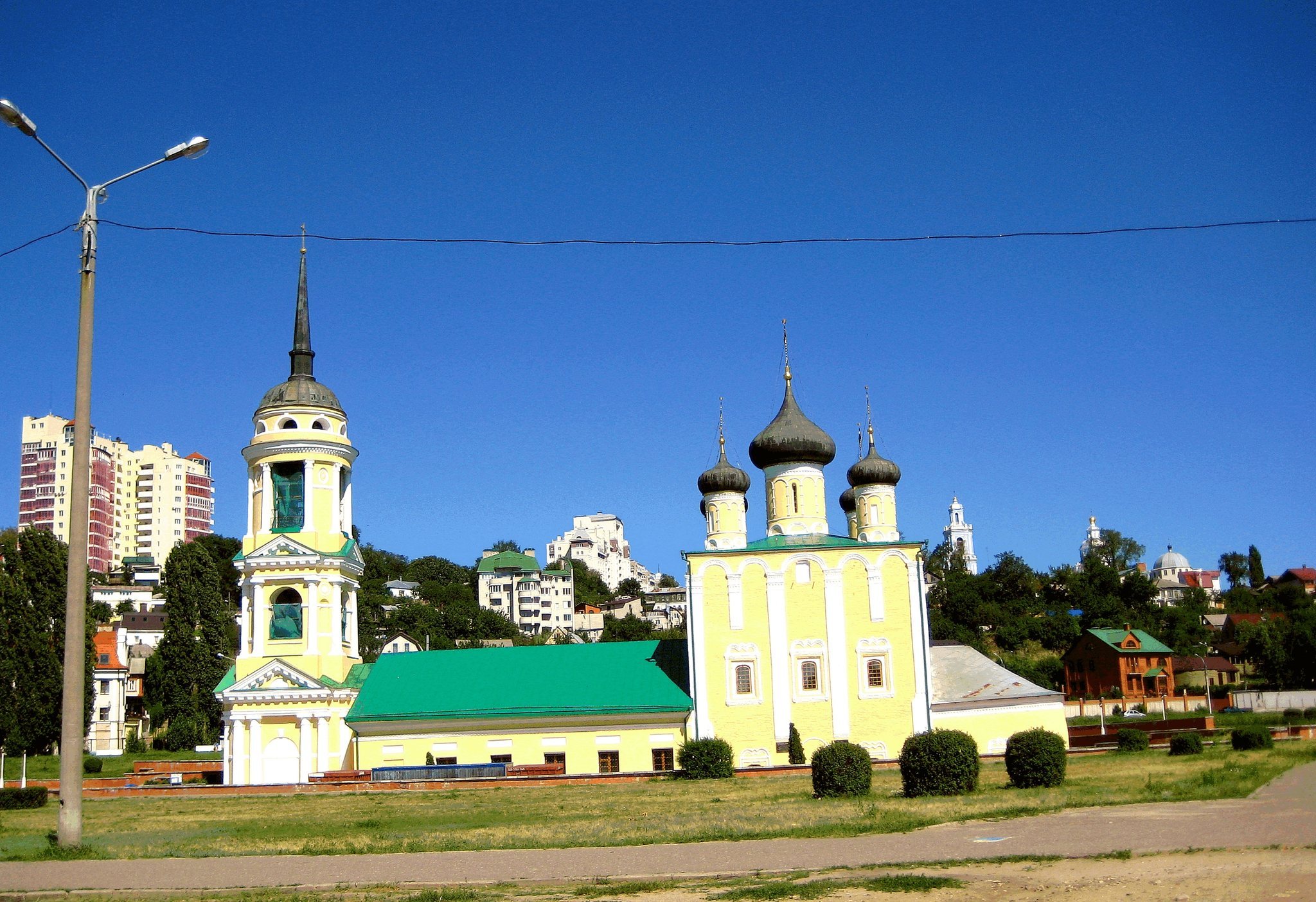
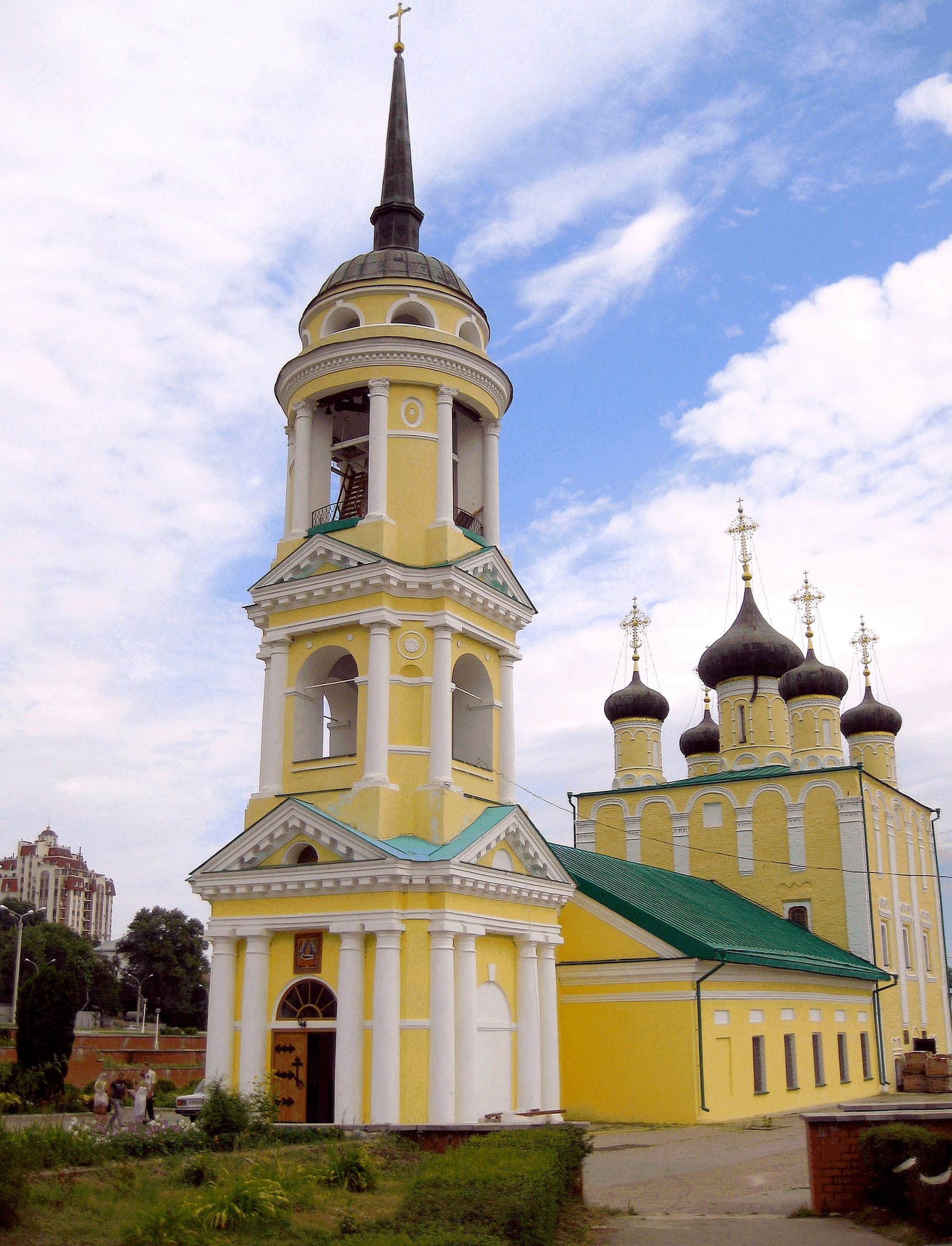
The church occupies a plot of approximately 0.142 hectares. Its surviving form brings together a tall central worship space, a low apse, a later refectory, and an integrated bell tower. The stone building preserves the contrast between its earlier Russian core and the Classical additions introduced during the nineteenth century and later repairs.
Main church and later additions
Stone central church
The oldest core is a high, square, single-nave volume rising 13.1 metres. It is crowned by five domes and terminates in a low, three-lobed apse. The stone structure represents the rebuilding planned after the wooden monastery church had suffered from floods and fire. Its original wall paintings are now covered by plaster, while the church retains one main altar and one iconostasis, the screen of icons separating the sanctuary from the nave.
Refectory and bell tower
A rectangular refectory or vestibule was enlarged in 1803 and fitted with side altars dedicated to the Epiphany and to Saints Anthony and Theodosius of the Caves. The same Classical phase produced the integrated three-tier bell tower, which reaches 21.4 metres. The refectory and tower distinguish the later additions from the older five-domed central volume.
Enclosure, burials, and interior furnishings
River-side enclosure and burials
Along the river side, a stone enclosure replaced an earthen rampart intended to protect the church from floodwater. A guardhouse was also added. Two gravestones were recorded within the enclosure in the 1920s, one marking the burial of Father Simeon in 1758 and the other that of the parishioner Praskovya Petrova in 1763. Earthworks in 1996 uncovered numerous human skeletons, which researchers believe may represent burials dating from the time of Peter the Great.
Venerated images and sacred objects
The interior contains venerated images of Saint Nicholas, Mary Magdalene, the Dormition of the Mother of God, the Prophet Elijah, and Theodore Ushakov. A cypress cross decorated with mother-of-pearl was brought from Jerusalem. The church also holds an icon of Theodore Ushakov containing a particle of his relics.
Naval memorials and commemorative features
Flags and memorial plaques
The church’s naval associations are represented by the Andreevsky flag and by memorial plaques. One plaque commemorates those who died aboard Komsomolets and Kursk. Another recalls the church’s connection with the blessing of the Russian fleet before the Azov campaign. Its date is calculated incorrectly as 16/3 May 1696; the correct date was 3/13 May 1696.
Cross on the opposite island
A wooden cross was erected on the island opposite the church on 12 June 2002. It commemorates the 330th anniversary of Peter the Great’s birth and extends the church’s memorial landscape beyond its enclosure.