National Roman Legion Museum Newport: Preserving Roman Isca Augusta


Site at a Glance
- Rating
- 4.6
- Popularity
- Low
- Country
- United Kingdom
- Primary era
- Classical
- External website
- Open
- Eras represented
- Classical
- Civilizations
- Roman
- Site type
- Museum
On this page12 sections
History
The National Roman Legion Museum is a museum in Caerleon, Newport, United Kingdom, established in 1850 to preserve and display discoveries from the Roman fortress of Isca Augusta. Built by the Romans in AD 75, the fortress was a permanent base for Legio II Augusta and formed part of the military system of Roman Britain. It remained occupied and operational for just over 200 years, making Caerleon an important centre of Roman military and civilian life in Wales.
The Roman fortress at Caerleon
Isca Augusta was a legionary fortress, a permanent fortified base occupied by a Roman legion and its supporting personnel. The Romans built it to defend the region, and the fortress was one of only three permanent legionary fortresses in Roman Britain. Civilian settlements developed around the military base, creating an archaeological record that includes evidence of both army life and the communities connected with it.
Foundation and development of the museum
The Caerleon Antiquarian Association was founded by John Edward Lee in 1847 and opened the museum three years later. The institution was taken over by the National Museum Wales in 1930 and now forms part of Amgueddfa Cymru, Museum Wales. Its work includes researching, preserving, and displaying approximately half a million objects from Caerleon and Usk and their surrounding areas.
The museum building received Grade II listed status in 1951, a designation recognizing special architectural or historic interest in the United Kingdom. It was largely demolished, enlarged, and rebuilt in 1987. The rebuilding left the original portico as the principal surviving element of the earlier museum building.
Remains
The museum stands within the surviving area of Roman Isca, on the line of the via principalis, the main cross-street of a Roman military fortress, leading toward the amphitheatre. Its displays and associated remains bring together the architecture of the fortress with objects that illuminate military, domestic, and civilian activity around the base.
The museum buildings and displays
The 1850 museum
The first museum was a simple box-shaped building designed by Henry Francis Lockwood of Hull. Constructed from Bath stone, it had a Greek Doric portico with four Doric columns made of oolite, a limestone formed from small rounded grains in shallow marine conditions. The building also reused ship’s timbers in its roof and stone details from Caerleon’s demolished Old Market House. The suggestion that the roof timbers came from HMS Collingwood remains uncertain, since the ship was still in service at the time and no clear connection with Newport is known.
The 1987 building
The replacement museum was built in a modernist style using steel, glass, and stone. It is largely windowless and featureless in its external treatment, while retaining the earlier building’s Greek Doric portico. Inside, the archaeological displays include gravestones, mosaics, pottery, weapons, coins, Roman currency, everyday objects, and military uniforms from the period of Isca Augusta. A Roman Garden and a full-sized barrack room support the museum’s interpretation of Roman life.
Associated Roman structures
Military bath house
The Roman complex associated with the museum includes the remains of the military bath house. It formed part of the fortress’s built environment and survives as one of the principal archaeological features connected with the museum.
Amphitheatre
Caerleon’s Roman amphitheatre survives as the most complete Roman amphitheatre in Britain. Its remains belong to the wider military complex established at Isca Augusta and provide physical evidence of the facilities associated with the fortress.
Fortress walls
Sections of the fortress walls also survive around the museum’s archaeological setting. They mark the defensive boundaries of the Roman base and help define the physical extent of Isca Augusta.
Legionary barracks
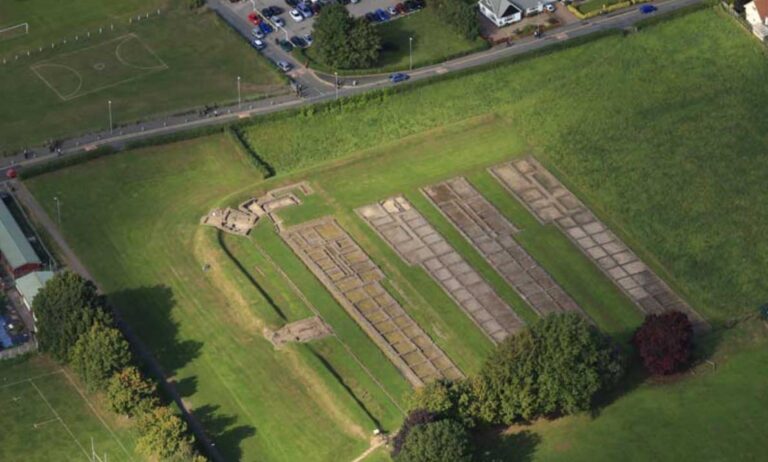
The associated remains include legionary barracks at Prysg Field. These are the only Roman legionary barracks on view anywhere in Europe, and they preserve evidence of the accommodation and organization of the Roman military base.