Greyfriars, Leicester: A Medieval Franciscan Friary
Site at a Glance
- Rating
- 4.8
- Popularity
- Very Low
- Country
- United Kingdom
- Primary era
- Medieval
- External website
- Open
- Eras represented
- Medieval
- Civilizations
- English
- Site type
- Religious
- Remains
- Monastery
On this page13 sections
History
Greyfriars, Leicester, in the United Kingdom, was a medieval friary of the Order of Friars Minor, the religious order founded by Saint Francis of Assisi and commonly known as the Franciscans or Grey Friars. Franciscan friars had reached Leicester before 1230, and a friary was established by about 1250 within the town walls, on its western side. Leicester was already one of seven English Franciscan houses with lectors responsible for teaching new recruits. The friary became a setting for religious life, political conflict, parliamentary business, and the burial of Richard III.
Foundation and medieval development
The acquisition of the friary’s large town plot is uncertain, although its foundation is generally placed in the middle of the thirteenth century. Simon de Montfort, sixth Earl of Leicester, was traditionally associated with its creation, but that attribution is considered unlikely. Gilbert and Ellen Luenor and John Pickering have also been proposed as founders or early benefactors. The dedication is uncertain as well, with associations proposed for both Saint Mary Magdalene and Saint Francis of Assisi.
The choir was completed around 1255, followed by the nave around 1300. King Henry III supplied oak for the choir stalls and wainscoting. Permission to enlarge the friars’ dwelling was granted in 1349, and William of Nottingham was buried in the friary cemetery around 1336. These developments formed part of the friary’s growth as a substantial Franciscan house within Leicester.
Political and parliamentary events
Greyfriars became involved in a dangerous political episode in 1402, when several Leicester friars conspired in support of the deposed King Richard II against Henry IV. Eight friars and a secular master of divinity were eventually convicted and executed after trial in London. Two further friars who initially escaped were later captured and executed at Lichfield. In the same year, a provincial chapter of the English Franciscans held at Leicester prohibited members of the order from speaking against the king.
In April 1414, Henry V convened Parliament at Leicester. The Lords met in the friary’s Large Hall, while the Commons met in the Greyfriars infirmary, a separate building outside the town walls on Millstone Lane. The sessions concentrated on suppressing Lollardy, a late-medieval reform movement that criticised aspects of the established church. Their severity gave the gathering its later name, the Fire and Faggot Parliament.
Richard III and the dissolution
Richard III, the last Yorkist king of England, was killed at the Battle of Bosworth on 22 August 1485 during the conflict that brought Henry Tudor, later Henry VII, to the throne. Richard’s body was taken to Leicester, displayed for several days, and then buried hastily in the Greyfriars church. In 1495, Henry VII paid for a high-status tomb of multicoloured marble, probably alabaster, to be erected over the burial. A possibly contemporary epitaph survives in a manuscript made by Thomas Hawley, although it apparently was never attached to the tomb.
Greyfriars was dissolved on 10 November 1538 during the suppression of England’s monasteries under Henry VIII, the Tudor king whose government transferred or sold much monastic property. The friary was then extremely poor, with an annual income of only £1 2s., and held only the land occupied by its buildings. Its community comprised the warden, William Gyllys, and six other people, presumably friars.
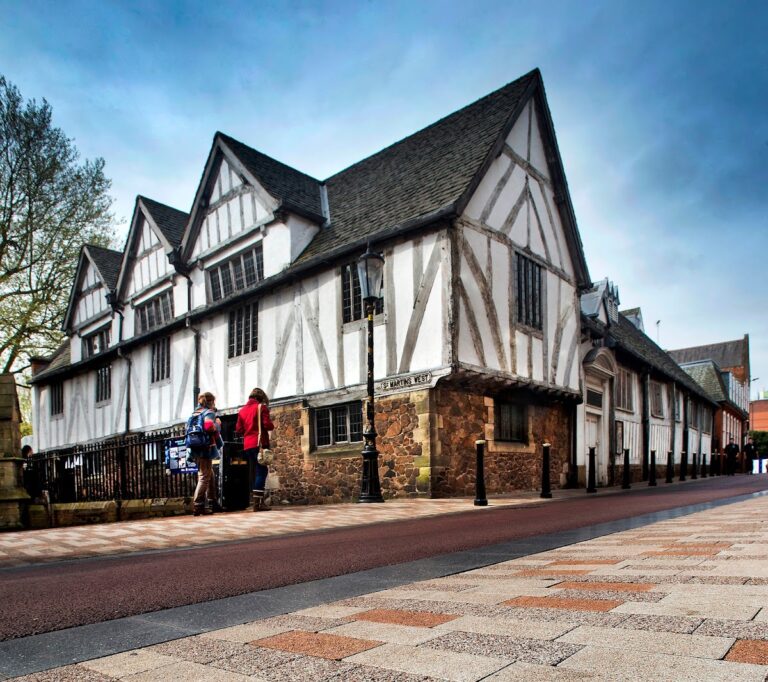
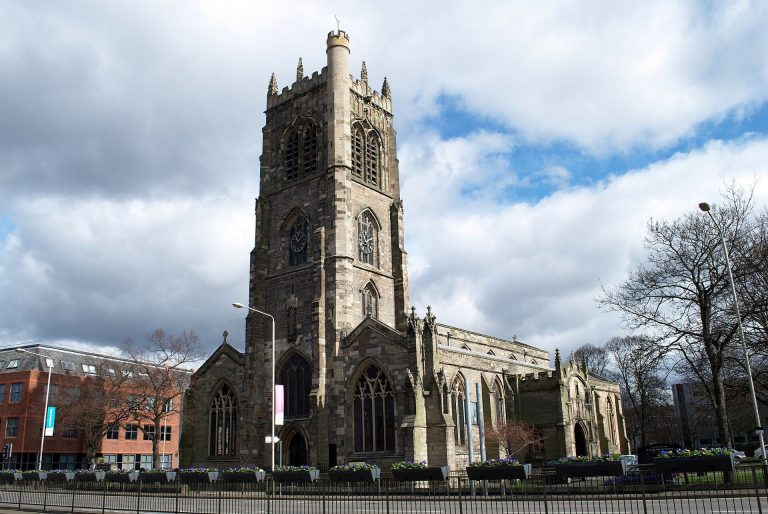
John Bellowe and John Broxholme acquired the former church and monastic buildings, demolished them in 1538, and sold their stone and other materials. Some stone and timber were reused in repairs to St Martin’s Church, now Leicester Cathedral. The tomb associated with Richard III is presumed to have been destroyed during the same process. A later story claimed that Richard’s bones were thrown into the River Soar near Bow Bridge, but twentieth-century historians regarded this as highly improbable.
Redevelopment and archaeological rediscovery
After the dissolution, Sir Robert Catlyn acquired the site, which later passed to Robert Herrick, three-times mayor of Leicester. Herrick built a mansion facing Friar Lane and laid out extensive gardens across the eastern part of the former friary grounds. In 1611, Christopher Wren Sr., an English clergyman and father of the architect Christopher Wren, recorded seeing a stone pillar there with an inscription stating that Richard III’s body lay at the site.
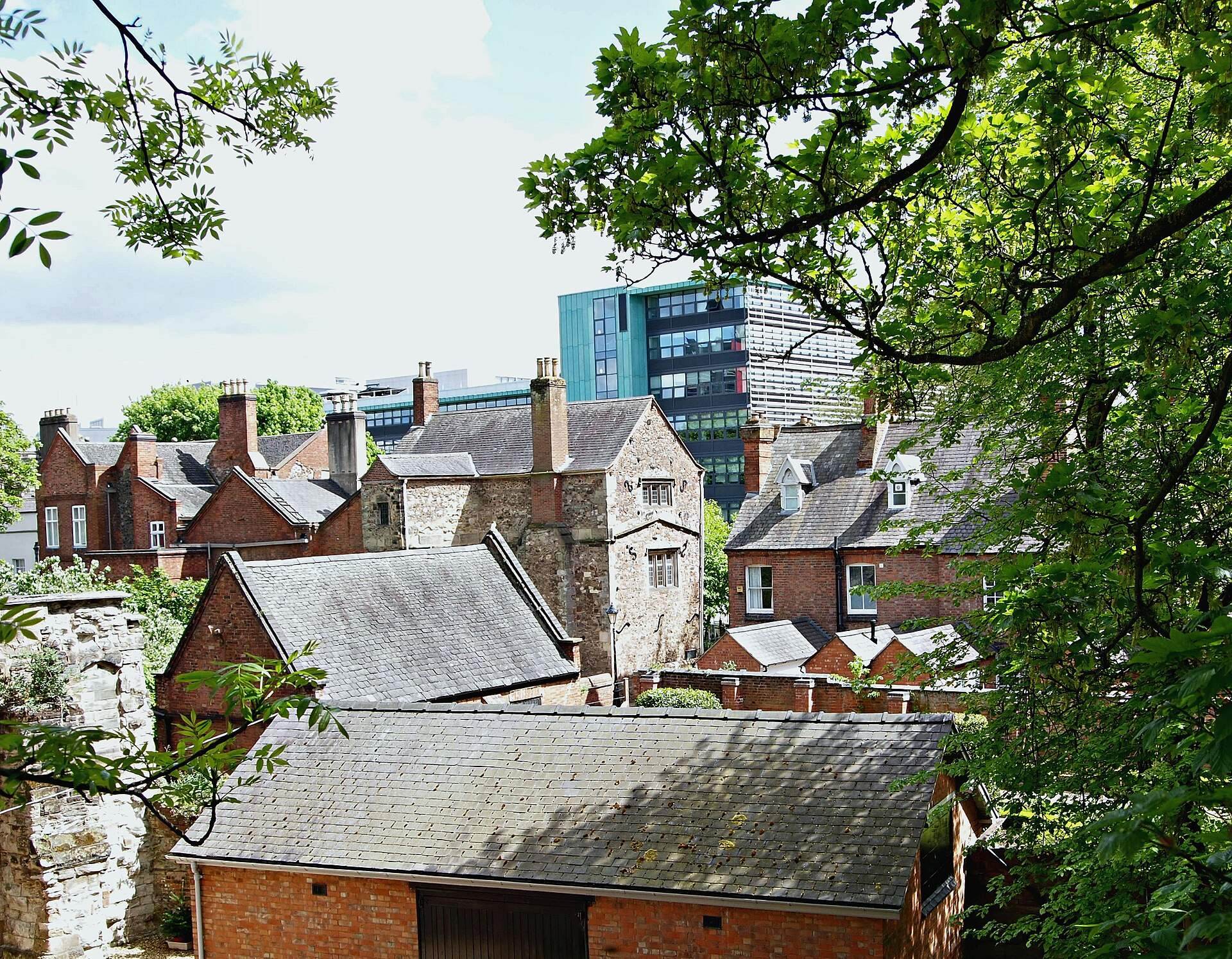
The former friary grounds were progressively redeveloped. Thomas Noble laid out New Street across the site in 1740, followed by Georgian buildings along New Street and Friar Lane. Thomas Pares enlarged the Herrick mansion and built a banking house at the eastern end of the site; that bank was rebuilt in 1900. The mansion was later subdivided, and part of the site was occupied by Alderman Newton’s school from 1864, with extensions added in 1887 and 1897. The former school buildings subsequently housed other schools and offices.
Leicester Corporation acquired the mansion and the remainder of the gardens in 1866, demolished the mansion, and created Grey Friars road between St Martins and Friar Lane. Commercial buildings followed, including Leicester Savings Bank in 1873, Conway Buildings in 1878, and the former Barradale office in 1880. A building erected in 1936 over the former Herrick mansion site served as Leicestershire County Council offices until 1965 and was later used for social-services administration.
Archaeological investigations in 2012 and 2013 located the friary church, cloisters, and associated buildings beneath later car parks, gardens, and school grounds. The excavations also identified Richard III’s grave and a male skeleton with severe scoliosis and major head wounds. On 4 February 2013, the University of Leicester confirmed the identification as Richard III through mitochondrial DNA comparison with descendants of his sister Anne of York, radiocarbon dating, skeletal characteristics, and the nature of the injuries.
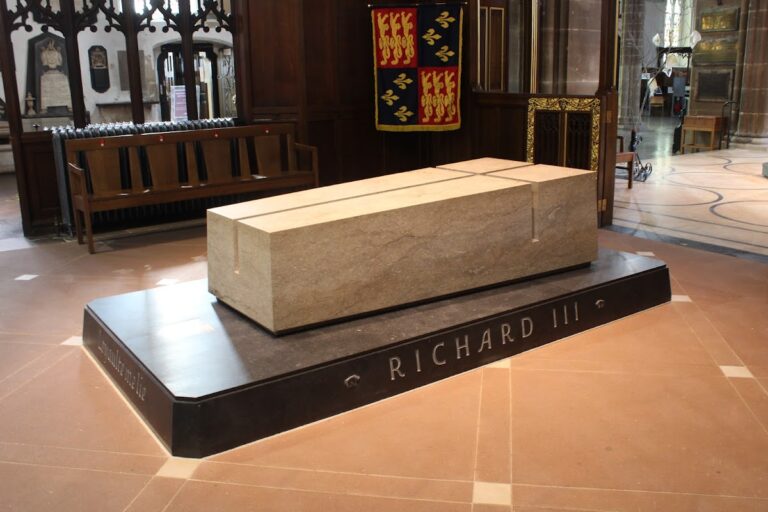
The discovery led to the conversion of the former Alderman Newton school buildings into the King Richard III Visitor Centre, opened in 2014. The centre incorporates the original grave beneath a covered area. Richard III’s remains were reburied in Leicester Cathedral on 26 March 2015 after a proposed reburial in York was rejected through judicial-review proceedings. Historic England designated Greyfriars as a scheduled monument in December 2017.
Remains
Precinct and church
The friary precinct occupied a large plot within Leicester’s town walls. Gates opened onto Peacock Lane, formerly St Francis Lane, to the north and Friar Lane to the south. The church stood in the north-eastern part of the plot, while the cloisters and other monastic buildings extended southward. Later buildings now enclose the former friary area along Grey Friars, Friar Lane, New Street, and St Martins, with the medieval remains lying beneath land successively used for gardens, car parks, back yards, and a school yard.
Friary church
The church had a buttressed choir measuring 10.4 metres across, with the nave continuing westward at the same width. Its foundations, floor levels, and demolition layer survived beneath about 30 centimetres of garden soil and a further 45 centimetres of mill waste used as a car-park base. Excavation exposed the north and south walls of the chancel, the eastern part of the church containing the high altar and normally reserved for the clergy. Floor tiles, stone choir pews, window moulding, and other construction materials helped define the building’s medieval form.
Cloisters and monastic buildings
The excavations also exposed parts of the cloister, a covered walkway arranged around an open courtyard and used to connect areas of a monastic complex. A chapter house with stone benches was identified among the associated buildings. A buttressed structure south of the chancel may pre-date the church. The wider 2013 excavation, made possible by removing the modern wall between the social-services car park and the former school playground, revealed further medieval fabric, including pottery, floor tiles in place, and other small finds.
Burials and surviving evidence
Richard III’s grave
Richard III’s grave lay within the former church and survived beneath the later development. Its location is now incorporated into the King Richard III Visitor Centre, where a covered viewing area marks the burial place and an upper platform includes reconstructions of Greyfriars and medieval Leicester. The king’s remains were removed for reburial in Leicester Cathedral in 2015, while the original grave remains part of the preserved archaeological site.
Chancel burials
Three additional graves were identified within the chancel and left undisturbed during the initial excavation. In front of the high altar, a substantial stone coffin contained an intact lead coffin. Preliminary examination indicated that its occupant was a woman who was probably a wealthy major benefactor, although her identity remains unknown.
Demolition and archaeological survival
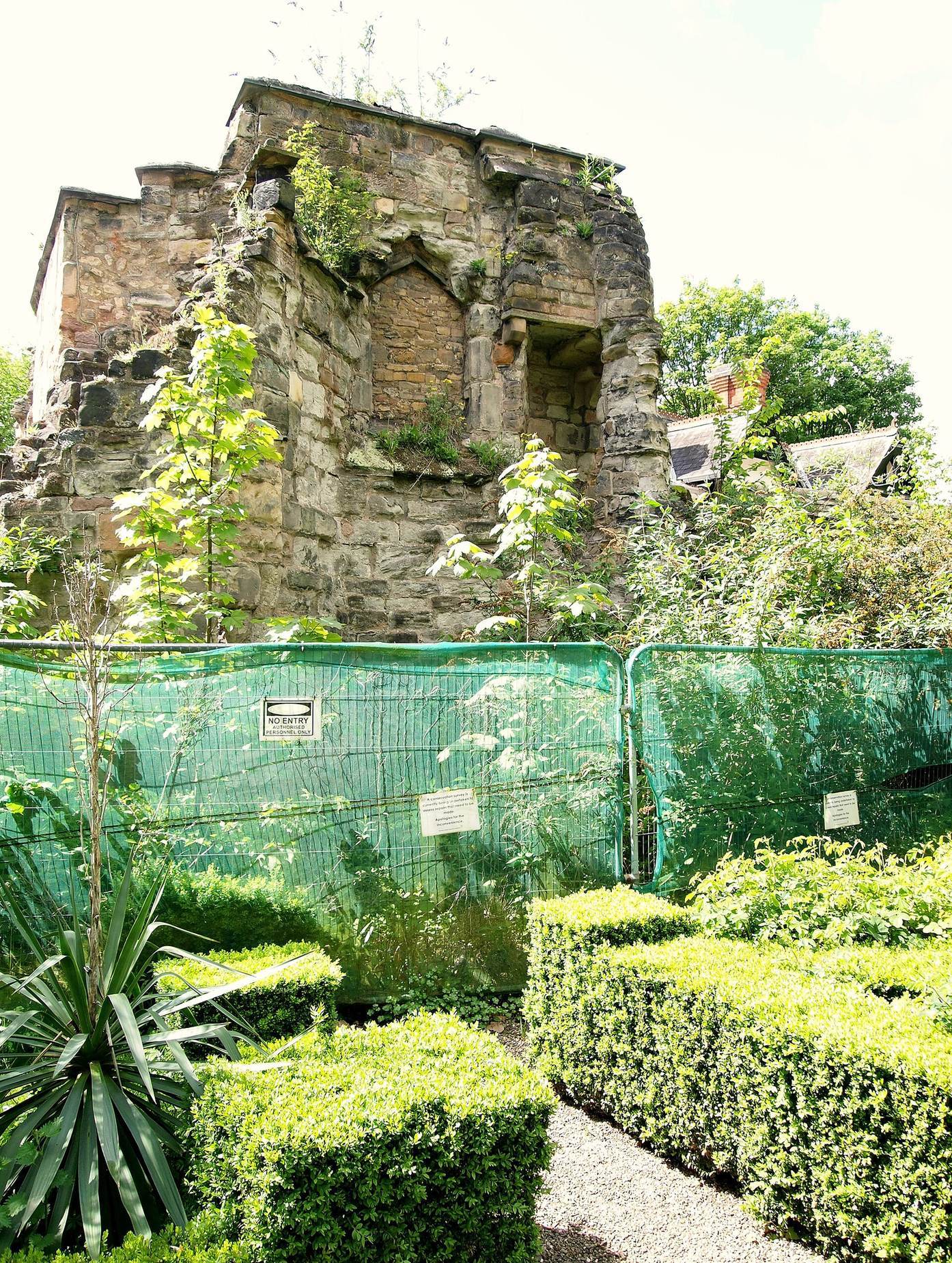
The friary’s stonework, timber, tracery, and other carved elements were dispersed or reused after the demolition. Wall trenches filled with demolition mortar, together with surviving foundations, floor levels, tiles, and other archaeological remains, preserve evidence of the medieval buildings. These remains allow the former church, cloisters, and associated structures to be traced beneath the later urban development.