Leicester Cathedral: A Church of England Cathedral and Historic Civic Church


Site at a Glance
- Rating
- 4.6
- Popularity
- Medium
- Country
- United Kingdom
- Primary era
- Modern
- External website
- Open
- Eras represented
- Medieval, Modern
- Civilizations
- British, English, Norman
- Site type
- Religious
- Remains
- Cathedral
On this page20 sections
History
Leicester Cathedral, formally the Cathedral Church of Saint Martin, is a Church of England cathedral in the United Kingdom. A church dedicated to Saint Martin of Tours has occupied the site since the medieval period, and the present building is predominantly Victorian and Gothic in style. The cathedral is the seat of the Bishop of Leicester and became the cathedral of the newly re-established Diocese of Leicester in 1927.
From Anglo-Saxon Leicester to the Norman church
The cathedral stands on ground containing Roman ruins. An earlier Anglo-Saxon cathedral stood elsewhere in Leicester, but the city’s last Anglo-Saxon bishop fled during the Danish invasions. The restoration of the diocese therefore came more than a thousand years after the end of Leicester’s Anglo-Saxon episcopal tradition. The Anglo-Saxon period describes the early medieval era in England before the Norman Conquest of 1066, while the Norman period followed the conquest and brought new political, architectural, and institutional forms.
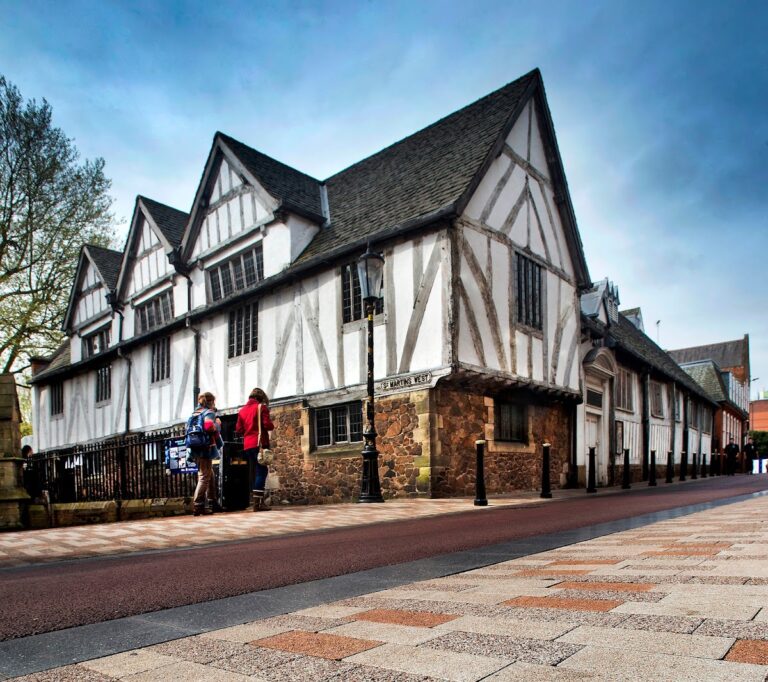
The church of Saint Martin was first recorded in 1086, when an older Anglo-Saxon church was replaced by a Norman building. It was probably one of the six Leicester churches mentioned in the Domesday Book. Parts of the present structure may derive from that twelfth-century church, which was rebuilt during the thirteenth and fifteenth centuries. During the Middle Ages, the church’s position beside Leicester Guildhall helped it develop into the city’s principal civic church, with close associations with merchants and urban guilds.
Cathedral status and modern development
St Martin’s was elevated to collegiate status in 1922. A collegiate church is served by a college of clergy rather than functioning solely as an ordinary parish church. The Diocese of Leicester was created in 1926, and St Martin’s became its cathedral the following year. Its earlier denominational history was Roman Catholic before its present affiliation with the Church of England.
The cathedral has also maintained a close institutional relationship with Leicester Grammar School. While the school stood beside the cathedral, its pupils attended regular morning assemblies and services there. The relationship continued after the school moved to Great Glen, about seven miles south of Leicester. Following extensive refurbishment in 2011, the cathedral offices and choir song school moved to the former school site, which was renamed St Martin’s House and formally opened by the Bishop of Leicester. The building also contains meeting and conference facilities.
Richard III and the cathedral
Richard III, the last English monarch to die in battle, was killed at the Battle of Bosworth Field in Leicestershire in 1485. He ruled from 1483 until his death. After the battle, his body was roughly buried at the Greyfriars religious house in Leicester. Excavations there in 2012 recovered his remains, which were publicly identified through DNA testing in February 2013.
Following a judicial-review decision in Leicester’s favour, plans were made for Richard’s reburial in the cathedral. He was reburied on 26 March 2015 by the Archbishop of Canterbury, after five days of commemorative events across Leicester and Leicestershire. Sophie, Countess of Wessex, represented Queen Elizabeth II, and Prince Richard, Duke of Gloucester, also attended. It was the first burial of an English monarch since the burial of Edward VIII, Duke of Windsor, in 1972.
The reburial prompted a wider reordering of the cathedral interior. A former cenotaph commemorating Richard III, which had stood in the chancel, was replaced by the king’s tomb. The choir screen was moved eastward, and the Chapel of Christ the King was created at the eastern end.
Protection, restoration, and archaeology
Leicester Cathedral was listed at Grade II* in 1950. The tower and spire received internal and external restoration in 2004 and 2005, including the cleaning and replacement of weakened stonework with newly carved stone from the Tyne Valley. The cathedral gardens were redesigned in July 2014, when a Richard III statue made in 1980 was installed. On 13 April 2017, Queen Elizabeth II distributed Maundy money at the cathedral. Maundy money consists of specially minted coins ceremonially given by the British monarch to selected recipients in recognition of Christian service.
Archaeological excavations began in 2022 on the site of the Old Song School as part of the Leicester Cathedral Revealed project for a new heritage and educational centre. A University of Leicester team identified a burial ground dating from the late Anglo-Saxon period. In March 2023, the same university discovered a Roman-period stone altar in the cathedral grounds, approximately 1,800 years old.
The cathedral follows the rites of the Church of England and uses Common Worship for its principal Sunday Choral Eucharist. Its history therefore combines the long religious continuity of a church dedicated to Saint Martin with the later civic, diocesan, and royal associations that shaped its modern identity.
Remains
Leicester Cathedral is a large Gothic church whose present appearance is chiefly Victorian. Its plan includes a nave, a chancel, two chancel chapels, and a tower carrying a 220-foot spire. The chancel is the eastern part of a church containing the principal altar and clergy seating. Four separate chapels occupy different parts of the building, while the surviving furnishings, memorials, bells, organ, and Richard III’s tomb preserve several layers of the cathedral’s religious and civic history.
Victorian building and principal spaces
Tower and spire
The tower was completed in 1862 and the spire in 1867. Both were designed by Raphael Brandon and follow an Early English manner, while Brandon’s work elsewhere in the church included Perpendicular-style elements. The tower and spire were loosely based on St Mary the Virgin at Ketton in Rutland. Architectural historian Nikolaus Pevsner described the composition as “intentionally impressive.”
Nave screen and Vaughan Porch
A large wooden screen separates the nave from the chancel. Charles Nicholson designed it, and Bowman of Stamford carved it. In 2015, van Heyningen and Haward Architects moved the screen eastward, placing it in front of Richard III’s tomb as part of the interior reordering for the reburial.
The Vaughan Porch stands on the south side of the church. J. L. Pearson designed it, and it was erected in 1897 to commemorate members of the Vaughan family who served successively as vicars during much of the nineteenth century. Seven saintly figures occupy sandstone niches on its front: Guthlac, Hugh of Lincoln, Robert Grosseteste, John Wycliffe, Henry Hastings, William Chillingworth, and William Connor Magee.
Chapels and windows
St Katharine’s Chapel
St Katharine’s Chapel lies north of the cathedral beside the sanctuary. Its window shows Saint Katharine bound to a wheel, while a carved panel below depicts Christ on the cross with Mary and John. Images of Saint Francis of Assisi and the seventeenth-century poet Robert Herrick have led to the chapel also being called the Herrick Chapel. It functions as a side chapel for smaller services and vigils.
St Dunstan’s Chapel
Opposite St Katharine’s Chapel across the chancel, St Dunstan’s Chapel is set aside for prayer. A hanging lamp indicates that the sacrament of Christ’s body and blood is reserved there for people too ill to attend church. Memorials to people who prayed in the chapel line its walls, and the south-east window depicts Saint Dunstan and scenes from his life.
St George’s Chapel
St George’s Chapel occupies the western end of the cathedral and commemorates the armed services. Formerly associated with the Guild of St George, it was reconstructed in 1921 and enclosed by a carved wooden screen. Memorials to the Royal Leicestershire Regiment include its battle honours and the names of those killed in the Crimean War, the South African War, and the two World Wars. The chapel window depicts Saint George killing the dragon.
Chapel of Christ the King
The Chapel of Christ the King adjoins the East Window at the eastern end of the cathedral. It was created during the reordering undertaken for Richard III’s burial and forms part of the changed arrangement of the eastern interior.
East Window
The East Window commemorates those who died in the First World War and includes an image of a First World War soldier. Its design contains a sun-like orb with cherubs, Christ surrounded by eight angels with red-glass wings, and Saint Michael standing on a dragon’s tail. Saint George stands on the dragon’s head. The lower row includes Joan of Arc, the Virgin Mary, Christ with mourning angels, Mary Magdalene, James, and Saint Martin of Tours.
Tomb, objects, and furnishings
Richard III’s tomb
Richard III’s tomb was designed by van Heyningen and Haward Architects and made by James Elliott. Its pale, three-ton Swaledale fossil-stone tombstone is a rectangular block with a deeply incised cross and an eastward taper. It rests on a low plinth of dark Kilkenny stone carrying Richard’s name, dates, and motto. Gary Breeze and Stuart Buckle carved the inscription, and Thomas Greenaway executed the king’s coat of arms in pietra dura, an inlay technique using pieces of coloured stone.
Richard’s remains lie in a lead ossuary, a container or chamber for human bones, inside an English-oak coffin made by Michael Ibsen, a direct descendant of Richard’s sister Anne of York. The coffin is in a brick-lined vault beneath the floor, below the plinth and tombstone. A permanent exhibition contains the decorated pall that covered the coffin during the reburial. Jackie Binns designed and embroidered the pall with scenes from the king’s life and the discovery of his remains beneath a car park near the cathedral.
Carved statues
Fourteenth-century carved wooden statues inside the cathedral are associated with different illnesses. One is shown with a medieval hearing device, while another is associated with shoulder pain.
Bells
The cathedral tower contains thirteen bells, including a peal of twelve. The tenor weighs approximately one ton. The bells were cast or recast in 1937 and carry inscriptions commemorating the coronation of George VI, congregational and civic donors, churchwardens, lay canons, and other named individuals. Their names include the Coronation, North, Congregation, Samson Smith, Jarvis, Partridge, Stelfox, Daniels, Fielding Johnson, Gertrude Ellis, Bowmar, John Edward Ellis, and Bellfounders bells.
Organ
The present organ was installed by J. W. Walker & Sons in 1873 and rebuilt by Harrison & Harrison in 1929 and 1972. An earlier instrument had been built in 1774 with 22 stops. The 1873 organ was enlarged to 51 stops across four 58-key manuals and a 30-key pedalboard, with 32-foot stops. Hill, Norman & Beard undertook later work in 1983, followed by Harrison & Harrison in 2003. The organ case follows a design by Charles Nicholson.
Nearby sites