Ryūan-ji Temple: A Shugendō Mountain Temple in Minoh, Japan

Site at a Glance
- Rating
- 4.3
- Popularity
- Low
- Country
- Japan
- Primary era
- Early Modern
- External website
- Open
- Eras represented
- Early Modern
- Civilizations
- Tokugawa
- Site type
- Religious
- Remains
- Temple
On this page10 sections
History
Ryūan-ji Temple is a Buddhist temple in Minoh City, Japan, belonging to the Honzan Shugenshu tradition, a Buddhist sect within Shugendō centered on mountain practice, ritual discipline, and pilgrimage. Known by the mountain name Minoh-san, it enshrines Benzaiten, the Buddhist-associated deity of music, eloquence, learning, and prosperity, and is traditionally regarded as one of Japan’s four principal Benzaiten sites.
Traditional Foundation
Temple tradition places the foundation either in 658, the fourth year of Emperor Saimei’s reign, or in 650 according to another account. En no Ozunu, the semi-legendary ascetic regarded as the founder of Shugendō, is said to have practiced beneath Minoh Waterfall before attaining enlightenment. He then built a hall, enshrined an image of Benzaiten, and named the institution Minoh-dera. The image is described in temple tradition as Japan’s first and oldest Benzaiten image.
Minoh’s religious reputation appears in a poem preserved in the Ryōjin Hishō, a collection traditionally associated with the twelfth-century Emperor Go-Shirakawa. The poem praises Minoh, identified with Ryūan-ji, together with nearby Katsuō-ji as dwellings of holy men. Temple tradition also associates the site with visits by the Buddhist figures Gyōki, Kūkai, Shōbō, Enchin, Hōnen, Nichiren, and Rennyo.
Imperial Associations and Destruction
During the fourteenth-century struggle to restore direct imperial rule, Emperor Go-Daigo was exiled to Oki Province after opposing the Kamakura shogunate. Prince Moriyoshi is said to have requested prayers at the temple for the emperor’s return. Temple tradition holds that Go-Daigo later granted the institution an imperial plaque and changed its name to Ryūan-ji.
The temple developed into a mountain religious center and is said to have possessed more than 80 halls and other buildings at its height. Its complex was burned during military fires associated with Oda Nobunaga in the Warring States period, a time of prolonged warfare among rival regional powers in Japan.
Rebuilding and Religious Life
The principal hall was rebuilt in 1656 on the command of Emperor Go-Mizunoo, who ruled in the early seventeenth century before retiring. Ryūan-ji also became associated with the performing arts through its devotion to Benzaiten. The Kamigata Kabuki figures Chikamatsu Monzaemon and Sakata Tōjūrō donated Daihannya Buddhist scriptures, a large collection traditionally consisting of 600 volumes.
A lottery-related ceremony took place at the temple in 1575. An earlier form of the Minoh Fortune tradition appears in a poem by Fujiwara no Kanetaka preserved in the Fuboku Wakashū, indicating that a prototype existed more than roughly 950 years ago. Winners received a Daifuku protective amulet rather than money. In its Edo-period form, illustrated in the Settsu Meisho Zue, numbered tickets were matched with wooden slips drawn from a box using an awl. Such lotteries helped temples and shrines raise money for repairs.
The tradition ended in the early Meiji period. After its name and form were changed, it was revived in 2009, still distributing protective amulets instead of cash. The revived ceremony takes place annually on October 10 as the central event of the Benzaiten Autumn Festival.
Ryūan-ji remains associated with mountain ascetic practice. The April 15 Founding-Abbot Memorial observance and the July 7 and November 7 ceremonies at the Gyōja Hall include fire rituals and processions by yamabushi, mountain ascetics who practice Shugendō. A monthly observance on the seventh day also includes a goma, or ritual fire offering. The temple grounds lie within Minoh Park and form the 55th station of the Eighty-Eight Sacred Places of Settsu and the 21st station of the Thirty-Three Sacred Places of Settsu. Its principal hall represents Benzaiten in the Seven Lucky Gods pilgrimage.
Remains
Temple Buildings
Principal Hall
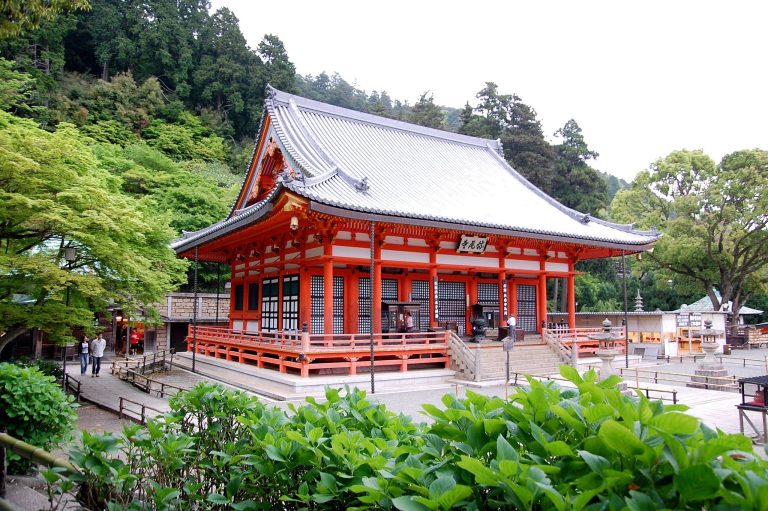
The principal hall, also called the Benzaiten Hall, is the temple’s main worship building and houses its principal image of Benzaiten. The present reconstruction dates to 1656 and reflects the rebuilding ordered by Emperor Go-Mizunoo.
Hōōkaku
Hōōkaku is a named building within the temple complex. It is registered as a national tangible cultural property.
Former Kitchen and Service Building
The former kitchen and residential service building dated from its rebuilding in 1699. Fallen trees caused by Typhoon 21 in September 2018 damaged the structure, which was subsequently dismantled and removed.
Scripture Collection
Ryūan-ji is associated with a mid-Edo-period Daihannya scripture collection comprising 597 volumes, six scripture chests, and 60 scripture wrappers. Chikamatsu Monzaemon and Sakata Tōjūrō donated the collection, linking the temple’s surviving religious materials with the performing-arts world associated with Benzaiten worship.