Shimogoryō Shrine: Kyoto’s Shrine of the Eight Goryō


Site at a Glance
- Rating
- 4.1
- Popularity
- Low
- Country
- Japan
- Primary era
- Early Modern
- External website
- Open
- Eras represented
- Early Modern
- Civilizations
- Tokugawa
- Site type
- Religious
- Remains
- Sanctuary
On this page12 sections
History
Shimogoryō Shrine is a Shinto shrine in Kyoto, Japan, whose origins are associated with the worship of the Eight Goryō and with the religious history of the former imperial capital of Heian-kyō, established at present-day Kyoto in 794. The shrine was historically revered as the ujigami, or tutelary deity, of the Kyoto Imperial Palace, and its name distinguishes it from Kamigoryō Shrine.
Origins in spirit appeasement
The shrine’s foundation is traditionally connected with a Goryō-e ceremony held on 20 May 863 at Shinsen-en in Heian-kyō during an outbreak of disease. Goryō were believed to be the spirits of people who had died violently or resentfully and then caused disasters such as epidemics. The ceremony sought to pacify spirits associated with political conflicts, placing the appeasement of the dead at the center of the shrine’s religious identity.
A separate tradition places the foundation in 839. In that account, the shrine was established to calm the spirits of Prince Iyo and his mother, Fujiwara no Yoshiko, who had died under unfortunate circumstances in 809. The relationship between this earlier foundation tradition and the ceremony of 863 remains unresolved in the shrine’s history.
The Eight Goryō
The principal deities are collectively known as the Eight Goryō. They comprise the Kibi spirit, Emperor Sudō, identified with Prince Sawara, Prince Iyo, Fujiwara no Yoshiko, Fujiwara no Hirotsugu, Tachibana no Hayanari, Bun’ya no Miyatamaro, and the deity called the Heavenly Thunder.
The Kibi spirit is often associated with Kibi no Makibi, although the shrine understands it as the peaceful spirit of the other six deities because Kibi no Makibi did not die resentfully. The Heavenly Thunder is often linked with Sugawara no Michizane. The shrine instead interprets it as the wrathful spirit of the other six deities, since the shrine’s tradition predates Michizane’s association with the thunder deity.
Several of these figures belonged to the family and political world of Emperor Kanmu, the ruler who established Heian-kyō. Prince Sawara was Kanmu’s crown prince, while Prince Iyo was his son and Fujiwara no Yoshiko was Iyo’s mother. Fujiwara no Hirotsugu, Tachibana no Hayanari, and Bun’ya no Miyatamaro were also historical figures whose spirits became part of the shrine’s goryō tradition.
Relocations and imperial patronage
Shimogoryō Shrine originally stood at the Lower Izumoji Goryō Hall in Izumo Township, in Atago District near the northern edge of present-day Teramachi-Imadegawa. Kamigoryō Shrine, once known as the Upper Izumoji Goryō Hall, stood to its north. Shimogoryō was later moved to a site west of Shinmachi-Demizu.
During the Ōnin War, the shrine’s sacred objects were taken temporarily to Hanazono Village in Kitayama for protection. In 1590, Toyotomi Hideyoshi’s large-scale reorganization of Kyoto led to another relocation. The shrine moved to its present site, which had previously been occupied by the Tokiwaidono estate of Saionji Sanetsune.
The shrine was destroyed in the Hōei Great Fire of 1708. The following year, a former Naishidokoro building from the temporary Imperial Palace was granted to Shimogoryō. The Naishidokoro was the imperial sanctuary associated with sacred regalia and court rites, and the transfer connected the rebuilt shrine with the architectural resources of the imperial court.
In 1732, Emperor Reigen was enshrined alongside the Eight Goryō, reportedly in accordance with his will. His enshrinement was also associated with the close relationship between the emperor and the father-and-son chief priests Izumiji Nobunao and Izumiji Naomoto. The shrine was again destroyed in the Tenmei Great Fire of 1788, with its earthen storehouse surviving. Its sacred objects were moved temporarily to Shimogamo Shrine, and in 1791 another former temporary-palace Naishidokoro building was granted to Shimogoryō and rebuilt as its main sanctuary.
Modern institutional history and rites
During the Meiji period, Shimogoryō was classified as a prefectural shrine. When Emperor Meiji stayed in Kyoto, an imperial envoy presented an offering on 1 February 1877. On 10 February, the emperor additionally granted 700 yen for the shrine’s permanent preservation.
The shrine has also been proposed as a possible identification of Izuminoi Shrine, a major shrine listed in the Engishiki, an early-tenth-century compilation of governmental regulations and ritual procedures that includes a register of officially recognized shrines. The identification was advanced by the scholar Shiga Tsuyoshi.
The annual rites have changed over time. Until the Meiji period, the mikoshi-welcoming rite was held on 18 July and the Goryō Festival on 18 August. After the Meiji period, these observances were reorganized into a procession on 1 May and a return procession on the 18th. The 18 August festival became the annual festival day and included Azuma-asobi, a court-associated performance of song and dance. The return procession is now held on the third Sunday of May, and its eve has also included a children’s mikoshi, a portable shrine used to convey a deity in ritual procession, organized with local elementary schools.
The shrine’s main sanctuary, worship hall, worship area, covered corridor, and intermediate hall are designated Kyoto City tangible cultural properties. These designations form part of the modern recognition of a complex shaped by repeated relocation, destruction, rebuilding, and imperial association.
Remains
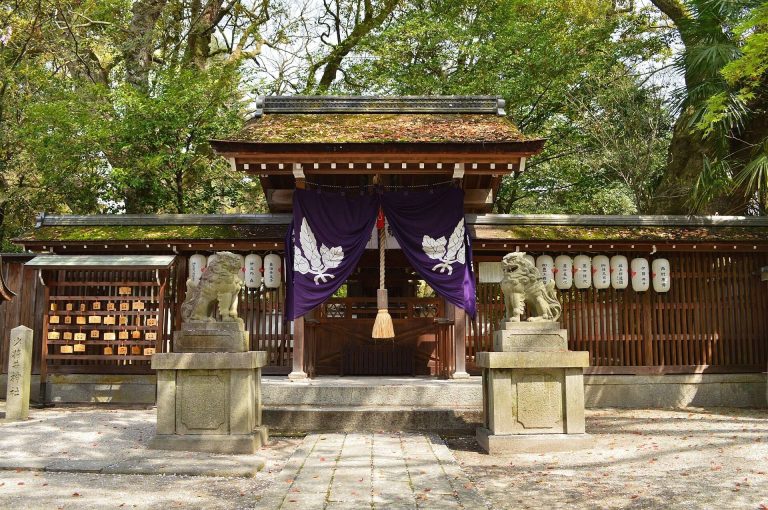
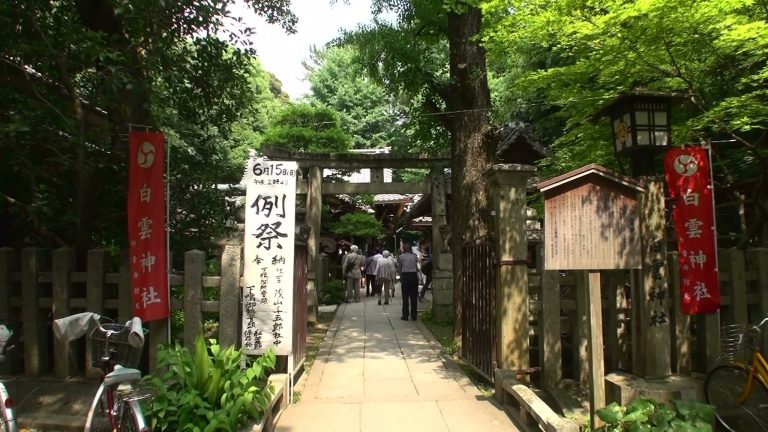
The precinct at Shimogoryō Shrine contains a torii, sacred gate, worship hall, main sanctuary, intermediate hall, covered corridor, worship area, office, kagura hall, and a structure for storing the portable shrine used in processions. Together, these buildings and ritual spaces form the surviving architectural setting of a shrine whose present arrangement reflects both its religious functions and its connections with the former imperial palace.
Main sanctuary and worship buildings
Main sanctuary
The main sanctuary is the former temporary-palace Naishidokoro building granted to the shrine after the Tenmei Great Fire. It was relocated in 1791 and rebuilt as Shimogoryō’s sanctuary. Its fabric therefore preserves a direct architectural connection with a temporary imperial palace and with the rebuilding of the shrine after the fire.
Worship hall and associated structures
The worship hall was built in 1798. It stands within a precinct that also includes the intermediate hall, covered corridor, worship area, sacred gate, torii, office, kagura hall, and the building used to store the procession mikoshi. The sacred gate is traditionally said to have been moved from the former Kenreimon Gate of the Kyoto Imperial Palace.
Subsidiary and associated shrines
Shinmei, Hachiman, and Kasuga shrines
Among the subsidiary shrines is Shinmei Shrine, which has Inner and Outer Shrine divisions. The precinct also contains Hachiman Shrine and Kasuga Shrine, the latter built during the Bunsei period from 1818 to 1831.
Additional deities and co-enshrinement
Other associated shrines include Sarutahiko Shrine, Suika Shrine, Kakinomoto Shrine, Inari Shrine, Munakata Shrine, Tenmangū Shrine dedicated to the deity of Kitano, and Ōkuninushi Shrine. A Five-Shrine Co-enshrinement Shrine brings together the deities of the Inbe, Great General, Takachiho, Atago, and Hiyoshi shrines.
Sarutahiko Shrine, Suika Shrine, and Kakinomoto Shrine together enshrine Sarutahiko, Yamazaki Ansai as the proponent of Suika Shinto, and the poet Kakinomoto no Hitomaro. These associated spaces broaden the precinct’s religious composition beyond the Eight Goryō while retaining its central focus on enshrined deities and ritual observance.