Myōman-ji Temple: Head Temple of the Kempon Hokke School


Site at a Glance
- Rating
- 4.3
- Popularity
- Low
- Country
- Japan
- Primary era
- Modern
- External website
- Open
- Eras represented
- Modern
- Civilizations
- Japanese
- Site type
- Religious
- Remains
- Monastery
On this page7 sections
History
Myōman-ji Temple is a Buddhist temple in Japan, in Kyoto, founded by Nichijū in the fourteenth century with the support of the merchant Tennojiya Tsūmyō. Nichijū had first served as a Tendai Buddhist priest and lecturer under the name Genmyō before turning to Nichiren Buddhism around 1380. He became associated with the foundation of the Kempon Hokke school, a Nichiren Buddhist tradition centered on the Lotus Sutra.
Foundation in medieval Kyoto
In 1383, Nichijū established a hall for the Lotus Sutra at Rokujō Bōmon Muromachi, in what is now Shimogyō Ward. The complex was formally organized in 1389 and named Myōman-ji. By then Nichijū was 68 years old. After traveling to Kyoto, presenting a petition to Emperor Go-En’yū, and receiving the rank of Nii Sōzu, he obtained imperial authorization to propagate Buddhism in Kyoto. This recognition helped establish the temple’s institutional position in the city.
A fire destroyed the buildings in 1395. Myōman-ji was then moved to Ayakōji Higashinōin and rebuilt. The buildings were destroyed again during the Ōnin War in 1467, a major civil conflict of medieval Japan, after which the temple moved to the Shijō-Horikawa area.
Destruction and repeated relocation
The Tenmon Hokke Disturbance of 1536 brought another destruction of the buildings, forcing the temple to take refuge in Sakai. In 1542, Emperor Go-Nara issued an imperial authorization permitting the Hokke sect to return to Kyoto. Myōman-ji was rebuilt on its former Shijō-Horikawa site.
In 1583, Hashiba Hideyoshi, later known as Toyotomi Hideyoshi, ordered another move, this time to Teramachi Nījō in present-day Kamigyō Ward. The temple stood beside Honno-ji, whose grounds extended toward the area of present-day Kyoto City Hall. Fires destroyed the buildings in 1628, 1708, and 1788, and the buildings were also lost during the Kinmon Incident of 1864. Reconstruction followed each destruction. A land-requisition order in 1871 reduced the temple’s holdings.
Modern transformation
Wartime forced evacuation in 1945 resulted in the loss of the land and buildings belonging to the temple’s four subtemples. Growing urbanization, noise, and environmental deterioration later led to the Great Relocation of the Shōwa Era. In 1968, Myōman-ji moved from Teramachi Nījō to its present location in Iwakura, Sakyō Ward. The former Teramachi site is now occupied by facilities including a Kyoto City Hall annex and the Kyoto City Fire Department, while the place-name Myōman-ji-mae-chō remains nearby.
Myōman-ji is the head temple of the Kempon Hokke school and belongs to the Rakuchū Twenty-one Hokke Temples pilgrimage. It also serves as a family mortuary temple for the Toyama family, whose lineage traces back to the court noble Toyama Mitsuaki, and for the Toyota family and its branches since Sakichi Toyota. Two associated works have nationally important cultural-property recognition: twenty waka calligraphic papers containing passages from the Lotus Sutra, including the handwriting of Emperor Kōgon, and a silk painting of Maitreya’s future descent, painted in Goryeo Korea in 1294. The latter became an Important Cultural Property in 2018 and is described as the third-oldest precisely dated Goryeo Buddhist painting.
Remains
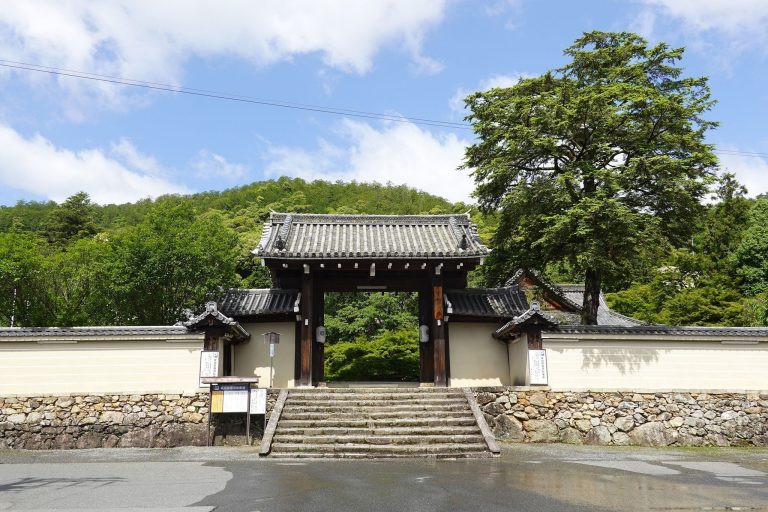
Myōman-ji stands in Iwakura, Sakyō Ward, Kyoto, under the mountain name Myōtōzan. Its formal name is Myōtōzan Myōman-ji, and its principal object of worship is the Sanbōson, a representation of the Three Treasures of Buddhism. The complex includes four subtemples, Jōjūin, Shōgyōin, Hōkōin, and Daijōin. Most of the buildings now present date from after the Second World War.
Gardens and planted grounds
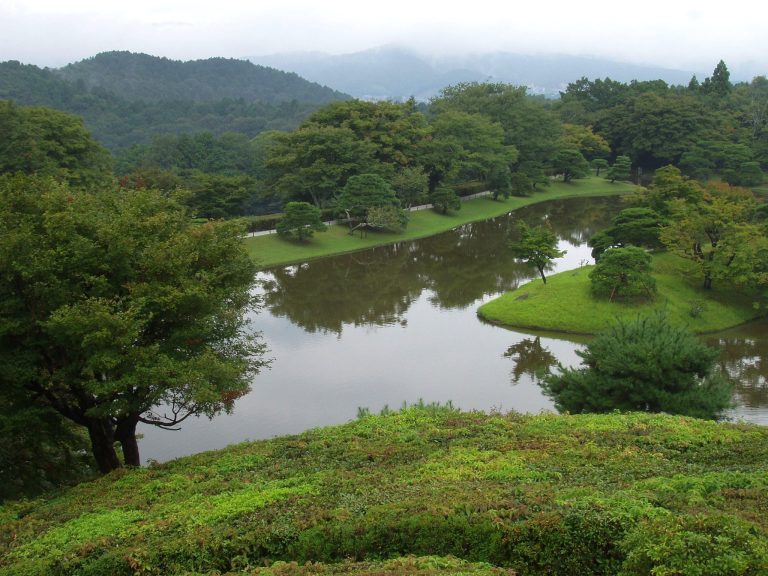
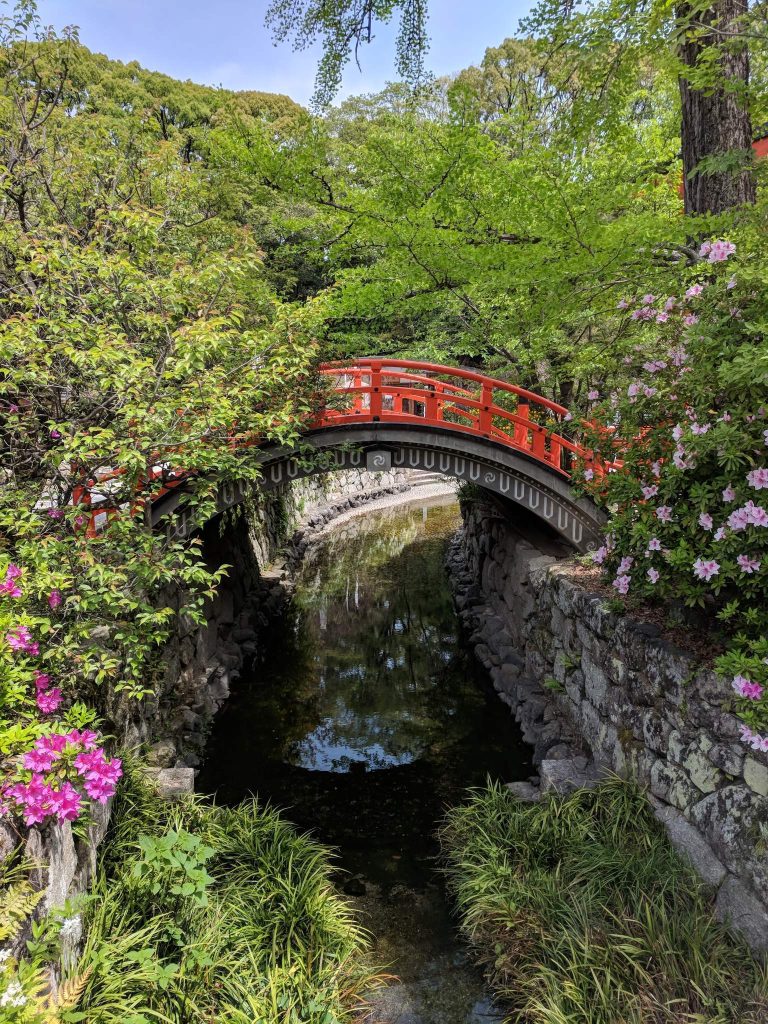
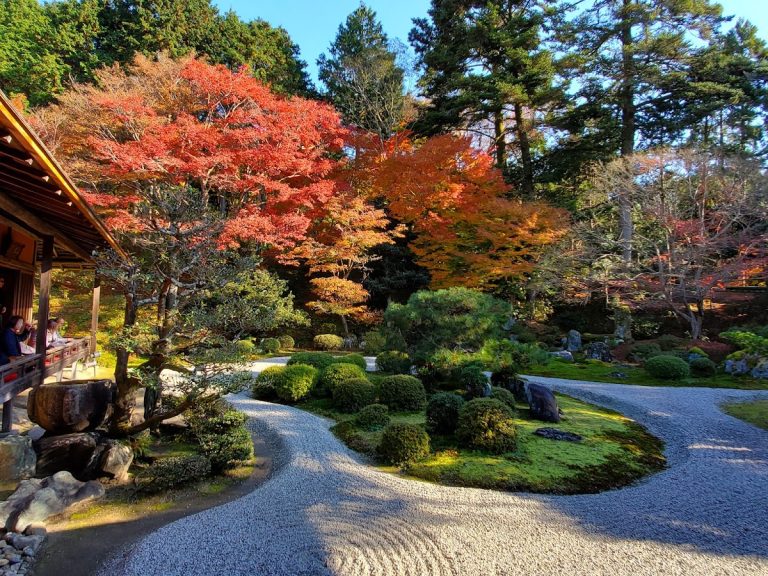
The Snow Garden is one of three celebrated gardens associated with snow, moon, and flowers. Matsunaga Teitoku, a poet regarded as the founder of haikai poetry, created the garden. In front of the temple, 3,000 azalea plants contribute to Myōman-ji’s modern reputation as a temple of flowers.
Religious buildings and associated features
A Buddhist relic pagoda stands beside the main hall. Built in 1973, it reproduces the form of the Mahabodhi Temple at Bodh Gaya in India, the major Buddhist pilgrimage temple traditionally associated with the Buddha’s enlightenment. The temple also houses the bell connected with the legend of Anchin and Kiyohime, where it is identified with the bell of Dōjō-ji.