Oyamazumi Shrine: A Shinto Shrine of Mountains, the Sea, and Warrior Devotion


Site at a Glance
- Rating
- 4.4
- Popularity
- Medium
- Country
- Japan
- Primary era
- Medieval
- External website
- Open
- Eras represented
- Medieval, Early Modern
- Civilizations
- Unclassified
- Site type
- Religious
- Remains
- Sanctuary
On this page22 sections
History
Oyamazumi Shrine is a Shinto shrine on Ōmishima Island in Imabari, Japan, dedicated to Ōyamatsumi, a kami associated with mountains and, at this shrine, also with the sea, navigation, and warfare. Construction for its relocation to the present site began in 701, and the buildings were completed in 716 after sixteen years of work; the enshrinement ceremony followed in 719. The shrine is regarded as the head shrine of shrines dedicated to Ōyamatsumi and is also known as the Protector Shrine of Japan.
Origins and relocation
The shrine’s earliest history is uncertain. One tradition attributes its establishment on Ōmishima to Ochi no Mikoto, a descendant of Ōyamatsumi. Another says that Ōyamatsumi was brought from Baekje to Settsu Province and later transferred to Iyo Province, although this account is not firmly corroborated. A third tradition attributes the construction of a shrine at the present site to Ochi Tamaoki, acting under imperial command.
Ritual activity on Ōmishima reaches back to the Yayoi period. Tradition places an earlier shrine in Settsu Province before its move to the island in 594, during the reign of Emperor Suiko. The shrine was formerly located in the southeastern part of Ōmishima, at the site now represented by Yokodono Shrine. Preparations for the later relocation included the enshrinement of the Five Dragon Kings on Mount Anjin.
Imperial recognition and provincial status
Oyamazumi Shrine first appears in the historical record in 766, when Ōyamatsumi received the rank of Junior Fourth Rank, Lower Grade, and five shrine households were assigned to the institution. In 837 it was recognized as a Myōjin shrine, a major shrine whose kami was regarded as especially powerful or manifest. Its rank rose to Senior Second Rank in 875 and Senior First Rank in 897.
The Engishiki, a tenth-century compilation of court regulations and shrine listings, recorded the shrine in 927 as a Myōjin Taisha in Ochi District of Iyo Province. During the medieval period it was regarded as the ichinomiya, the highest-ranked shrine of the province. Its connection with the title Protector Shrine of Japan expressed the breadth of its religious and political standing.
The hereditary priesthood belonged first to the Ochi clan and later to the Mishima family. The chief priestly office was called the Ōhōri office, and its holders adopted the surname Ōhōri. Successive imperial courts and military families, including the Taira, Minamoto, and Kono clans, worshipped at the shrine. Warriors donated swords, armor, bows, and other military equipment as offerings for victory and protection in battle.
War, rebuilding, and pilgrimage
Warfare brought major destruction in 1322, when a fire destroyed the main sanctuary and worship hall. Shrine tradition places the rebuilding of both structures in 1378, while an inscription in the projecting porch of the main sanctuary supports a further rebuilding in 1427. The shrine’s religious influence extended across the Inland Sea. In the later Edo period, pilgrims undertaking the formal Shikoku pilgrimage visited Oyamazumi Shrine and dedicated sutras at its associated Jingūji temple. The shrine was an additional destination rather than one of the numbered stations.
The former shrine territory was especially extensive during the Muromachi period. It included seven islands known as the Seven Mishima Islands, across which seventeen subsidiary shrines were said to have stood. Related shrines also existed on Ōshima, Tsushima, and the coast of Shikoku.
The Battle of Ōmishima took place in 1543. Shrine tradition says that Tsuruhime, remembered as a female warrior associated with Ōmishima, was killed during the battle. Her later association with Oyamazumi Shrine is commemorated by bronze statues, festivals, and processions. The claim that a particular suit of armor was worn by Tsuruhime remains disputed among some armor specialists.
From the Edo period to the present
Oyamazumi Shrine formerly operated with twenty-four Buddhist subtemples as part of a system in which Shinto shrines and Buddhist temples commonly functioned together. Eight were transferred to the shrine’s detached sanctuary in Imabari during the Shōji era. Most of the remaining institutions were dissolved after the Meiji government separated Shinto and Buddhism. Tōenbō survives as a former subtemple and preserves the Buddhist image identified with Ōyamatsumi.
The modern shrine-ranking system made Oyamazumi a National Shrine of the Middle Rank in 1871. It was elevated to a National Shrine of the Great Rank in 1915, the only shrine in Shikoku to hold that rank. It is now a Beppyo shrine of the Association of Shinto Shrines. The Ancestral Spirits Hall was destroyed by arson in 1992 by members of the Chūkaku-ha, who regarded it as a remnant of Japanese imperialism; the building was later reconstructed.
Immediately after the Pacific War, the shrine temporarily safeguarded about 10,000 valuable naval materials and teaching items from the Imperial Japanese Naval Academy, along with materials from Itsukushima Shrine, to prevent their confiscation by Allied occupation authorities. The naval materials were later returned to the Self-Defense Forces. When occupation authorities ordered the disposal of swords not designated as National Treasures, shrine officials secretly buried some of them. They were subsequently returned to the Japanese government.
The shrine holds eight National Treasures and seventy-six Important Cultural Properties. About forty percent of Japan’s designated National Treasure and Important Cultural Property armor in the relevant categories is held here, while the frequently repeated figure of more than eighty percent is incorrect.
Festivals and associated shrines
Important observances include the principal festival on the lunar-calendar date corresponding to April 22, the Rice-Planting Festival on the fifth day of the fifth lunar month, the Harvest Festival on the ninth day of the ninth lunar month, and the Sanzuna Grand Festival on the twenty-second day of the eighth lunar month.
One-Man Sumo is performed during the Rice-Planting and Harvest Festivals. A performer represents the rice spirit and contests the champion Ichiriki-yama in three bouts. The rice spirit wins two bouts, symbolizing an assured spring harvest and gratitude for the autumn harvest. The practice is recorded by at least the fourteenth century and also appears in records from 1707 and 1735. After an interruption following 1984, it was revived by Ōmishima Middle School students and later by local adults. One-Man Sumo was designated an Ehime Prefectural Intangible Cultural Property in 1964 and redesignated an Intangible Folk Cultural Property in 1977.
The detached Oyamazumi Shrine in Imabari was founded in 703 after Ochi Tamazumi invited the shrine’s presence there, and its sanctuary was built in 712. Nankōbō, now independent, is the only one of the eight former subtemples still adjoining that detached shrine. Other connected places include the detached Anaba Shrine beside the shore near Mikushiyama and the port, traditionally dated to 779, and subsidiary shrines at Miko-no-miya, Itsukushima, Todoroki, Tenjin, Dai, and the Coastal Resting Place. During the Sanzuna Grand Festival, portable shrines travel to Mishima Shrine at Dai and stop at the Coastal Resting Place on the return journey.
Remains
Central precinct
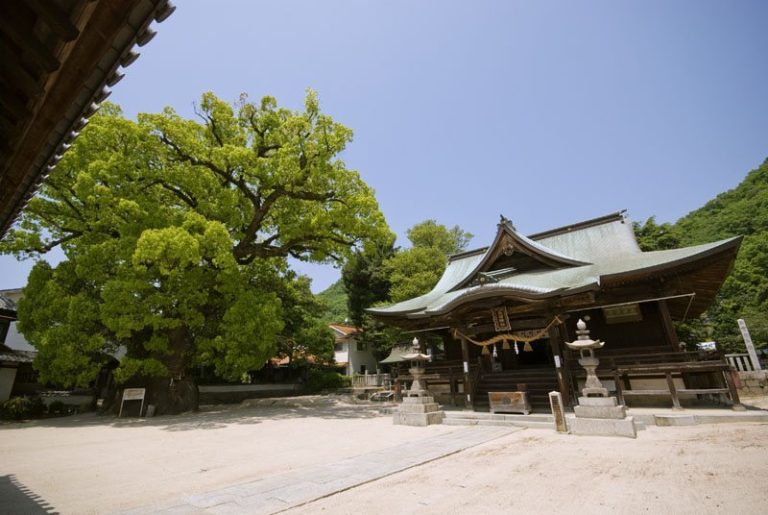
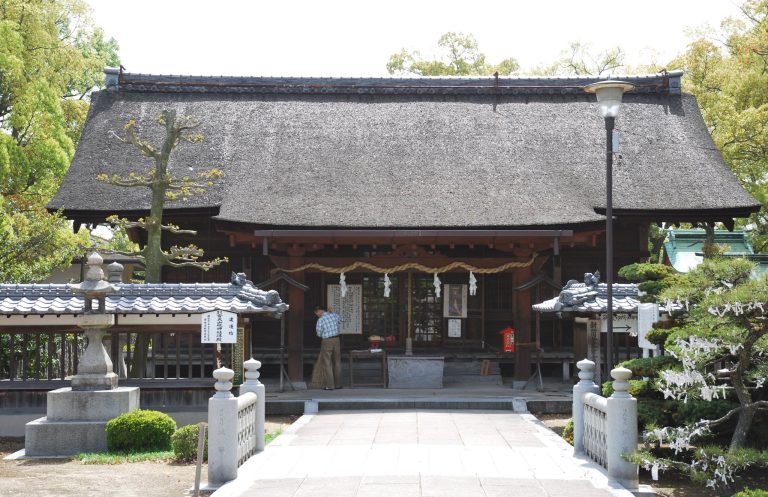
The main precinct stands on the western coast of Ōmishima, at the western foot of Mount Washigatou. The principal sanctuary is a three-bay nagare-zukuri building, a Shinto style in which the roof extends forward in a flowing asymmetrical curve. It has a cypress-bark roof. The sanctuary’s present form reflects the rebuilding associated with 1427, while the adjacent worship hall is an Important Cultural Property.
Main Gate
The two-story Main Gate is built entirely of cypress and has a copper-sheet roof. It rises twelve meters and is flanked by two guardian figures, each 2.5 meters high. Completed in 2010, it reconstructs the gate destroyed in the 1322 fire, 688 years earlier.
Sacred Gate
The Sacred Gate was originally donated in 1661 by Matsudaira Sadamasa, lord of the Matsuyama domain. Its first form used unpainted wood and a gabled cypress-bark roof. After deterioration, it was replaced and completed in 2016 as a guardian gate with figures at both sides. The former gate was moved in 2017 to another Oyamazumi Shrine at Kawamo in Takahashi.
Torii and festival structures
The First Torii faces the Seto Inland Sea, while the Second Torii marks the entrance from the road. Their plaques reproduce an Important Cultural Property plaque traditionally attributed to the courtier and calligrapher Fujiwara no Sukemasa. The First Torii was built in 1933. A gold-colored bronze group representing the Hayato Dance stands in the corridor to the left of the Sacred Gate. It was made by Nakamura Shinya and unveiled in 2010.
The Ema Hall dates from 1985. The sacred rice field is used for the Rice-Planting and Harvest Festivals, with the Osajikiden standing in front of it. This unpainted-wood building has an irimoya roof, a hipped-and-gabled form, covered in copper sheets. Processions carrying mikoshi, or portable shrines used to carry a kami during ritual processions, pass through the structure during agricultural ceremonies.
Horse Hall and water features
The Horse Hall is a wooden building with a tiled roof and a dedicatory ridge plaque dated 1735. The former shrine office, now called the Saikan, is used for retreat and ritual purification, while the present shrine office is a modern reinforced-concrete building. The precinct also contains a sacred pond, known as Benzaiten Pond, and a well beside the main sanctuary. The well is dedicated to Mizuha-no-me, and its water is used in ceremonies.
Mikoshi Storehouse
Built in 1997, the Mikoshi Storehouse uses wooden azekura construction and has an irimoya roof covered with copper sheets. It houses six portable shrines. Three older examples belong to the main shrine, Kamitsu Shrine, and Shimotsu Shrine, while three are newer. The three older portable shrines are designated tangible cultural properties of Ehime Prefecture.
Camphor grove and sacred mountains
The precinct and nearby area contain a group of camphor trees designated as a national natural monument. Thirty-eight trees form the designated group, and another camphor tree away from the precinct is an Ehime Prefecture-designated natural monument. The grove was heavily affected by the 1322 war fire and by a major flood in 1722.
The Camphor Tree Planted by Ochi no Mikoto stands within the precinct. Another hollow-trunked camphor tree forms the Sacred Tree Gate, or Seiju no Mon, at the entrance to the Outer Sanctuary. Passing through it is traditionally associated with longevity. Mount Washigatou rises about 436 meters and is the highest peak of Ōmishima. It is the shrine’s sacred mountain. Mount Anjin lies behind the shrine and contains a small shrine associated with the Five Dragon Kings, while Komiyama is the mountain area behind the main precinct where the Outer Sanctuary stands.
Secondary shrines and Buddhist remains
Outer Sanctuary and Tōenbō
The Outer Sanctuary was formerly the outer sanctuary of the Jingūji. Its principal image is a seated Amida Buddha, flanked by standing images of Kannon and Seishi. At Tōenbō, a surviving former Jingūji subtemple, the principal image is the seated Buddhist figure identified with Ōyamatsumi. It was transferred there during the Meiji separation of Shinto and Buddhism.
Kamitsu and Shimotsu shrines
Kamitsu Shrine stands to the right of the main sanctuary and is dedicated to Kamitsu-hime and the Thunder Deity. Its three-bay nagare-zukuri building, with a cypress-bark roof, is thought to have been rebuilt between 1394 and 1428, during the Ōei era. It underwent major repairs in the Enkyō and Bunsei eras and dismantling repairs in 1968.
Shimotsu Shrine stands to the left of the main sanctuary and is dedicated to Shimotsu-hime and Takakago. Its building is also a three-bay nagare-zukuri structure with a cypress-bark roof. Behind the main sanctuary, Himekomura Shrine is dedicated to Konohanasakuya-hime and her children Hohodemi and Hosuseri. Its festival is held on October 26.
Seventeen Shrine complex
The Seventeen Shrine complex consists of Moriyamazumi Shrine joined to sixteen other shrines. Its building is traditionally dated to the 1378 rebuilding and is an Ehime Prefecture-designated tangible cultural property. A group of seventeen wooden deity sculptures is enshrined inside and is designated an Important Cultural Property.
Other precinct shrines
Katsuragi Shrine, Haraido Shrine, and the Iyo Provincial Shrine occupy a single small structure outside the Sacred Gate. Uka Shrine stands on the island in the sacred pond, and Uma Shrine is beside the Horse Hall. Beyond the Meiji River, the Ancestral Spirits Shrine stands on a hill. Its present wooden building was reconstructed after the 1992 fire and is associated with Okuninushi and the spirits of shrine followers. Nearby Yasaka Shrine is dedicated to Susanoo and Sukuna-hikona, while the Five Grains Shrine is dedicated to Uka-no-mitama.
Island shrines and landscape
Yokodono Shrine at Seto occupies the former location of Oyamazumi Shrine before the 719 move. Nearby Mitarashi Spring still supplies water for the grand festival, and the Yokodono Great Deity Buddhist Hall houses an image of Daitsu Chisho Buddha and the sixteen princes.
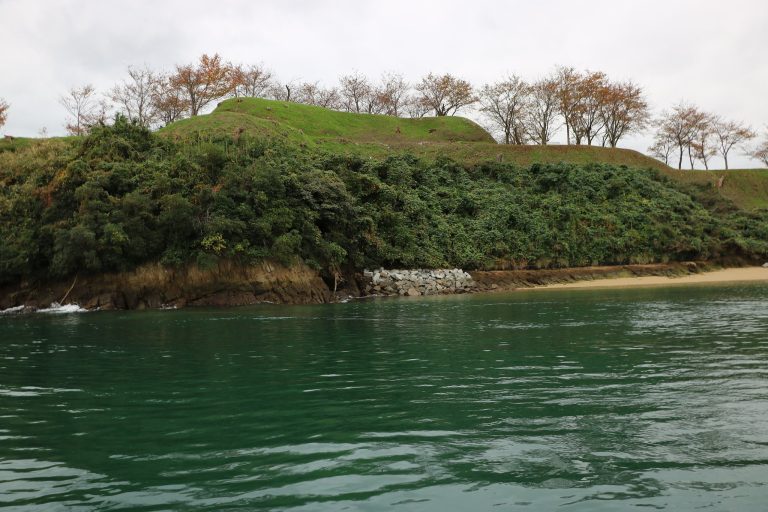
Anaba Shrine stands beside the shore near Mikushiyama and the port. Dedicated to Iwanagahime, it includes a worship hall and a separate building containing votive offerings associated with fertility and women’s health. Mikushiyama is also the location of confirmed remains of a medieval castle and is designated an Ehime Prefecture scenic place. A stone associated with Ochi Tamazumi stands near the Sacred Tree Gate, while the Kujirayama burial mound in Imabari is traditionally identified as the tomb of Ochi no Mikoto.
Three Hōkyō-intō pagodas stand near the hillside south of the shrine, beyond the south corridor and across the Meiji River. The central pagoda is traditionally said to have been erected in 1318 to commemorate the visit of the monk Ippen.
Weapons, documents, and museum collections
The shrine’s cultural-property collection is especially associated with swords, armor, bows, arrows, and other weapons. These objects are preserved and displayed in the Shiyōden and National Treasure Hall. National Treasures include four important suits of armor: an early Heian-period Omodaka-odoshi armor traditionally attributed to a donation by Ochi Oryōshi Yoshikata, and late Heian-period examples traditionally associated with Kono Michinobu, Minamoto no Yoshitsune, and Minamoto no Yoritomo.
Other National Treasures include a Chinese Tang-period white-bronze mirror decorated with animals and grapes, a great sword with a 136-centimeter blade and an inscription dated 1366, a Kamakura-period sword mounting traditionally associated with Prince Morinaga, and a great sword with an 180-centimeter blade traditionally attributed to Omori Hikoshichi. The latter warrior is said to have defeated Kusunoki Masashige. The two specified great swords have recorded curvatures of 4.8 and 5.4 centimeters.
Important Cultural Properties include a wooden plaque reading “Protector Shrine of Japan, Great Deity Mishima,” traditionally attributed to Fujiwara no Sukemasa; a gold-inlaid double-edged iron halberd kept as a sacred treasure; wooden guardian figures with inscriptions dated 1322 and 1323; and the seventeen wooden deity sculptures in the Seventeen Shrine complex. The collection also includes numerous armor components, bows, quivers, helmets, sleeves, sword fittings, bronze water vessels, and lacquerwork. Two designated swords, one signed Yukizane and another by Kunihiro, were stolen in 1942.
The shrine preserves 274 volumes of votive linked verse dating from 1445 to 1660, together with an inventory from 1777. Contributions by members of the Ōhōri family, the Kono and Ochi clans, and local inhabitants illustrate the range of devotion connected with the shrine. A further 210 documents from the Mishima family survive. Ehime-designated properties include the Kamitsu Shrine building, the Seventeen Shrine building, three medieval portable shrines, and an early Muromachi-period long-handled ritual ewer. Imabari-designated holdings include 221 volumes of the Great Perfection of Wisdom Sutra.
Maritime Museum collection
The Maritime Museum and Hayama Memorial Hall displays the Hayama Maru and marine specimens from the Seto Inland Sea, together with ores and minerals from across Japan. The sixteen-ton vessel was built in 1934 at the Yokosuka Naval Arsenal as a sampling and research ship. Equipped with a winch for dredging underwater material, it later served as a training vessel and a patrol vessel during the occupation, before becoming associated with marine-biology collecting by Emperor Showa.