Manas Ordo: National Cultural-Historical Complex in Kyrgyzstan
Site at a Glance
- Rating
- 4.5
- Popularity
- Very Low
- Country
- Kyrgyzstan
- Primary era
- Medieval
- Eras represented
- Iron Age, Classical, Medieval
- Civilizations
- Chagatai Khanate, Karakhanid, Scythian
- Site type
- Religious
- Remains
- Tomb
On this page16 sections
History
Manas Ordo is a national cultural-historical park, museum, pilgrimage site, and traditional-culture center in Kyrgyzstan, near Talas at the entrance to the Kenkol Gorge. The complex is organized around the Manas Kümböz, a domed funerary tower traditionally revered as the tomb of Manas, the legendary Kyrgyz hero whose epic tells of the defense and unification of the Kyrgyz people. Its modern development took shape in 1995, during celebrations of the 1,000th anniversary of the Manas epic, an anniversary also commemorated by the United Nations General Assembly.
From sacred tomb to national complex
The site was formerly called the Manas Reserve. In 1996, following large-scale redevelopment connected with the millennium celebrations, it officially became the Kyrgyz National Manas Ordo Complex. The name reflects the expanded role of the site as a place for preserving the epic, supporting cultural traditions, and maintaining a pilgrimage center around the mausoleum.
The institutional history of the monument began with the restoration of the mausoleum in 1970. A state museum was established there in 1976 as the Museum of Literature and Ethnography of the Manas Epic. During the period of perestroika, the political and social reform era in the Soviet Union, the institution became the Manas State Museum-Reserve in 1990. Its successive administrations developed the site as both a museum complex and a national memorial.
For Kyrgyz communities, the mausoleum and the wider sacred landscape associated with Manas include mountains, marked stones, caves, waters, springs, and place names. Pilgrims have traditionally come to recite Quranic prayers, sacrifice animals, and make communal offerings. They seek unity, faith, prosperity, peace, children, or healing, and this pilgrimage tradition continues at Manas Ordo.
The identity of the mausoleum
The historical identification of the central mausoleum remains uncertain. Its inscription names the burial place as that of Kenizek-Khatun, daughter of the emir Abuka, while Kyrgyz tradition identifies it as the tomb of Manas. A well-known legend explains the discrepancy by saying that Kanikey, Manas’s widow, ordered a woman’s name to be carved on the monument to mislead enemies and grave robbers.
Archaeological investigation found the remains of a man whose height was approximately two metres, a discovery later used in support of the Manas identification. The tomb’s attribution remains unconfirmed, however. Other interpretations identify the monument as the grave of a Karakhanid or Chagatai-period princess. These labels refer to the era of the Karakhanid Turkic dynasty or the political period associated with the Chagatai Khanate, and some theories place the construction of the mausoleum centuries before the events described in the epic.
Archaeological and scholarly attention
The first known scholarly notice of the mausoleum appeared in 1897 in a work by the historian Vasily Bartold on his research in Central Asia. A.S. Kolesnikova photographed the monument in 1907, although those photographs were later lost. Photographs made by F.I. Belderman in 1922 and 1937 became important early visual records, and a 1939 publication on the art of Soviet Kyrgyzstan further circulated information about the monument.
Archaeological and architectural interest grew during the 1930s. An expedition organized by the Kyrgyz Committee of Sciences and the Kyrgyz Pedagogical Institute, led by B.M. Zima, excavated the mausoleum in 1937. The Seven Rivers Archaeological Expedition, led by Alexander Bernshtam, began further investigation in 1938, when A.M. Belenitsky fully read the Arabic inscription. The mausoleum became the first major architectural monument in Kyrgyzstan to be placed under restoration.
The site and the surrounding Kenkol Gorge preserve evidence of nomadic activity from the Early Iron Age through the eighteenth century. Archaeological work has also identified burial mounds connected with the Saka-Usun period, a Kenkol cemetery, rock carvings, balbals, and stone tools. Since 2010, Manas Ordo has been included on Kyrgyzstan’s proposed World Heritage list as part of a group of Silk Road sites.
Continuing cultural use
Manas Ordo remains a center for preserving and transmitting the Manas epic. Its Manas Studies Center and Manaschi School support the oral tradition. A manaschi is an oral performer who recites the epic in verse, and the school was established with assistance from UNESCO. The manaschi Kamil Mamadaliev taught seven younger performers.
The complex also supports traditional medicine, communal offerings, and national equestrian games. Kyrgyz horsemanship games have been held there every summer since 1995, while large events and horse games take place on national holidays. These continuing religious and cultural practices maintain Manas Ordo as a spiritual and national memorial.
Remains
The mausoleum and burials
Manas Kümböz
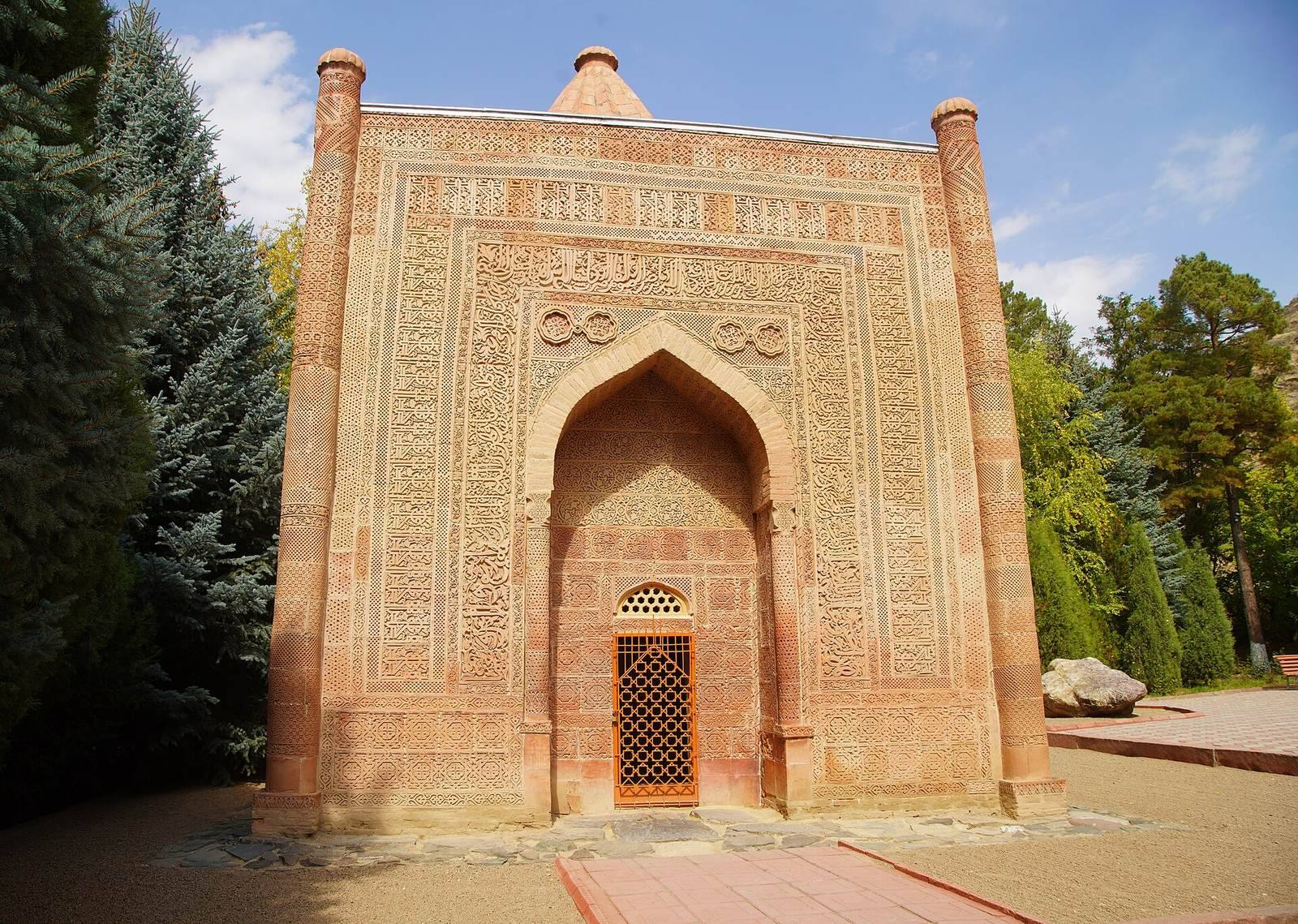
The central Manas Kümböz stands at the foot of the mountains on a complex covering approximately 225 hectares, near the entrance to the Kenkol Gorge. The Talas River lies to the south, beyond which the high Kyrgyz mountains begin. The mausoleum is a square-plan structure of red fired brick, approximately 11 metres high and covering about 50 square metres. Its single chamber is crowned by a two-part dome, with a hemispherical inner dome and an outer ribbed, pointed or faceted dome.
Three exterior sides are plain. The main facade and its lance-shaped entrance niche are faced with carved clay or terracotta mosaic panels. Geometric Kyrgyz patterns and Arabic inscriptions cover the panels, whose relief and calligraphic ornament produce strong contrasts of light and shade. One inscription uses Kufic, an early angular form of Arabic calligraphy, and includes the phrase “Allah’s is the dominion.” A second inscription, written in divani script, names Kenizek-Khatun as the daughter of the emir Abuka.
Burial chambers
The mausoleum contains burials from several periods. Excavations found two later coffins in the eastern part, disordered human bones in the central area, and another wooden coffin beneath the floor. Two earlier burials lay below the later graves, while a western grave was covered with unbaked bricks measuring 25 by 25 centimetres. The skeleton in an underground burial belonged to a man whose height exceeded two metres.
The building continued to serve as a burial place after its construction. Newer interments replaced older graves as earlier burials deteriorated. Scenes from the Shahnameh, the Persian epic poem, may have been painted on the interior walls, although this interpretation remains tentative.
Archaeological landscape
Lapidarium and stone monuments
A lapidarium beside the mausoleum contains balbals, rock carvings, and stone tools from several periods. A balbal is a stone funerary marker or anthropomorphic memorial figure associated with a burial. Several balbals at Manas Ordo date from the sixth to ninth centuries, and one carries an inscription in Yenisei-Orkhon runic script.
Burial grounds and carvings
The open grounds preserve or display burial mounds associated with the Saka-Usun tradition, a Kenkol cemetery dated broadly from the end of the first millennium BC into the first half of the first millennium AD, and rock carvings from the same general period. Together with the finds in the lapidarium, these features place the mausoleum within a wider archaeological landscape shaped by successive periods of nomadic activity.
Museum and cultural buildings
Manas Epic Museum
The Manas Epic Museum occupies a two-storey domed building. Its displays concern the epic, Manas, famous manaschi, archaeological discoveries from the region, and the history of the Talas Valley. Collections include clothing, weapons, everyday objects, and horse and camel equipment from the nineteenth century. Material from the tenth to fourteenth centuries is arranged in reconstructions associated with the eras of the Manas epic and Genghis Khan. Dioramas and large paintings present episodes from the epic.
A stone panel above the museum’s large wooden entrance shows three tigers surrounding a tunduk, the circular smoke opening at the top of a Kyrgyz yurt. The symbol connects the building with a central element of Kyrgyz domestic and cultural identity.
Manas Ata Flower Garden
On the right side of the complex, the Manas Ata Flower Garden contains a circular rose garden bordered by trees. At its center stands a six-metre bronze statue of Manas on an 18-metre pedestal. The figure tramples and strangles dragons, representing the protection of the Kyrgyz people, and is surrounded by statues of forty horsemen who represent Manas’s warriors and supporters.
Supporting structures
Other parts of the complex include an administration building, the Manas Studies Center, a vehicle area, and a bridge or arch representing Manas’s forty companions. Manas Village lies on the opposite side of the grounds. A yurt provides a setting for a manaschi to perform the epic, while a folk-medicine center, communal offering hall, horse arena, Manas Karaul lookout hill, and smaller structures support the site’s cultural and ritual functions. The summit of the lookout hill overlooks the surrounding valley and the complex.