Zarautsoy Rock Paintings: Prehistoric Hunting Art in Uzbekistan
Site at a Glance
- Rating
- 5
- Popularity
- Very Low
- Country
- Uzbekistan
- Primary era
- Stone Age
- Eras represented
- Stone Age
- Civilizations
- Unclassified
- Site type
- Civic
- Remains
- Rock Art
On this page13 sections
History
Zarautsoy Rock Paintings are a prehistoric rock-art complex in Uzbekistan, located in the Zarautsoy gorge on the eastern slope of the Kugitang Mountains, about 100 to 110 kilometers northwest of Termez. The principal paintings are generally dated to the Mesolithic and Neolithic, successive prehistoric periods associated respectively with intensified hunting and the development of more settled farming and herding communities, with later additions extending the sequence. The commonly proposed date is approximately the 12th to 5th millennia BCE. The images are especially important for their depictions of hunters, animals, weapons, and ritual activity.
Prehistoric imagery and dating
Most researchers place the main paintings in the Neolithic, while A. A. Formozov argued for a Mesolithic date. A Paleolithic attribution has also been proposed for some images. G. V. Parfyonov assigned a group of small bull figures in a lower shelter to the Magdalenian, a late Upper Paleolithic culture of western Europe associated with figurative art. Other features of the Zarautsoy imagery, including bows, domesticated dogs, and its artistic treatment, have been used to place the principal compositions later than the Paleolithic.
The scenes have been interpreted as expressions of hunting magic and ritual activity intended to secure successful hunts. Formozov and A. P. Okladnikov related the paintings to the social life of prehistoric communities and to religious ideas involving magic. These interpretations help explain why hunting scenes dominate the imagery, although the meaning of particular anthropomorphic figures remains uncertain.
Discovery and early investigations
The paintings came to wider attention in 1939, when the hunter I. F. Lamaev found them and informed G. V. Parfyonov, director of the Surxondaryo regional museum. In 1940, a joint expedition of the Uzbekistan Art History Museum, the Surxondaryo regional museum, and the Panjikent local-history museum began systematic investigation under Parfyonov. He continued his work at Zarautsoy from 1940 to 1945, joined by A. Yu. Roginskaya, A. A. Formozov, D. Zh. Kibirov, and other researchers.
The expedition of 1942 and 1943 included Parfyonov, artists such as A. S. Kirillov, and Lamaev, who also worked as a local historian. During roughly a month and a half in the field, the team copied the paintings, recorded inscriptions and rock features, and examined additional painted shelters and archaeological locations. A scientific report on the early investigations, prepared by Parfyonov, was presented to the academic council of the Uzbekistan Art History Museum on 18 January 1941. In 1943, Parfyonov identified some of the oldest isolated animal figures in Shelters 2 and 4. Washing the rock surfaces with water made further images clearer and brought the number of recognized figure types and forms to 48.
Archaeology and protection
Archaeological work in northern Zarautsoy recovered a flat flint implement used as a knife. At Duldul Ota Cave, cleaning the cultural layers revealed Stone Age habitation, including stone tools and archaic flint-limestone fragments attributed to the Mousterian, a Paleolithic stone-tool tradition commonly associated with Neanderthal populations in western Eurasia. The finds were transferred to the Uzbekistan Art Museum.
A special republican commission visited Zarautsoy at the end of 1945 to examine the site and the tectonic and geomorphological setting of the eastern Kugitang slope. A republican conference on prehistoric art held in 1946 requested government confirmation of a decision to designate Zarautsoy a state reserve. The paintings are protected by the state and were added to UNESCO’s World Heritage Tentative List in the Cultural category on 18 January 2008. A tentative-list entry identifies a site as suitable for possible future nomination and is not the same as inscription on the World Heritage List.
Field copies and expedition materials were installed in two large halls of the Surxondaryo regional museum. These displays included large painted landscape panels and watercolor copies arranged chronologically. Further copies of the principal paintings are held in Moscow museums, including museums devoted to anthropology, natural history, fine arts, history, and biology.
Remains
Gorge and painted shelters
Mountain landscape
Zarautsoy occupies a narrow mountain valley and basin formed between the Big and Small Qorchiq ranges. Springs feed the Zaraut stream, which eventually joins the Sherabot River. Exposed limestone, rocky slopes, remnants of earlier walls, and stone enclosures form the physical setting for the painted shelters and grottoes.
Main grotto and shelters
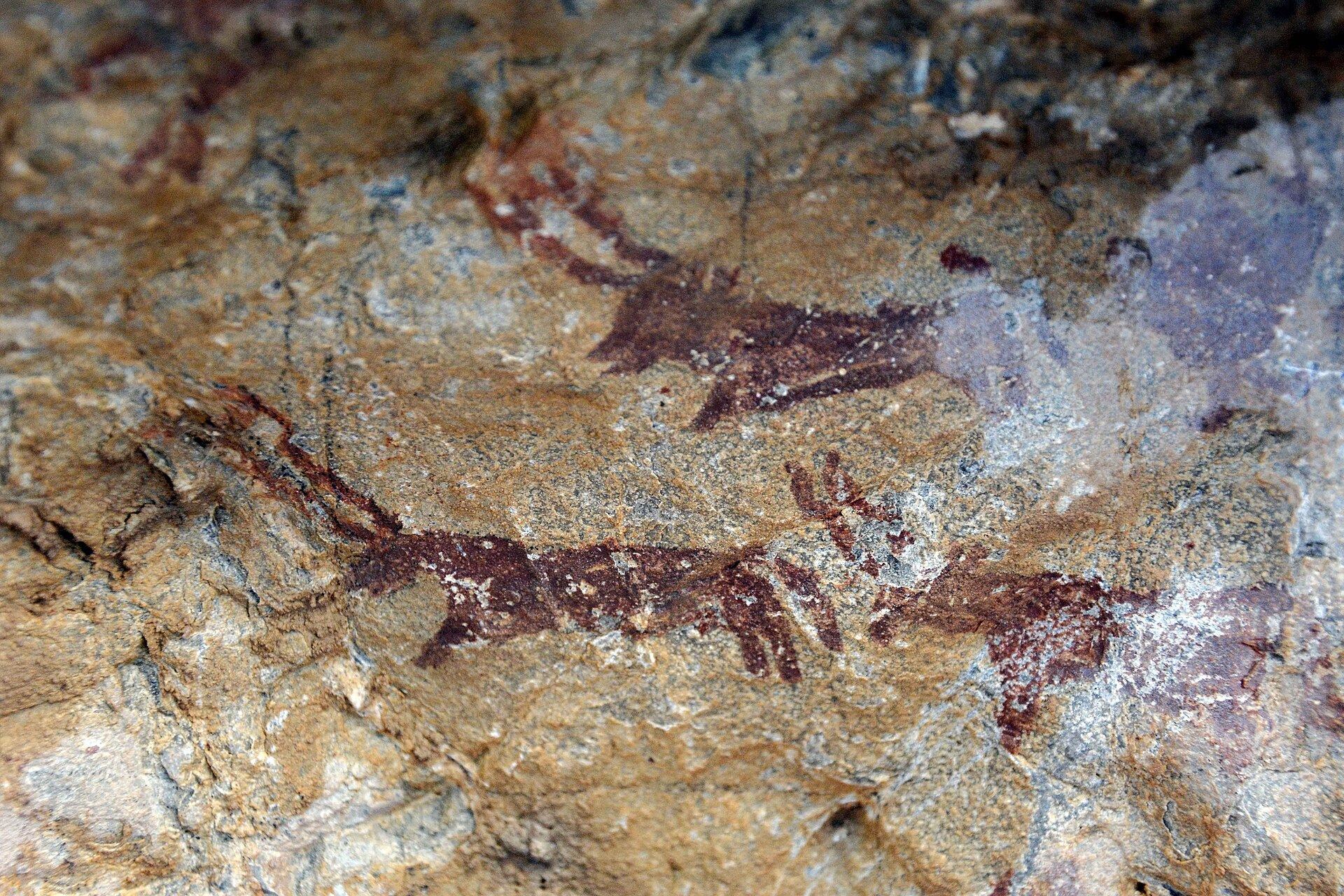
The site consists of a gallery of paintings spread across rock overhangs, niches, arches, and small grottoes in the gorge. The principal grotto lies at approximately 2,000 meters above sea level. Its painted surfaces are covered by limestone deposits or calcareous flowstone, a sheet-like mineral deposit formed when water flows over a cave or rock-shelter surface. The images are generally small, measuring about 4 to 20 centimeters in length.
Painted compositions
Northern compositions
Three main groups of compositions are distinguished within the principal grotto, with two on the northern side and one on the western side. The northern groups include a hunting scene in which masked or bird-disguised hunters pursue wild bulls. Another scene shows goitered gazelles, slender desert and steppe gazelles named for their enlarged throat area, with one animal struck by an arrow or dart.
Western hunting group
The western group contains hunting scenes involving spiral-horned goats. Across the site, animal figures are generally shown in profile and rendered with a realistic treatment, while the hunters are more schematic. They wear bell-shaped garments, and some have bird-like heads. One composition shows people hunting wild bulls with the help of dogs.
Animal and human figures
More than 200 images belong to the Mesolithic, Neolithic, and later periods. They include wild bulls, dogs, foxes, wild boars, spiral-horned goats, goitered gazelles, ibex, insects, and other animals, together with human figures, masked hunters, bows and arrows, spears, sickle-shaped tools, and other objects. Between some human figures and a bull are narrow-bodied forms with human-like features and tails. These have been interpreted as mythical masters of animals assisting the hunters, but that identification remains an interpretation.
Pigments and later additions
The paintings were made mainly with natural red ochre, an earth pigment colored by iron minerals, in several shades. Artists used both outline and shaded techniques. A group of black images, showing bulls and human figures in a natural hollow below a painted area, has been described as the only black-painted group at Zarautsoy; the other images are predominantly red.
A small archer beneath a larger bull appears to predate the composition painted over it. Other later images occupy the lower part of the grotto ceiling. They include a solitary human figure wearing a garment with a leather hood, a mountain goat, an animal resembling a deer, geometric lines, engraved patterns, and signs whose meaning remains unexplained. Arabic inscriptions were added to some rock surfaces in later periods.