Akbaur: A Bronze Age Ritual Grotto and Archaeological Site in Kazakhstan
Site at a Glance
- Rating
- 4.4
- Popularity
- Very Low
- Country
- Kazakhstan
- Primary era
- Bronze Age
- Eras represented
- Bronze Age, Iron Age
- Civilizations
- Scythian
- Site type
- Religious
- Remains
- Sanctuary
On this page9 sections
History
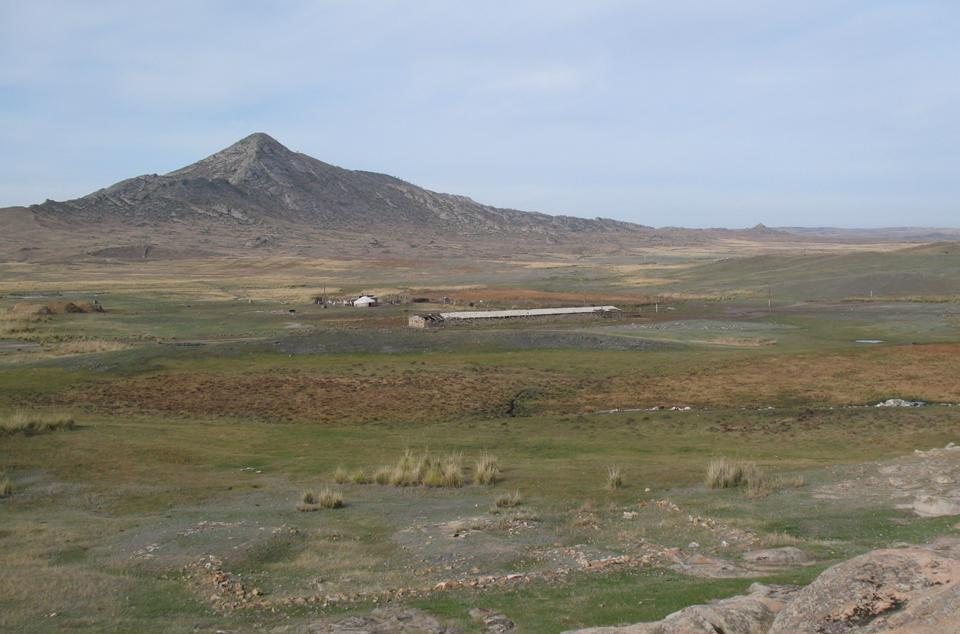
Akbaur is a Bronze Age archaeological monument in Kazakhstan, created by prehistoric communities around 3000 BC and associated with a grotto used for ritual activity. The site lies on the piedmont of Akbaur Mountain, near Besterek village in East Kazakhstan, and is also connected with Korzhimbay Mountain. It has been described both as a Bronze Age monument and as one of Kazakhstan’s oldest known Neolithic temples. Popular comparisons with Stonehenge reflect its proposed ceremonial and astronomical functions, while ancient beliefs regarded Akbaur as the centre of the world.
Bronze Age sanctuary
The painted grotto appears to have served as a sacred place for sacrifices and ceremonies. The ground in front of it hosted larger religious gatherings at particular times of the year, including the beginning of the year in March. One interpretation identifies Akbaur as an open-air temple, meaning a ritual site whose principal ceremonial space lies outdoors rather than inside a conventional building. This interpretation places emphasis on the site’s westward orientation and connects its ceremonies with funerary rites and sacrifice.
Ritual activity at Akbaur and near the Kyzyl-Tas mountains may have involved mountain worship and early cults associated with the sky, the Sun, storms or rain, animals, and plants. These associations help explain the range of figures and signs painted inside the grotto, although their precise meanings remain uncertain. Proposed readings include a sacred guide to the route of human salvation, an early form of writing, and a map of the night sky. More speculative claims have connected the images with extraterrestrial visitors, but that interpretation is not an established historical conclusion.
Later settlement and Saka activity
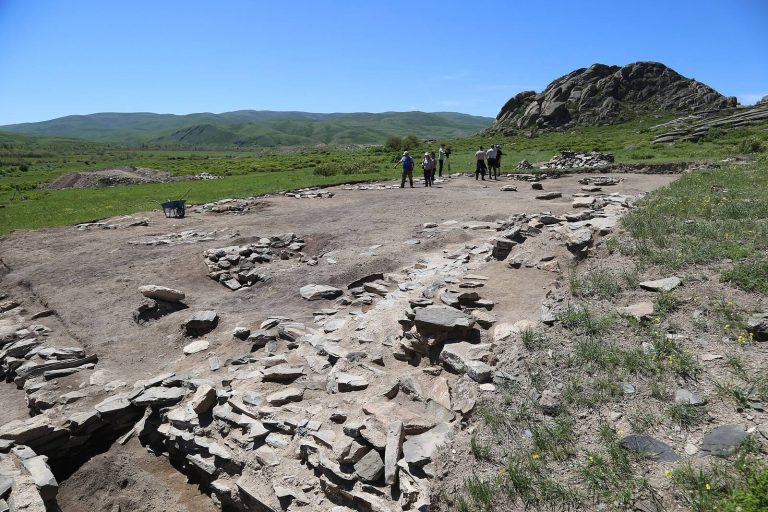
The first archaeological layer contains a settlement from the final Bronze Age and the beginning of the Early Iron Age. In 2019, excavation beside the grotto revealed a permanent settlement dating to the early Saka period. The Saka were an Iron Age population of the Eurasian steppe commonly associated with nomadic and semi-nomadic pastoral life, but the evidence from Akbaur indicates that some Saka communities also maintained settled activities.
Stone grain graters and whetstones, together with horse and sheep bones, point to a community involved in several kinds of work. Archaeologists associate the settlement with agriculture, stone working, textile production, pottery firing, and the manufacture of iron tools. This evidence adds a domestic and productive dimension to a site otherwise especially known for its sacred grotto and ceremonial interpretations.
Investigation and continuing interpretations
Systematic investigation took place from 1970 to 1990 through an archaeological expedition of the Academy of Sciences of Kazakhstan directed by Zeinolla Samashev. Later work expanded attention beyond the painted grotto to the settlement and the surrounding ritual landscape. Akbaur continues to support several interpretations rather than one settled explanation. It has been described as an ancient observatory for systematic observations of celestial bodies, while another theory treats a rock inscription as a map of a route of human salvation associated with a global catastrophe and the Irtysh River as a refuge or landmark. A separate mystical interpretation presents the site as an energetic and informational generator with two positive and two negative zones operating for about 5,000 years. That claim is not part of archaeological consensus.
Remains
Akbaur occupies a rocky mountain setting and is organized around a grotto, painted rock surfaces, stone circles, rows of stones, large rock formations, and other features spread across the surrounding ground. The grotto is positioned about 5 to 6 metres above the foot of the mountain. Together, these remains have been used to propose ritual, funerary, astronomical, and metallurgical activities, although the functions of several features remain uncertain.
The grotto and painted wall
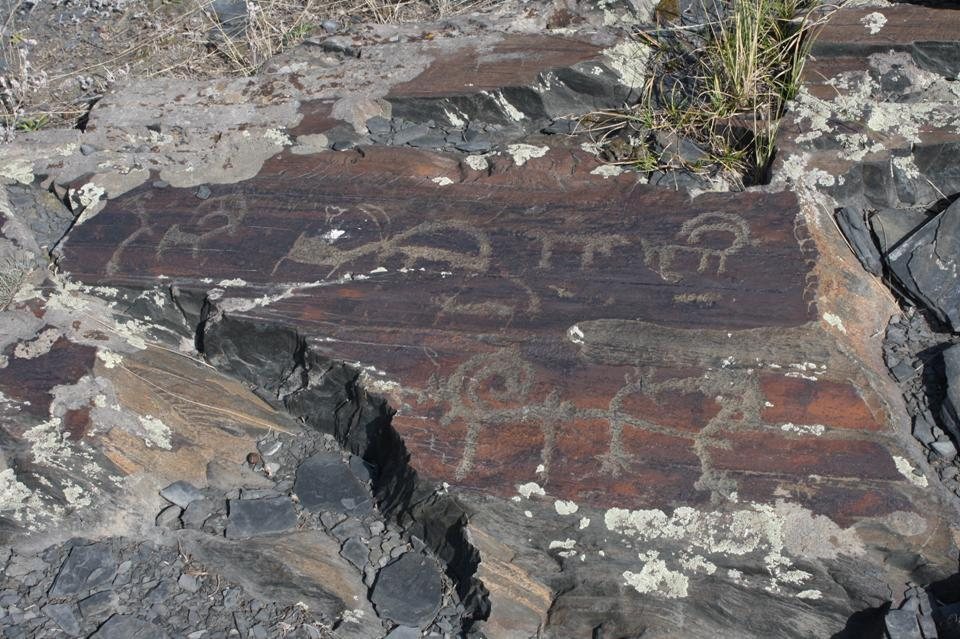
Akbaur’s grotto is a cave with a conical interior resembling a hut. Its semicircular space is covered by a stone slab with a heart-shaped opening. The principal decorated surface lies opposite the entrance and preserves about 80 painted rock images. People, a mountain goat, a bull, a two-wheeled cart, hut-like dwellings, lines, dots, triangles, rectangles, zigzag forms, crosses, and other signs appear across the wall.
The images were painted rather than carved into the stone. They use brown or red-brown ochre, a natural earth pigment based commonly on iron oxides, and date to about 3000 BC, at the beginning of the third millennium BC. Suggestions that animal blood was also used remain uncertain. Many figures are separated by intervals of about 90 centimetres, 60 centimetres, and 180 centimetres. A two-wheeled cart, a bull, and a mountain goat appear among the apparent central motifs, surrounded by geometric forms, human figures, and approximately three or four hut-like structures. The paintings have been described as having no equivalent elsewhere in Kazakhstan.
Some interpretations connect the images with hopes for fertile land and the prosperity and reproduction of livestock and people. A funerary interpretation gives particular importance to the cart, which was placed in the grave of the deceased and understood as a vehicle carrying the person’s soul to another world. Crosses have been read as signs of the Sun or stars and possibly as elements of an incomplete star map related to the sanctuary’s south-western orientation. White and black deer and mountain goats may have participated in sacrificial symbolism, while deer carrying the Sun on their antlers have been interpreted as images of the cosmic sacred animal of Eurasian nomads.
Stone circles and ceremonial features
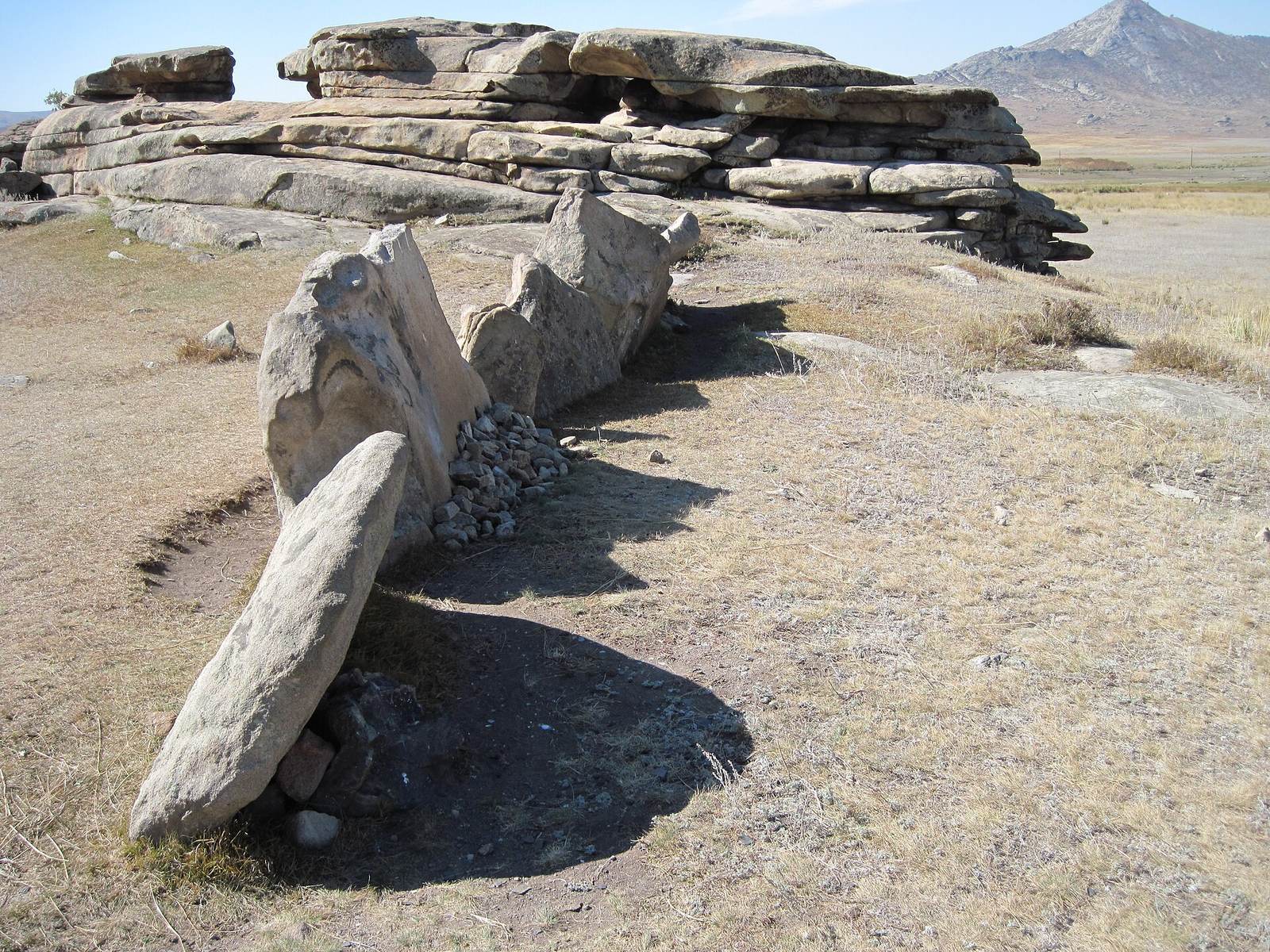
Stone circles at the site have been interpreted as places for religious or other rites. Rows of stones may have formed alleys for ritual processions, linking parts of the wider ceremonial landscape. About 100 metres from the decorated wall stands a large mushroom-shaped rock that specialists have interpreted as a possible altar. These readings remain connected to the proposed ritual use of the grotto and its surrounding ground.
Features associated with astronomical observation
Several physical features have been cited in support of an observatory interpretation. They include foundations of ancient buildings, an area identified as a sundial, and granite slabs bearing what has been interpreted as information arranged like an astronomical grid. Another feature is an approximately 25-metre-wide, amphitheatre-like arrangement. Granite rocks or slabs around it rise about 2.5 to 4 metres and form a horseshoe-shaped enclosure with stepped surfaces that may have served as seats.
A stone associated with the grotto contains apparently artificial cup-like depressions. One proposed arrangement would have allowed sunlight reflected from a lower depression to appear in an upper one at sunrise on the spring equinox, the time of year when day and night are approximately equal in length. Other interpretations regard the depressions as sacrificial places or moulds for molten ore. Ore ingots corresponding to their forms were found nearby, so ritual, astronomical, and early metallurgical explanations remain under consideration.
Furnaces and surrounding activity
Remains of furnaces occur in the surrounding tract. Some chambers were small enough to accommodate only one or two people, while others were described as very large. Their presence, together with the cup-like depressions and nearby ore ingots, has contributed to interpretations of early metalworking at Akbaur. The relationship between these industrial remains and the grotto’s ceremonial features is not yet resolved.