Shams al-Rasul Mausoleum: A Sasanian Fire Temple in Amol, Iran


Site at a Glance
- Rating
- 3.9
- Popularity
- Very Low
- Country
- Iran
- Primary era
- Classical
- External website
- Open
- Eras represented
- Classical, Medieval
- Civilizations
- Sassanid
- Site type
- Religious
- Remains
- Temple
On this page5 sections
History
Shams al-Rasul Mausoleum is a Sasanian-era structure in Amol, Iran, traditionally associated with the burial place of Shams al-Din Muhammad ibn Mahmud Amuli, an Iranian scholar and physician. It stands in the old part of the city, in the area known as Avam Kuy, and is also called Shams Tabarsi Amuli.
The building is identified as the Fire Temple of Amol, a Zoroastrian place of worship where a sacred fire was maintained for religious ritual. Its later identification as the mausoleum of Shams al-Rasul is considered mistaken, although the burial place associated with Shams al-Din Muhammad ibn Mahmud Amuli is located inside the structure.
Sasanian Amol
During the Sasanian period, the Iranian dynasty that ruled from 224 to 651 CE, the fire temple stood in the old urban area alongside Amol’s market and a Sasanian fortress. The fortress was said to have been completely destroyed during the early Islamic conquests, while the fire temple and the ancient market remained.
The monument is generally attributed to the Sasanian period because of its form, brick construction, and resemblance to recognized Iranian towers and fire temples. Its architectural features have also been compared with ninth-century AH tower buildings, and its style has been described as Timurid, a tradition associated with the Timurids in the late fourteenth and fifteenth centuries.
Damage and Protection
Earthquakes and regional weather damaged the structure, including its domed covering. Repair work took place in recent decades, followed by a further restoration undertaken by cultural-heritage authorities in 1391. Iran registered the monument among its national monuments in 1975 under registration number 1060.
Remains
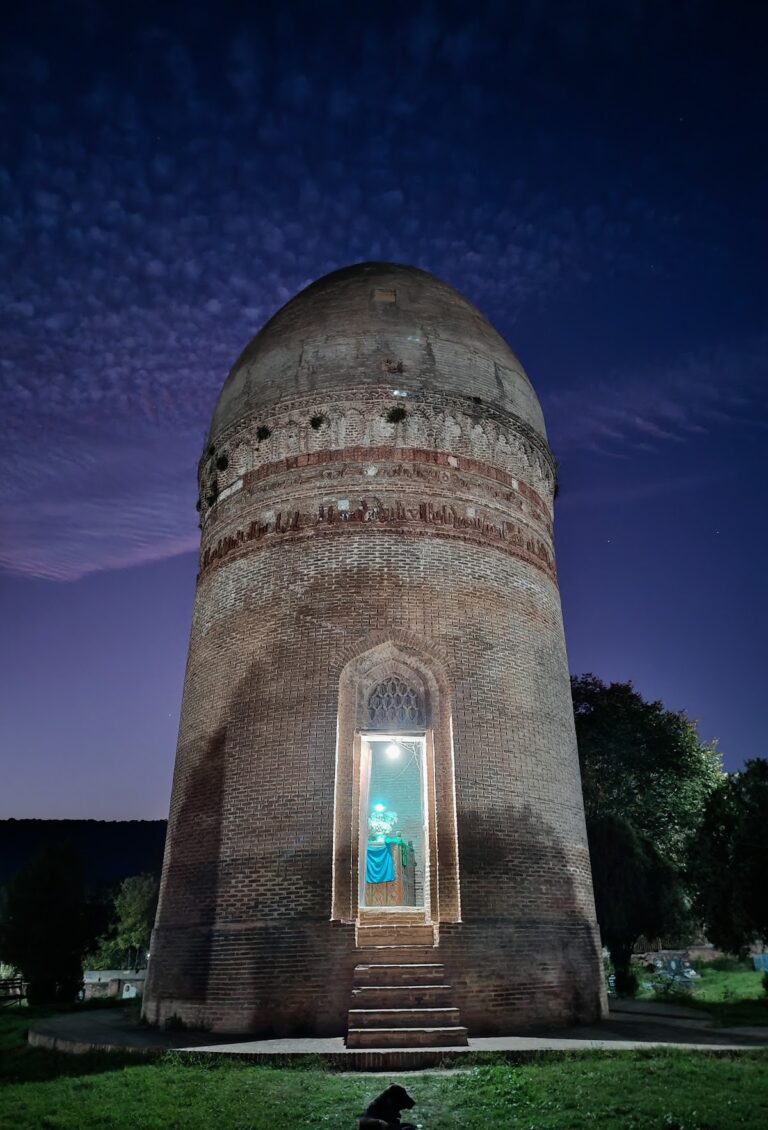
The monument occupies the Chaksar neighborhood of Avam Kuy in Amol’s old urban area. Its main body has a square plan and rises into a conical, tower-like dome. The dome was formed with inner and outer shells, both of which suffered damage from earthquakes and weathering.
Brick Tower and Dome
Bricks of differing dimensions and sizes, bonded with mortar, form the building. The upper part of the square body contains muqarnas, a three-dimensional decoration made from small stepped or niche-like elements, including examples at the level where the dome begins. Brick arches, brick cornices, and tilework decorate the upper section.
The rounded, tower-like dome gives the building its principal vertical form. Its comparatively substantial size in relation to other towers of its period has been noted alongside its resemblance to Iranian tower buildings and fire temples. The interior contains the burial place associated with Shams al-Din Muhammad ibn Mahmud Amuli.