Pile Gate, Dubrovnik: The Principal Western Entrance to the Old Town


Site at a Glance
- Rating
- 4.7
- Popularity
- Medium
- Country
- Croatia
- Primary era
- Early Modern
- Eras represented
- Medieval, Early Modern
- Civilizations
- Republic of Ragusa
- Site type
- Military
- Remains
- Gate
On this page8 sections
History
Pile Gate is the historic western entrance to Dubrovnik’s Old Town in Croatia. It developed at the point where the islet of Lausa, containing the oldest part of the city, met the mainland and served for centuries as Dubrovnik’s principal overland entrance. The passage was the oldest surviving access through the city’s fortifications and initially formed the only external approach to the settlement.
Early access and the Pile Fortress
From its foundation, Dubrovnik occupied the southern part of the present Old Town. Until the twelfth century, a narrow and shallow marine inlet separated the city from the mainland at the location of today’s Stradun. The entrance at Pile therefore controlled the connection between the fortified settlement and the land beyond it. The gate led toward the Pile suburb, whose name derives from the Ancient Greek polai, meaning “gate.”
The site was occupied by the former Pile Tower or Pile Fortress, whose existence is documented from 972. The fortress was demolished by the Austrians in 1818, although portions of its structure survive between the present outer and inner gates. An earlier entrance at the site is known from the thirteenth century, before the gate complex acquired its current form.
Medieval and republican control
During the medieval period, the gate was locked at night, and its key was kept in the Rector’s Palace, the seat and official residence of Dubrovnik’s elected rector. Under the Dubrovnik Republic, the maritime republic that governed Dubrovnik and its territories until 1808, the wooden drawbridge was raised each evening at a designated hour. It was lowered early in the morning so that suburban residents and merchants could enter the city.
The inner gate was rebuilt in 1460, and the outer gate followed in 1537. Together they strengthened and formalized the western approach while preserving the entrance’s long-standing role in the movement of people and goods. Pile Gate is now recognized as one of Dubrovnik’s principal landmarks and as the largest entrance into the city’s fortified urban core.
Remains
The gate complex
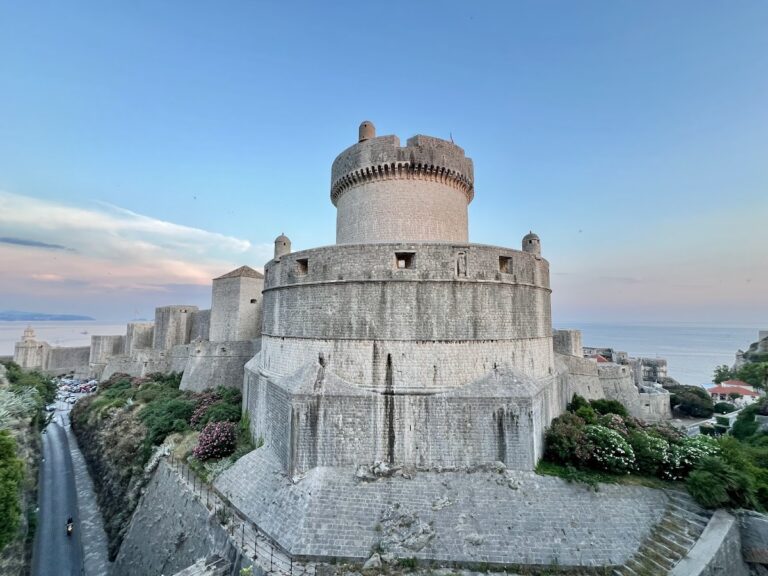
Pile Gate forms a semicircular ensemble in the western line of Dubrovnik’s city walls, between the Puncjela and Minčeta towers. It consists of an outer gate and an inner gate, arranged along the approach into the fortified city. The inner passage cuts through the main city wall and leads toward Pasko Miličević Square and Stradun.
Inner gate
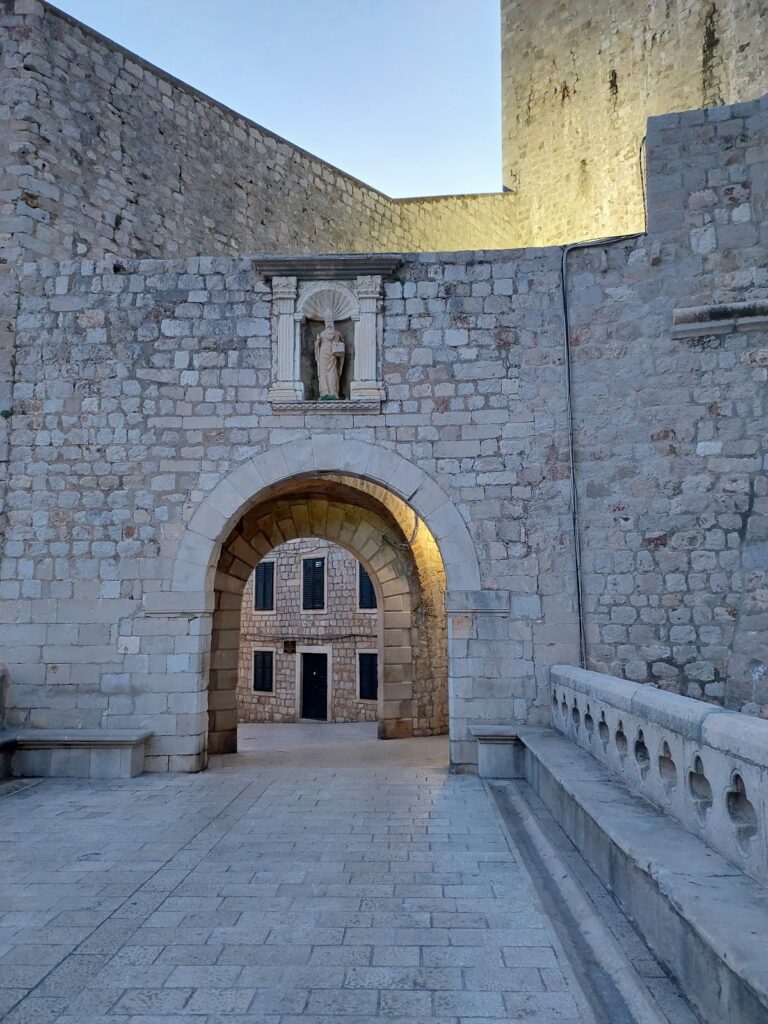
The inner gate was built in 1460 and follows the form of the Peskarija Gate on the opposite side of Dubrovnik. Its pointed Gothic arch marks the passage through the main defensive wall. Above the arch stands a statue of Saint Blasius, Dubrovnik’s patron saint and a central figure in the city’s religious identity. The sculpture was made by Ivan Meštrović, a prominent Croatian sculptor of the twentieth century.
Outer gate
Built in 1537, the outer gate is a Renaissance arch set into the wall of the former semicircular Pile Fortress. A niche above the entrance contains another statue of Saint Blasius. Beneath it are three smaller sculptures, representing the heads of two women and one man. A local legend connects these heads with a Franciscan friar who supposedly seduced two nuns from the nearby Convent of Saint Clare.
Bridge and moat
A stone bridge provides access to the outer gate. A permanent single-span stone bridge crossed the moat in 1397. After the moat was widened in 1471, that bridge was dismantled and replaced by a three-span stone bridge designed by Paskoje Miličević, a Dubrovnik city engineer associated with numerous structures in the city. Stone benches run along the bridge parapet.
Between 1533 and 1537, the span immediately before the gate was replaced by a wooden drawbridge, a bridge that could be raised or lowered to control passage across a defensive gap. The moat directly outside the outer gate is now a garden. Remains of the former Pile Tower or Fortress can still be seen between the outer and inner gates, preserving part of the earlier defensive arrangement within the later entrance complex.