Ganjali Khan Caravanserai: A Safavid Travel Complex in Iran


Site at a Glance
- Rating
- 4.7
- Popularity
- Very Low
- Country
- Iran
- Primary era
- Early Modern
- Eras represented
- Early Modern
- Civilizations
- Safavid
- Site type
- Economic
- Remains
- Caravanserai
History
Ganjali Khan Caravanserai is a Safavid-period roadside establishment in Kerman, Iran, built under the Safavid dynasty as part of the Ganjali Khan Complex. A caravanserai provided accommodation and services for traveling merchants, pilgrims, and other travelers. The complex was created at the request of Ganjali Khan, a Safavid-era patron associated with its foundation. Its Islamic school opened officially in 1599, while the caravanserai opened in 1613.
The school functioned from 1599 to 1794, and the caravanserai continued serving travelers from 1613 until the twentieth century. The site later accommodated a lecture hall, an art studio, and a cultural center, reflecting changes in its use after its original institutional and commercial functions had ended.
The school and caravanserai were placed on Iran’s National Heritage register under number 297 in 1937. In 2023, the caravanserai became part of The Persian Caravanserai, a UNESCO World Heritage serial property comprising 54 historic caravanserais in 24 Iranian provinces. The inscription recognized the property under cultural criteria (ii) and (iii).
Remains
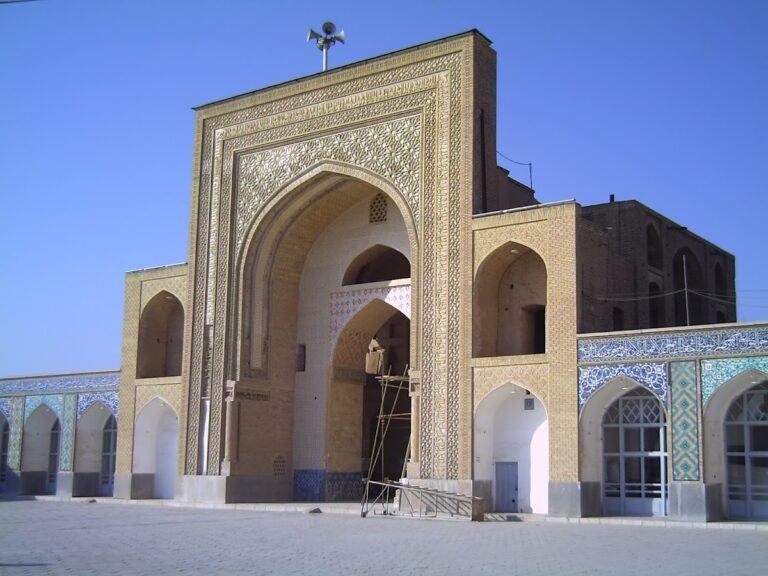
The surviving site combines a historic Islamic school and caravanserai within the Ganjali Khan Complex. Both buildings have two floors and express Safavid architectural design. Their construction uses brick, plaster, and tile, materials that define the visible architectural fabric of the complex.
The caravanserai occupies approximately 2,200 square metres, while the school covers about 724 square metres. Together, these buildings preserve the physical setting for the complex’s educational and traveler-related functions, with the caravanserai forming the larger of the two documented structures.