All Saints Church in Górki Wielkie: A Gothic Roman Catholic Parish Church


Site at a Glance
- Rating
- 4.6
- Popularity
- Low
- Country
- Poland
- Primary era
- Medieval
- External website
- Open
- Eras represented
- Medieval, Early Modern, Modern
- Civilizations
- Habsburg, Holy Roman Empire
- Site type
- Religious
- Remains
- Church
On this page7 sections
History
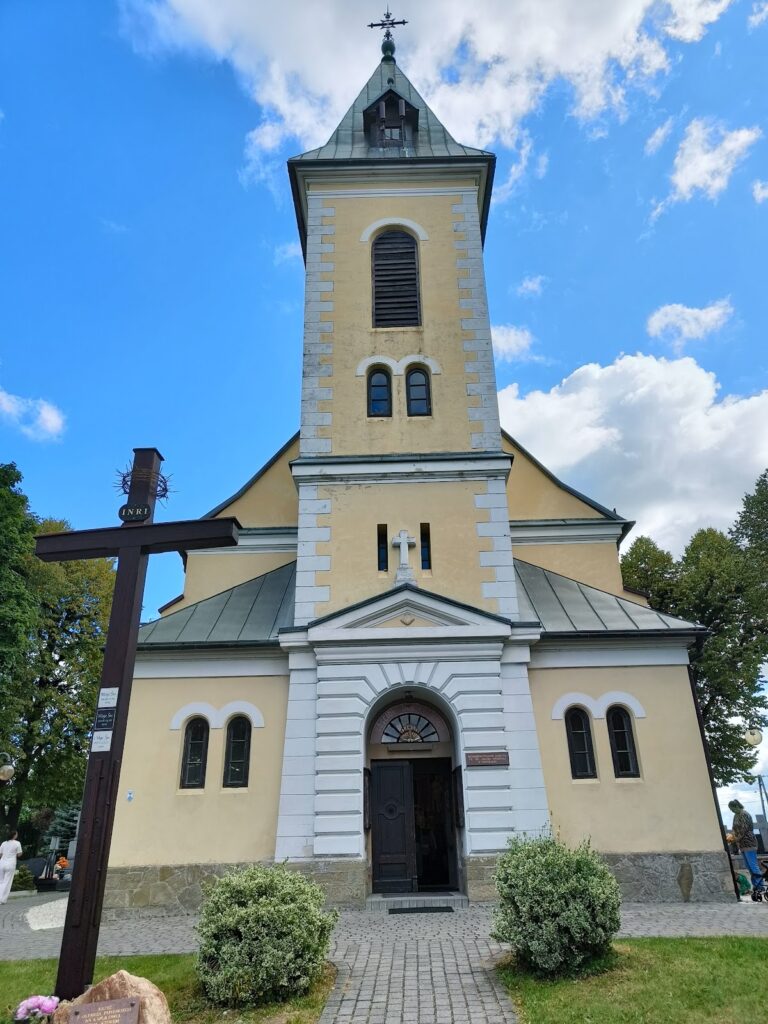
All Saints church in Górki Wielkie is a Roman Catholic parish church in Poland, built in 1417 in the Gothic style on the site of an earlier chapel. The parish is first mentioned in the 1417 register of Peter’s Pence, a historical charitable payment associated with support for the papacy. The church belongs to the Diocese of Bielsko-Żywiec, and its liturgical feast is observed on 1 November.
The building was rebuilt or altered in 1662. In 1779, the Marklowski family ordered a renovation, and further changes took place during the nineteenth century. A grave associated with Erdman Marklowski remains in the church grounds, marked by a tomb slab dated 1765. Henryk Górecki, the owner of Górki Wielkie, died in 1682, and his tomb slab was later incorporated into the masonry entrance gate.
A Catholic cemetery was established beside the church in 1858 on Kępka Prochaskowa, a small local elevation. Those buried there include the writer Zofia Kossak, her husband Zygmunt Szatkowski, their son Juliusz, Kossak’s father Tadeusz, and the folk writer Walenty Krząszcz.
The church underwent thorough renovation after the Second World War. In 1980, the brothers Morawiec executed the interior polychrome decoration, painted ornamentation in multiple colors. The church was entered in the heritage register in 1960 and again under designation A-313/78 in 1978. Its church and immediate surroundings also form the Natura 2000 protected area “Church in Górki Wielkie” (PLH240008), established to conserve important habitats and species, particularly its bat populations.
Remains
Church building and interior
Layout and medieval portal
The church stands on the right bank of the Brennica. It has a single nave, one tower, and one altar. A late-Gothic stone portal leads to the sacristy, and its stonework bears the coat of arms of the Górecki family.
Furnishings and decoration
A seventeenth-century baptismal font founded by Jan Górecki is now used as a holy-water stoup. A cross beside it dates from 1888. The Baroque pulpit dates from the eighteenth century, while the main altar and the remaining furnishings and interior decoration date from the nineteenth century. The interior also contains the polychrome executed in 1980. The organ has ten stops, one manual, and a pedal division.
Entrance gate and cemetery
The masonry entrance gate to the church grounds contains Henryk Górecki’s tomb slab, commemorating the village owner who died in 1682. The adjacent cemetery includes a stone cross dated 1900 and the graves of Zofia Kossak, Zygmunt Szatkowski, Juliusz Szatkowski, Tadeusz Kossak, and Walenty Krząszcz.
Bat colonies
The church attic supports colonies of greater mouse-eared bats, numbering approximately 190 individuals in August, and lesser horseshoe bats, numbering approximately 75. These colonies contribute to the protected status of the church and its immediate surroundings within the Natura 2000 area.