Església de Sant Serni de Nagol: An Eleventh-Century Romanesque Church in Andorra


Site at a Glance
- Rating
- 4.6
- Popularity
- Very Low
- Country
- Andorra
- Primary era
- Medieval
- External website
- Open
- Eras represented
- Medieval, Early Modern
- Civilizations
- Unclassified
- Site type
- Religious
- Remains
- Church
On this page10 sections
History
Església de Sant Serni de Nagol is an eleventh-century Roman Catholic church in Andorra, built in the Romanesque tradition and dedicated to Saint Saturnin, also known as Saint Sernin. It belongs to the Diocese of Urgell, a Roman Catholic jurisdiction centred on the historic bishopric of Urgell in the eastern Pyrenees. The church was consecrated in 1055 by Guillem Guifredo, bishop of Urgell, and the record of that ceremony is preserved in the National Archives of Andorra.
Medieval foundation
The church was established during the eleventh century as a compact place of worship in Nagol, in the parish of Sant Julià de Lòria. Its Romanesque form reflects a medieval European architectural tradition associated with heavy masonry, simple geometric shapes, semicircular arches, and relatively compact church plans.
The mural paintings belong to the same period as the church’s construction. They are among the earliest known examples of Romanesque art in Andorra and are regarded as the principality’s oldest Romanesque mural paintings. Their style is more primitive than that of other Andorran examples and retains pre-Romanesque characteristics. Comparisons have been made with the paintings in the church of Marmellar at El Montmell.
Later alterations and preservation
The building was altered substantially during the seventeenth and eighteenth centuries. Work affected the apse and nave, and a porch was added over the entrance. The church’s earlier mural decoration was found in 1976 beneath whitewashed walls, bringing the medieval paintings back into view. A restoration carried out in 1979 included the removal of an altarpiece.
Església de Sant Serni de Nagol was registered as an Asset of Cultural Interest by Andorra’s Cultural Heritage authorities on 16 July 2003. This status forms part of the modern protection of a church whose consecration, architecture, and paintings preserve evidence of Andorra’s medieval religious history.
Remains
Setting and exterior layout
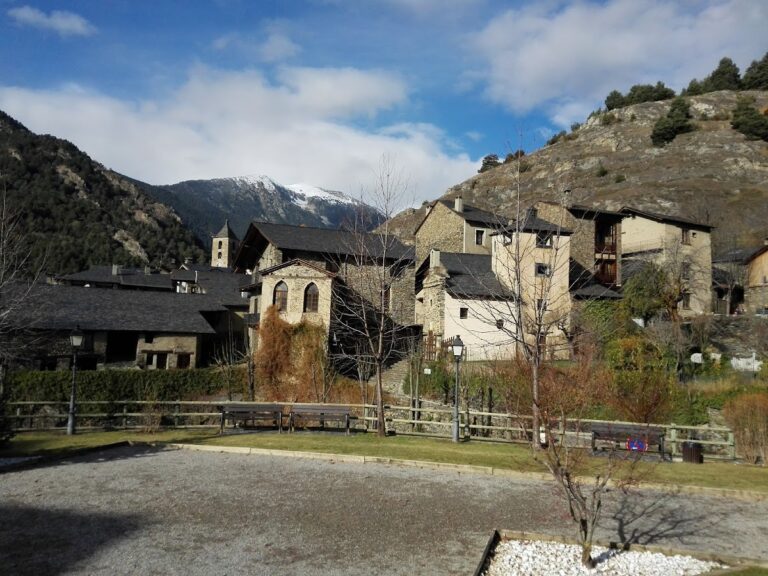
The church stands on a rocky promontory in Nagol, a village at approximately 1,120 metres above the Valira valley. It lies slightly south of the village houses beside a bend in the road, with the building overlooking the valley. Construction took place directly on the rock, without foundations, and the floors of both the nave and apse were cut into the natural stone.
This is a small, single-nave Romanesque building with a rectangular plan, a semicircular apse, and a west-facing bell gable. The bell gable is a wall-like structure rising above the church and contains two semicircular-headed openings for the bells. The nave measures 9.34 metres in length, while the apse is given as 11.5 metres. A small cemetery adjoins the church.
Entrance porch
The entrance is set in the south facade beneath the later porch. Its doorway has a semicircular head, and a granite basin for holy water stands beside it. The original barrel vault over the nave was replaced by a roof with exposed wooden beams.
Interior furnishings and paintings
Altarpieces and sacred objects
The interior preserves two altarpieces. One is a fifteenth-century Gothic work dedicated to Saint Saturnin. Gothic architecture developed after the Romanesque period and is associated with pointed arches and more elaborate structural and decorative forms. The second altarpiece is dedicated to Saint Martin. The church also contains a Romanesque cross.
Romanesque mural paintings
The mural paintings survive on the presbytery walls and the triumphal arch, the arch separating the nave from the apse or presbytery. Their scenes include angels adoring the Agnus Dei, the Lamb of God, a Christian symbol associated with Jesus Christ, sacrifice, and redemption. Other figures include unidentified saints, an eagle possibly associated with Saint John, and the triumphant Christ or a representation of the Apocalypse.
Another scene shows a saint or archangel defeating a dragon or serpent. The figure has been identified as either Saint Michael or Saint George. If it represents Saint George, the painting is considered the earliest surviving evidence of the cult of Saint George in Catalonia. One bearded angelic figure may represent John the Baptist, while another archangel is depicted in a Byzantine manner.
Coins from the church
Coins were found inside the church when the paintings were rediscovered. They date from the sixteenth and seventeenth centuries and were minted in the surrounding area, including Urgell, Castellbò, and Vic. Their presence adds later evidence to the medieval fabric and religious furnishings preserved within the building.