St. Amandus: A Roman Catholic Church in Cologne-Rheinkassel


Site at a Glance
- Rating
- 4.8
- Popularity
- Very Low
- Country
- Germany
- Primary era
- Medieval
- External website
- Open
- Eras represented
- Medieval, Early Modern
- Civilizations
- Holy Roman Empire
- Site type
- Religious
- Remains
- Church
On this page9 sections
History
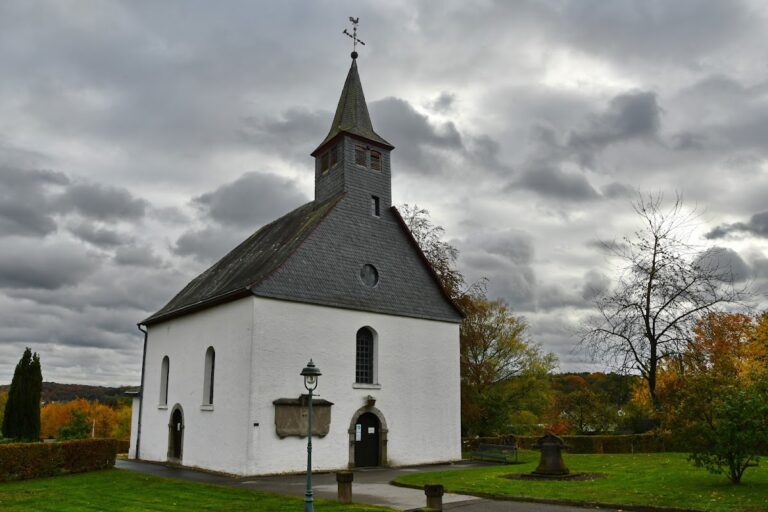
St. Amandus is a Roman Catholic church in Cologne-Rheinkassel, Germany, whose history extends from an eleventh-century predecessor through a major medieval enlargement and later Gothicized alterations. The church belongs to the parish of St. Pankratius am Worringer Bruch in the Archdiocese of Cologne.
Early Foundation and Medieval Rights
The circumstances of the church’s foundation are not fully known. It may have been established from the Amandus Monastery at Elno, now Saint-Amand-les-Eaux. In 899, Charles the Simple, the Carolingian king of West Francia who ruled from 898 to 922, confirmed that monastery’s possessions along the Rhine. The shared dedication to Saint Amandus of Maastricht, a seventh-century missionary and bishop associated with the early spread of Christianity in the Low Countries, suggests that these possessions may have included the church at Rheinkassel.
In 1156, Knechtsteden Abbey and the Cologne collegiate foundation of St. Gereon reached a settlement concerning rights to the parish church. A collegiate foundation was a community of clerics organized around a church and governed by a chapter. In 1185, Archbishop Engelbert I of Cologne definitively assigned Rheinkassel to the St. Gereon collegiate foundation.
Expansion under St. Gereon
Archaeological excavations in 1979 revealed the foundations of an earlier hall church beneath the present building. A hall church has a nave and side aisles of approximately similar height, without a markedly elevated central nave. During the twelfth century, the building was raised by three metres.
Around 1220, the St. Gereon collegiate foundation began a major enlargement and embellishment. The nave was expanded with two aisles, and the choir was rebuilt in an elaborately articulated form based on the collegiate church of St. Gereon in Cologne. The rebuilding also provided the church with its first vaulting.
Later Alterations and Furnishings
The present vault dates from the seventeenth century and was given a Gothicized treatment. Gothic architecture is associated with pointed arches and complex vaulting; here, the term describes a later vault shaped in that style. The western tower, built around 1200, was reduced by one storey during the same century.
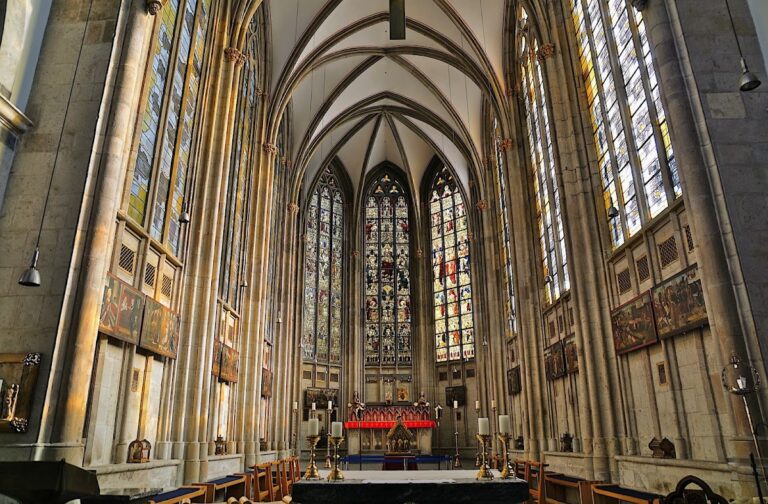
Older furnishings entered the church mainly during the nineteenth and twentieth centuries. A Madonna and Child dates from 1330–1340, while a Crucifixion group dates from the fifteenth century. Seventeenth-century figures represent Saint Amandus, Saint Hubertus, Saint Barbara, and Saint Michael. During the second half of the nineteenth century, representations of Christ, Moses, and Peter were added, together with the communion rail, Stations of the Cross, and organ gallery. Dieter Hartmann created the choir windows in 1987.
Remains
Medieval Structure
St. Amandus incorporates the foundations of the eleventh-century hall church found beneath the present building. The surviving church is organized around a nave with two side aisles, the latter belonging to the enlargement begun around 1220. Its choir is articulated both internally and externally and is flanked by two towers. The choir design follows the model of the collegiate church of St. Gereon, and the choir area contains a reduced-scale copy of that Cologne church.
Western Tower and Vault
The western tower dates from around 1200. It originally rose one storey higher than it does today, but that upper storey was removed in the seventeenth century. The surviving vault also belongs to the seventeenth century and has a Gothicized form.
Artworks and Interior Features
The interior includes a Madonna and Child from 1330–1340 and a fifteenth-century Crucifixion group. Sculptural figures of Saint Amandus, Saint Hubertus, Saint Barbara, and Saint Michael date from the seventeenth century. Later additions include representations of Christ, Moses, and Peter, a communion rail, Stations of the Cross, and an organ gallery. The choir windows were made by Dieter Hartmann in 1987.
Bells
Six bells hang in the church’s two towers. Four are used together as a regular peal, while two historic bells are rung individually.