Holy Cross Church, Bearsted: A Medieval Anglican Parish Church


Site at a Glance
- Rating
- 4.7
- Popularity
- Very Low
- Country
- United Kingdom
- Primary era
- Medieval
- External website
- Open
- Eras represented
- Medieval
- Civilizations
- English
- Site type
- Religious
- Remains
- Church
On this page8 sections
History
Holy Cross Church, Bearsted, is an active Anglican parish church in Bearsted, Kent, United Kingdom. Anglicanism is the Christian tradition represented by the Church of England, and a parish church serves a defined local ecclesiastical parish. Construction began in the 13th century and continued in stages through the 14th and 15th centuries. The church belongs to the Church of England’s Diocese of Canterbury, within the Province of Canterbury, the Archdeaconry of Maidstone, and the Deanery of North Downs.
Medieval development
The church grew gradually during the later Middle Ages. Its 14th-century arcade was altered in the following century, when its two eastern bays were rebuilt. A chantry was established on the north side of the aisle during the 14th century. A chantry was a chapel or endowed foundation created for prayers or masses for the dead. Known as the Milgate Chantry, it was suppressed in 1536.
The Milgate Chantry and later associations
After its suppression, the Milgate Chantry became associated with the owners of Milgate House at Thurnham. From the 1560s until 1624, those owners included members of the Fludd family. Elizabeth Andras, the wife of Sir Thomas Fludd, and her son Robert Fludd are commemorated in the church. Robert Fludd, who died in 1637, was an English physician and occultist.
Restoration and commemoration
The church underwent restoration during the 19th century, when features including the panelling and pews were renewed. Much of the roof was replaced during the 20th century. Memorials commemorate Margarete and Steven Mason, who died in 1552 and 1560, Henrye Brockill of Aldington, who died in 1596, and Susanna Cage, who died in 1634. Late-17th-century floor tablets commemorate Eleonor, John, and Guillemo Cage.
John Dyke, described as the last man hanged on Penenden Heath in 1830, is buried in the larger graveyard attached to the churchyard. Holy Cross Church has been listed at Grade I since 23 May 1967. In England, Grade I denotes exceptional architectural or historic interest. Three table tombs and the village war memorial in the churchyard have Grade II listing, a category for nationally important buildings or structures of special interest.
Remains
Exterior and layout
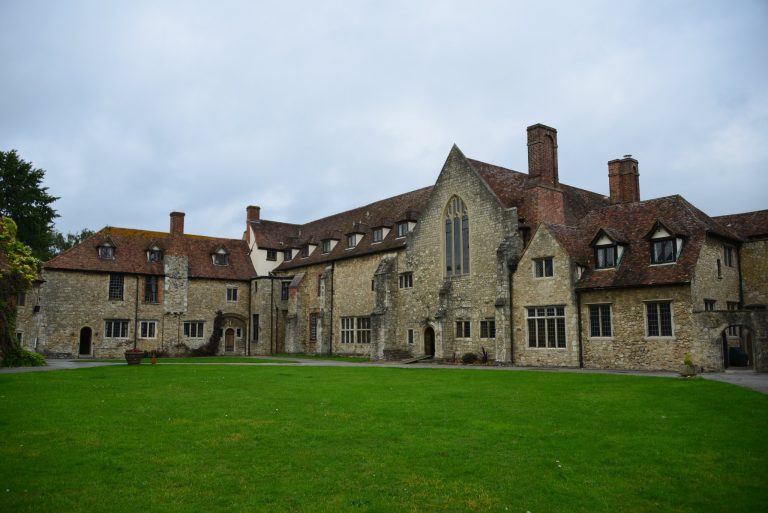
Holy Cross Church is built from local ragstone, with roofs covered in plain tiles. The nave has a single aisle on its north side and is entered through a south porch. At the western end stands a square, three-storey tower with a crenellated parapet. A stair turret occupies its south-east corner, while staggered buttresses strengthen the other three corners.
Three stone beasts occupy the corners of the tower parapet. They replace earlier figures that eroded over time. The originals may have represented three wolves from the arms of Rhirid Flaidd, an ancestor of the Fludd family line. The church stands within a small churchyard, with a larger graveyard attached on its eastern side. Three table tombs and the village war memorial are located in the churchyard.
Nave, aisle, and chancel
The arcade between the nave and north aisle has four bays. It was built in the 14th century, although the two eastern bays were reconstructed in the 15th century. A single arch at the western end may be Anglo-Saxon. A stair leading to the rood loft is set into the nave’s south wall. A rood loft was a gallery associated with the rood, a representation of the Crucifixion traditionally placed above the division between nave and chancel.
The chancel contains a 13th-century sedile and piscina. A sedile is a seat set into the chancel wall for clergy, while a piscina is a basin traditionally used to wash sacred vessels. The windows are generally small, apart from those at the eastern ends of the nave and aisle and the window above the doorway in the tower’s west wall. The south wall has 13th-century lancets to the left of the porch and in the chancel, while the windows on the north side date from the 14th century.
Chantry and memorials
The 14th-century Milgate Chantry occupies the north side of the aisle. Inside the church, Robert Fludd is commemorated by a memorial with a bust set on a plinth. The church also contains the memorials and floor tablets associated with the Mason, Brockill, Cage, and Andras families.