Monastery of San Adrián de Sasabe: A Romanesque Church and Medieval Episcopal Seat


Site at a Glance
- Rating
- 4.7
- Popularity
- Low
- Country
- Spain
- Primary era
- Medieval
- External website
- Open
- Eras represented
- Medieval
- Civilizations
- Crown of Aragon
- Site type
- Religious
- Remains
- Church
On this page9 sections
History
The Monastery of San Adrián de Sasabe is a medieval Christian monastic and episcopal site in Spain, near Borau in the Lubierre valley. Founded in the late ninth century, it preserves a Romanesque church begun in the second half of the eleventh century and completed between about 1100 and 1104. Its church is the surviving evidence of a monastery that already existed during the Visigothic period, and the institution was reportedly the most important monastery in the County of Aragón during the tenth century.
Monastery and episcopal refuge
During Muslim incursions and the rule of the Emirate and later Caliphate of Córdoba, the bishops of Huesca and Aragón used monasteries in the Pyrenees as refuges and temporary episcopal seats. San Adrián de Sasabe was one of these itinerant seats, alongside Jaca, San Juan de la Peña, and San Pedro de Siresa.
A bishopric known as Sasabe was established around 922 as a suffragan diocese, meaning that it was placed under the authority of a metropolitan archdiocese, in this case Tarragona. Its territory had previously belonged to the Diocese of Pamplona. The first bishop was Ferriolus, also called Ferriolo, followed by Fortuño, Aureolus, Atón, Mancius, García, and Sancho.
Cathedral and Romanesque rebuilding
In the eleventh century, the monastery church served as a cathedral and episcopal seat before Jaca Cathedral was built. The transfer to Jaca began after the Synod of Jaca in 1063 and was complete by 1077, when the bishopric was suppressed and its territory reassigned to the Diocese of Jaca. San Adrián de Sasabe remained directly attached to that bishopric, and one of its canons continued to hold a place in the chapter at Jaca.
Around 1042, Ramiro I, the eleventh-century king of Aragón, restored the monastery and church, removed laypeople who had been living there, and installed Bishop García I. The present church was begun in the second half of the eleventh century, completed between about 1100 and 1104, and consecrated in 1104 by Bishop Esteban of Huesca. Abbot Sancho de Larrosa was entrusted with its completion; his relative Aznar de Larrosa had previously held the abbacy.
Decline and later memory
The transfer of the episcopal seat, the rapid advance of the frontier, and the arrival of Cluniac monks contributed to the monastery’s declining importance. The Cluniac movement, centered on the Benedictine Abbey of Cluny, promoted stricter monastic observance and reshaped religious institutions across medieval western Europe. San Adrián de Sasabe eventually lost its original monastic function. By the mid-eighteenth century, the church was being used as the Hermitage of San Adrián, and it had previously also been dedicated to Saint Natalia.
A local tradition connects the monastery with the Holy Grail, the relic traditionally identified as the cup used by Jesus at the Last Supper. According to this tradition, the bishops of Huesca concealed the relic at San Adrián de Sasabe during the Muslim invasions. It was later said to have passed through Jaca, San Juan de la Peña, the Aljafería in Zaragoza, and Barcelona before reaching Valencia Cathedral.
Excavation and protection
The church remained buried beneath sediment for several centuries. Excavation and clearance began in 1957 after residents of Borau requested the work because stagnant water had filled the building, and an access road was constructed as part of the intervention. Flooding continues to threaten the church. The site was declared a Historic-Artistic Monument in 1965 and is now protected as a Bien de Interés Cultural within Spain’s historic-heritage system. In 1969, the former diocese was nominally restored as the titular see of Sasabe, an ecclesiastical title for a bishopric that no longer functions as an ordinary residential diocese.
Remains
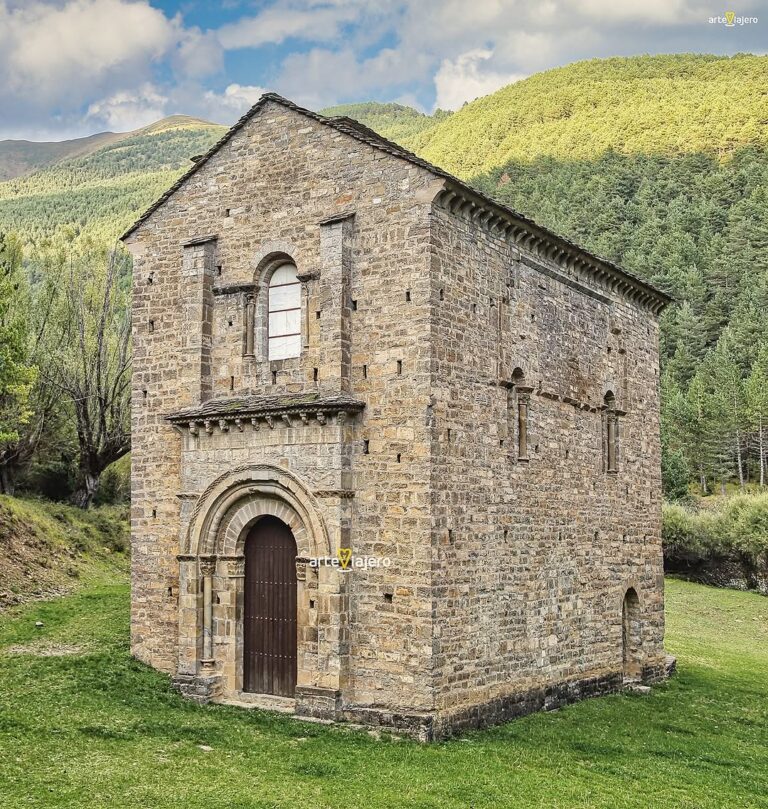
The surviving above-ground monument is the Romanesque church, standing on the left bank of the Lubierre, a tributary of the Aragón, shortly after the Cáncil and Lupán streams join to form the river. The building has a rectangular single-nave plan, with a narrow rectangular choir bay and a semicircular apse extending eastward. The choir is raised by three steps. Buried remains of the earlier monastic complex may also survive around the church.
Apse and masonry
The apse is covered by a quarter-sphere vault, also called a calotte. Outside, blind arcades, which are decorative arches attached to the wall, and pilaster strips divide its surface into three sections. Each section contains a narrow round-arched window. The arches rest on corbels carved with rosettes. One corbel carries a head, while another shows an equal-armed cross grasped by a hand.
The apse, its blind arcades, pilaster strips, semicircular windows, and carved corbels belong to the Lombard Romanesque tradition. This regional form of Romanesque architecture is especially associated with rhythmic exterior wall articulation and repeated decorative arcades. The nave is built from regularly dressed stones carefully laid in courses. A doorway on the north side led to the tower, whose lower structure survives.
West and south portals
The church has portals on its west and south façades, both reached by steps descending below the present ground level. The west entrance is set within a roofed projection of the wall. Three archivolts, or ornamental bands following the curve of an arch, surround the opening, with a column on either side. The outer archivolt carries a checkerboard frieze, while the middle one has roll mouldings.
The capitals and imposts of the west portal columns are richly carved. The left capital displays stylized leaves arranged in four superimposed rows, while the right capital shows human figures. The south portal has plain wedge-shaped stones and a frieze with roll moulding. Beside it, an inscription states in Latin that three bishops rest there. As many as seven bishops who used the title bishops of Aragón at Sasabe are said to have been buried at the church.
Burial, excavation, and present condition
Before the excavation, only the upper part of the church could be reached through a window above the west portal, and shepherds used this area as a shelter. Clearance revealed the lower portions of the building and restored its architectural form to view. The church remains vulnerable to flooding, a condition that also shaped the modern history of its excavation and preservation.