San Martino a Montughi: A Roman Catholic Church in Florence


Site at a Glance
- Rating
- 4.5
- Popularity
- Very Low
- Country
- Italy
- Primary era
- Early Modern
- External website
- Open
- Eras represented
- Early Modern, Modern
- Civilizations
- Grand Duchy of Tuscany, Italian
- Site type
- Religious
- Remains
- Church
On this page10 sections
History
San Martino a Montughi is a Roman Catholic church in Florence, Italy, dedicated to Saint Martin of Tours and belonging to the Archdiocese of Florence. Standing on Montughi hill, the church has documented origins in 1222 and was rebuilt from its foundations in 1539 on the traditional site of an earlier church.
Montughi and the Ughi family
Montughi originally referred to the hill occupied by the church before the name extended to the surrounding district. It derives from Monte degli Ughi, or Mons Ugonis, recalling the Ughi family residence on the hill. The family traced its foundation to Ugo, Marquis of Tuscany, and held political offices until 1292. Its members later entered the legal professions. Alamanno Ughi became a marquis in 1782, while the family ended after Minerva Ughi married Orlando Lorenzi.
The sixteenth-century rebuilding
The present church was begun in 1539 at the initiative of Francesco Campana, the parish priest and a scholar of Latin who had become secretary of the Florentine Republic in 1531. Giuliano di Baccio d’Agnolo received the commission for the construction and also directed the building of the canonry’s loggia, the residence and institutional complex associated with the church’s canons.
Alterations and reconstruction
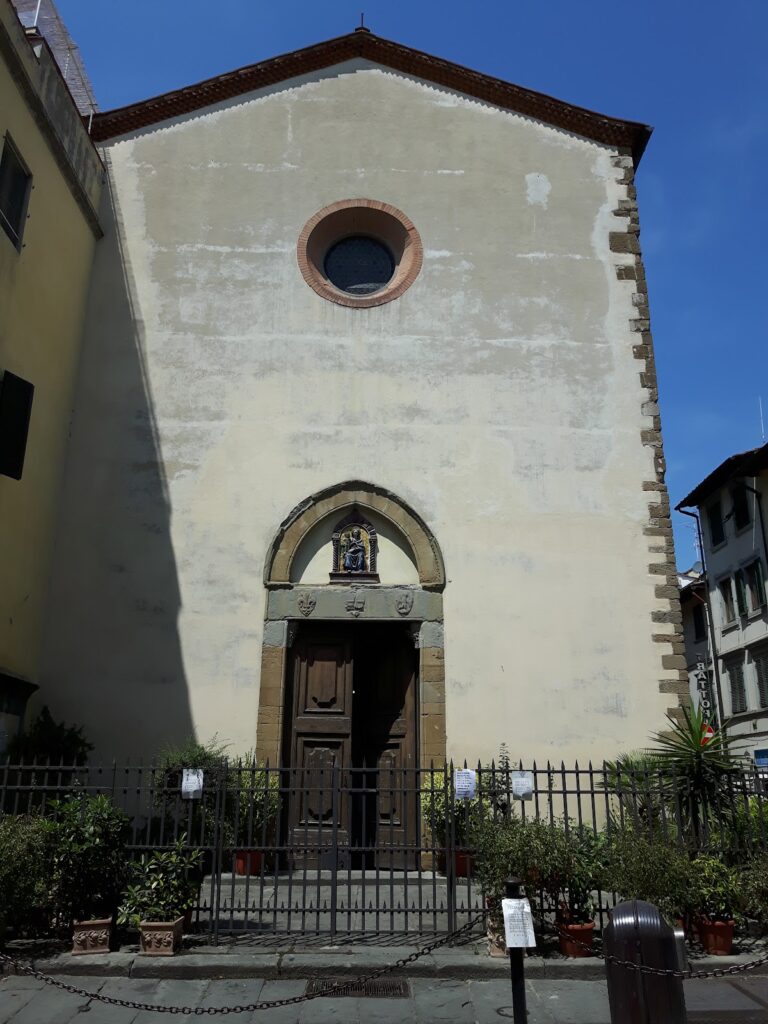
In 1782, Carlo Filippo Ughi altered the church by installing a new ceiling, adding a bell tower, and transforming the high altar. Between 1910 and 1924, the building was extensively reconstructed because the earlier structure was in danger of collapse. Frederick Stibbert, whose villa stood opposite the church, provided funds for a new bell tower, and Giovanni Paciarelli prepared its design. The new facade was completed on 11 February 1933.
Expansion of the parish
As the population grew on the plain below Montughi, the parish priest determined that another church was needed to serve the residents there. Construction of the Church of the Immaculate Conception began in 1935 and ended in 1936. San Martino a Montughi and the new church subsequently formed one parish.
Burials and a troubled modern episode
The church contains the burials of Raffaello Morghen, a Neapolitan copperplate engraver born in Portici in 1758 and deceased in Florence in 1833, and the astronomer Cosimo Vignali. Morghen’s monument, made by Odoardo Fantacchiotti in 1854 at the expense of his pupils, is instead in the left aisle of the Basilica of Santa Croce. From 1997 to 1999, Father Athanase Seromba served as the parish’s vice-parish priest under the name Atanasio Sumba Bura while evading an international arrest warrant connected with crimes against humanity committed in Rwanda in 1994, including responsibility for the massacre of 2,000 Tutsi people.
Remains
San Martino a Montughi stands on Montughi hill and is approached from Via Stibbert. The surviving complex brings together the facade and bell tower shaped by the twentieth-century reconstruction, the church interior with paintings and devotional furnishings, and associated canonry and rectory spaces containing decorative works.
Facade and bell tower
The new facade has a lunette above the architrave showing Saint Martin dividing his cloak with a poor man, the charitable act traditionally associated with the fourth-century Christian bishop. Mario Chiari, a nephew of the parish priest Alessandro Sostegni, made the composition. The bell tower belongs to the building’s later history: one was added in the alterations of 1782, while another was constructed during the reconstruction carried out from 1910 to 1924.
Altars and paintings
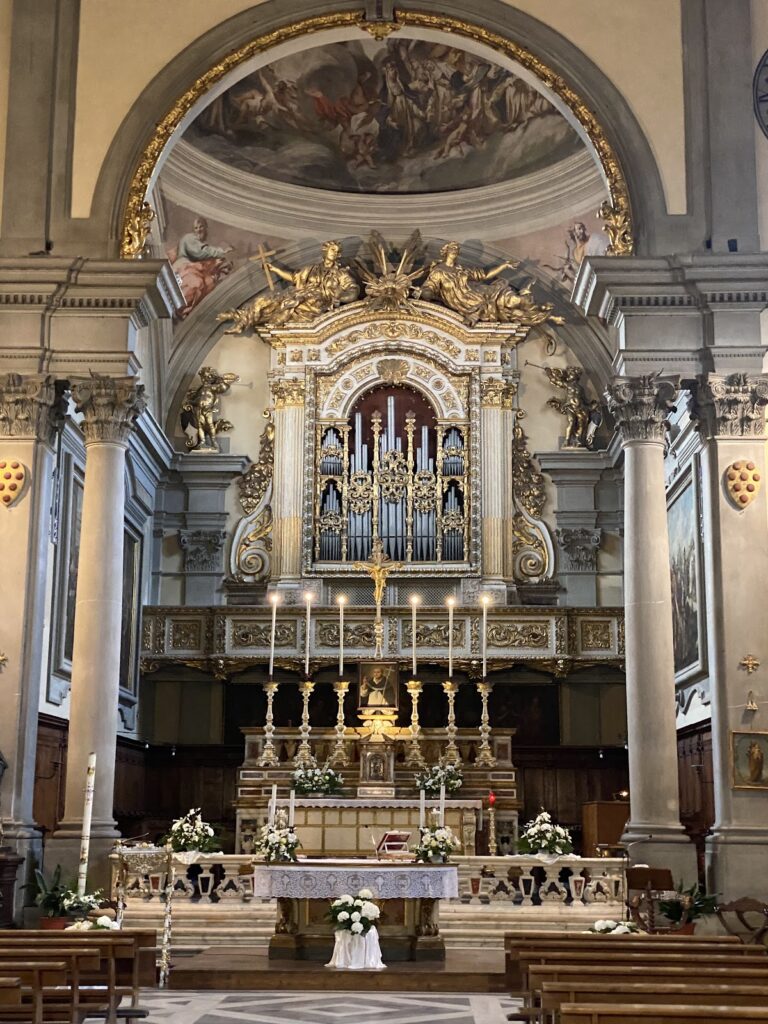
The altar of the Madonna of the Rosary contains a canvas by Matteo Rosselli depicting the Virgin Mary with the saints. Agostino Veracini’s painting of Saint Martin occupies the high altar. Opposite it is a 1631 Crucifix by Jacopo Vignali, shown with Saints Philip, Anthony, Charles, and Sebastian.
Canonry and rectory decoration
The canonry’s loggia, built under the direction of Giuliano di Baccio d’Agnolo, is decorated with stucco scenes and mythological figures. The rectory contains older stuccoes with biblical subjects, restored in 1881 by Michele Piovani. Its walls also display glazed terracottas in the Robbian tradition, a brightly finished glazed-terracotta technique developed and popularized by the della Robbia family. These works came from the tabernacle of Sant’Antonino on Via Vittorio Emanuele.