Hegge stave church: A Medieval Parish Church in Norway


Site at a Glance
- Rating
- 4.2
- Popularity
- Very Low
- Country
- Norway
- Primary era
- Medieval
- External website
- Open
- Eras represented
- Medieval, Early Modern, Modern
- Civilizations
- Norwegian
- Site type
- Religious
- Remains
- Church
On this page9 sections
History
Foundation in the Middle Ages
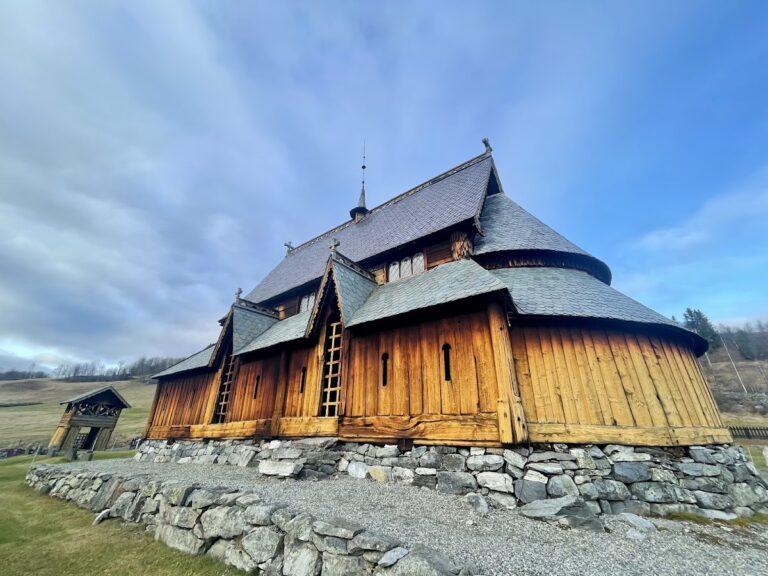
Hegge stave church is a 13th-century medieval wooden parish church in Hegge, Norway, built in the stave tradition around 1215–1216. A stave church is constructed around upright load-bearing posts, traditionally called staves. The church was founded and consecrated around 1216, and tree-ring analysis indicates that some of its timber was felled in that year. Its earliest surviving written reference dates from the fourteenth century, by which time the church was already established.
The church originally belonged to the Catholic Church. After the sixteenth-century Protestant Reformation, the religious movement that reduced Catholic institutional control across much of northern Europe and established Lutheran churches in places such as Norway, it became part of the Lutheran tradition. It now belongs to the Church of Norway and serves Hegge Parish in the Valdres Deanery and the Diocese of Hamar. A deanery is a district made up of several parishes, while a diocese is a larger church region overseen by a bishop.
Alterations and restoration
The church’s exterior changed after the Reformation, when ridge turrets were added. On 23 January 1665, an inspection found the building in very poor condition. An extensive restoration and renovation followed, with further repairs carried out in 1706 and 1712.
The choir was enlarged in 1807, giving it a rectangular floor plan, and the nave was extended westward in 1844. During that work, the open-air side corridors were brought inside the nave to create more seating. A sacristy, a room for storing worship materials and vestments, was added east of the choir in 1864.
Twentieth-century repairs and continued use
Major repairs in 1924–1925 addressed rot and the settlement of the foundations. The work was directed by the Norwegian architect Arnstein Arneberg, who was known for designing and restoring churches and other major buildings. The church received a new foundation, decayed structural members were replaced, the porch was enlarged, and smaller windows were installed.
Hegge stave church remains an active parish church and accommodates approximately 150 people. It is automatically protected as a Norwegian cultural-heritage site.
Remains
Layout and structure
Nave and choir
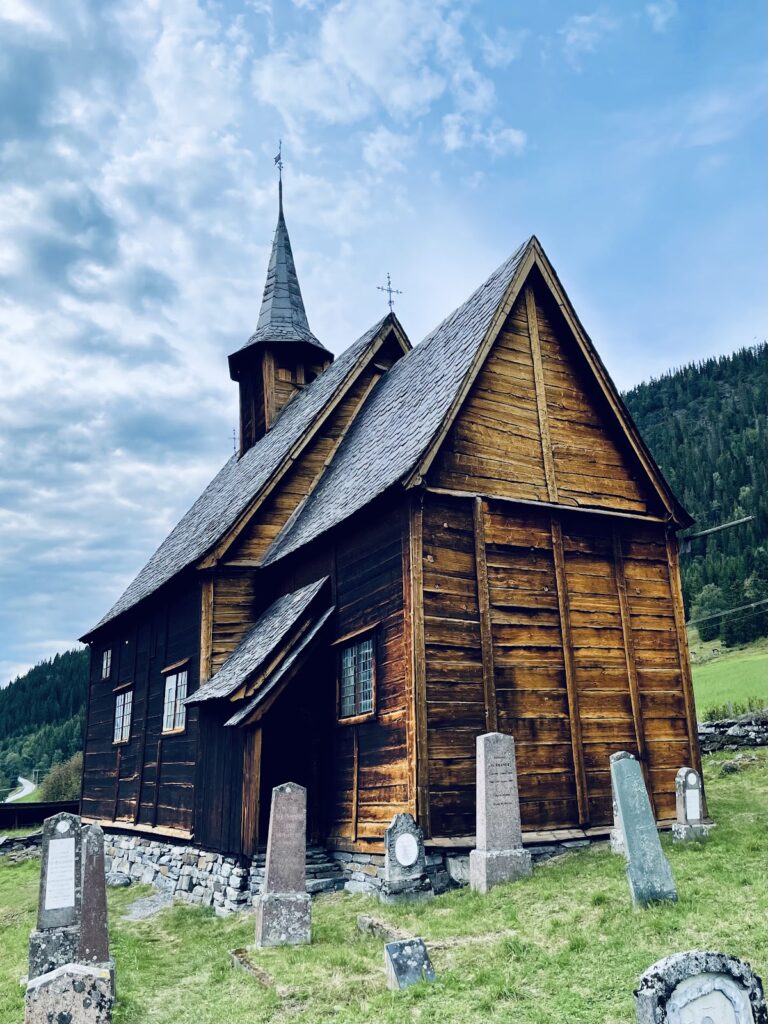
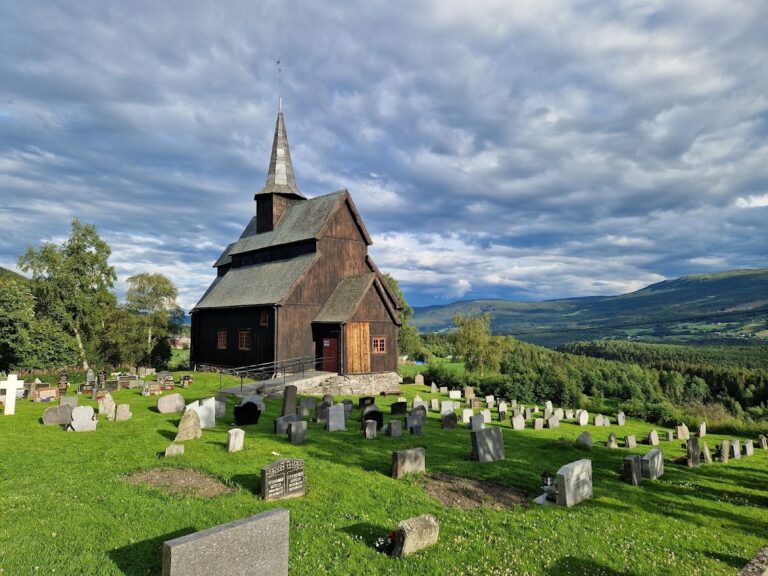
The surviving medieval church is a brown wooden building in a long-church design, with a rectangular nave and a smaller, narrower choir. The choir became rectangular when it was enlarged in 1807. A tower rises above the nave. The church has a basilica-type interior, meaning that a higher central space is flanked by lower side areas. Eight free-standing wooden columns, or staves, form an arcade around the central area, whose raised roof is no longer visible internally because a ceiling was inserted later.
Carved architectural features
The lower ends of the corner posts carry carved plant tendrils, while their upper ends bear carved masks. One mask has a single eye and may represent Odin, the Norse god associated with wisdom, knowledge, poetry, and war, although this identification remains uncertain. The west portal is flanked by two columns that support lions.
Objects and surroundings
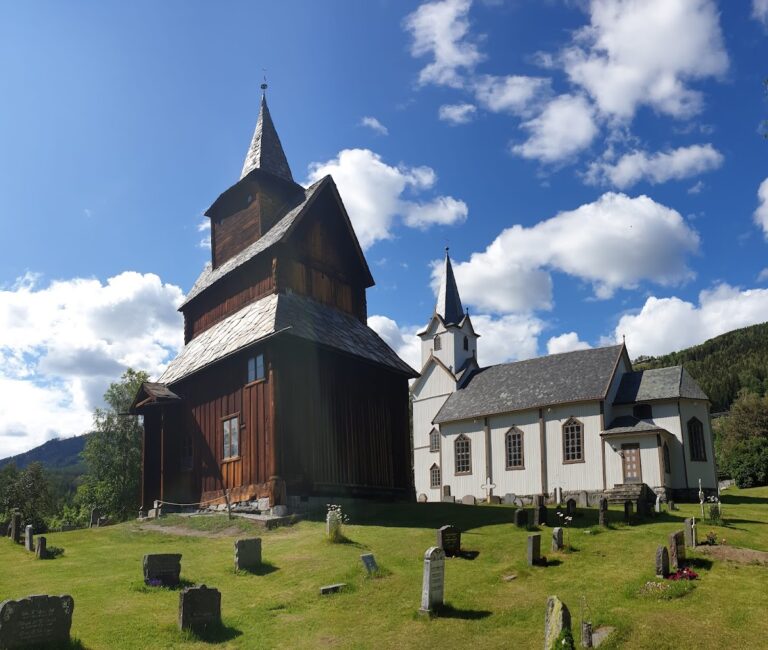
A cemetery surrounds the church, and a small bell tower stands several metres away. A runic inscription inside the church reads in translation, “Erling Arnason wrote these runes.” The 13th-century baptismal font is decorated on its exterior with knot, tree, human-figure, and star motifs. The church also preserves a coarse-linen vestment dated 1686 and a painting of the Sacrifice of Isaac, a biblical episode in which Abraham is commanded to offer Isaac but is stopped by God. The painting was presented to the church in 1643. Its altarpiece, an artwork or decorated structure placed behind or above an altar, was carved by a local artist in 1780.