Kloster Gevelsberg: A Cistercian Nunnery and Noblewomen’s Foundation in Germany
Site at a Glance
- Rating
- 4.5
- Popularity
- Very Low
- Country
- Germany
- Primary era
- Medieval
- External website
- Open
- Eras represented
- Medieval, Modern
- Civilizations
- Holy Roman Empire
- Site type
- Religious
- Remains
- Monastery
On this page11 sections
History
Kloster Gevelsberg in Gevelsberg, Germany, was founded around 1230 to 1236 as a Cistercian nunnery, a community belonging to a Catholic order known for communal worship, manual labor, and an austere way of life. Cistercian nuns were living there by 1236. Dedicated to Mary and Saint Lawrence, the monastery developed at the site connected with the murder of Engelbert, Archbishop of Cologne, in 1225.
Foundation and pilgrimage
After Engelbert’s murder, Caesarius of Heisterbach soon reported miracles at the place where it occurred. A cross and a wooden chapel were first erected there in his memory. Heinrich of Molenark, the new Archbishop of Cologne, supported the establishment of a monastery at the site, while Archbishop Konrad of Hochstaden later protected the community. This protection also placed Kloster Gevelsberg in a comparatively strong dependence on the archdiocese of Cologne.
The monastery soon became a pilgrimage destination and a center for the veneration of Engelbert of Cologne. During its early years, it maintained close relations with Heisterbach. Christina, one of its first abbesses, was closely involved in the foundation of the daughter monasteries at Benninghausen and Rees.
Property and community
Donations from citizens of Cologne enabled the monastery to enlarge its property during the thirteenth century. It retained some urban holdings and later sold others, while Cologne ministerials and nobles from the surrounding region also contributed land and possessions. In the fifteenth century, the community owned a town house in Cologne known as “cleyne Gevelsberg,” or Kleingevelsberg, which provided accommodation for members visiting the city.
An abbess and a prioress directed the convent. The backgrounds of the first abbesses and the number and origins of the earliest nuns are not known. Later members came partly from Cologne’s bourgeoisie and partly from the regional nobility. The nuns initially followed personal poverty, but by 1263 they possessed personal property. Lay brothers and sisters, called conversi, also supported the community’s work and religious life without belonging to the choir of professed nuns.
Kloster Gevelsberg had no independent parish rights and remained subordinate to the parish in Schwelm. In 1281, the convent acquired estates at Wiesdorf, now within the Leverkusen area, together with rights over a parish. The distance of these estates meant that the acquisition did not alter the monastery’s broader ecclesiastical position.
Secular foundation and dissolution
During the Reformation, around 1577, the monastery became a secular noblewomen’s foundation. This type of institution housed women of noble status who were not necessarily bound by the rules of a monastic order. As a simultaneous foundation, Kloster Gevelsberg admitted women from Catholic and Protestant families.
The statutes of 1657 assigned its twelve positions among Reformed, Lutheran, and Catholic women, with five reserved for Reformed members, three for Lutheran members, and three for Catholics. In practice, the Catholic share was often smaller. No Catholic women were present in 1609 and 1624, and Catholic Masses were not celebrated during those years.
Construction continued during the seventeenth and eighteenth centuries. The abbess’s house was rebuilt or newly constructed, and the church was extended and remodeled. A new residence for the head of the foundation was completed in 1805. The foundation was dissolved in 1812. Structural deterioration led to the closure of the church in 1823, and the building was demolished in 1826. During the twentieth century, the former monastery buildings housed a convalescent home operated by the von Bodelschwingh Foundations Bethel.
Remains
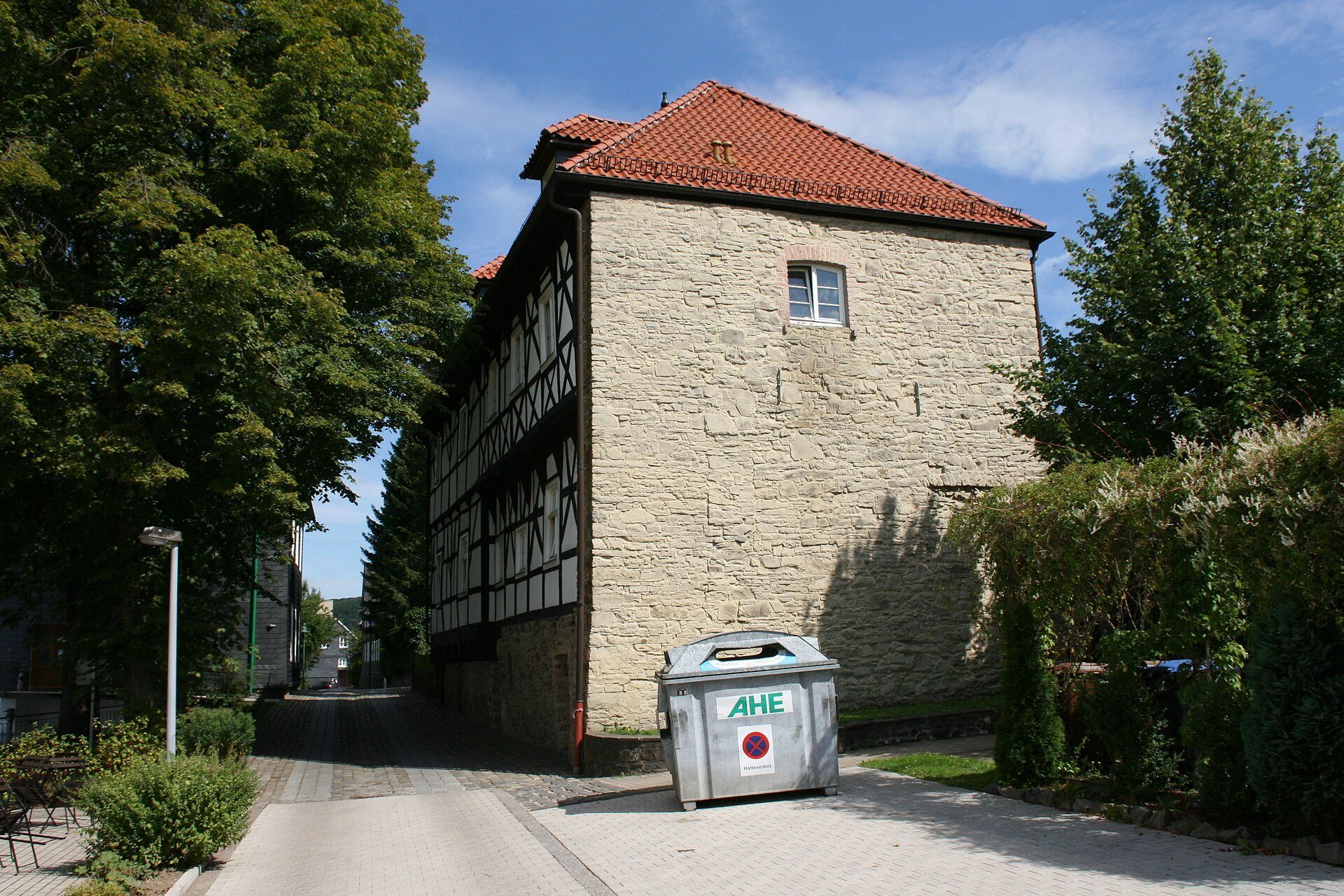
The surviving monastery buildings form the principal physical remains of Kloster Gevelsberg. The thirteenth-century convent buildings were completed by about 1237 and stood without a direct structural connection to the church. Their later forms include the older abbess’s house and the residence built in 1805, while the monastery church survives through its historical and archaeological record rather than as a standing building.
Church and commemorative features
Monastery church
The monastery church was a thirteenth-century four-bay basilica, a longitudinal church with a central nave and lower side aisles. It had no transept and included a tower at the west end. The western tower probably contained a gallery from which the nuns could attend services. Extensions and alterations were made while the institution functioned as a noblewomen’s foundation. Structural deterioration brought the church’s use to an end in 1823, and it was demolished three years later.
Statue of Engelbert
Inside the church stood a life-size wooden statue of Engelbert, the murdered Archbishop of Cologne whose memory gave the foundation its commemorative and pilgrimage focus.
Monastery residences
Old Abbess’s House
The building now known as the Old Abbess’s House is a half-timbered structure erected on a high, massive stone base. It belongs to the group of convent buildings completed by about 1237, although the monastery complex later underwent further construction.
New Abbess’s House
The New Abbess’s House was built in 1805 as the residence of the foundation’s head. Its simple Bergisch classicist design is clad in slate, distinguishing it from the older half-timbered abbess’s house.